
FastSAR


FastSAR forms synthetic aperture radar (SAR) images on x86 and ARM CPUs, Nvidia GPUs and Google Cloud TPUs from Python. It reads frequency-domain CPHD files (versions 1.0, 1.1 and 0.3) and NISAR, Sentinel-1 and ALOS PALSAR raw data, forms spotlight, stripmap and sliding spotlight images by factorized backprojection, and provides autofocus, terrain-informed focusing, radiometric calibration, products of several collections of one scene, interferometry, geolocation, map GeoTIFFs and SICD and SIDD output.
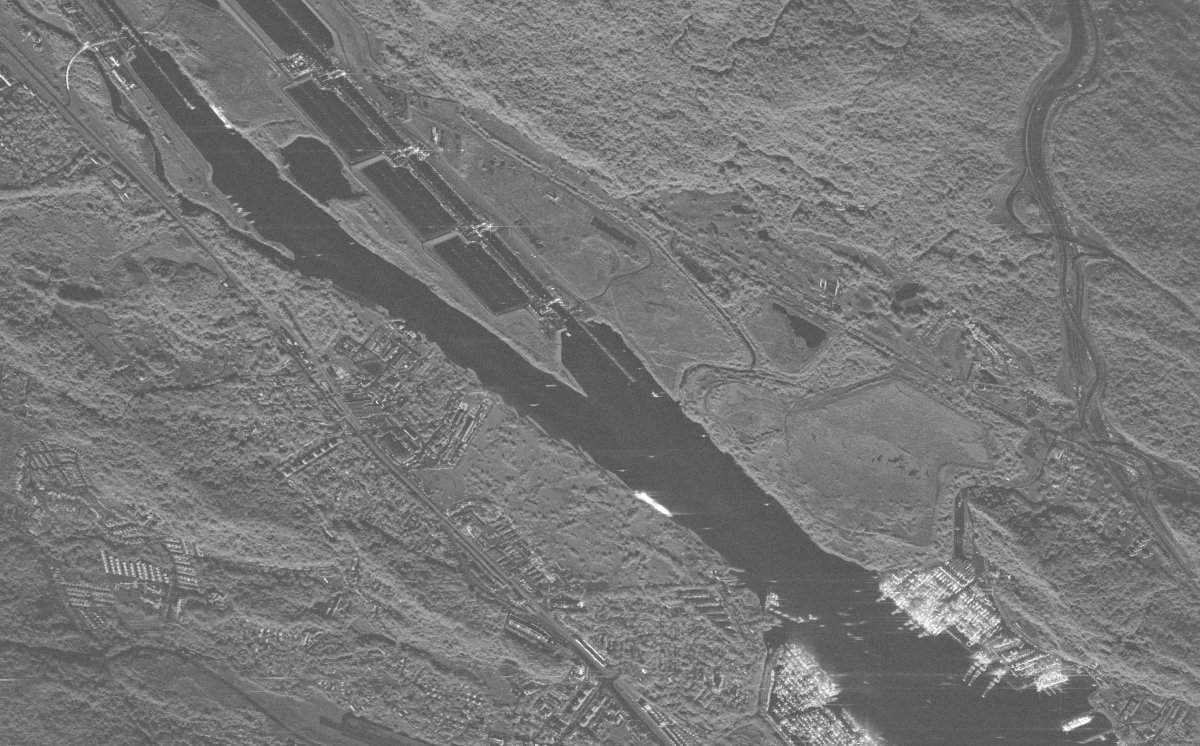
Panama Canal, Pacific entrance (Umbra open data, 2023-07-18): 12,207 by 8,808 pixels in 3.0 s on an Nvidia L4
(warm former, transfers included; float32, -59.9 dB against the float64 reference of
precision.md), downsampled. A
c4d-highmem-16 CPU instance (16 vCPUs, 8 cores) takes 11.3 s. The fastest open-source exact backprojection that forms this
collection, the sar_bp example of NVIDIA's MatX, takes 12.5 s on the L4 as shipped and 11.6 s with float64 pixel
coordinates, against 10.8 s for FastSAR's exact backprojection at the same accuracy; on the CPU, ISCE3 would take an
estimated 4.8 h.
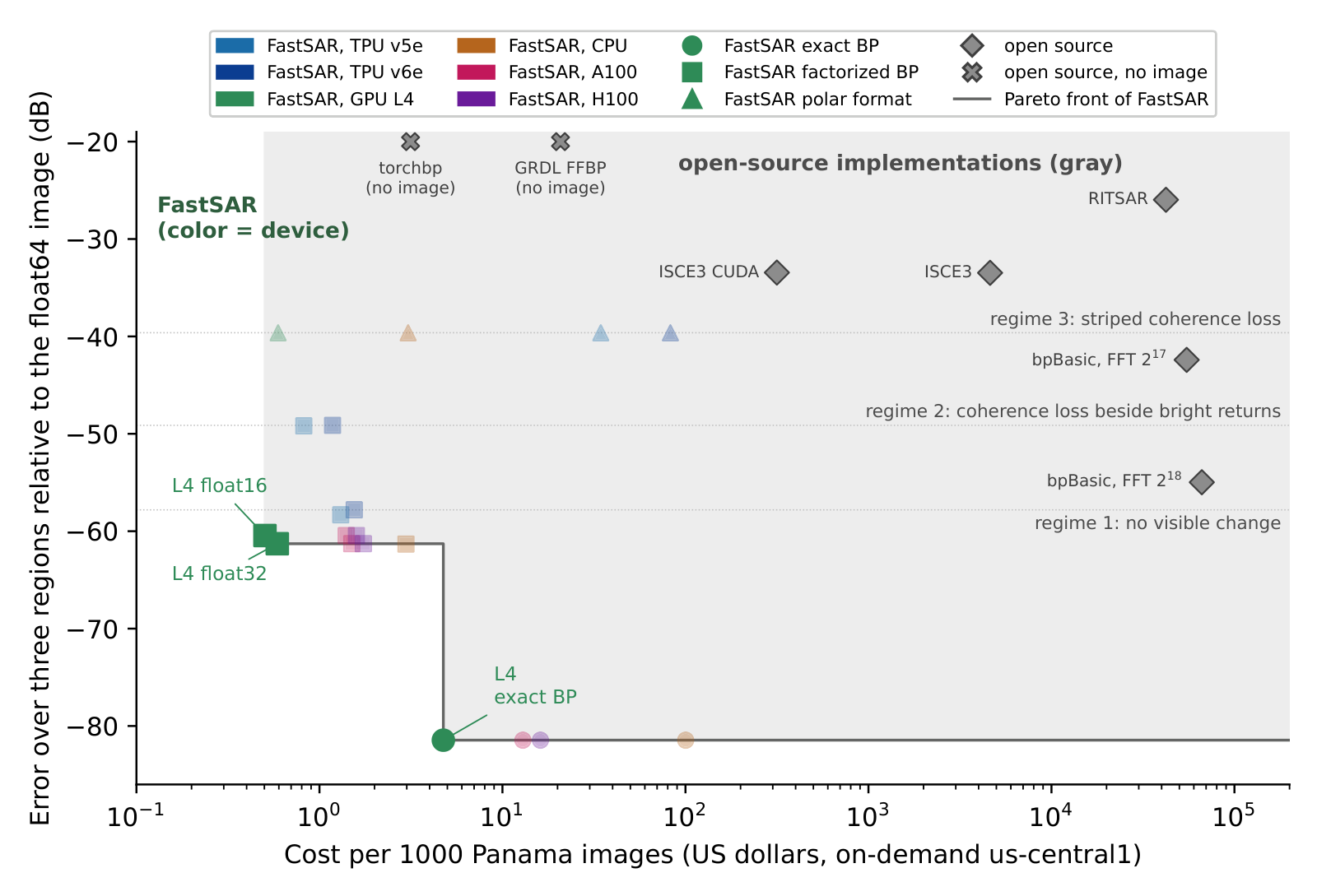
Cost per 1000 Panama images (October 2026 prices) against error over the lock, port and ship regions (FastSAR relative to a float64 backprojection at 64 times oversampling, the open-source codes to the float64 reference; performance, comparison).
Install
Linux on x86-64 or 64-bit ARM and macOS on Apple silicon, Python 3.10 to 3.13. The wheels for these platforms
carry the CPU kernels prebuilt, so the CPU backend needs no compiler: on x86-64 at three instruction-set levels
(x86-64-v2, x86-64-v3 with AVX2, x86-64-v4 with AVX-512), of which the best one the processor runs is loaded. Where
a C++ compiler is present the kernels are compiled on first use for the exact processor instead: g++ with OpenMP
on Linux (GCC 12 or later on ARM; Debian and Ubuntu: apt install g++), Apple's clang on macOS (the command line
tools, xcode-select --install, which also serve the Metal backend of ExactFormer on Apple GPUs). Other
platforms (Linux with musl such as Alpine, other processors) have no wheel: pip installs the source distribution
there, which has no prebuilt kernels, so the CPU backend needs the compiler. The GPU backend needs an
Nvidia driver for CUDA 12 or later and the tpu extra a Cloud TPU VM.
pip install fastsar                  # CPU, Nvidia GPU, and the CPHD, SICD and SIDD files (no other package)
pip install "fastsar[tpu]"           # tpu: jax[tpu] for Cloud TPUs
pip install "fastsar[geo]"           # geo: rasterio for GeoTIFFs and DEMs
pip install "fastsar[raw]"           # raw: h5py for the NISAR raw reader
On Linux x86-64 the installation includes CuPy and the CUDA runtime libraries (about 2 GB), so a machine with an
Nvidia driver uses its GPU with no system CUDA toolkit; on other platforms pip install "fastsar[cuda]" adds
CuPy where its wheels exist. An environment that already holds another CuPy build should install FastSAR with
--no-deps and its dependencies by hand, since two CuPy wheels cannot share an environment.
What a machine needs beyond pip's packages depends on its hardware. After installing, python -m fastsar.doctor
reports which backends are ready (the CPU kernels in use, prebuilt or built by the C++ compiler; CuPy for the GPU's
CUDA version; the TPU build of JAX; the readers' packages) and prints the command that installs each missing piece;
python -m fastsar.doctor --install runs the pip commands among them.
From a clone: pip install -e ".[cuda,io]" or uv sync. The CUDA tensor-core kernels (float16, and float32 on compute capability 8.0 and later) need nvcc from the CUDA toolkit; without it float32 runs on the CUDA cores, more slowly. On the CPU set
OMP_NUM_THREADS=<physical cores> OMP_PLACES=cores OMP_PROC_BIND=close (the prebuilt kernels read OMP_NUM_THREADS only). Importing fastsar sets
XLA_PYTHON_CLIENT_PREALLOCATE=false unless it is already set, so that JAX does not reserve most of a GPU's memory
before the CUDA kernels run (performance.md).
Quickstart
The chain below reads a CPHD file and writes a GeoTIFF and a SICD, so it needs pip install "fastsar[io,geo]".
import fastsar
from fastsar import products

out = fastsar.form_cphd('scene_CPHD.cphd')        # mode, grid and window from the file
img = out['image']                                # complex64 [nx, ny] on a ground plane at the scene height
lat, lon, h = products.geolocate(out, 100, 200)   # pixel (100, 200) on the ground
products.write_geotiff('amp.tif', **products.geocode_image(out))   # amplitude on a north-up UTM grid
products.write_sicd('scene.nitf', out)            # complex image with its geometry
process_cphd goes from the file to a finished product in one call, with the processed area, the image plane,
autofocus, sidelobe weighting and the display remap as options
(product-options.md):
fastsar.process_cphd('scene_CPHD.cphd', 'scene_SICD.nitf')                   # ground-plane SICD: the image as
                                                                             # formed, unweighted, autofocused
fastsar.process_cphd('scene_CPHD.cphd', 'slant.nitf', plane='slant')         # slant-plane SICD, as most
                                                                             # producers deliver
fastsar.process_cphd('scene_CPHD.cphd', 'scene_SIDD.nitf', product='sidd')   # ground-plane SIDD: apodized, NRL
                                                                             # remap, shadows down
fastsar.process_cphd('scene_CPHD.cphd', 'wide.nitf', product='sidd', area='black')   # out to where -10 dB
                                                                                     # terrain meets the noise
The default SICD is on the ground plane (Grid.Type PLANE, Grid.ImagePlane GROUND, rows along ground range away
from the radar, the view from above), because that is the plane FastSAR forms on: exact for any track, and one
resampling fewer. Most producers deliver slant-plane SICDs, and a tool that assumes one without reading
Grid.ImagePlane needs plane='slant'
(what to check).
Every stage after formation runs where the image lives, on the CPU, an Nvidia GPU or a TPU.
The same call takes stripmap and sliding-spotlight collections, with the weightings, autofocus along the track and the quality areas in ground range. Three more things it does, each where the data allow it:
fastsar.process_cphd('scene_CPHD.cphd', 'focused.nitf', dem='dem.tif', geoid=22.4)   # terrain off the image
                                                                                     # plane, focused from a DEM
fastsar.process_stack(['a_CPHD.cphd', 'b_CPHD.cphd', 'c_CPHD.cphd'], 'mean_SIDD.nitf')   # several collections
                                                                                         # of one scene, averaged
fastsar.process_stack(['a_CPHD.cphd', 'b_CPHD.cphd'], 'coherence.tif', product='coherence')   # or a coherent pair
- Terrain-informed focusing (
dem=, spotlight collections) removes the defocus of terrain above or below the image plane, computed from the collection geometry and the DEM (product-options.md). - Calibration: where a CPHD file states its reference level (
PTRef; Umbra's do, Capella's do not), a spotlight SICD carries theRadiometricblock, with the antenna pattern pointed as the data confirm it (product-options.md). - Several collections of one scene:
process_stackforms them on one ground grid, registers them, and writes their incoherent average, or the coherence, interferogram, coherent sum or change of a pair (stack.md).
For a look at a spotlight collection without the full chain, quicklook reads only the pulses and samples its
resolution needs and forms a picture of the tasked scene by polar format: a 2048-pixel picture of a 9.1 GB Capella
file in 0.15 s on 16 CPU threads, from 112 MB of its samples, and the whole scene at full resolution (175
megapixels) in 7 s, or 1.7 s on a GPU
(processing-chain.md).
fastsar.quicklook('scene_CPHD.cphd', 'look.png') # 2048 pixels on the longer side; size=, resolution=
examples/chain.py runs this chain from the command line (--simulate needs no data);
form_umbra.py and form_capella_stripmap.py form
vendor grids. quicklook.py writes a quick look and prints the
time of each stage.
Supported data, modes and devices
| Data | Modes | Status |
|---|---|---|
| Capella CPHD | stripmap, spotlight, sliding spotlight | checked against vendor SICDs; a 2022 dynamic stripmap is correct near the center only |
| Umbra CPHD | spotlight | three open-data collections on the vendor's grid |
| ICEYE CPHD | dwell spotlight | formed (28 GB history); not compared with the vendor image |
| NISAR L0B (RRSD) | stripmap | io.read_nisar; corner reflectors placed against the survey and JPL's RSLC |
| Sentinel-1 Level-0 | stripmap, wave | io.read_sentinel1; IW and EW bursts not split |
| ALOS PALSAR level 1.0 | stripmap (FBS, FBD) | io.read_palsar; ScanSAR not handled |
| TOA-domain CPHD | not supported | |
| Simulated echoes | stripmap, ScanSAR, TOPS, any track | fastsar.stripmap, burst, patches |
CPU (cpu) |
Nvidia GPU (cuda) |
Cloud TPU (tpu) |
Any JAX device (jax) |
|
|---|---|---|---|---|
| Factorized backprojection | C++ (OpenMP on Linux): AVX-512 or AVX2 on x86-64, NEON on ARM | CUDA via CuPy | Pallas | JAX program |
| Precision | float32 | float32, float16 | three-pass (default), single-pass | float32, float16 |
Exact backprojection (ExactFormer) |
C++ (OpenMP on Linux), float32 with float64 tile centers | CUDA, the same | falls back to jax |
float32, float64 block centers |
Polar format (algorithm='pfa') and quicklook run as C++ stages on the CPU, CUDA kernels on a GPU and compiled
float32 programs on a TPU or any JAX device.
Documentation
docs/README.md lists every page; start with the processing chain. Measurement records are in sar-accel-study. To cite FastSAR, use CITATION.cff.
Contributing and license
CONTRIBUTING.md explains how to run the tests (GitHub Actions runs the CPU suite; the CUDA and TPU tests run on those machines before a release). MIT license (LICENSE).
1 maintainer

Metadata
1 maintainer
Release files for fastsar 0.3.1
For a detailed explanation of source distributions (sdists) and built distributions (wheels), please see the package formats documentation.
Source distribution (sdist)
| File | Size | Uploaded | Provenance | Actions |
|---|---|---|---|---|
| fastsar-0.3.1.tar.gz | 988.2 kB | Without provenance | Details for fastsar-0.3.1.tar.gz |
Built distributions (wheels)
| File | Interpreter | ABI | Platform | Actions Reset |
|---|---|---|---|---|
| fastsar-0.3.1-py3-none-manylinux_2_24_x86_64.manylinux_2_28_x86_64.whl | Python 3 | none | Linux glibc 2.24+ x86-64, Linux glibc 2.28+ x86-64 | Details for fastsar-0.3.1-py3-none-manylinux_2_24_x86_64.manylinux_2_28_x86_64.whl |
| fastsar-0.3.1-py3-none-manylinux_2_24_aarch64.manylinux_2_28_aarch64.whl | Python 3 | none | Linux glibc 2.24+ ARM64, Linux glibc 2.28+ ARM64 | Details for fastsar-0.3.1-py3-none-manylinux_2_24_aarch64.manylinux_2_28_aarch64.whl |
| fastsar-0.3.1-py3-none-macosx_11_0_arm64.whl | Python 3 | none | macOS 11.0+ ARM64 | Details for fastsar-0.3.1-py3-none-macosx_11_0_arm64.whl |
Total release size: 5.2 MB
Release files / fastsar-0.3.1.tar.gz
| Download URL | fastsar-0.3.1.tar.gz |
|---|---|
| Size | 988.2 kB |
| Tags | Source |
|
SHA-256 checksum How to use checksums |
8cd1fb197ecccfd9327a3bf0c076a21f8f1eb6ab9d02830cff7410fd40f24e6f
|
|
BLAKE2b-256 checksum How to use checksums |
b26804b6ca67be21f0b9fb6a8284f36389a9372c13e939c92b1d9daa3a9d186c
|
| Upload date | |
|
Uploaded using Trusted Publishing? What is trusted publishing? |
No |
| Uploaded via |
twine/7.0.0 CPython/3.13.13
|
Release files / fastsar-0.3.1-py3-none-manylinux_2_24_x86_64.manylinux_2_28_x86_64.whl
| Download URL | fastsar-0.3.1-py3-none-manylinux_2_24_x86_64.manylinux_2_28_x86_64.whl |
|---|---|
| Size | 2.3 MB |
| Tags | Linux glibc 2.24+ x86-64 Linux glibc 2.28+ x86-64 Python 3 |
|
SHA-256 checksum How to use checksums |
fcbe979c977498c15ea0fb000465675a43dce668a5001b1fdd889c1e39f9dc84
|
|
BLAKE2b-256 checksum How to use checksums |
e457556b3ba04771c161e1dbc998b50020560c4f856c309ce3e165f4eda00a8f
|
| Upload date | |
|
Uploaded using Trusted Publishing? What is trusted publishing? |
No |
| Uploaded via |
twine/7.0.0 CPython/3.13.13
|
Release files / fastsar-0.3.1-py3-none-manylinux_2_24_aarch64.manylinux_2_28_aarch64.whl
| Download URL | fastsar-0.3.1-py3-none-manylinux_2_24_aarch64.manylinux_2_28_aarch64.whl |
|---|---|
| Size | 1.2 MB |
| Tags | Linux glibc 2.24+ ARM64 Linux glibc 2.28+ ARM64 Python 3 |
|
SHA-256 checksum How to use checksums |
5775a1bf4d0d9ab2c1bb5fb503366955de7ace2dc033fbe6cf35ff8401fa1e7c
|
|
BLAKE2b-256 checksum How to use checksums |
59418b468361546262db4d6a9225dbee62de1061f62c6d2be6bd03a8b8bf0965
|
| Upload date | |
|
Uploaded using Trusted Publishing? What is trusted publishing? |
No |
| Uploaded via |
twine/7.0.0 CPython/3.13.13
|
Release files / fastsar-0.3.1-py3-none-macosx_11_0_arm64.whl
| Download URL | fastsar-0.3.1-py3-none-macosx_11_0_arm64.whl |
|---|---|
| Size | 702.1 kB |
| Tags | Python 3 macOS 11.0+ ARM64 |
|
SHA-256 checksum How to use checksums |
c52035bbf290fc5a08257a59866a73303dfc58acc03c9abe6343a99048eba36f
|
|
BLAKE2b-256 checksum How to use checksums |
54dc24f79bdbc1edf3872eaedafaa00dba483ade72277627d88a5c6ade250e21
|
| Upload date | |
|
Uploaded using Trusted Publishing? What is trusted publishing? |
No |
| Uploaded via |
twine/7.0.0 CPython/3.13.13
|
Security for fastsar 0.3.1
Provenance
Provenance describes where a file came from. On PyPI, provenance is shared via attestations, which provide a verifiable record of the build or publishing details. View details, limitations and caveats.
No provenance found
None of the files in this release were uploaded with provenance metadata.
A note on package security
PyPI is a repository for distributing packages, not a service for auditing them. While third-party security researchers and our staff do their best to detect and remove malicious packages, PyPI cannot guarantee the quality, security or suitability of any given package.
To learn more about protecting yourself from malicious actors, visit our package security documentation.














