
Faultree
A Python tool for Fault Tree Analysis (FTA) using Ordered Binary Decision Diagrams (OBDD).
Overview
- Converts a Fault Tree (FTA) JSON into an Ordered BDD using the
ddpackage. - Supports logic gates: AND, OR, XOR (exactly-one), K-of-N.
- Exact top-event and intermediate-event probabilities in O(|BDD|) time (memoized Shannon cofactor recursion) — repeated/shared events are handled exactly, with no cut-set approximations.
- Outputs algebraic and symbolic expressions.
- Supports internal event cloning via
ref(reference nodes), making the model a DAG. - Probabilities can be scalars or sample arrays (evaluated elementwise), given inline, as a JSON mapping, or loaded from CSV/Excel files.
Graphical interface
faultree gui (or python -m faultree gui) opens a local web app in the
browser: load or build a tree, give the basic events probabilities or
distributions, and explore the exact results without writing code.
faultree gui                            # http://127.0.0.1:8765/, or a free port
faultree gui --port 9000 --no-browser   # choose the port; open the page yourself
It runs entirely on your computer: a small standard-library server, bound to
127.0.0.1, serves the page and calls analyze() and minimal_cut_sets().
Nothing is loaded from the internet (it works offline) and it needs no extra
dependency. Ctrl+C stops it. The interface is in Portuguese and English: it
follows the browser's language, and the PT/EN switch changes it.
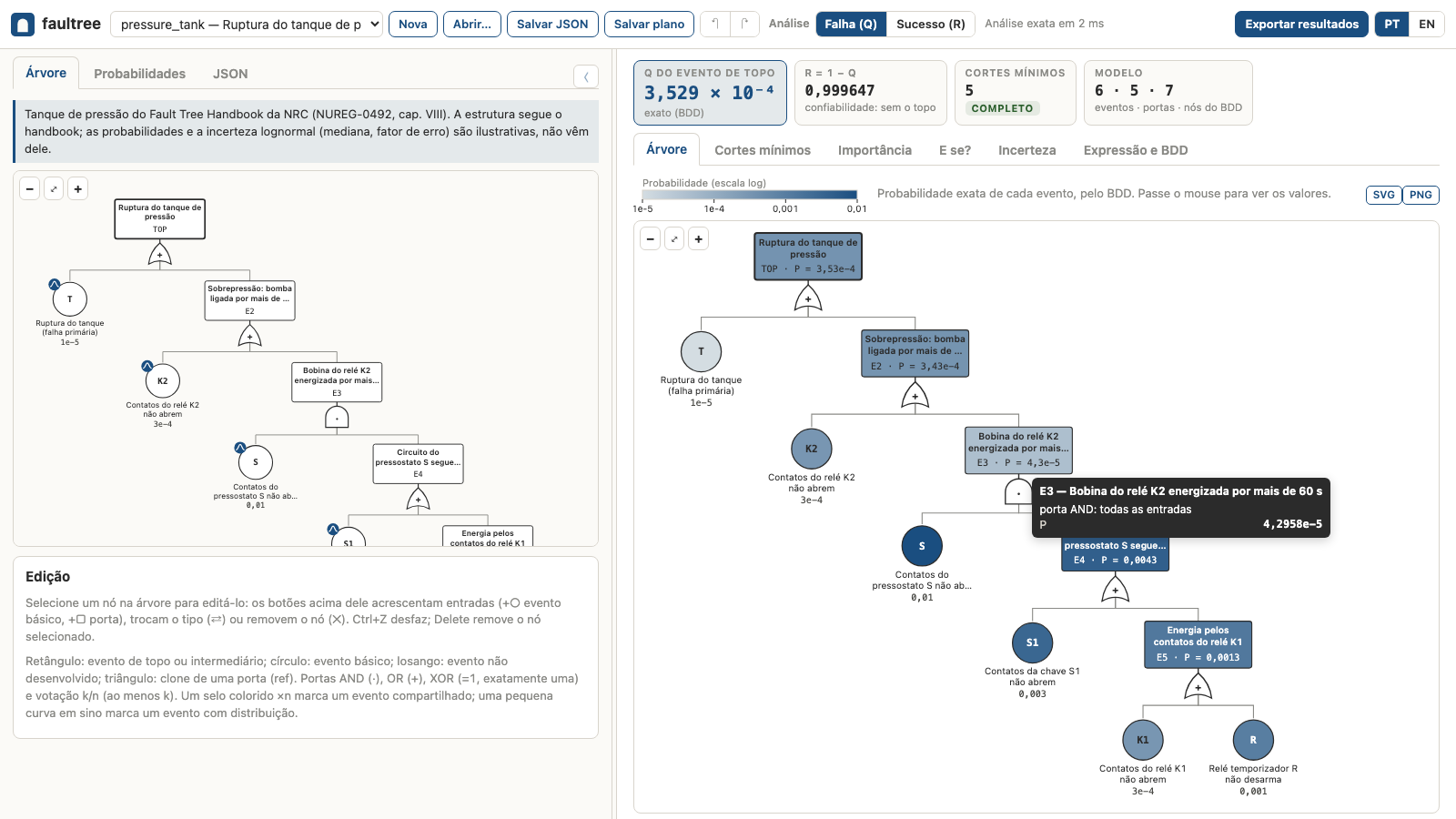
The model is on the left:
- Tree: the editor. Select a node to add basic events or gates, change
the gate (AND, OR, XOR = exactly one, k-out-of-n), share a basic event
between branches, or add a clone of a gate (faultree's
ref); undo and redo with Ctrl+Z / Ctrl+Shift+Z. Every occurrence of a shared event, and a gate together with its clones, carries the same marker in a colour of its own (a letter A, B, C…, the colour alone, or the count ×n), and hovering or selecting one highlights all the others. - Probabilities: the probability of every basic event, given directly or by a failure model at a mission time t: p = F(t) for a time to failure that is exponential, Weibull, normal, lognormal, gamma or uniform, or a count of failures reaching k (binomial over n demands, Poisson over [0, t]). In success mode the event value is the reliability 1 − F(t). Optionally, a distribution of p for the uncertainty analysis (lognormal by median and error factor, beta, uniform, log-uniform); a CSV/Excel probability file can be imported (one column per event; one row gives point values, several rows give joint sample vectors).
- JSON: the model in faultree's format, to edit or paste (recursive or flat) and apply.
- The top bar opens the examples in
examples/and JSON files, saves the model in the recursive or the flat format, and switches between failure analysis (Q) and success analysis (R, with reliabilities as inputs). The ⚙ button opens the settings: the shared-event marker, highlighting of occurrences and automatic or scientific notation (kept in the browser).
The results are on the right, recomputed as you edit:
- A summary: exact Q (or R) and its complement, the number of minimal cut sets with the completeness flag, the model and BDD sizes, and the uncertainty band once it has been run.
- Tree: the exact probability of every event drawn on the tree (one-hue, logarithmic colour scale), with the values on hover.
- Minimal cut sets: a sortable table (order, probability, share of Q), the largest contributions, the completeness flag and maximum order, and the rare-event sum and min-cut upper bound next to the exact Q. Hovering a row marks its events on the model tree.
- Importance: Birnbaum, criticality, RAW and RRW of every basic event as sortable bars, and a RAW × RRW (or Birnbaum × criticality) scatter with the usual screening thresholds.
- What if?: click basic events to set them failed or working; Q and every gate are recomputed exactly, with the ratio to the base Q.
- Uncertainty: draws joint samples of the events that have a
distribution, propagates them exactly as sample vectors, and shows the
histogram or CDF of Q with its 5/50/95 % percentiles, mean and point value,
and the spread of each importance measure per event. Runs are reproducible:
each event draws from
numpy.random.default_rng([seed, zlib.crc32(event_id)]). - Expression and BDD: faultree's expression and symbolic forms and, for small trees, the BDD with the probability of each node (the Shannon recursion behind the exact result).
- Export results saves a JSON with the model, settings, point results, what-if scenario and uncertainty run; every chart has SVG and PNG buttons.
The GUI keeps an event's distribution in an uncertainty field
({"dist": "lognormal", "median": 1e-3, "ef": 3}), its failure model in
failure_model ({"dist": "weibull", "beta": 1.8, "eta": 12000}) with
mission_time and time_unit on the top event, and an optional Portuguese
name in name_pt; the engine ignores them and reads prob, which the GUI
saves as F(t) at the mission time. examples/pressure_tank.json is the
pressure tank of the NRC Fault Tree Handbook (NUREG-0492), with illustrative
probabilities; examples/cooling_system.json uses every kind of failure
model. More screenshots are in docs/gui.
Installation
Requires Python ≥ 3.10.
pip install faultree            # library + CLI (needs only dd and numpy)
pip install "faultree[server]"  # + FastAPI/uvicorn for the API server
pip install "faultree[excel]"   # + pandas/openpyxl to read Excel probability files
CSV probability files need no extra dependency. faultree uses dd.autoref,
the pure-Python BDD backend of dd, so no C compiler or CUDD is needed at
run time, which also lets it run in the browser under Pyodide. PyPI has only
Linux wheels and the source of dd; for Pyodide, build a pure-Python wheel
first with pip wheel dd --no-deps --no-binary dd.
From a checkout of this repository:
pip install -e ".[server,test]"
Tree Format
- Fields:
id(string): Unique identifier for the event.name(string): Descriptive name.event_type:top,intermediate,basic, orundeveloped.gate:AND,OR,XOR,K_OF_N, ornull/BASICfor leaves.children(list): Child nodes.k(int): Required forK_OF_Ngates (0 <= k <= n).prob(finite float or non-empty list of finite floats): Probability for basic/undeveloped events. A list is treated as a one-dimensional sample vector and propagated elementwise.ref(string): ID of another node to clone/reference.prob_file(string, optional, top level): CSV/Excel file with one column per basic-event id, resolved relative to the tree JSON.
Gate semantics: XOR means exactly one input (a mutually-exclusive gate),
not chained parity. K_OF_N means at least k of the n inputs.
Every basic event must have a probability (from the tree, --probs, or a
probability file); a missing probability is an error unless
--assume-missing-zero is passed.
Supported Formats
Faultree supports two JSON formats (auto-detected):
- Recursive Tree (standard): Nodes nested within
children. - Flat List: Nodes defined in
ft_nodesandbe_nodeslists, withbranchesreferencing child IDs.
Event IDs must identify one definition. Repeating an identical definition is
accepted as an inline copy of the same event; conflicting repeated definitions
are rejected. A flat model must provide an explicit analysis/esd_nodes
root or have exactly one unreferenced root, and every declared node must be
reachable from it.
Usage
faultree examples/basic_tree.json
# or equivalently
python -m faultree examples/basic_tree.json
Override probabilities (inline JSON or a CSV/Excel path):
faultree examples/basic_tree.json --probs '{"BE1": 0.05}'
faultree examples/fta4b.json --probs examples/fta4b_probs.csv
A probability CSV has a header row of basic-event ids and one row per sample.
Columns may be separated by ,, ; or a tab; with ; or a tab, decimal
commas (0,05) are read as well, which is what Excel writes in pt-BR and
other comma-decimal locales. The .csv/.xlsx extension is not
case-sensitive.
Reliability analysis (dual/success tree). The tree keeps its failure-logic
structure, but inputs are interpreted as reliabilities and the result is the
system success probability R = 1 - Q:
faultree examples/fta3_success.json --reliability
Structured JSON (top-event probability, conditional probabilities, importance measures and the assumptions used) and minimal cut sets:
faultree examples/fta4.json --structured
faultree examples/fta4.json --cut-sets        # optional max order, default 6
JSON output is strict: non-finite values (for example an infinite risk
reduction worth when one event alone guards the top event) are written as
null.
Run the API server (binds to 127.0.0.1 by default; pass --host 0.0.0.0
to expose it):
faultree --serve
Example request:
curl -X POST http://localhost:8000/analyze \
  -H "Content-Type: application/json" \
  -d '{
    "tree": {
      "id": "TOP",
      "gate": "OR",
      "children": [
        {"id": "A", "prob": 0.1},
        {"id": "B", "prob": 0.2}
      ]
    }
  }'
Features
- Logic Gates: AND, OR, XOR (exactly one), K-of-N (at least k).
- Exact quantification: weighted model counting via the BDD cofactor recursion — linear in BDD size, exact for repeated/shared events.
- Importance measures (
analyze(),--structured; fault-tree mode): Birnbaum, criticality(Q − Q0)/Q, risk achievement worth (RAW) and risk reduction worth (RRW), computed exactly on the BDD for every basic event, also elementwise for sample vectors. Criticality equals the risk-decrease form that PRA codes often call Fussell-Vesely (1 − 1/RRW); Fussell's cut-set definition is larger and agrees with it only for rare events. - Minimal cut sets (
minimal_cut_sets(),--cut-sets): bounded enumeration for monotone AND/OR/K-of-N trees, with an explicit completeness flag. - Dual tree mode: reliability/success probability from the same tree.
- Sampled probabilities: equal-length array-valued probabilities are joint
samples and propagate elementwise. Unequal lengths are rejected by default;
--resample-independentexplicitly bootstraps independent marginals and therefore discards joint alignment.--shuffleuses a shared permutation. - Symbolic output: algebraic expressions (e.g.
(A + B * C)). - Ref/clones: reuse events within the same tree using
{"ref": "ID"}(cycles are detected and rejected). - API: FastAPI server (
/analyze,/health) for integrating with other tools. - GUI:
faultree gui, a local web interface (standard library only).
Development
pip install -e ".[server,test]"
python -m pytest
tests/test_auto_examples.py cross-checks every example tree against an
independent brute-force oracle; tests/test_examples.py pins hand-computed
golden values; tests/test_fixes.py covers regression cases (success-mode
XOR duality, cycle detection, input validation, server behavior).
Backlog
- Minimal Cut Sets at scale: ZBDD-based extraction beyond the bounded enumeration.
- Variable Ordering: Heuristics and
ddsifting for BDD size reduction. - Time-Dependent Analysis: the GUI computes event probabilities from failure models at one mission time; next: Q(t) curves, repairable components (availability), failure models in the engine and CLI, and uncertainty on model parameters (e.g. on λ).
- Sound Uncertainty Propagation: jointly sampled Monte Carlo / LHS with percentile bounds (replacing per-event resampling).
- Common-Cause Failure: beta-factor / MGL / alpha-factor groups.
- Transfer Symbols: Split trees across multiple files (
transfer_in). - Open-PSA MEF: import/export for ecosystem interoperability.
- Frontend: the local GUI (
faultree gui) covers editing, exact results, cut sets, importance, what-if and uncertainty. Next: navigation of large trees (collapse branches, search), state-of-knowledge correlation between identical components in the uncertainty analysis, and a Pyodide build that needs no local server.
Notes
- Assumes independent basic events.
- Variable ordering is based on traversal order unless specified with
--ordering(which must cover all basic events). - The engine (and the underlying
ddlibrary) is recursive: extremely deep trees/BDDs (~1000 levels) can hit Python's recursion limit.
Bounded monotone minimal cuts
minimal_cut_sets(tree, max_order=6, max_candidates=10000, max_sets=1000, max_basic_events=32) returns positive minimal cuts for AND/OR/K_OF_N models.
Always inspect complete, truncated and reason; an incomplete list is not
an exhaustive reliability result. XOR needs signed implicants and is rejected.
Limits apply to enumeration, not a hard wall-clock or BDD-memory budget.
1 maintainer

Metadata
1 maintainer
Release files for faultree 0.4.0
For a detailed explanation of source distributions (sdists) and built distributions (wheels), please see the package formats documentation.
Source distribution (sdist)
| File | Size | Uploaded | |
|---|---|---|---|
| faultree-0.4.0.tar.gz | 131.9 kB | Details |
Built distribution (wheel)
| File | Interpreter | ABI | Platform | Reset |
|---|---|---|---|---|
| faultree-0.4.0-py3-none-any.whl | Python 3 | none | any | Details |
Total release size: 246.8 kB
Release files / faultree-0.4.0.tar.gz
| Download URL | faultree-0.4.0.tar.gz |
|---|---|
| Size | 131.9 kB |
| Tags | Source |
|
SHA-256 checksum How to use checksums |
8368bb7bc94ae48886eb1464f8c80b288ae407ddb20a8f01a713b7e380d1d9e4
|
|
BLAKE2b-256 checksum How to use checksums |
3f79b9a371fa3ae2337fec0174ca6a592df1567edaedc8cddf696d32cdb8eb04
|
| Upload date | |
|
Uploaded using Trusted Publishing? What is trusted publishing? |
No |
| Uploaded via |
twine/7.0.0 CPython/3.14.7
|
Release files / faultree-0.4.0-py3-none-any.whl
| Download URL | faultree-0.4.0-py3-none-any.whl |
|---|---|
| Size | 115.0 kB |
| Tags | Python 3 |
|
SHA-256 checksum How to use checksums |
f715f73cbd7810932147e5d96c92c3fb294ae41559d56ad635ba2bfeb776381e
|
|
BLAKE2b-256 checksum How to use checksums |
5b1c529aa2d6e4fa0f49e990d3d51002cbb64ed494f69350717979528d9e01fc
|
| Upload date | |
|
Uploaded using Trusted Publishing? What is trusted publishing? |
No |
| Uploaded via |
twine/7.0.0 CPython/3.14.7
|














