
fdia-graph
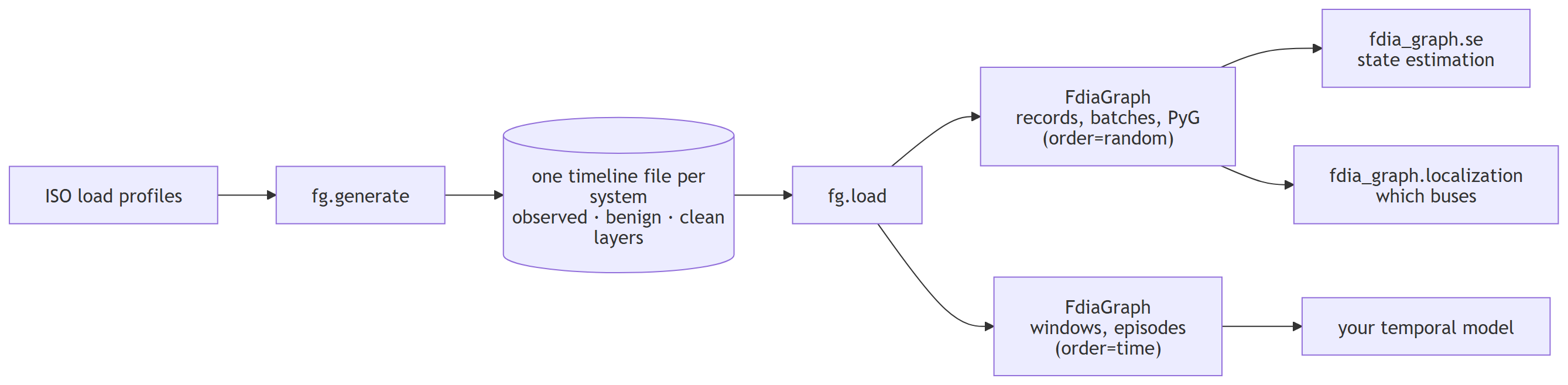
Stealthy FDIA localization datasets for power grids, PyTorch-ready in one line. Eight IEEE systems (14 / 30 / 57 / 89 / 118 / 145 / 200 / 300 buses), one continuous timeline of 72,000 frames each: a record table when shuffled, a time series when not.
import fdia_graph as fg

ds = fg.load("ieee118", split="train")     # auto-downloads + caches
for batch in ds.loader(batch_size=64):
    batch["node_x"], batch["edge_x"], batch["edge_index"], batch["y"], batch["family"]

ts = fg.load("ieee118", split="test", order="time")   # the same frames in time order
Xw, yw = ts.windows(W=24, stride=12)                  # [n, 24, N, 4] windows for an LSTM / TGN
| Read | To learn |
|---|---|
docs/ROADMAP.md |
which file does what, and how the paths connect |
docs/guides/generation.md |
how a timeline is generated, and which layers a feature may read |
docs/reference/DATA_DICTIONARY.md |
what every array means |
docs/reference/GLOSSARY.md |
every term, with where it lives in the code |
docs/reference/CONCEPTS_TO_CODE.md |
paper equations to functions |
docs/reference/CLASS_MAP.md |
architecture: the UML class and module diagrams, drawn from the code |
docs/reference/EXAMPLES.md |
runnable baselines, the timeline as sequences, dataset stats |
docs/se/ · docs/localization/ · docs/trust/ · docs/federated/ |
the analysis modules, with results |
CONTRIBUTING.md |
rules, pull-request flow, releases |
Install
| command | gives |
|---|---|
pip install fdia-graph |
the loader (numpy, h5py) |
pip install "fdia-graph[torch]" |
+ PyTorch DataLoader, learned localizers |
pip install "fdia-graph[pyg]" |
+ torch_geometric records and timelines |
pip install "fdia-graph[se]" |
+ state estimation, residual localization (pandapower, scipy; add [torch] for speed) |
pip install "fdia-graph[generate]" |
+ pandapower, to generate custom data |
pip install "fdia-graph[iso]" |
+ gridstatus, to download CAISO and ERCOT load profiles (NYISO needs no extra) |
pip install "fdia-graph[federated]" |
+ torch and scikit-learn, for fdia_graph.federated |
pip install "fdia-graph[all]" |
every extra above |
Data is pinned per SDK version and cached in ~/.cache/fdia_graph. fg.load(..., release="v0.7.2")
pins a data version (the v0.7.2 record shards still load); pip install --upgrade fdia-graph moves it forward.
Load
One file per system, one loader. order decides what the file is to you:
fg.load("ieee300", split="train")                              # 60/20/20 chronological split, episodes never cut
fg.load("ieee118", split="test", families=["Aq", "At", "Al"])  # family subset
fg.load("ieee118", units="pu")                                 # per-unit + radians (default: physical)
fg.load("ieee118", order="random", seed=0)                     # the record table: a fixed permutation
fg.load("ieee118", split="test", order="time")                 # the time series: windows, episodes
| you want | call |
|---|---|
| a whole split at once | ds.export() (arrays), ds.export(format="torch"), ds.export(format="pandas") |
| windows for an LSTM / TGN | ds.windows(W, stride, label, layer, per_bus=True) on a time-ordered view (one sequence per bus) |
| the attack episodes | ds.episodes (onset, length, family, buses) |
| the attack removed | every record carries benign and edge_benign next to node_x and clean |
| custom data | fg.generate(system, name, attacked_frac=..., families=..., frames=...), then fg.load(name) |
State estimation
from fdia_graph.se import SubspacePrior                       # pip install "fdia-graph[se]"

train, test = fg.load("ieee118", split="train"), fg.load("ieee118", split="test")
est = SubspacePrior(rank_frac=0.5, reweight="huber", c=2.5).fit(train)
xhat = est.estimate(test)          # [n, 2N-1] = [theta rad (non-slack) | V pu (all buses)]
print(est.score(test))             # per-family angle / voltage MAE vs the clean truth
One solver, six estimators that each change one thing: WLS, AdaptiveWeighting, ResidualRemoval,
SubspacePrior, JacobianWeighting, GatedPrior. Results: docs/se/.
Localization
from fdia_graph.localization import SwingThreshold, BusCNN     # numpy only / [torch]

loc = SwingThreshold(fa_target=0.01).fit(train)     # per-bus thresholds from benign records only
flag = loc.localize(test)                           # [n, N] bool: which buses are called attacked
print(loc.score(test))                              # per-family node-F1, strict accuracy, DR next to FA

zs = dict(families=[0, 1, 2])                       # the papers' zero-shot protocol
cnn = BusCNN().fit(fg.load("ieee118", split="train", **zs), val=fg.load("ieee118", split="val", **zs))
One calibration, five localizers: SwingThreshold, DeltaThreshold, ResidualLocalizer, BusMLP,
BusCNN. Results: docs/localization/.
Data
Each record is a sparse measurement graph with N buses (nodes) and E branches (edges).
A shape reads "values per item": [N,4] is 4 numbers per bus.
| field | shape | columns | meaning |
|---|---|---|---|
node_x |
[N,4] |
|V|, P_inj, Q_inj, theta |
bus meters (node_m is the mask) |
edge_x |
[E,2] |
P_from, Q_from |
branch flows (edge_m is the mask) |
edge_index |
[2,E] |
from_bus; to_bus |
connectivity |
edge_attr |
[E,8] |
r, x, b, g, gs, bs, tap, shift |
static line physics (Data.edge_phys in PyG) |
y |
[N] |
1 attacked, 0 clean | |
family |
scalar | 0 benign, 1 Aq, 2 Ad, 3 As, 4 Ar, 5 At, 6 Al, 7 Am (fg.FAMILIES) |
|
temporal_delta, swing |
[N,2] |
ΔP, ΔQ |
change against the previous frame, and as a z-score of recent change |
benign, edge_benign |
[N,4], [E,2] |
as above | the same scan with the attack removed, noise kept |
clean, edge_clean, edge_clean_full |
[N,4], [E,2], [E,2] |
as above | noiseless truth: buses, metered branches, every branch |
seq_id, timestep, split |
scalars | episode index (-1 benign), frame index, partition | |
slack, ybus, yf, yt |
dataset attributes | reference bus, admittance matrices |
Full reference: docs/reference/DATA_DICTIONARY.md.
Attacks
| family | attack | classical BDD | plausibility |
|---|---|---|---|
Aq |
load rescale, the subnetwork around the buses re-solved locally, one frame | evades | every per-bus change within a 5% to 20% band |
At |
slow load ramp, re-solved locally every frame | evades | peak 2.4% to 5.2% of the load (0.2% per frame over a 12 to 26 frame rise), 60 frames |
Al |
load redistribution that lightens a line's apparent loading (a real overload reads lighter), re-solved locally, one frame | evades | 2% to 20% band, load conserved |
Am |
the redistribution reached in per-frame steps under the noise floor | evades | 2% to 20% band, spread over 60 scans |
Ad / As / Ar |
meter bias / scaling / replay, one frame | caught | Ad and As 2% to 20% band; Ar replays an earlier benign scan and records the realized change |
Every stealthy family is a local false state [WU26]: the attacker solves the power flow of a
subnetwork around the attack with the boundary voltages held true, writes only that subnetwork's
meters, and the measurement vector stays consistent with an AC state, so the residual test sees noise.
The meters written are the tamper masks in the file's attack/ group.
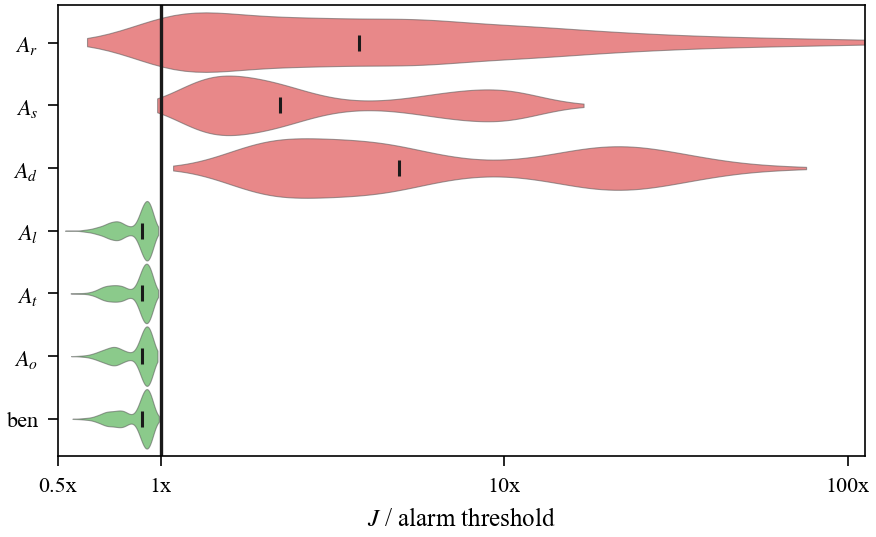
Bad-data statistic relative to the alarm threshold, per family. Green families are indistinguishable from benign; red ones trip the alarm. Meter error follows an accuracy-class model (per-meter bias plus per-scan jitter). Report per-family node-F1 next to the false-alarm rate, never accuracy.
Citation
| cite | for |
|---|---|
| Yuan, Li & Ren, Modeling load redistribution attacks in power systems, IEEE T-SG 2(2), 2011 | LRA |
| Haghshenas, Hasnat & Naeini, A Temporal GNN for Cyber Attack Detection and Localization in Smart Grids, IEEE ISGT 2023 | ramp |
| Zaman & Lin, PING: Physics-Informed GNNs to Generalize FDIA Localization, NAPS 2025 | measurement model |
| Asprou, Kyriakides & Albu, Variable Weights in a WLS State Estimator, IEEE T-IM 63, 2014 | meter noise |
| Boyaci et al., Joint Detection and Localization of Stealth FDIA, IEEE T-SG, 2022 | protocol |
| Wu, Wang, Hu, Ye & Tang, Dynamic PMU configuration for stealthy multi-snapshot FDIA mitigation, IEEE T-SG 17(1), 2026 | local false states, Am, trusted meters |
License
Data under CC BY 4.0, code under MIT (see LICENSE). Synthetic, from public IEEE cases. Not for
operational decisions.
1 maintainer

Release files for fdia-graph 0.20.0
For a detailed explanation of source distributions (sdists) and built distributions (wheels), please see the package formats documentation.
Source distribution (sdist)
| File | Size | Uploaded | |
|---|---|---|---|
| fdia_graph-0.20.0.tar.gz | 218.8 kB | Details |
Built distribution (wheel)
| File | Interpreter | ABI | Platform | Reset |
|---|---|---|---|---|
| fdia_graph-0.20.0-py3-none-any.whl | Python 3 | none | any | Details |
Total release size: 411.5 kB
Release files / fdia_graph-0.20.0.tar.gz
| Download URL | fdia_graph-0.20.0.tar.gz |
|---|---|
| Size | 218.8 kB |
| Tags | Source |
|
SHA-256 checksum How to use checksums |
266952ed33162fb6063153fd6bf37f0641a497dd20cb00997217cf55e5fb4ea3
|
|
BLAKE2b-256 checksum How to use checksums |
eb0a4ff82a292b6d650278d1c7c625b030ba501210c401df71c992326e8a34e0
|
| Upload date | |
|
Uploaded using Trusted Publishing? What is trusted publishing? |
Yes |
| Uploaded via |
twine/7.0.0 CPython/3.13.14
|
Provenance
Provenance describes where a file came from. On PyPI, provenance is shared via attestations, which provide a verifiable record of the build or publishing details. View details, limitations and caveats.


PyPI Publish Attestation
PyPI verified that this artifact, at this checksum, originated from the publisher listed below.
Signed by GitHub Actions, verified by PyPI on Sep 25, 2026.
Transparency logRelease files / fdia_graph-0.20.0-py3-none-any.whl
| Download URL | fdia_graph-0.20.0-py3-none-any.whl |
|---|---|
| Size | 192.7 kB |
| Tags | Python 3 |
|
SHA-256 checksum How to use checksums |
f052f5e8362425a014e866318f28e0c492fe45be99b13da1df9436b15c0e3f13
|
|
BLAKE2b-256 checksum How to use checksums |
b8c7f0116bb07b4339da06aaa5ecea80d572f9e0e4a8b9099b420777087b42fb
|
| Upload date | |
|
Uploaded using Trusted Publishing? What is trusted publishing? |
Yes |
| Uploaded via |
twine/7.0.0 CPython/3.13.14
|
Provenance
Provenance describes where a file came from. On PyPI, provenance is shared via attestations, which provide a verifiable record of the build or publishing details. View details, limitations and caveats.
PyPI Publish Attestation
PyPI verified that this artifact, at this checksum, originated from the publisher listed below.
Signed by GitHub Actions, verified by PyPI on Sep 25, 2026.
Transparency log













