
fdmguard
A part that prints beautifully but cannot be assembled (or falls over mid-print) is a failed part. Function first, print quality second.
Judge every print choice by function first (does it assemble, stay on the bed while printing, move, hold, survive handling) and only then by print quality (supports, flat faces, hole roundness). Every print choice (orientation, splitting into pieces, adding joints) is a trade-off. Always include "keep the original author's geometry unchanged" as an option, compare all options in one table, and let a human decide.
fdmguard is a small Python CLI/library plus a Claude Code skill. It stops an AI agent (or a person) from "optimising a 3D-printed part for printability" in ways that break the assembly.
Status: alpha. All examples and figures use synthetic geometry generated in code. The tolerances are starting points for FDM PLA, not measurements of your printer. Nothing here simulates printing.
Where this comes from
These four failures happened while adapting an open-source hobby robot for FDM PLA printing. Each one passed the checks that were being used at the time.
| # | What went wrong | What catches it | Fix |
|---|---|---|---|
| 1 | Filament-pin holes drawn at 1.85-1.9 mm for 1.75 mm filament. FDM holes print 0.1-0.3 mm small; the pins did not go in. | holes |
draw slip-fit pin holes at 2.1 mm; at least 0.4 mm diametral clearance for printed peg-in-hole |
| 2 | A horizontal split left two regions joined only by a flat strip about 0.5 mm thick and 0.9 mm wide. It snapped in handling. | necks (0.7 mm erosion splits it into 2 chunks) |
keep every joining section at least about 1.6 mm |
| 3 | A flat 1.76 mm plate: 51% of its area was 1.6-1.8 mm wide strips, 13% narrower than 1.6 mm, plus a free 12 mm arm. A thickness/erosion check missed it. | strips (per-layer 2D opening) |
widen strips; report the marginal band too |
| 4 | The main one. To print a one-piece part flat with no supports, it was split in two halves joined by an added keel with screws. The mating pocket was carved only around the seated pose (+0.3 mm). The seated pose had zero overlap, every check passed, and the halves printed clean. But moving the part into the pocket along its insertion path hit a 20-24 mm long, 0.4-0.7 mm undercut rim. It could not be assembled, and forcing it breaks PLA. The original one-piece design dropped in cleanly except for two small intentional snap tabs. | insertion |
sweep the moving part along its path (grown about 0.1 mm for FDM, 0.25 mm steps). Every step must show zero overlap except named, small snap regions. Cut pockets with the swept volume. |
Also from failure 4: the original design had zero clearance on two seat faces. Seated pockets need about +0.2-0.25 mm per side for FDM.
A fifth failure came later: a 54 mm tall one-piece part was oriented
"diagonally" because that orientation had the least support (2.8%). Its
first-layer bed contact was only 0.5 mm², so it would likely topple or detach.
The same part standing on a face had 127 mm² of contact, a rounder bearing bore
(axis vertical) and 21.5% support, and that was the right choice. stability
catches this.
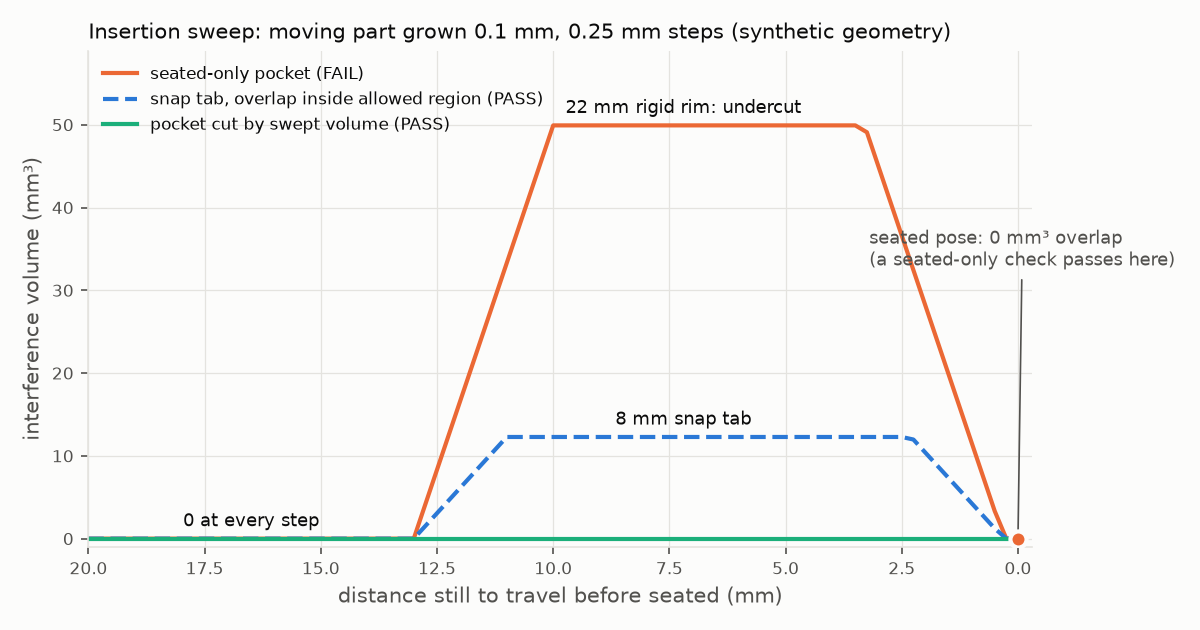
Synthetic block-into-pocket pair. The seated-only pocket has 0 mm³ overlap at the seated pose, so a seated check passes, but the 22 mm rim interferes over 13 mm of travel. The pocket cut by the swept volume has 0 overlap at every step. The 8 mm snap tab overlaps only inside its declared allowed region.
Install (local, not published)
uv sync                     # or: pip install -e .
uv run fdmguard --help      # or: python -m fdmguard --help
Python >= 3.10. Dependencies: manifold3d, trimesh, numpy, shapely, scipy, pyyaml.
Checks
Exit codes for every command: 0 PASS, 1 FAIL, 2 bad input (missing file,
open or empty mesh). A bad input is never reported as a pass. Every command
also accepts --json for machine-readable output (for agents and CI).
insertion: sweep the real assembly path
fdmguard insertion moving_seated.stl fixed.stl [more_fixed.stl ...] \
    --direction=-z --travel 20 --step 0.25 --grow 0.1 \
    [--allow tab:x0,y0,z0,x1,y1,z1] [--max-snap-length 12] [--full] [--json]
- The moving mesh is in its seated pose.
--directionis the motion direction during assembly (x|-x|y|-y|z|-zordx,dy,dz; write--direction=-zso the minus sign is not read as an option). The part starts atseated - direction * traveland moves to seated in--stepsteps; the exact seated pose is always the last step. --growmodels FDM over-size. Default modeinplaneis the union of the part translated bygrowin 8 directions perpendicular to travel, so the seat stop face is not grown.--grow-mode fullis a true Minkowski sum with a small octahedron (experimental: it also grows the stop face, so a seated part resting on a floor will report contact).- Overlap volume is computed per fixed part with exact mesh booleans (manifold3d) and split into outside and inside allowed snap regions.
- PASS needs: (a) the start pose outside every fixed part's bounding box,
(b) zero overlap outside allowed regions at every step (1e-3 mm³ noise floor),
and (c) the overlap inside each allowed region no longer than
--max-snap-length(12 mm) in the plane perpendicular to travel. Length is measured per connected piece of overlap, so a long rigid rim still fails inside one big "allowed" box or several small tiled boxes. There is no depth limit; a warning is printed when the overlap is deeper than--warn-snap-depth(1.0 mm). - The seated-pose-only result is printed next to the path result.
Real output on the synthetic pair (bad pocket, then the swept-cut fix; the
first table is shortened by the tool itself, --full prints every step):
$ fdmguard insertion examples/out/insert_rim.stl examples/out/socket_seated_only.stl --direction=-z --travel 20
| step | to go (mm) | socket_seated_only overlap | socket_seated_only outside allowed | socket_seated_only in allowed | ok |
|---|---|---|---|---|---|
| 0 | 20.00 | 0.000 | 0.000 | 0.000 | yes |
| 29 | 12.75 | 4.160 | 4.160 | 0.000 | NO |
| 30 | 12.50 | 8.320 | 8.320 | 0.000 | NO |
...
| 78 | 0.50 | 3.328 | 3.328 | 0.000 | NO |
| 80 | 0.00 | 0.000 | 0.000 | 0.000 | yes |

seated-pose-only check : PASS  (outside overlap 0.000 mm^3)
insertion-path sweep   : FAIL  (worst step 52 at 7.00 mm to go, outside overlap 49.920 mm^3; 81 steps of 0.25 mm, grow 0.1 mm)
NOTE: seated pose is clear but the part cannot travel there. Seated-only clearance is not enough.

$ fdmguard insertion examples/out/insert_rim.stl examples/out/socket_swept.stl --direction=-z --travel 20
| step | to go (mm) | socket_swept overlap | socket_swept outside allowed | socket_swept in allowed | ok |
|---|---|---|---|---|---|
| 0 | 20.00 | 0.000 | 0.000 | 0.000 | yes |
| 80 | 0.00 | 0.000 | 0.000 | 0.000 | yes |

seated-pose-only check : PASS  (outside overlap 0.000 mm^3)
insertion-path sweep   : PASS  (no overlap outside allowed regions at any step; 81 steps of 0.25 mm, grow 0.1 mm)
Library helper: fdmguard.insertion.swept_volume(moving, direction, travel)
returns the union of the moving part over the path. Subtract it (grown a
little) from the fixed part to cut a pocket that admits the real motion.
necks: thin joins left by splitting
fdmguard necks part.stl [--radius 0.7] [--pitch 0.05]
Erodes each body of the solid by r on a voxel grid and counts chunks above
0.5 mm³. A body that falls apart into several chunks is joined only by a
section thinner than about 2r (status NECK). A body that vanishes
completely is reported as THIN, not as a pass. Parts with more than one body are noted. Accuracy is
about half the voxel pitch (0.025 mm by default).
strips: narrow strips on each printed layer
fdmguard strips part.stl [--width 1.6] [--layer 0.2] [--up z] [--band 0.2]
For each mid-layer section P, computes the opening (P shrunk by w/2) grown by w/2
with mitre joins (so square corners are not reported as thin). Material outside
the opening is narrower than w. Also reports the marginal band w .. w+band,
because a plate can pass at 1.6 mm and still be mostly 1.6-1.8 mm strips.
--up sets the build direction in the mesh's axes; results depend on it.
holes: printed hole size for pins and screws
fdmguard holes --pin 1.75                        # table of recommended sizes
fdmguard holes --pin 1.75 --fit slip part.stl    # also check round holes in a mesh
| fit | added to nominal (diametral) | example |
|---|---|---|
| press | +0.10 | |
| slip | +0.35 | 1.75 mm filament pin -> 2.10 mm |
| peg (printed in printed) | +0.40 | |
| screw-clearance | +0.60 | M3 -> 3.6 mm |
| screw-tap (pilot) | -0.20 | M3 -> 2.8 mm |
Mesh checking finds circular holes whose axis is along --up from layer
sections (circularity >= 0.9) and flags holes smaller than the recommendation.
If no round hole is found, the result is "nothing checked" (exit 1), not a pass.
Calibrate these values with a test print on your own printer.
stability: printable without toppling
fdmguard stability part_in_print_orientation.stl [--up z] [--min-contact 20] [--max-slenderness 10]
The mesh must be in print orientation. The part is dropped to z = 0, then the tool reports first-layer bed contact (sections at z = 0.1 / 0.3 / 0.5 mm), height, contact width (short side of the minimum rotated rectangle around the first-layer contact), height / contact width, and whether the centre of mass (uniform density) is over the contact footprint, with a tip angle.
Defaults (conservative, configurable): FAIL if contact < 20 mm², if height / contact width > 10, or if the centre of mass is not over the footprint. WARN above height / contact width 5 (add a brim). This is a geometric screen. It does not model adhesion, nozzle forces, brims, or supports that touch the bed.
Real output on the synthetic 54 mm post with an 8 mm bore:
$ fdmguard stability examples/out/post_on_edge.stl
stability: post_on_edge.stl: up axis z
  height                 : 48.1 mm
  bed contact z=0.1/0.3/0.5 : 3.2 / 9.6 / 16.0 mm^2  (min 20)
  contact width          : 0.20 mm
  height / contact width : 240.4  (warn > 5, fail > 10)
  centre of mass         : z 24.0 mm, over base: NO, tip angle -30.3 deg
  -> FAIL
  FAIL: first-layer contact 3.2 mm^2 < 20 mm^2
  FAIL: height / contact width = 240.4 > 10
  FAIL: centre of mass is not over the contact footprint: the part leans out of its base

$ fdmguard stability examples/out/post_face_down.stl
stability: post_face_down.stl: up axis z
  height                 : 54.0 mm
  bed contact z=0.1/0.3/0.5 : 173.8 / 173.8 / 173.8 mm^2  (min 20)
  contact width          : 14.00 mm
  height / contact width : 3.9  (warn > 5, fail > 10)
  centre of mass         : z 27.0 mm, over base: yes, tip angle 14.5 deg
  -> PASS
tradeoff: function gates first, then print metrics
fdmguard tradeoff options.yaml
See examples/tradeoff_block.yaml. Each option
lists insertion, necks, strips, stability (printable without toppling)
as pass, fail, unknown, or a check
spec that fdmguard runs on meshes. It also lists extra_hardware,
geometry_change (none|minor|major) and print metrics (lower is better).
Rules:
- A gate that is missing or
unknownis UNVERIFIED, never a pass. - Only options that pass every gate are ranked on print metrics.
- The suggestion defaults to the least-change passing option. Another option replaces it only if it is no worse on function cost (geometry change, extra hardware) and at least as good on every print metric and strictly better on one.
- The file must contain an option with
original: true. If the original fails a gate, the output says so. - The table is always printed. A human decides.
Real output (the insertion and stability gates marked as checks were run on meshes; the print metrics in the file are illustrative numbers, not slicer output). The minimum-support diagonal option is gated out by stability:
| option | insertion | necks | strips | stability | extra hardware | geometry change | function gates | support_pct | hole_error_mm | print_time_min | print rank | suggested |
|---|---|---|---|---|---|---|---|---|---|---|---|---|
| original | PASS | PASS | PASS | PASS | 0 | none | PASS | 18 | 0.15 | 95 | 2 | yes |
| reorient (same geometry) | PASS | PASS | PASS | PASS | 0 | none | PASS | 9 | 0.25 | 100 | 1 |  |
| diagonal, min support | PASS | PASS | PASS | FAIL | 0 | none | FAIL | 3 | 0.3 | 105 | - (gated out) |  |
| split + keel, seated-only pocket | FAIL | PASS | PASS | PASS | 2 | major | FAIL | 0 | 0.1 | 80 | - (gated out) |  |
| split + keel, swept pocket | PASS | PASS | UNVERIFIED | PASS | 2 | major | UNVERIFIED | 0 | 0.1 | 82 | - (gated out) |  |

Checks run:
- original: insertion: seated-only PASS, path PASS
- original: stability: PASS (bed contact 344.2 mm^2, height 24.0 mm, height/width 1.8)
- diagonal, min support: stability: FAIL (bed contact 5.1 mm^2, height 26.5 mm, height/width 132.6)
- split + keel, seated-only pocket: insertion: seated-only PASS, path FAIL
- split + keel, swept pocket: insertion: seated-only PASS, path PASS

Recommendation: original
'original' is the least-change option that passes every function gate. Also passing: reorient (same geometry). They change more or are not better on every print metric. This is a suggestion. Show this table to a human and let them decide.
Examples and tests
sh examples/run_examples.sh      # writes examples/out/*.stl, runs every check, asserts exit codes
uv run python examples/make_figures.py
uv run pytest -q
The synthetic cases (src/fdmguard/synthetic.py) reproduce each failure and a
fix: pin holes 1.9 vs 2.1 mm; a split part with a 0.5 x 0.9 mm neck vs a
1.6 x 2.0 mm neck; a plate with 1.7 / 1.2 mm strips vs 2.4 mm strips; and the
block-into-pocket pair (seated-only pocket, swept pocket, small snap tab with
and without an allowed region, a long rim inside an "allowed" box, and zero
seat clearance); and a 54 mm post balanced on an edge vs standing on a face.
Agent skill
Copy skills/fdmguard/ to ~/.claude/skills/ (or your project's
.claude/skills/). The skill tells the agent when to run the checks, in which
order, the tolerance defaults, the anti-patterns, and to show the trade-off
table instead of deciding silently.
Limits
- Straight-line insertion only. Rotations or multi-leg paths need several runs.
- FDM over-size is modelled as a fixed grow. It is not a print or warp simulation.
- Snap regions are axis-aligned boxes in the fixed parts' frame. The tool judges a snap by overlap length only; it does not compute stress or flex.
- Strips and holes use horizontal layer sections in the chosen up axis.
- Meshes must be closed manifold solids.
See docs/DESIGN.md for goals, non-goals, key decisions and the roadmap, and docs/PRIOR_ART.md for related tools. The pieces are known techniques; this project is a small, focused combination of them.
繁體中文摘要
印得漂亮但裝不起來、或印到一半倒掉,就是失敗的零件。先顧能用,再顧印得好。 先看功能(裝得進去、印的時候不會倒、能動、 夾得住、拿起來不會斷),再看列印品質(支撐、平面、孔圓度)。拆件、換方向、 加接頭都是取捨。比較時一定要包含「維持原作者幾何不變」這個選項,把所有 選項放在同一張表,讓人來決定。
insertion:沿著實際組裝路徑掃描(零件外擴 0.1 mm、每步 0.25 mm), 只看最終位置的檢查會漏掉路徑上的倒扣。necks:內縮 0.7 mm 後如果裂成多塊,代表有細頸。strips:逐層 2D 開運算,找出窄於 1.6 mm 的細條,並回報 1.6–1.8 mm 的邊緣比例。holes:1.75 mm 線材銷孔畫 2.1 mm;列印件對列印件至少 0.4 mm 直徑間隙。stability:列印方向的貼床面積與高寬比;只看支撐 % 選「斜放」常常會倒。tradeoff:功能關卡先過,才比列印指標;預設推薦改動最少的選項。
所有範例都是程式產生的合成幾何,公差只是起始值,請用自己的印表機校正。
License
Apache-2.0. See LICENSE.
1 maintainer

Metadata
1 maintainer
Release files for fdmguard 0.1.0
For a detailed explanation of source distributions (sdists) and built distributions (wheels), please see the package formats documentation.
Source distribution (sdist)
| File | Size | Uploaded | Provenance | Actions |
|---|---|---|---|---|
| fdmguard-0.1.0.tar.gz | 283.3 kB | With provenance | Details for fdmguard-0.1.0.tar.gz |
Built distribution (wheel)
| File | Interpreter | ABI | Platform | Actions Reset |
|---|---|---|---|---|
| fdmguard-0.1.0-py3-none-any.whl | Python 3 | none | any | Details for fdmguard-0.1.0-py3-none-any.whl |
Total release size: 321.9 kB
Release files / fdmguard-0.1.0.tar.gz
| Download URL | fdmguard-0.1.0.tar.gz |
|---|---|
| Size | 283.3 kB |
| Tags | Source |
|
SHA-256 checksum How to use checksums |
6bf185a7e82951c4195ee79c3488790947a8059fb004a235c8282e0fbd43ef8d
|
|
BLAKE2b-256 checksum How to use checksums |
48648d01a4bafcb1c0329ba18c2307897b475ca0e18e64a702b1e215f9b51f2f
|
| Upload date | |
|
Uploaded using Trusted Publishing? What is trusted publishing? |
Yes |
| Uploaded via |
twine/7.0.0 CPython/3.13.16
|
Provenance
Provenance describes where a file came from. On PyPI, provenance is shared via attestations, which provide a verifiable record of the build or publishing details. View details, limitations and caveats.


PyPI Publish Attestation
PyPI verified that this artifact, at this checksum, originated from the publisher listed below.
Signed by GitHub Actions, verified by PyPI on Nov 29, 2026.
Transparency logRelease files / fdmguard-0.1.0-py3-none-any.whl
| Download URL | fdmguard-0.1.0-py3-none-any.whl |
|---|---|
| Size | 38.6 kB |
| Tags | Python 3 |
|
SHA-256 checksum How to use checksums |
4b1a228fd61e659fd614efb3f6f3f81d44276a38b87388faca67c4827b7b9478
|
|
BLAKE2b-256 checksum How to use checksums |
9579e2519d0e850784c9e8ad4e9289f0365ff01b6c80e972df963403698c9174
|
| Upload date | |
|
Uploaded using Trusted Publishing? What is trusted publishing? |
Yes |
| Uploaded via |
twine/7.0.0 CPython/3.13.16
|
Provenance
Provenance describes where a file came from. On PyPI, provenance is shared via attestations, which provide a verifiable record of the build or publishing details. View details, limitations and caveats.
PyPI Publish Attestation
PyPI verified that this artifact, at this checksum, originated from the publisher listed below.
Signed by GitHub Actions, verified by PyPI on Nov 29, 2026.
Transparency logSecurity for fdmguard 0.1.0
Provenance
Provenance describes where a file came from. On PyPI, provenance is shared via attestations, which provide a verifiable record of the build or publishing details. View details, limitations and caveats.
Full provenance
Both files in this release have been uploaded with provenance metadata.
Attestation for fdmguard-0.1.0.tar.gz
PyPI Publish Attestation
PyPI verified that this artifact, at this checksum, originated from the publisher listed below.
Signed by GitHub Actions, verified by PyPI on Nov 29, 2026.
Transparency logA note on package security
PyPI is a repository for distributing packages, not a service for auditing them. While third-party security researchers and our staff do their best to detect and remove malicious packages, PyPI cannot guarantee the quality, security or suitability of any given package.
To learn more about protecting yourself from malicious actors, visit our package security documentation.














