
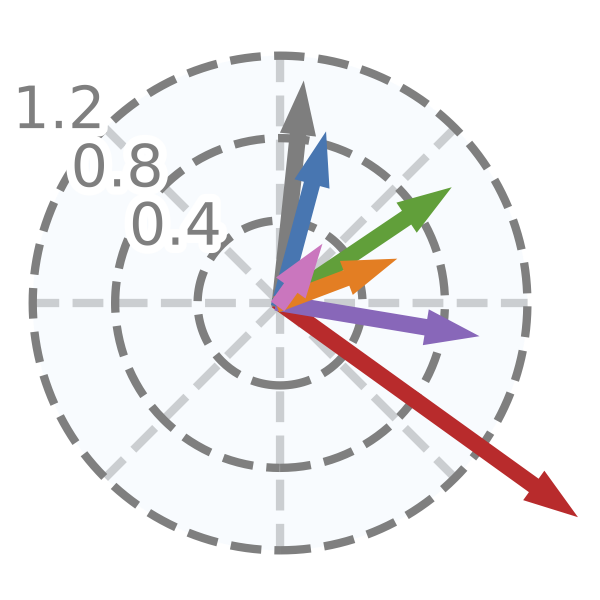
Feature Clock: High-Dimensional Effects in Two-Dimensional Plots

What is it?
It is difficult for humans to perceive high-dimensional data. Therefore, high-dimensional data is projected into lower dimensions to visualize it. Many applications benefit from complex nonlinear dimensionality reduction techniques (e.g., UMAP, t-SNE, PHATE, and autoencoders), but the effects of individual high-dimensional features are hard to explain in the latent spaces. Most solutions use multiple two-dimensional plots to analyze the effect of every variable in the embedded space, but this is not scalable, leading to k plots for k different variables. Our solution, Feature Clock, provides novel visualizations that eliminate the need for multiple plots to inspect the influence of original variables in the latent space. Feature Clock enhances the explainability and compactness of visualizations of embedded data.
Table of Contents
Main Features
Feature Clock allows creation of three types of static visualizations, highlighting the contributions of the high-dimensional features to linear directions of the two-dimensional spaces produced by nonlinear dimensionality reduction:
- Global Feature Clock indicating the direction of features’ contributions in low-dimensional space for the whole dataset.
- Local Feature Clock explaining features’ impact within selected points.
- Inter-group Feature Clock visualizing contributions between groups of points.
Where to get it
The source code is currently hosted on GitHub at: https://github.com/OlgaOvcharenko/feature_clock_visualization.git
Binary installers for the latest released version are available at the Python Package Index (PyPI).
# PyPI
pip install feature-clock
Instalation
Feature Clock can be installed from PyPI:
pip install feature-clock
All dependencies are listed in requirements.txt and can be installed separately.
pip install -r requirements.txt
License
Documentation
There is documentation, and a simple tutorial.
1 maintainer

Metadata
1 maintainer
Release files for feature-clock 1.0.2
For a detailed explanation of source distributions (sdists) and built distributions (wheels), please see the package formats documentation.
Source distribution (sdist)
| File | Size | Uploaded | Provenance | Actions |
|---|---|---|---|---|
| feature_clock-1.0.2.tar.gz | 34.1 kB | Without provenance | Details for feature_clock-1.0.2.tar.gz |
Built distribution (wheel)
| File | Interpreter | ABI | Platform | Actions Reset |
|---|---|---|---|---|
| feature_clock-1.0.2-py3-none-any.whl | Python 3 | none | any | Details for feature_clock-1.0.2-py3-none-any.whl |
Total release size: 50.8 kB
Release files / feature_clock-1.0.2.tar.gz
| Download URL | feature_clock-1.0.2.tar.gz |
|---|---|
| Size | 34.1 kB |
| Tags | Source |
|
SHA-256 checksum How to use checksums |
02a2c017519b8dedf40c4e7032fc359185011e158ad16f30f495121b03201c59
|
|
BLAKE2b-256 checksum How to use checksums |
411a01035ee89d19aa51a4d95f3518ffc49a3f09161defeecc6e5a2e72464fc7
|
| Upload date | |
|
Uploaded using Trusted Publishing? What is trusted publishing? |
No |
| Uploaded via |
twine/5.0.0 CPython/3.11.8
|
Release files / feature_clock-1.0.2-py3-none-any.whl
| Download URL | feature_clock-1.0.2-py3-none-any.whl |
|---|---|
| Size | 16.7 kB |
| Tags | Python 3 |
|
SHA-256 checksum How to use checksums |
023028d909b5de5028c0b1a7192c47fa15c7e300327bc84a72383b3fdbdc6c1b
|
|
BLAKE2b-256 checksum How to use checksums |
5834471c418563c9120750644087ae2380019c6faaddec448eafab5c72d0d7c0
|
| Upload date | |
|
Uploaded using Trusted Publishing? What is trusted publishing? |
No |
| Uploaded via |
twine/5.0.0 CPython/3.11.8
|
Security for feature-clock 1.0.2
Provenance
Provenance describes where a file came from. On PyPI, provenance is shared via attestations, which provide a verifiable record of the build or publishing details. View details, limitations and caveats.
No provenance found
None of the files in this release were uploaded with provenance metadata.
A note on package security
PyPI is a repository for distributing packages, not a service for auditing them. While third-party security researchers and our staff do their best to detect and remove malicious packages, PyPI cannot guarantee the quality, security or suitability of any given package.
To learn more about protecting yourself from malicious actors, visit our package security documentation.














