

Open finite element infrastructure for nonlinear computational mechanics.














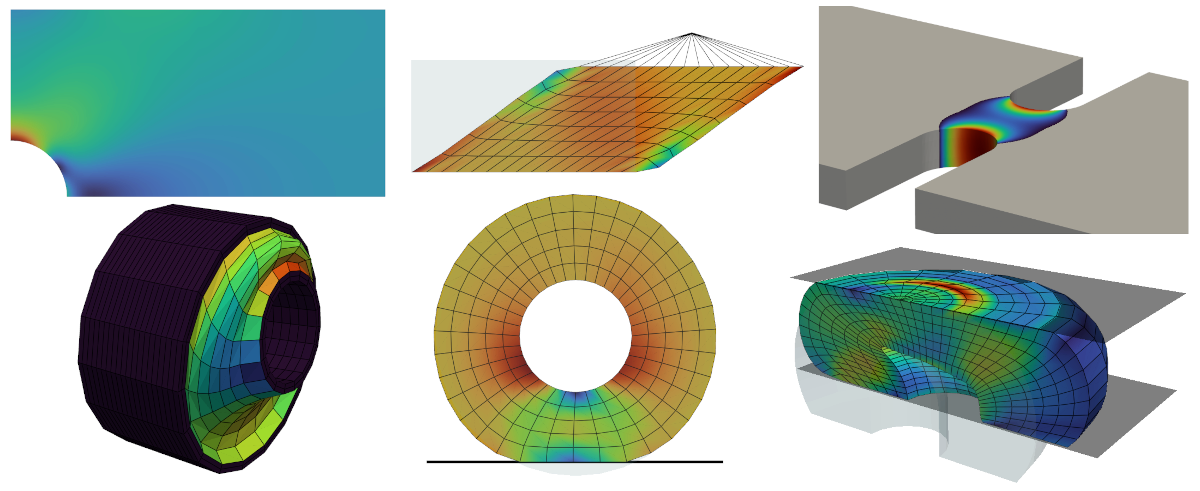
FElupe is an open, Python-based finite element infrastructure for nonlinear computational solid mechanics, providing high-level and extensible workflows for research and engineering applications.
✨ Highlights
- ✅ pure Python, only NumPy and SciPy required
- ✅ easy-to-learn high-level API
- ✅ nonlinear deformation of solid bodies
- ✅ job plugins, e.g. cutbacks, animations, live dashboard
- ✅ interactive plots with PyVista, WebGL or Matplotlib
- ✅ typical finite elements
- ✅ cartesian, axisymmetric, plane strain and mixed fields
- ✅ hyperelastic materials with automatic differentiation
FElupe achieves efficient NumPy-based computations through vectorized element-wise operations on trailing array axes [1]. The finite element method, as used in FElupe, is based on [2], [3] and [4]. Related scientific articles are listed in the sections of the API reference.
📦 Installation
Install Python, open a terminal and run
pip install felupe[all]
The documentation covers more details, like required and optional dependencies and how to install the latest development version.
🚀 Getting Started
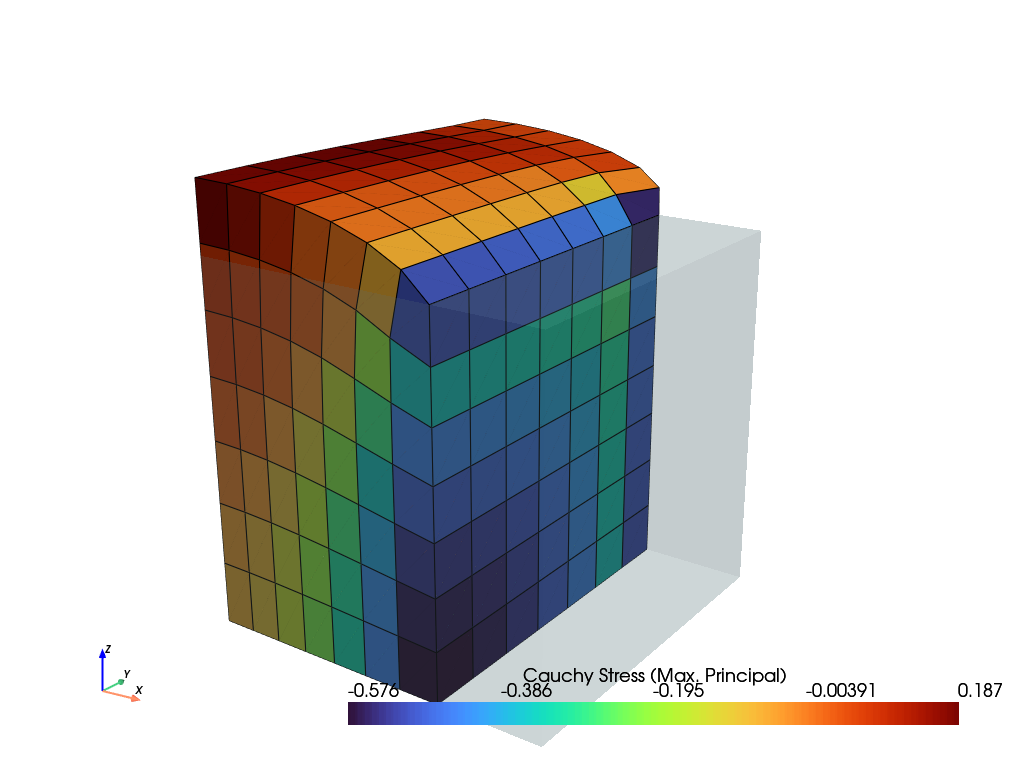
This minimal code-block demonstrates a nonlinear simulation of a hyperelastic cube under compression.
import felupe as fem

mesh = fem.Cube(n=8)
region = fem.RegionHexahedron(mesh)
field = fem.FieldContainer(fields=[fem.Field(region, dim=3)])

boundaries = fem.dof.uniaxial(field, clamped=True, move=-0.3)
solid = fem.SolidBody(umat=fem.NeoHooke(mu=1, bulk=5), field=field)

step = fem.Step(items=[solid], boundaries=boundaries)
job = fem.Job(steps=[step]).evaluate()

solid.plot("Principal Values of Cauchy Stress").show()
📖 Documentation
The documentation is located here.
🧩 Extension Packages
The capabilities of FElupe may be enhanced with extension packages created by the community.
| Package | Description |
|---|---|
| contique | Numerical continuation of nonlinear equilibrium equations. |
| hyperelastic | Constitutive hyperelastic material formulations |
| matadi | Material Definition with Automatic Differentiation (AD) |
| statescale | Snapshot-Driven State Upscaling |
| tensortrax | Differentiable Tensors based on NumPy Arrays |
| feplot | A visualization tool for FElupe |
🛠️ Testing
To run the FElupe unit tests, check out this repository and type
tox
📝 Scientific Publications
A list of articles in which
Expand the list...
-
A. Dutzler, C. Buzzi, and M. Leitner, "Nondimensional translational characteristics of elastomer components", Journal of Applied Engineering Design and Simulation, vol. 1, no. 1. UiTM Press, Universiti Teknologi MARA, Sep. 21, 2021. doi: 10.24191/jaeds.v1i1.20.
-
C. Buzzi, A. Dutzler, T. Faethe, J. Lassacher, M. Leitner, and F.-J. Weber, "Development of a tool for estimating the characteristic curves of rubber-metal parts", in Proceedings of the 12th International Conference on Railway Bogies and Running Gears, 2022 (ISBN 978-963-9058-46-0).
-
J. Torggler, A. Dutzler, B. Oberdorfer, T. Faethe, H. Müller, C. Buzzi, and M. Leitner, "Investigating Damage Mechanisms in Cord-Rubber Composite Air Spring Bellows of Rail Vehicles and Representative Specimen Design", Applied Composite Materials. Springer Science and Business Media LLC, Aug. 22, 2023. doi: 10.1007/s10443-023-10157-1. Simulation-related Python scripts are available on GitHub at adtzlr/fiberreinforcedrubber.
-
E. Navas, K. Blanco, D. Rodríguez-Nieto, and R. Fernández, "Design and grasp planning of a reconfigurable hybrid soft gripper using SINDy and virtual object representation", Sensors and Actuators A: Physical, vol. 401, p. 117621, Apr. 2026, doi: 10.1016/j.sna.2026.117621.

📄 Changelog
All notable changes to this project will be documented in this file. The format is based on Keep a Changelog, and this project adheres to Semantic Versioning.
📚 References
[1] T. Gustafsson and G. McBain, "scikit-fem: A Python package for finite element assembly", Journal of Open Source Software, vol. 5, no. 52. The Open Journal, p. 2369, Aug. 21, 2020. 
[2] J. Bonet and R. D. Wood, "Nonlinear Continuum Mechanics for Finite Element Analysis". Cambridge University Press, Mar. 13, 2008. 
[3] K. J. Bathe, "Finite Element Procedures". 2006, isbn: 978-0-9790049-0-2.
[4] O. C. Zienkiewicz, R. L. Taylor and J. Z. Zhu, "The Finite Element Method: its Basis and Fundamentals". Elsevier, 2013. 
🔓 License
FElupe - finite element analysis (C) 2021-2026 Andreas Dutzler, Graz (Austria).
This program is free software: you can redistribute it and/or modify it under the terms of the GNU General Public License as published by the Free Software Foundation, either version 3 of the License, or (at your option) any later version.
This program is distributed in the hope that it will be useful, but WITHOUT ANY WARRANTY; without even the implied warranty of MERCHANTABILITY or FITNESS FOR A PARTICULAR PURPOSE. See the GNU General Public License for more details.
You should have received a copy of the GNU General Public License along with this program. If not, see https://www.gnu.org/licenses/.
1 maintainer

Metadata
1 maintainer
Release files for felupe 12.1.0
For a detailed explanation of source distributions (sdists) and built distributions (wheels), please see the package formats documentation.
Source distribution (sdist)
| File | Size | Uploaded | Provenance | Actions |
|---|---|---|---|---|
| felupe-12.1.0.tar.gz | 612.1 kB | With provenance | Details for felupe-12.1.0.tar.gz |
Built distribution (wheel)
| File | Interpreter | ABI | Platform | Actions Reset |
|---|---|---|---|---|
| felupe-12.1.0-py3-none-any.whl | Python 3 | none | any | Details for felupe-12.1.0-py3-none-any.whl |
Total release size: 1.2 MB
Release files / felupe-12.1.0.tar.gz
| Download URL | felupe-12.1.0.tar.gz |
|---|---|
| Size | 612.1 kB |
| Tags | Source |
|
SHA-256 checksum How to use checksums |
0af441c118515e80d4e59000c2a043fac7f87c5888524882077d12547e8845ca
|
|
BLAKE2b-256 checksum How to use checksums |
59552de09884e53ed61e6ad0c43bf8bf30919ad743572487e00629638781851d
|
| Upload date | |
|
Uploaded using Trusted Publishing? What is trusted publishing? |
Yes |
| Uploaded via |
twine/7.0.0 CPython/3.13.16
|
Provenance
Provenance describes where a file came from. On PyPI, provenance is shared via attestations, which provide a verifiable record of the build or publishing details. View details, limitations and caveats.


PyPI Publish Attestation
PyPI verified that this artifact, at this checksum, originated from the publisher listed below.
Signed by GitHub Actions, verified by PyPI on Nov 16, 2026.
Transparency logRelease files / felupe-12.1.0-py3-none-any.whl
| Download URL | felupe-12.1.0-py3-none-any.whl |
|---|---|
| Size | 598.9 kB |
| Tags | Python 3 |
|
SHA-256 checksum How to use checksums |
f07b112b278f096b77ea295ae591842cefab802d75d28e035b03f5432a574850
|
|
BLAKE2b-256 checksum How to use checksums |
df7124d9bf0cd82fde412dfa36c45c5f591f7426c56ba9129031c75d66ed6036
|
| Upload date | |
|
Uploaded using Trusted Publishing? What is trusted publishing? |
Yes |
| Uploaded via |
twine/7.0.0 CPython/3.13.16
|
Provenance
Provenance describes where a file came from. On PyPI, provenance is shared via attestations, which provide a verifiable record of the build or publishing details. View details, limitations and caveats.
PyPI Publish Attestation
PyPI verified that this artifact, at this checksum, originated from the publisher listed below.
Signed by GitHub Actions, verified by PyPI on Nov 16, 2026.
Transparency logSecurity for felupe 12.1.0
Provenance
Provenance describes where a file came from. On PyPI, provenance is shared via attestations, which provide a verifiable record of the build or publishing details. View details, limitations and caveats.
Full provenance
Both files in this release have been uploaded with provenance metadata.
Attestation for felupe-12.1.0.tar.gz
PyPI Publish Attestation
PyPI verified that this artifact, at this checksum, originated from the publisher listed below.
Signed by GitHub Actions, verified by PyPI on Nov 16, 2026.
Transparency logA note on package security
PyPI is a repository for distributing packages, not a service for auditing them. While third-party security researchers and our staff do their best to detect and remove malicious packages, PyPI cannot guarantee the quality, security or suitability of any given package.
To learn more about protecting yourself from malicious actors, visit our package security documentation.














