
Hop-by-hop forwarding chain validation with ECMP graph visualization. Not a traceroute — a FIB trace.

Project description
fibtrace
Hop-by-hop forwarding chain validation from the device perspective. Not a traceroute — a FIB trace.
⚠️ Alpha software. fibtrace is under active development. Interfaces, output schemas, and CLI flags may change between 0.x releases. Not recommended for unattended automation or mission-critical change gates until a 1.0 release establishes API stability. See Status & Security.
The Problem
When a network path breaks, traceroute tells you where packets die. It doesn't tell you why.
To find the root cause, you SSH into the first device, check the route table, check the FIB, validate ARP resolution, inspect the egress interface — then move to the next hop and do it all again. Device by device, control plane to data plane, tedious but precise.
Every network engineer knows this workflow. Nobody has automated it.
fibtrace does. Given a target prefix and a starting device, it walks the forwarding chain hop by hop, validating what each device actually knows and what it's actually doing with the traffic. When it finds ECMP, it follows every branch. When it finds a problem, it tells you exactly what broke and where.
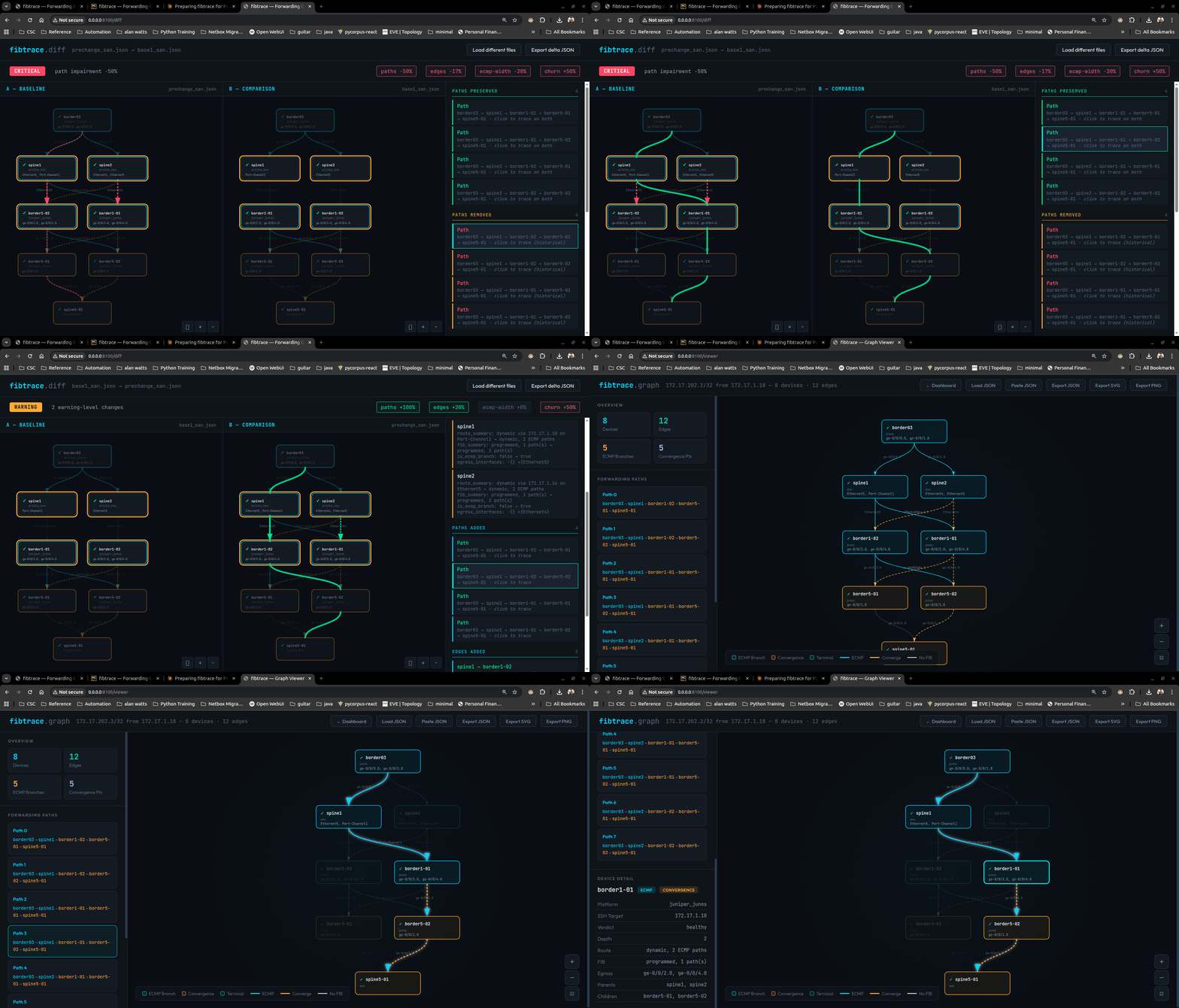
The result is a forwarding graph — a DAG of every device in the path, every ECMP branch, every convergence point, and every forwarding decision between them. Exportable as JSON, Graphviz DOT, or visualized in an interactive HTML viewer.
How It Works
At each hop, fibtrace asks four questions:
- Is there a route? — RIB lookup for the prefix
- Is it in the FIB? — Is the route programmed in the forwarding table?
- Is the next-hop resolved? — ARP entry (IPv4) or ND entry (IPv6), MAC address learned?
- Is the egress link healthy? — Interface up, error counters clean?
Then it follows the next-hop to the next device and repeats. The walk continues until it reaches a connected route (end of path), a black hole (problem found), or an unresolvable next-hop (problem found). ECMP paths are followed as a DAG — every branch is validated, every convergence point is tracked.
Quick Start
# Core CLI only — walk, diff, view
pip install fibtrace

# With optional UIs
pip install 'fibtrace[tui]'        # + Textual TUI
pip install 'fibtrace[web]'        # + FastAPI web dashboard
pip install 'fibtrace[tui,web]'    # everything

# Headless walk
fibtrace walk -p 10.1.0.0/24 -s 172.16.1.1 -u admin --password secret --domain example.com

# Open the graph viewer (then drag-drop or load JSON files)
fibtrace view
All functionality is exposed through a single fibtrace command with subcommands:
| Subcommand | Purpose |
|---|---|
fibtrace walk |
Headless forwarding chain walker |
fibtrace diff |
Compare two forwarding graphs |
fibtrace view |
Open the HTML graph viewer in a browser |
fibtrace tui |
Textual TUI — live forwarding chain visualization |
fibtrace web |
Run the FastAPI web dashboard |
Run fibtrace <subcommand> --help for subcommand-specific options.
Typical Workflow
# 1. Run a trace, save the graph
fibtrace walk -p 172.17.1.136/32 -s 172.17.1.135 -u admin --password secret \
    --skip-mac --nh-source auto --json > trace.json

# 2. Open the viewer
fibtrace view

# 3. Drop trace.json onto the viewer (or click Load JSON / Paste JSON)
#    Click paths in the sidebar to highlight individual ECMP branches
#    Click nodes for device detail (route, FIB, egress, parents/children)
#    Export SVG or PNG for documentation
Pre/Post Change Validation
Snapshot a chain, make a change, snapshot again, and diff the two forwarding graphs to see exactly what changed in the forwarding plane:
# 1. Preflight snapshot
fibtrace walk -p 172.17.202.2/32 -s 172.17.1.18 -u admin --password secret \
    --graph preflight.graph.json

# 2. Execute the change (BGP prepend, interface shut, peer cleanup, ...)

# 3. Postflight snapshot
fibtrace walk -p 172.17.202.2/32 -s 172.17.1.18 -u admin --password secret \
    --graph postflight.graph.json

# 4. Compare — one-line verdict
fibtrace diff preflight.graph.json postflight.graph.json

# Or a MOP-ready markdown report
fibtrace diff preflight.graph.json postflight.graph.json --markdown -o validation.md

# Or the interactive side-by-side viewer (served by the web app at /diff)
The diff tool reports continuous capacity metrics (path impairment, edge impairment, ECMP-width impairment, path churn) rather than a count of what moved, so a successful rerouting MOP that preserved capacity reads as zero impairment with high churn, while a degradation reads as impairment with the dimension of loss made explicit. A CRITICAL verdict fires when verdicts worsen, devices become unreachable, or path/ECMP impairment crosses 50%.
Forwarding Graph
The core output of fibtrace is a forwarding graph — a directed acyclic graph where nodes are devices, edges are forwarding decisions, and the topology captures every ECMP branch and convergence point in the path.
The graph captures structural properties that a flat hop list cannot:
- ECMP branch points — nodes with multiple outgoing edges
- Convergence points — nodes with multiple incoming edges
- Path enumeration — every unique source-to-terminal path through the DAG
- Edge classification — ECMP siblings, convergence edges, loop edges
Graph Output Formats
JSON (--json or --graph) — Full graph structure with nodes, edges, adjacency, and metadata. The --json flag includes the graph inside the full trace output; --graph writes the graph standalone.
Graphviz DOT (--dot) — Renders with dot -Tpng trace.dot -o trace.png. ECMP branches colored blue, convergence points yellow, terminal nodes green, unreachable nodes red.
HTML Viewer — A standalone browser-based visualizer, packaged with fibtrace and launchable via fibtrace view. Supports drag-drop, file browse, or paste for loading graph JSON. Interactive dark-themed DAG with path highlighting, device detail panel, and SVG/PNG export. No server required.
# Launch the viewer
fibtrace view

# Copy the viewer HTML to a local path (for sharing or embedding)
fibtrace view -o viewer.html
Next-Hop Source Selection
fibtrace collects both RIB and FIB next-hops at every device. The --nh-source flag controls which drives the walk:
| Mode | Behavior | Use When |
|---|---|---|
fib (default) |
FIB next-hops preferred, RIB fallback | FIB parsers are trusted and complete |
rib |
RIB next-hops preferred, FIB fallback | FIB parser has known gaps (e.g., Junos ECMP) |
auto |
Whichever source has more next-hops | Belt and suspenders — always gets the widest ECMP view |
Both sources are always collected and recorded in the graph nodes (route_summary and fib_summary), regardless of which drives the walk. A mismatch between the two is itself useful diagnostic data — it tells you whether the FIB is fully programmed.
TUI
fibtrace also runs as a terminal application with a split-pane layout: a forwarding tree on the left and a live log on the right. Devices appear in the tree as they're discovered, with a spinner while probing and a verdict icon when complete. ECMP branches fork visually as sibling nodes.
# Requires the [tui] extra: pip install 'fibtrace[tui]'

# Live trace
fibtrace tui -p 10.0.0.0/24 -s 172.16.1.1 -u admin --password secret

# Demo mode — replay a mock trace (no network needed)
fibtrace tui --demo
Three log verbosity levels, toggled live with a keypress:
| Key | Level | Shows |
|---|---|---|
b |
Basic | Connection events, per-hop verdicts, ECMP notifications, final summary |
v |
Verbose | + every command sent, parser result (✓/✗), parser type, verdict reasoning |
d |
Debug | + raw output excerpts, timing, parser detail, ECMP branch/convergence points, path enumeration |
The status bar shows completion state, device count, ECMP branches, elapsed time, active log level, and keybindings. Press q to quit.
Web Dashboard
fibtrace also ships a browser-based dashboard — FastAPI + WebSocket-streamed terminal output, interactive graph viewer, side-by-side diff viewer. Drop two graph JSONs onto the /diff page to see path impairment, edge deltas, and ECMP-width changes rendered as dual graphs.
# Requires the [web] extra: pip install 'fibtrace[web]'

fibtrace web --host 0.0.0.0 --port 8100
# Open http://localhost:8100  (default admin / fibtrace)
The subprocess model means the web app doesn't import fibtrace internals — each trace runs as a child python -m fibtrace.walker process. That keeps the web layer isolated from walker changes and lets multiple concurrent users run traces without sharing state. See README_WEB.md for deployment details, environment variables, and architecture notes.
Supported Platforms
| Platform | Parsing | IPv4 | IPv6 | Status |
|---|---|---|---|---|
| Arista EOS | Native JSON (| json) |
✅ | ✅ | Tested in production lab |
| Juniper Junos | Native XML (| display xml) |
✅ | ✅ | Tested in production lab (14.1+) |
| Cisco IOS/IOS-XE | Regex (ranked pattern list) | ✅ | ✅ | Tested in production lab |
| Cisco NX-OS | Native JSON (| json) |
✅ | v6 commands ready, parsers pending | Parsers written, untested |
Platform detection is automatic — fibtrace fingerprints each device via prompt analysis and show version output, then selects the correct command set and parser.
Mixed-vendor paths work transparently. The trace adapts its CLI syntax per hop (e.g., CIDR notation for EOS, dotted-mask for IOS, bare IP for Junos host routes) and its output parsing (JSON for EOS/NX-OS, XML for Junos, regex for IOS). Address family is detected from the target prefix and drives command selection automatically.
Verdict Reference
fibtrace evaluates each hop against a truth table and assigns a verdict:
| Verdict | Meaning | Terminal? |
|---|---|---|
HEALTHY |
Route in RIB, programmed in FIB, next-hop resolved, link clean | No — walk continues |
NO_ROUTE |
No RIB entry for the prefix (and no default route) | Yes — path is broken here |
BLACKHOLE |
FIB entry is null/drop | Yes — traffic is discarded |
RIB_ONLY |
Route exists but not programmed in FIB | No — walk continues |
INCOMPLETE_ARP |
Next-hop ARP/ND is unresolved | No — walk continues |
INTERFACE_DOWN |
Egress interface is down | No — walk continues |
INTERFACE_ERRORS |
Error counters above threshold | No — walk continues |
UNREACHABLE |
SSH connection to device failed (after neighbor discovery fallback) | Yes — can't evaluate |
Interface errors and ARP issues are flagged but never stop the trace. The walk always continues to the next hop — reachability is confirmed or denied by the SSH connection, not by error counters on the previous device.
CLI Reference
fibtrace <subcommand> [options]

Subcommands:
  walk   Headless forwarding chain walker (primary interface)
  diff   Compare two forwarding graph JSON files
  view   Open the HTML graph viewer in a browser
  tui    Live forwarding chain visualization (requires [tui] extra)
  web    Run the FastAPI web dashboard (requires [web] extra)

fibtrace walk usage:
  fibtrace walk [-h] -p PREFIX -s SOURCE -u USERNAME
                [--password PASSWORD] [--key-file KEY_FILE]
                [--max-depth MAX_DEPTH] [--timeout TIMEOUT]
                [--legacy-ssh] [--error-threshold ERROR_THRESHOLD]
                [--skip-mac] [--nh-source {fib,rib,auto}]
                [--domain DOMAIN] [--log LOG]
                [--json] [--graph FILE] [--dot FILE]

Arguments:
  -p, --prefix          Target prefix (e.g., 10.0.0.0/24, 172.16.1.1,
                        2001:db8::/32, or 2001:db8::1)
  -s, --source          Source device IP to start the walk
  -u, --username        SSH username
  --password            SSH password
  --key-file            Path to SSH private key

Walk Options:
  --max-depth           Maximum hop depth (default: 15)
  --timeout             Per-command timeout in seconds (default: 10.0)
  --legacy-ssh          Enable legacy SSH ciphers/KEX for old devices
  --error-threshold     Interface error count threshold (default: 100)
  --skip-mac            Skip MAC table lookups (faster on L3 paths)
  --nh-source           Next-hop source: fib (default), rib, or auto
  --domain              DNS domain suffix for neighbor hostname resolution

Output:
  --json                Full trace + forwarding graph as JSON to stdout
  --graph FILE          Write forwarding graph JSON to file
  --dot FILE            Write Graphviz DOT to file
  --log FILE            Write full diagnostic JSON to file
Installation
fibtrace uses optional extras to keep the base install small. The walker, diff, and viewer launcher have no UI dependencies; TUI and web components are opt-in.
| Install command | Includes |
|---|---|
pip install fibtrace |
walk, diff, view — the headless core |
pip install 'fibtrace[tui]' |
+ Textual TUI (adds textual, rich) |
pip install 'fibtrace[web]' |
+ FastAPI web dashboard (adds fastapi, uvicorn, jinja2, itsdangerous, websockets, python-multipart) |
pip install 'fibtrace[tui,web]' |
Both UIs |
pip install 'fibtrace[dev]' |
All of the above + pytest, build, twine |
Requires Python 3.9 or newer.
Architecture
fibtrace/
├── __init__.py                 # Package exports + __version__
├── __main__.py                 # python -m fibtrace → CLI dispatcher
├── cli.py                      # Unified CLI dispatcher (subcommands)
├── client.py                   # SSH client (Paramiko invoke-shell wrapper)
├── commands_and_parsers.py     # Platform fingerprinting, command sets, AF-aware dispatch
├── diagnostics.py              # Structured diagnostic capture and formatters
├── diff.py                     # Forwarding graph diff — impairment metrics, verdicts
├── events.py                   # HopEvent dataclass — walker ↔ TUI contract
├── forwarding_graph.py         # DAG representation — nodes, edges, path enumeration, export
├── models.py                   # Vendor-neutral forwarding data models (dual-stack)
├── parsers.py                  # Platform parsers: raw CLI output → model dataclasses
├── theme.tcss                  # TUI dark terminal theme (Textual CSS)
├── tui.py                      # Textual TUI — tree + log split-pane
├── viewer.py                   # Browser launcher for the HTML graph visualizer
├── fibtrace_viewer.html        # Standalone browser-based graph visualizer
├── walker.py                   # BFS chain walker, verdict assessment, graph construction
└── web/                        # FastAPI dashboard (optional, [web] extra)
    ├── app.py                  # FastAPI app, WebSocket terminal streaming, session auth
    ├── auth.py                 # Pluggable auth backends (env / LDAP / SSH-proxy)
    ├── __main__.py             # `fibtrace web` entry point (uvicorn launcher)
    ├── templates/              # login, dashboard, graph, viewer, diff pages
    └── static/
Forwarding Graph Construction
The walker builds a ForwardingGraph during BFS traversal. Each walker event maps to exactly one graph mutation:
| Walker Event | Graph Mutation |
|---|---|
| New hop gathered | add_node() + add_edge() from parent |
| ECMP convergence | add_edge() only (node already exists) |
| Unreachable next-hop | add_node(reachable=False) + add_edge() |
| Loop detected | add_edge(is_loop=True) |
ECMP detection is structural — any node with >1 outgoing edges is a branch point. Convergence detection is the inverse — any node with >1 incoming edges is a convergence point. This is more reliable than counting next-hops per-device because it accounts for the actual graph topology, including convergence edges that the per-hop counter would miss.
Walker ↔ TUI Integration
The walker is synchronous (Paramiko blocking SSH). The TUI is async (Textual event loop). They communicate through a single shared type — HopEvent — defined in events.py. Neither side imports the other.
Walker thread                    TUI async loop
─────────────                    ──────────────
ChainWalker.walk()               FibTraceApp._run_live_trace()
  ├─ connect, fingerprint          │
  ├─ emit(hop_start) ──queue.put──→├─ queue.get() → _add_pending_node()
  ├─ gather forwarding state       │
  ├─ emit(hop_done)  ──queue.put──→├─ queue.get() → _update_node_verdict()
  ├─ enqueue next-hops             │
  └─ emit(trace_done) ─queue.put──→└─ queue.get() → _update_status()
The walker pushes HopEvent objects into a thread-safe queue.Queue. The TUI polls at 50ms and processes events on the main Textual thread. No callback set? Zero overhead — the walker runs identically in headless mode.
Design Decisions
Forwarding-plane only. fibtrace doesn't care about OSPF metrics, BGP local-pref, or admin distance. The routing protocol already picked a winner — fibtrace validates whether that winner is actually forwarding packets. Route protocol is recorded as a lightweight enum (connected, static, dynamic) for human context, not as an input to any decision.
Graph, not list. The forwarding path is a DAG, not a sequence. ECMP creates fan-out, convergence creates fan-in, and a flat list can't represent either. The ForwardingGraph builds incrementally during BFS traversal and captures the full topology with structural annotations (branch points, convergence points, loop members). The legacy list[Hop] is maintained for backward compatibility with the TUI tree renderer.
Default route aware. When a device has no specific route but has a default, that's a valid forwarding decision — the device will forward the packet. fibtrace follows the default just like any other route, annotating the hop so you can see where specific routing ends. This matters in leaf-spine and stub networks where edge devices routinely forward via default.
Dual-stack from the ground up. Address family is detected from the target prefix and drives the entire walk — command selection, parser dispatch, next-hop resolution strategy. IPv4 and IPv6 share the same models, walker, and verdict logic. The only AF-specific code is in command templates and the link-local resolver.
Link-local resolution without topology. OSPFv3 (and IS-IS) use link-local next-hops that can't be SSH'd to. Rather than requiring LLDP, CDP, or a topology database, fibtrace correlates across address families: ND gives a MAC, the ARP table gives the IPv4 address that owns that MAC. When the ND table is empty, fibtrace derives the MAC directly from the EUI-64 encoding in the link-local address. Two extra commands per link-local hop, zero external dependencies.
Neighbor discovery fallback. When direct SSH to a FIB next-hop fails, fibtrace queries LLDP and CDP on the parent device's egress interface to find the neighbor's management address. For LAG interfaces, it detects the aggregate and falls back to a filtered full-table query. DNS resolution tries the system name as-is, then with a configurable domain suffix (--domain). Three fallback layers before declaring a device unreachable.
Hostname-based device tracking. Devices are identified by the hostname extracted from the CLI prompt, not by the SSH target IP. In real networks, the same device is reachable via multiple IPs (management, loopback, transit interfaces), and different devices can share IPs (unnumbered interfaces, overlapping transit subnets). The prompt is the canonical identity.
Diagnostic-first. Every command execution is wrapped in a diagnostic record: the exact command sent, the full raw output, which parser was used, what it extracted (or why it failed), and wall-clock timing. Three TUI log levels surface increasing diagnostic detail in real time, and --log dumps the full JSON post-mortem.
Parser Strategy
Three tiers, best to worst:
| Tier | Method | Platforms | Reliability |
|---|---|---|---|
| 1 | Native JSON | Arista EOS, NX-OS | High — structured output |
| 1 | Native XML | Juniper Junos (14.1+) | High — stable across all versions |
| 2 | TextFSM | Cisco IOS/IOS-XE (future) | Medium — template-based |
| 3 | Ranked Regex | Cisco IOS/IOS-XE | Functional — tested against real devices |
Parsers are dispatched via a registry keyed on (Platform, data_type). Data types include: route, fib, arp, nd, arp_by_mac, interface, and mac_table. Adding a new platform means writing parser functions for the relevant data types and registering them.
SSH Client
The SSH client is adapted from Secure Cartography, a production-hardened Paramiko wrapper validated against 350+ devices. Features: invoke-shell mode (required for most network gear), pagination disable shotgun, legacy cipher/KEX support, ANSI sequence filtering, and multi-vendor prompt detection with hostname extraction.
Status & Security
Alpha. Core functionality — walker, forwarding graph, diff, viewer — is stable enough for operational use in controlled change windows. Expect breaking changes to CLI flags, graph schema fields, and module paths between 0.x releases. Pin your version (fibtrace==0.4.0) if you're scripting against the JSON output or integrating with a pipeline.
Authentication is deliberately minimal. The web dashboard currently ships with one backend: a JSON user dict in an environment variable (FIBTRACE_USERS). Passwords are compared as plaintext against the env value. This is appropriate for:
- A lab on an isolated management VLAN
- A single-operator local install
- Running behind an authenticating reverse proxy (Cloudflare Access, oauth2-proxy, Tailscale Funnel, SSO-gated nginx, etc.)
It is not appropriate for:
- Internet-exposed deployments without a front-end auth layer
- Shared-tenant environments where password hygiene matters
- Any deployment where a compromised dashboard credential gives access to production network devices — which is every real deployment, because the dashboard prompts for SSH credentials that the walker then uses directly
The fibtrace.web.auth module stubs Ldap3Backend and SshProxyBackend for future wiring; until those land, treat dashboard auth as a thin speed-bump, not a security boundary.
Credential handling in live traces. The walker receives SSH credentials as command-line arguments to the subprocess, which means they are visible to anyone with shell access on the web host (via ps aux, /proc/<pid>/cmdline). The web app does not persist credentials, but the subprocess exposure is real. Stdin-based credential passing is on the roadmap; until then, either run the web host with restricted shell access or use the CLI directly where this exposure is also present but under the operator's direct control.
HTTPS. The built-in FastAPI/uvicorn server supports direct SSL via uvicorn's --ssl-keyfile / --ssl-certfile flags (drop to uvicorn fibtrace.web.app:app ... to use them today, or wait for these flags to be exposed through fibtrace web in a later release). For production, a proper reverse proxy (nginx, caddy) handles TLS better — cert rotation without restart, HTTP/2, OCSP stapling.
Roadmap
The core walk engine, forwarding graph, TUI, and web dashboard are proven across both address families and four vendor platforms. These are the next targets:
- Speed — Async/parallel SSH within a BFS level. ECMP branches at a given depth connect sequentially today; they could connect simultaneously.
- TUI graph integration — Render the forwarding graph DAG in the TUI tree view, replacing the flat hop list.
- TextFSM templates — Replace IOS regex parsers with NTC-templates for better cross-version reliability.
- NX-OS IPv6 parsers — v6 command templates are in place; ND and ARP-by-MAC parsers needed for NX-OS.
- MPLS label path tracing — Models include label stacks and LFIB lookups. Parsers and walker integration needed.
- VXLAN/overlay tracing — Follow the overlay, then validate the underlay for each VTEP-to-VTEP segment.
- Web auth backends — The
fibtrace.web.authmodule stubs LDAP3 and SSH-proxy backends (authenticate against a network device). Wire them up and expose viaFIBTRACE_AUTH_BACKEND.
License
MIT


Download files
Download the file for your platform. If you're not sure which to choose, learn more about installing packages.
Source Distribution
Built Distribution
Filter files by name, interpreter, ABI, and platform.
If you're not sure about the file name format, learn more about wheel file names.
Copy a direct link to the current filters
File details
Details for the file fibtrace-0.4.0.tar.gz.
File metadata
- Download URL: fibtrace-0.4.0.tar.gz
- Upload date:
- Size: 147.8 kB
- Tags: Source
- Uploaded using Trusted Publishing? No
- Uploaded via: twine/6.2.0 CPython/3.10.12
File hashes
| Algorithm | Hash digest | |
|---|---|---|
| SHA256 |
da03d88a07b4dfdad676eb4936a8a0cc1c4bbdcc6f7aeab4f01abd7be98b11d2
|
|
| MD5 |
233241b6e8ab0ca6252bd7c7ea1c8128
|
|
| BLAKE2b-256 |
015c0c99fdba4e00a600077f7496d92ffdca57835f27ed22b6ce3d66b0cd665b
|
File details
Details for the file fibtrace-0.4.0-py3-none-any.whl.
File metadata
- Download URL: fibtrace-0.4.0-py3-none-any.whl
- Upload date:
- Size: 147.6 kB
- Tags: Python 3
- Uploaded using Trusted Publishing? No
- Uploaded via: twine/6.2.0 CPython/3.10.12
File hashes
| Algorithm | Hash digest | |
|---|---|---|
| SHA256 |
7b86773429953f5713772080041cd7c889042b7643cf7adf04c925fc856e7248
|
|
| MD5 |
a0a9996f6d16ddfc1a34482dc4bc54ce
|
|
| BLAKE2b-256 |
ba56d9a58d4204be31b8a331f6f69b9927e735cbd552b316f1a92609b205b45b
|






