
Fiducio




Fiducio is a model-agnostic Python library of post-hoc calibrators for 2D and 3D semantic segmentation. Give it the logits or probabilities of any segmentation model and a labelled calibration set, and a calibrator returns better-calibrated probabilities without retraining the segmentation model. It implements temperature, vector, matrix and Dirichlet scaling, their translation-invariant variants, and the class-conditional (CDC, CMSap, CMSop) calibrators introduced in our paper Rethinking Post-Hoc Calibration in Semantic Segmentation, accepted at TMLR. Whether the segmentation is preserved depends on the calibrator; see the guarantees below.
It works with PyTorch U-Net, nnU-Net, SegFormer or any model that produces
logits: Fiducio only ever sees (B, C, *spatial) tensors and never needs to know
the architecture.
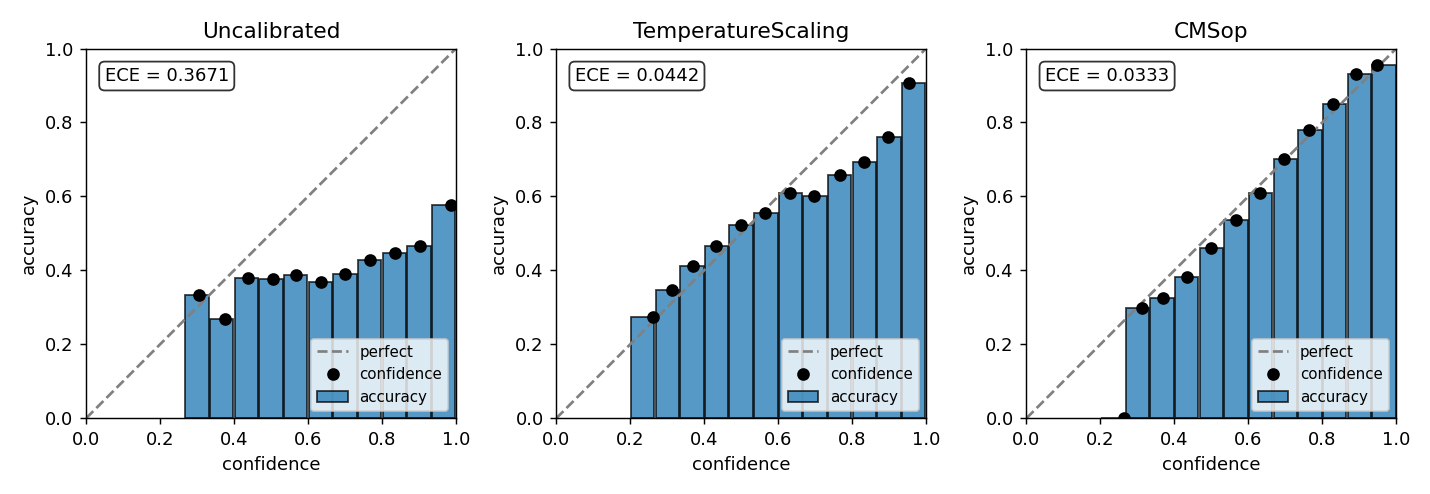
Top-1 reliability diagrams on held-out synthetic data (regenerate with
examples/readme_figure.py).
Install
Fiducio is available on PyPI:
pip install fiducio
or, in a uv application:
uv add fiducio
Requires Python ≥ 3.10 and PyTorch ≥ 2.10. The core install depends only on numpy and torch. Optional extras:
fiducio[plots] (matplotlib reliability diagrams), fiducio[docs],
fiducio[dev], fiducio[all].
To install the development version from GitHub:
pip install "git+https://github.com/fiducio-ai/Fiducio.git"
For development from a checkout, use the committed uv lockfile:
uv sync --locked
uv run --no-sync pytest
This uses CPU PyTorch for development. See CONTRIBUTING.md for the pinned uv version, documentation and build commands.
Quick start
import torch
from fiducio import TemperatureScaling, load_calibrator

# From a held-out, labelled calibration set:
logits = torch.randn(8, 4, 64, 64)  # (B, C, H, W) model logits
labels = torch.randint(0, 4, (8, 64, 64))  # (B, H, W) labels

calibrator = TemperatureScaling(input_type="logits").fit(logits, labels)

# Apply to new predictions (returns calibrated probabilities):
probs = calibrator.transform(torch.randn(2, 4, 64, 64))

# Save and reload (loads on CPU by default):
calibrator.save("calibrator.pt")
calibrator = load_calibrator("calibrator.pt")
Every calibrator exposes the same API:
fit(predictions, targets, mask=None), transform, predict_proba,
fit_transform, save, and the top-level load_calibrator.
Accepted tensor shapes
The class axis is always dimension 1.
| Use case | predictions |
targets |
|---|---|---|
| 2D segmentation | (B, C, H, W) |
(B, H, W) |
| 3D segmentation | (B, C, D, H, W) |
(B, D, H, W) |
| general n-D | (B, C, *spatial) |
(B, *spatial) |
| per-pixel table | (N, C) |
(N,) |
Inputs may be logits or probs (set input_type). Binary segmentation is two
channels (C = 2). mask and ignore_index exclude voxels from fitting.
Calibrators
| Class | Alias | Translation-invariant | Decision preservation |
|---|---|---|---|
TemperatureScaling |
TS |
yes | argmax and full order |
EnsembleTemperatureScaling |
ETS |
yes | argmax and full order |
VectorScaling |
VS |
no | — |
MatrixScaling |
MS |
no | — |
TranslationInvariantMatrixScaling |
MSc |
yes | — |
DirichletCalibration |
DC |
yes | — |
ClassConditionalMatrixScaling |
CMS / CDC |
yes | — |
ArgmaxPreservingMatrixScaling |
CMSAP / CMSap |
yes | argmax |
OrderPreservingMatrixScaling |
CMSOP / CMSop |
yes | argmax and full order |
Translation-invariant means the output is unchanged when the same constant is added to every input logit of a voxel.
Every calibrator also exposes decision_function (calibrated logits) and a
configurable optimizer ("adam" default, or "lbfgs").
Early stopping
Adam-fitted calibrators support the paper's recipe of early stopping on a validation set (with an optional learning-rate decay on plateaus):
from fiducio import OrderPreservingMatrixScaling

calibrator = OrderPreservingMatrixScaling(max_iter=2000, patience=20, lr_patience=10)
calibrator.fit(
    logits,
    labels,
    val_predictions=val_logits,
    val_targets=val_labels,  # held out from both
)
The iterate with the best validation NLL is kept. The default fixed budget
(max_iter) is short, so it can underfit expressive calibrators; prefer a larger
max_iter together with patience for CDC, CMSap and CMSop. This reproduces
only the Adam + validation-NLL early-stopping recipe; the paper's case batching,
class weighting, schedules, clipping and hyperparameter search are not part of the
library (see the implementation guide).
Paper method mapping
| Paper method | Class |
|---|---|
| TS | TemperatureScaling |
| MS | MatrixScaling |
| MSc | TranslationInvariantMatrixScaling |
| CDC | ClassConditionalMatrixScaling |
| CMSap | ArgmaxPreservingMatrixScaling |
| CMSop | OrderPreservingMatrixScaling |
CDC, CMSap and CMSop are class-conditional: they fit one affine map per
uncalibrated top class, all experts optimized jointly by a single
optimizer minimizing one cross-entropy loss over every voxel at once, with L2
regularization (lambda_reg / mu_reg) applied to the affine map induced in
the common logit space rather than to the raw per-expert parameters — this
keeps the regularization meaningful for CMSap/CMSop, whose parameters are
non-negative margins/gaps rather than raw matrix entries. Pass
independent_experts=True to instead fit each expert in its own optimization
loop on only the voxels routed to it.
Calibration metrics are included: negative_log_likelihood,
expected_calibration_error (ECE, population-weighted), average_calibration_error
(ACE, unweighted over the same bins — doesn't let a sparsely populated bin get
drowned out by a large one), brier_score, reliability_curve, plus an
optional reliability-diagram plot (fiducio.plots.reliability_diagram, needs
fiducio[plots]).
BA-ECE (boundary-aware ECE), per-case metric aggregation, the DSC/flip-rate
audit and the paper's paired hierarchical-bootstrap tests are not included; the
shipped metrics are top-1 pooled point estimates. average_calibration_error is the
unweighted mean over non-empty uniform bins (not the adaptive ACE of other work)
and is also available as unweighted_calibration_error.
Documentation
The paper project page presents the methods, interactive illustrations and published results.
The paper implementation guide records method
mapping, numerical-reference coverage, fitting limits and the remaining steps
needed to reproduce the paper's experiments. For ensemble inputs, see
examples/ensemble_pooling.py.
Results in the paper
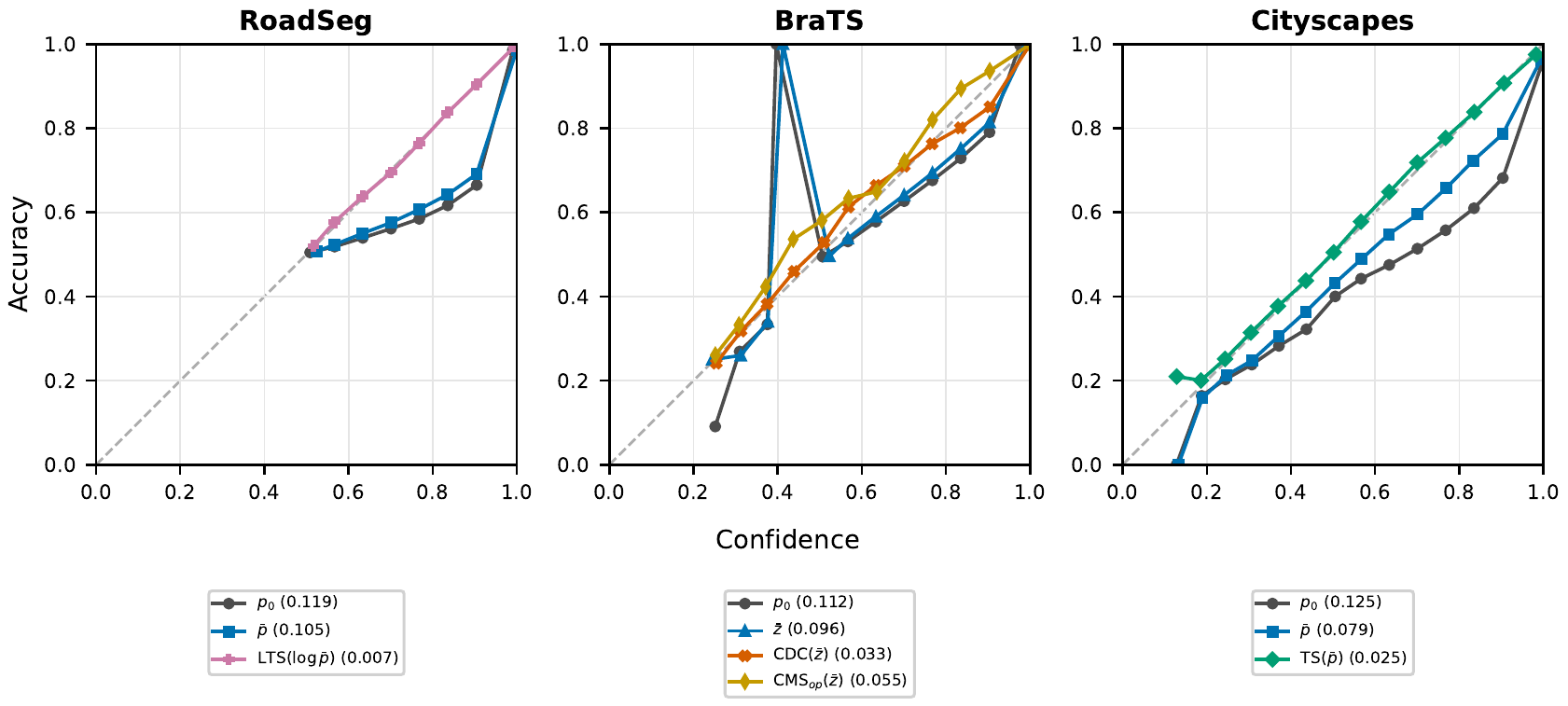
The paper compares these calibrators on real segmentation benchmarks. The
reliability diagrams below (paper appendix) show the uncalibrated ensemble
pooling (p0, p̄) against the best calibrator per dataset; the exact
protocol, datasets and metrics are in the paper. This repository ships the
calibrators, not the fitted models or benchmark pipelines, so it does not
regenerate these figures (see the
implementation guide).
Full guide and API reference: https://fiducio-ai.github.io/Fiducio/
Citation
Fiducio accompanies the paper Rethinking Post-Hoc Calibration in Semantic
Segmentation (Kirscher et al., Transactions on Machine Learning Research, 2026;
OpenReview, preprint: arXiv:2607.01902).
If you use Fiducio in your research, please cite it using the metadata in
CITATION.cff, or:
@article{kirscher2026rethinking,
  title   = {Rethinking Post-Hoc Calibration in Semantic Segmentation},
  author  = {Kirscher, Tristan and Kahl, Kim-Celine and Kovacs, Balint and
             Rokuss, Maximilian and Maier-Hein, Klaus and Coubez, Xavier and
             Meyer, Philippe and Faisan, Sylvain},
  journal = {Transactions on Machine Learning Research},
  issn    = {2835-8856},
  year    = {2026},
  url     = {https://openreview.net/forum?id=xwNoSNxgxV}
}
Status
Fiducio is beta (0.x): usable and tested, with an API that may still change
before 1.0. It is not certified for safety-critical or clinical use.
License
1 maintainer

Metadata
1 maintainer
Release files for fiducio 0.2.0
For a detailed explanation of source distributions (sdists) and built distributions (wheels), please see the package formats documentation.
Source distribution (sdist)
| File | Size | Uploaded | |
|---|---|---|---|
| fiducio-0.2.0.tar.gz | 1.8 MB | Details |
Built distribution (wheel)
| File | Interpreter | ABI | Platform | Reset |
|---|---|---|---|---|
| fiducio-0.2.0-py3-none-any.whl | Python 3 | none | any | Details |
Total release size: 1.8 MB
Release files / fiducio-0.2.0.tar.gz
| Download URL | fiducio-0.2.0.tar.gz |
|---|---|
| Size | 1.8 MB |
| Tags | Source |
|
SHA-256 checksum How to use checksums |
c2e9d4404b101d3d09ce9b3de9ab94dde87b4b3719e248e6bb78c61bc04c1aa8
|
|
BLAKE2b-256 checksum How to use checksums |
429de920393331a1b358677e97bc4b8e477b256ed5d7bb1a0ce7ec72db5a8a82
|
| Upload date | |
|
Uploaded using Trusted Publishing? What is trusted publishing? |
Yes |
| Uploaded via |
twine/7.0.0 CPython/3.13.14
|
Provenance
Provenance describes where a file came from. On PyPI, provenance is shared via attestations, which provide a verifiable record of the build or publishing details. View details, limitations and caveats.


PyPI Publish Attestation
PyPI verified that this artifact, at this checksum, originated from the publisher listed below.
Signed by GitHub Actions, verified by PyPI on Oct 4, 2026.
Transparency logRelease files / fiducio-0.2.0-py3-none-any.whl
| Download URL | fiducio-0.2.0-py3-none-any.whl |
|---|---|
| Size | 48.1 kB |
| Tags | Python 3 |
|
SHA-256 checksum How to use checksums |
35370bf486bb1fc711dd09bbd1fbb89c971ab223327e99327a0032125cdf692f
|
|
BLAKE2b-256 checksum How to use checksums |
e5d73dc0ad9106333e99ea8f2b4d3ae8e02dee9ee7a049cb3ce63064726e8f31
|
| Upload date | |
|
Uploaded using Trusted Publishing? What is trusted publishing? |
Yes |
| Uploaded via |
twine/7.0.0 CPython/3.13.14
|
Provenance
Provenance describes where a file came from. On PyPI, provenance is shared via attestations, which provide a verifiable record of the build or publishing details. View details, limitations and caveats.
PyPI Publish Attestation
PyPI verified that this artifact, at this checksum, originated from the publisher listed below.
Signed by GitHub Actions, verified by PyPI on Oct 4, 2026.
Transparency log













