
fieldproof
Document extraction that shows its work: every field linked to the exact words it came from.



LLMs are good at pulling structured data out of invoices, contracts, and forms.
In production the question is never "can it extract a total" - it's "can I trust
this total, on this document, without a human re-reading the whole page."
Most extraction pipelines give you a JSON blob and a confidence number pulled
out of nowhere. fieldproof instead makes the model cite a verbatim quote for
every field, locates that quote on the page with word-level bounding boxes,
checks that the quote actually supports the value it's attached to, runs
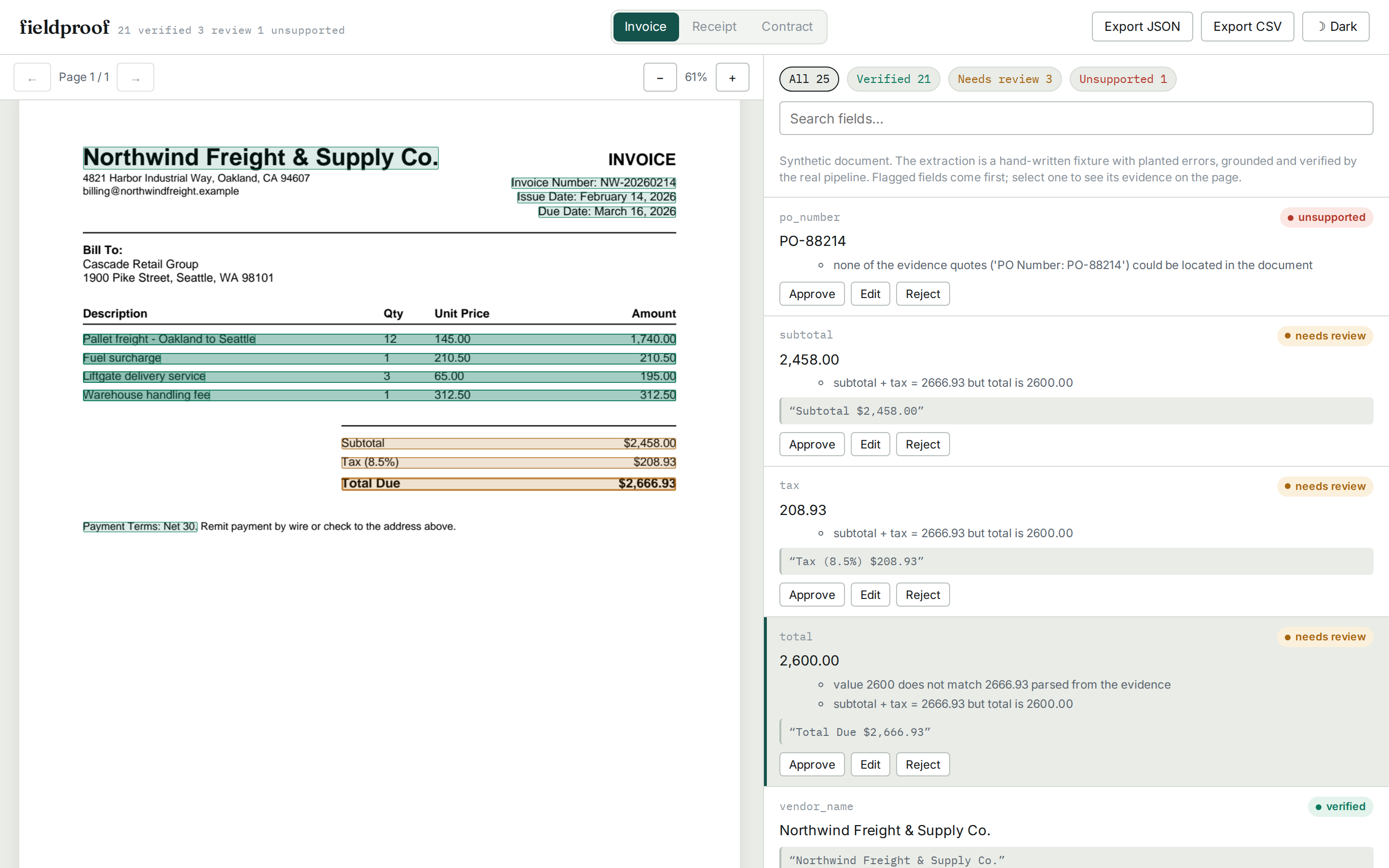
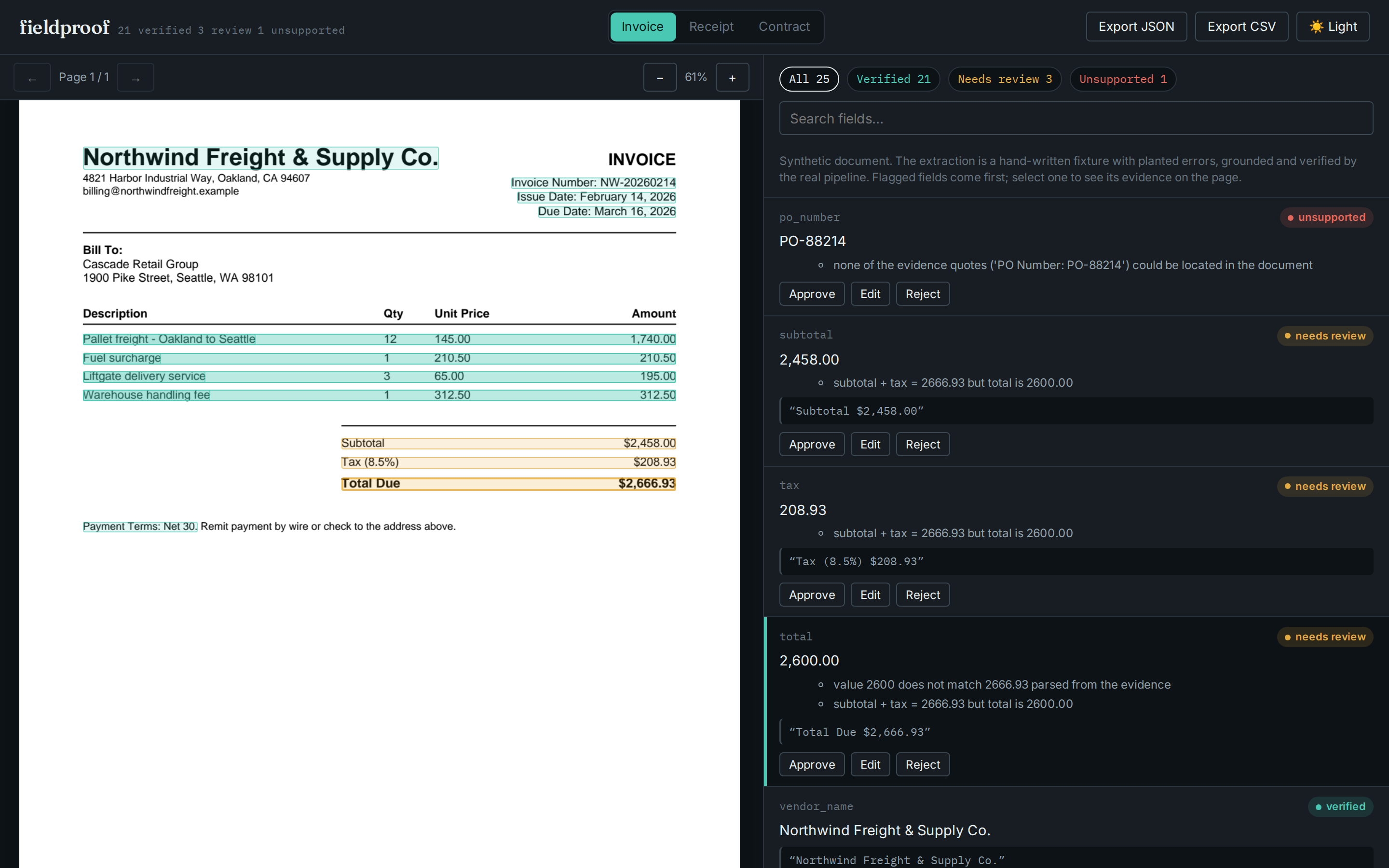
cross-field arithmetic and date-ordering checks, and gives a human a review UI
to confirm or fix whatever's left. Every field ends up verified,
needs_review, or unsupported - never a bare number with no way to check it.
Dark mode
Live demo
antonsoo.github.io/fieldproof - three
synthetic sample documents (invoice, receipt, contract), grounded and
verified ahead of time by the real Python pipeline. It opens on the invoice
with its first flagged field selected; switch documents from the top bar, or
link straight to one (#receipt, #contract). The candidate extractions
are hand-written fixtures in the shape an LLM returns, with deliberately
planted errors - a hallucinated PO number, a total
that doesn't match its line items, and a misread date - so you can see exactly
what the verifier catches. No backend: the demo runs entirely on precomputed
JSON and static page images.
Quickstart
pip install fieldproof
The sample documents used below live in the repo (examples/), so clone it
to try them:
git clone --depth 1 https://github.com/antonsoo/fieldproof && cd fieldproof
fieldproof extract examples/invoice.pdf --schema invoice --provider fixture \
  --fixture examples/fixtures/invoice.json --out result.json
--provider fixture replays a stored JSON extraction (no API key needed,
useful for CI/offline). To extract with Claude instead, set
ANTHROPIC_API_KEY and pass --provider anthropic (--model picks the
model; --max-tokens raises the output limit for a document whose
extraction is cut off at the default 16,000). To review the result in
the browser instead: fieldproof serve. The PyPI package includes the built
UI, fonts and all, so the page asks no host but your own server for anything,
and its Content-Security-Policy would not let it: a document you review stays
on your machine. From a source checkout, build the UI first (see
Development).
Features
- Grounded extraction - every field is
{value, evidence, page}, not a bare value. Built-in Pydantic templates for invoices, receipts, and contract key terms; bring your own schema and it works the same way. - Provider-agnostic - an
Extractorprotocol with an Anthropic (Claude) implementation using structured outputs, and a fixture provider for tests, CI, and offline demos. - Real grounding, not string search - exact match first, rapidfuzz-based fuzzy alignment as a fallback, tolerant of curly quotes, ligatures, hyphenated line-wraps, and OCR noise. Exact matches are required to land on whole word boundaries (a quote never matches mid-token), and a quote that occurs more than once is disambiguated by locality rather than silently taking the first hit. Maps back to word bounding boxes and merges them into per-line highlight rectangles.
- Verification, not just a confidence score - numbers, dates, currency, and strings are independently re-derived from the matched evidence and compared to the claimed value; line items are checked against subtotal, subtotal + tax against total, and due date against issue date.
- A review UI that shows the reasoning - flagged fields sort to the top;
click a field to jump to its evidence on the page; hover a highlight to
see which field it supports; currency fields display formatted (
312.50,2,458.00) while the underlying value and export stay machine numbers; approve, edit, or reject; export approved values as JSON or CSV. - Optional OCR - scanned PDFs fall back to Tesseract if it's installed; documented as a degraded mode, not silently pretended to be as reliable as a native text layer.
Usage
CLI
fieldproof extract doc.pdf --schema invoice --provider anthropic --out result.json
fieldproof verify result.json doc.pdf   # re-ground/re-verify an existing extraction
fieldproof serve --port 8000            # API + review UI
--provider anthropic defaults to claude-opus-5-5 (Claude Opus 5.5); pass
--model claude-sonnet-5-5 or any other model id to override it.
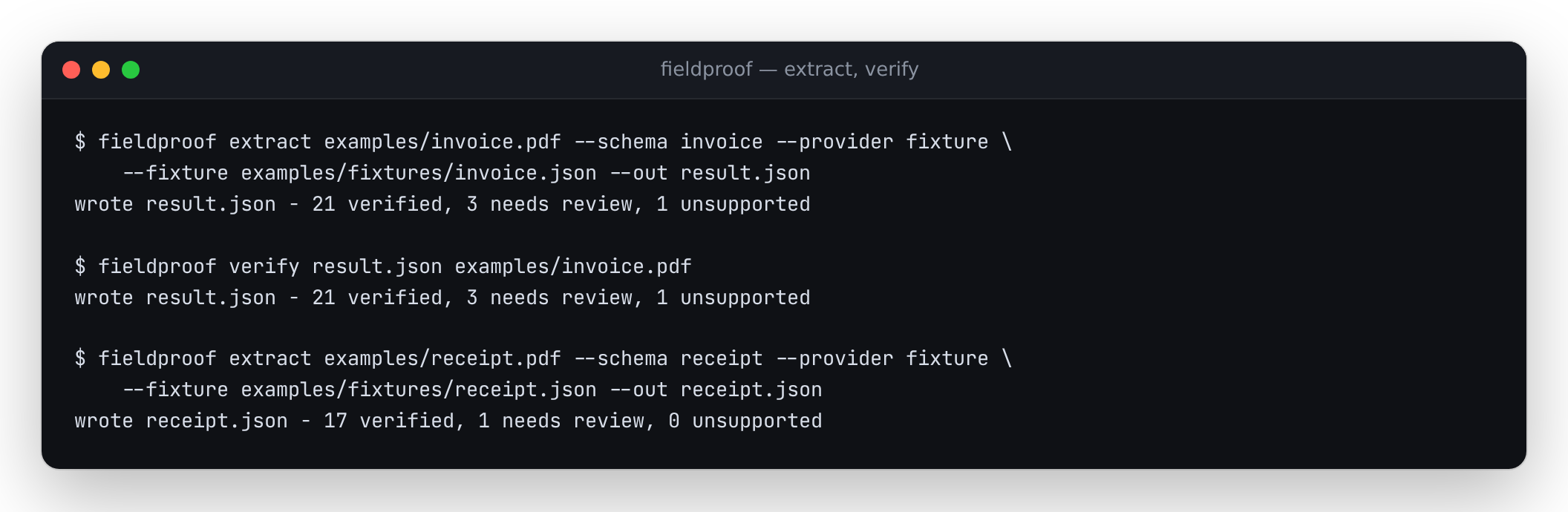
Real output, captured from this repo's sample documents:
As a library
from fieldproof.document import load_pdf
from fieldproof.schemas import Invoice
from fieldproof.extract import FixtureExtractor
from fieldproof.verify import verify

document = load_pdf("examples/invoice.pdf")
result = FixtureExtractor(fixture_path="examples/fixtures/invoice.json").extract(document, Invoice)
report = verify(result.data, document)

for field in report.fields:
    if field.status != "verified":
        print(field.path, field.status, field.reasons)
# po_number unsupported ["none of the evidence quotes (...) could be located in the document"]
# subtotal needs_review ['subtotal + tax = 2666.93 but total is 2600.00']
# tax needs_review ['subtotal + tax = 2666.93 but total is 2600.00']
# total needs_review ['value 2600 does not match 2666.93 parsed from the evidence', ...]
Bring your own schema
Any Pydantic model built from Evidenced[T] leaves works - fieldproof.ground
and fieldproof.verify walk it generically (iter_evidenced_fields), they
never reference Invoice/Receipt/ContractKeyTerms by name:
from pydantic import BaseModel
from fieldproof.schemas import Evidenced

class PurchaseOrder(BaseModel):
    po_number: Evidenced[str]
    approved: Evidenced[bool]
    amount: Evidenced[float]
Cross-field rules (line-item sums, date ordering) are schema-specific and currently only implemented for the built-in Invoice/Receipt templates - see Limitations.
Bring your own extractor
Extractor is a structural protocol (def extract(self, document, schema) -> ExtractionResult) - implement it against any provider and
fieldproof.ground / fieldproof.verify work unchanged, since they only
depend on the Evidenced shape, not on Anthropic.
How it works
flowchart LR
    PDF["PDF"] --> DOC["document<br/>words + bboxes + page images"]
    DOC --> EXT["extract<br/>Anthropic / fixture provider"]
    EXT -->|"schema instance:<br/>value + evidence quotes"| GRD["ground<br/>normalize + align quotes to words"]
    DOC --> GRD
    GRD --> VER["verify<br/>value-vs-evidence + cross-field rules"]
    VER --> REP["verified / needs_review / unsupported"]
    REP --> UI["review UI<br/>approve, edit, export"]
Trust is established in four steps, and a field is only verified if all
four hold:
- Quote. The model must produce a verbatim substring for every value
(
fieldproof.extract.anthropic_providerinstructs this explicitly and uses structured outputs so it's enforced by the schema, not just asked nicely). No quote ->unsupportedimmediately; no need to even look at the page. - Alignment.
fieldproof.groundnormalizes both the quote and the page text (NFKC, straight quotes/dashes, collapsed whitespace) and tries an exact substring match first, falling back to rapidfuzz's partial-ratio alignment (fuzz.partial_ratio_alignment) for the best-scoring substring of the page. Below a 70/100 score, the quote is treated as not found; a match under 92/100 is flagged as weak evidence even if it's found. A match has to cover whole words - a quote like"1"can never match the trailing digit of a street number like"4821", though it may leave out punctuation glued to a word (the comma in"1,", the$in"$2,458.00"). When the best fuzzy window cuts a word, the quote is scored against the whole words instead, so"wind"is not found in"Northwind"and"458.00"is only a weak match for"$2,458.00". When a quote genuinely occurs more than once,fieldproof.verify.enginedisambiguates it by preferring whichever occurrence is on the same row as another field from the same object that's already been grounded (e.g. a line item'squantitynext to its already-groundeddescription); with nothing nearby to disambiguate against, the field becomesneeds_reviewwith an "ambiguous, appears N times" reason rather than silently guessing. The matched span is mapped back through an index map to the exact words it covers (via each word's character offset into the page's flattened text), and those words' bounding boxes are merged into per-line highlight rectangles. - Value check. The claimed value is independently re-derived from the
matched evidence text - not trusted just because a quote was found
nearby - and compared: numbers are parsed with currency/thousands-
separator handling and checked against every plain number in the
evidence, not just the last one (evidence for a row-level field is often
the whole row, e.g. a quantity of
1is checked against"Fuel surcharge 1 210.50 210.50"), excluding percentages so"Tax (8.5%) $208.93"can't be misread as8.5; dates are parsed from either ISO-8601 or a handful of common formats and compared as calendar dates, and a numeric date whose first two parts are both 12 or under (03/04/2026) is read in whichever order another date on the same document settles (03/14/2026means month first) - with no such date it goes to review rather than being verified under a guessed convention; strings use fuzzy partial-ratio (a short value inside a longer quote should still match), except that every run of digits in the value must be in the evidence as written -NW-20260215is 96% similar toNW-20260214and a different invoice; booleans look for whole words like yes/no/not/confirmed/denied (so "notice" isn't a "no"). Any mismatch ->needs_review. - Cross-field rules. For invoices and receipts: line items must sum to
the subtotal, subtotal + tax must equal the total (both within a $0.02
tolerance), and the due date must not precede the issue date. A failed
rule marks every field it involves as
needs_reviewand records why.
Grounding quality, checked against ground truth
tests/test_ground.py and tests/test_e2e.py don't just assert "no
exception" - they assert exact match scores and exact reasons against
documents with known content: an exact quote must score 100, a quote with a
dropped colon and a curly apostrophe must score ≥85 but not be flagged
is_exact, a quote spanning a hyphenated line-wrap must still ground at
≥80, a quote that's genuinely absent must return no match at all rather
than a low-quality one, and - the concrete regression this repo shipped
with - a bare "1" on examples/invoice.pdf must ground to one of its two
line-item quantities, never to the trailing digit of the "4821" street
address, and must resolve to the correct line item by row locality when
both are plausible. tests/test_e2e.py runs the full pipeline against the
checked-in sample documents and pins down exactly which field each planted
error is expected to surface as - a regression that stops catching the
hallucinated PO number or the misread date fails a test, not just a manual
look at the demo.
Performance
Measured on this machine (14 vCPU, 48 GB RAM, WSL2 Linux), 200-iteration
average, on examples/invoice.pdf (25 leaf fields across 4 line items):
| Stage | Time |
|---|---|
| PDF text-layer load (pdfplumber) | 22.6 ms |
| Grounding + verification, all 25 fields | 4.3 ms |
Extraction time is dominated by the provider's network round trip, not anything in this repo.
Accuracy and limitations
- OCR is a degraded mode, not equivalent to a text layer. Scanned PDFs
are supported only if the optional
ocrextra (pytesseract+ a system Tesseract install) is present; grounding still fuzzy-matches against whatever text Tesseract produced, but OCR accuracy drops sharply on skewed scans, low contrast, or unusual fonts, and word boxes are per-word pixel boxes with no sub-word offsets. Treat an OCR'd document's results as "Tesseract thinks this is what's there," not ground truth. - Tables aren't structurally parsed. Line items are extracted by the LLM reading the page text in reading order, not by detecting table cells/columns - a table with an unusual layout (merged cells, multi-line cells, columns that don't read top-to-bottom-then-left-to-right) can confuse the model's reading of which number belongs to which row, even though each individual value's grounding is still checked independently.
- No handwriting support. Neither the text-layer path nor the OCR fallback is designed for handwritten text.
- Cross-field rules are schema-specific. They're implemented for the
built-in Invoice and Receipt templates only
(
fieldproof.verify.cross_field); a custom schema gets grounding and value-vs-evidence checks but no arithmetic/date-ordering rules unless you add your own. - String matching is fuzzy by design, which means a sufficiently short or generic value can occasionally find a spurious match inside unrelated evidence text. The 92/100 "strong match" threshold and the independent value check are there to catch most of this, but neither is a proof.
- Ambiguous quotes are resolved by row locality, not proven correct.
When a short quote occurs more than once, fieldproof prefers the
occurrence nearest another already-grounded field from the same row
(see How it works) rather than flagging every such
field
needs_review- a reasonable heuristic, not a guarantee. Two identical amounts in the same row (a line item whereunit_priceandamounthappen to be equal) can still ground to either one; the value check still passes either way, but the highlighted box may point at the wrong column of an otherwise-correct row. - The Anthropic adapter is tested against the real SDK, not a live
model - there's no API key configured in this repo's CI. The tests run
the
anthropicSDK over a mocked HTTP transport that answers in the Messages API's wire format, so the request (the schema as structured-output JSON Schema, the prompt,max_tokens) and the handling of replies (a complete one, one cut off atmax_tokens, a refusal, an API error, a missing key) are the real thing. What no such test can check is whether a model follows the evidence-quoting instructions in the system prompt; that is what grounding and verification are for.
Architecture
src/fieldproof/
  document/   PDF loading (pdfplumber), page rendering (pypdfium2), optional OCR (pytesseract)
  schemas/    Evidenced[T], the generic field walker, Invoice/Receipt/ContractKeyTerms
  extract/    Extractor protocol, Anthropic provider, fixture provider
  ground/     text normalization, exact/fuzzy quote alignment, bbox merging
  verify/     value-vs-evidence checks, cross-field rules, the verdict engine
  server/     FastAPI app (upload, extract, review, export)
  cli.py      extract / verify / serve
web/          Vite + TypeScript review UI (no framework)
scripts/      synthetic sample-document generator, static-demo data precomputation
examples/     synthetic sample PDFs + fixture extractions (planted errors, for the demo/tests)
Python ≥3.11, uv for dependency management,
src layout, fully typed (mypy --strict-adjacent; see pyproject.toml).
Development
uv sync --extra dev --extra ocr
uv run pytest
uv run ruff check src tests
uv run mypy src

cd web && npm ci && npm run typecheck && npm run lint && npm run build
fieldproof serve from a checkout serves web/dist. For a release,
uv run python scripts/bundle_ui.py && uv build builds the UI into the
package first, so the wheel carries it.
Regenerate the sample documents and demo data after changing them - the
output (web/public/demo-data/) is committed, since the Pages deploy is a
plain npm ci && npm run build:demo with no Python step:
uv run python scripts/generate_samples.py
uv run python scripts/build_demo_data.py   # writes + commit web/public/demo-data/
Contributing
See CONTRIBUTING.md. Issues and pull requests welcome.
License
MIT © 2026 Anton Soloviev
Part of Officina, a set of small open-source tools by Anton Soloviev.
1 maintainer

Metadata
1 maintainer
Release files for fieldproof 0.2.7
For a detailed explanation of source distributions (sdists) and built distributions (wheels), please see the package formats documentation.
Source distribution (sdist)
| File | Size | Uploaded | |
|---|---|---|---|
| fieldproof-0.2.7.tar.gz | 529.0 kB | Details |
Built distribution (wheel)
| File | Interpreter | ABI | Platform | Reset |
|---|---|---|---|---|
| fieldproof-0.2.7-py3-none-any.whl | Python 3 | none | any | Details |
Total release size: 1.1 MB
Release files / fieldproof-0.2.7.tar.gz
| Download URL | fieldproof-0.2.7.tar.gz |
|---|---|
| Size | 529.0 kB |
| Tags | Source |
|
SHA-256 checksum How to use checksums |
c3b4c2c35a57cf3db02f067c7af6c840250ad52b6870610f68880d9c5375b2fa
|
|
BLAKE2b-256 checksum How to use checksums |
7dc4288cc6bfa0f4c4520f388339faf746ea42d607b4e4c592d7b5369b32592f
|
| Upload date | |
|
Uploaded using Trusted Publishing? What is trusted publishing? |
No |
| Uploaded via |
uv/0.12.21 {"installer":{"name":"uv","version":"0.12.21","subcommand":["publish"]},"python":null,"implementation":{"name":null,"version":null},"distro":{"name":"Ubuntu","version":"24.04","id":"noble","libc":null},"system":{"name":null,"release":null},"cpu":null,"openssl_version":null,"setuptools_version":null,"rustc_version":null,"ci":null}
|
Release files / fieldproof-0.2.7-py3-none-any.whl
| Download URL | fieldproof-0.2.7-py3-none-any.whl |
|---|---|
| Size | 530.9 kB |
| Tags | Python 3 |
|
SHA-256 checksum How to use checksums |
1e4bab8f7b59db7171c9e31d062cc88759a90d27038ca24edc752057b9406236
|
|
BLAKE2b-256 checksum How to use checksums |
64386c556a63334ea9618ef57dd045973f9ea60e1a10761dc86dbc50728865f2
|
| Upload date | |
|
Uploaded using Trusted Publishing? What is trusted publishing? |
No |
| Uploaded via |
uv/0.12.21 {"installer":{"name":"uv","version":"0.12.21","subcommand":["publish"]},"python":null,"implementation":{"name":null,"version":null},"distro":{"name":"Ubuntu","version":"24.04","id":"noble","libc":null},"system":{"name":null,"release":null},"cpu":null,"openssl_version":null,"setuptools_version":null,"rustc_version":null,"ci":null}
|














