


filerecords is a python command line tool to better keep track of files and directories for data science projects (or any kind of big directory structure).
It works similar to GIT but instead of keeping track of the actual file contents it keeps a registry of comments and flags. This allows users to comment their important files and directories to add more detailed descriptions than just a good file name or directory name.
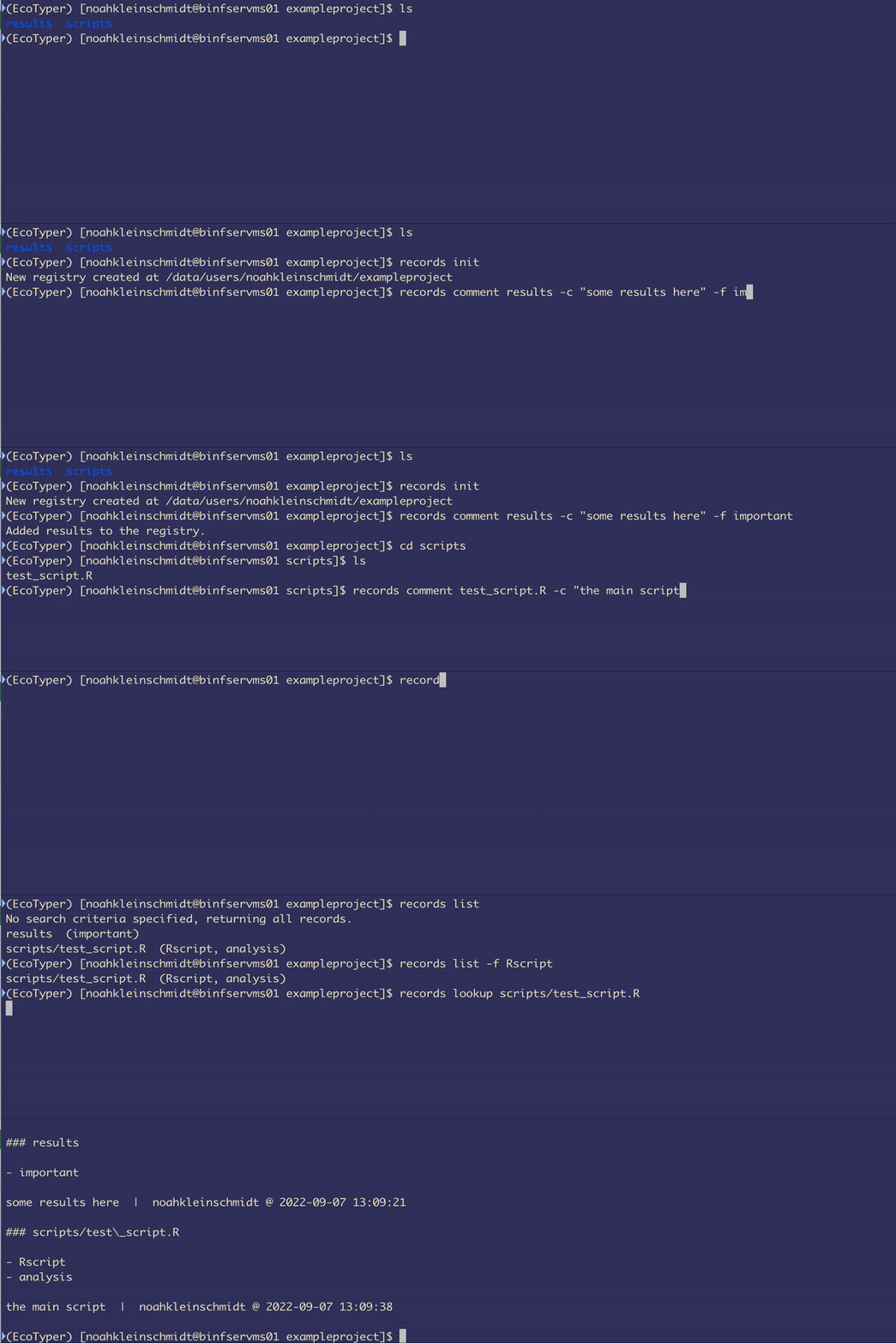
Short overview
This is a brief listing of all commands. More details on their use can be found in the documentation on readthedocs.
To create a new registry within a directory use:
records init
To add a comment about a file or directory use: This will add new comments to file entries while preserving the old ones.
records comment the_file -c "the comment" -f flag1 flag2 ...
To remove a file or directory from the registry use: (by default this will also remove the file in the filesystem!)
records rm the_file
To move a file or directory while keeping the records use: (by default this will also move the file in the filesystem!)
records mv the_current_path the_new_path
To remove/undo the last comment from a file or directory use:
records undo the_file
This also works for flags:
records undo the_file -f the_flag_to_remove
To get a file's records use:
records lookup the_file
this will print the latest comment to the terminal.
To read the entire records of a file use:
record read the_file
To search for files and directories based on flags or regex patterns use:
records list -f flag1 -e the_regex_pattern
This can be restricted to files in the current working directory by:
records ls
instead of the full list command.
To only add a flag (but no comment) to a file use:
records flag the_file -f flag1
This could also be achieved using
records comment the_file -f flag1
To define new flag groups to the registry use:
records flag -g group1 : flag1 flag2 -g group2 : flag3 flag4
To remove all file records from the registry use:
records clear
To completely remove a registry use:
records destroy
To export the registry either in YAML or markdown format use:
records export yaml|md|both
1 maintainer

Metadata
1 maintainer
Release files for filerecords 0.0.1
For a detailed explanation of source distributions (sdists) and built distributions (wheels), please see the package formats documentation.
Source distribution (sdist)
| File | Size | Uploaded | Provenance | |
|---|---|---|---|---|
| filerecords-0.0.1.tar.gz | 32.3 kB | Without provenance | Details |
Built distribution (wheel)
| File | Interpreter | ABI | Platform | Reset |
|---|---|---|---|---|
| filerecords-0.0.1-py3-none-any.whl | Python 3 | none | any | Details |
Total release size: 73.5 kB
Release files / filerecords-0.0.1.tar.gz
| Download URL | filerecords-0.0.1.tar.gz |
|---|---|
| Size | 32.3 kB |
| Tags | Source |
|
SHA-256 checksum How to use checksums |
6fb9df45d057794f1b796a001c83170537bb9d77475076a1f04ba4ed288efce6
|
|
BLAKE2b-256 checksum How to use checksums |
175ca4969c357113169c1a9d6140ef2299b7dcc35509f3eef14c4cec9b3bd3c4
|
| Upload date | |
|
Uploaded using Trusted Publishing? What is trusted publishing? |
No |
| Uploaded via |
twine/4.0.0 CPython/3.8.12
|
Release files / filerecords-0.0.1-py3-none-any.whl
| Download URL | filerecords-0.0.1-py3-none-any.whl |
|---|---|
| Size | 41.2 kB |
| Tags | Python 3 |
|
SHA-256 checksum How to use checksums |
1985a0150e4cccfaa52d5371efea08188f5e4c07415d258c0c415ead0a54293f
|
|
BLAKE2b-256 checksum How to use checksums |
5ac1b99dafe6d94af2d78ec6f8472cb18a9dc1561c5b7cf3b52e08e98fa41714
|
| Upload date | |
|
Uploaded using Trusted Publishing? What is trusted publishing? |
No |
| Uploaded via |
twine/4.0.0 CPython/3.8.12
|
Security for filerecords 0.0.1
Provenance
Provenance describes where a file came from. On PyPI, provenance is shared via attestations, which provide a verifiable record of the build or publishing details. View details, limitations and caveats.
No provenance found
None of the files in this release were uploaded with provenance metadata.
A note on package security
PyPI is a repository for distributing packages, not a service for auditing them. While third-party security researchers and our staff do their best to detect and remove malicious packages, PyPI cannot guarantee the quality, security or suitability of any given package.
To learn more about protecting yourself from malicious actors, visit our package security documentation.













