
🖐️ fing: Represent all fingering systems for wind instruments 🖐️
fing is a general representation of fingering systems for woodwinds, reeds, and keyed
brass.
It's primarily aimed at electronic wind instrument programmers and users, and wind players wanting to notate alternative fingering systems such as multiphonics, but could be useful to almost any instrumentalist wanting to teach others, or to delve deeply into fingering patterns.
fing has three goals:
-
To represent new and existing fingering systems as documents that can easily be written, read and understood by humans and computers alike.
-
To easily create classic and new types of fingering charts - tables, images and even animations - for players at all levels.
-
To be usable on any keyed monophonic instrument, any human language, and any definition of note.
Example: recorder fingering
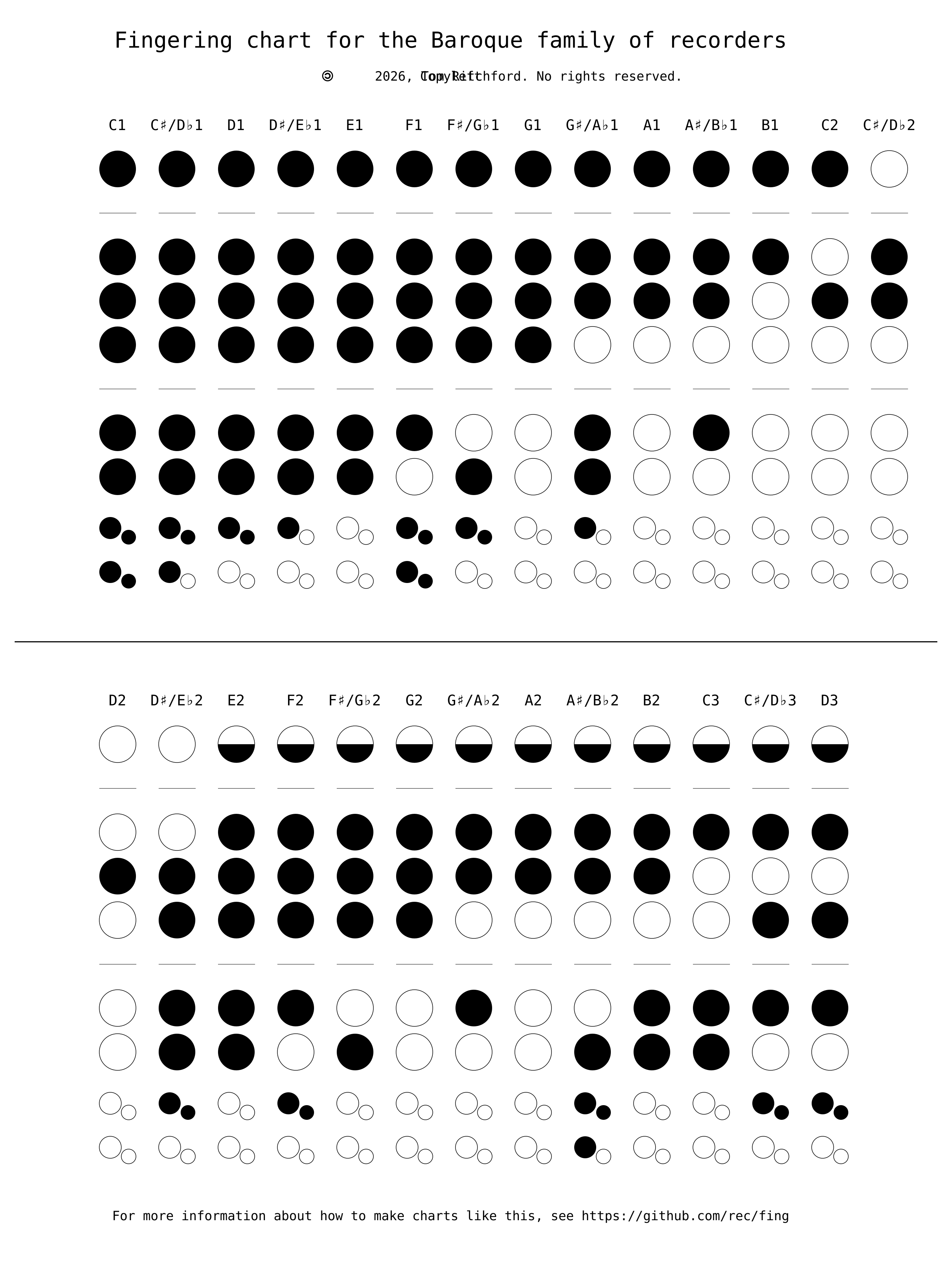
Here's a full specification of the Baroque fingerings for the recorder family:
(It's written in a format called TOML designed to be straight-forward for both humans and computers to read and write.)
This short layout document together with the specification above, created this image:
How does fing work?
Buttons and Fingerings
A Button is a key, pad, button, switch or lever that can be pressed, or a hole that
can be covered fully or partially, and a Fingering is a collection of zero or more
pressed Buttons.
here's the Button definition for the octave hole on the recorder:
[buttons.octave]
short_name = 'oct'
press = "left-thumb"
description = 'Half-cover the thumb hole with the nail'
Fingerings are defined in terms of those Buttons, like this:
[fingerings]
all = 'oct lt l1 l2 l3 r1 r2 r3 r3h r4 r4h cb  '

C_1 = 'lt  l1  l2  l3  r1  r2  r3  r4      '
Db1 = 'lt  l1  l2  l3  r1  r2  r3  r4h     '
D_1 = 'lt  l1  l2  l3  r1  r2  r3          '
Eb1 = 'lt  l1  l2  l3  r1  r2  r3h         '

... many more ...
General modifier Buttons which lower or raise all notes by a semitone, an
octave or some other value are also possible. It appears that every electronic
wind instrument has at least one modifier Button, if only an octave key.
The Layout
There's a separate layout system to describe how to render a FingeringSystem into
graphical fingering Charts using a simple, standard text-based graphical language called
Scalable Vector Graphics or SVG.
You can have many different Charts for one fingering system and it's open-ended, so any
conceivable Chart can be created.
The resulting SVG can be displayed in any browser or web page, edited by hand as text or with free and open source tools, embeded in a PDF, Illustrator, Photoshop or other graphical document, and printed at any resolution.
Development roadmap/diary
As of late March
Most of the below is done.
In particular, the fingering system of the Yamaha WX7 seems to have been mostly or perhaps completely specified, though it needs some new software features before it can be fully verified and aggressively tested.
I have been playing the WX7 since it came out in 1987, and yet I discovered quite a few interesting fingerings that don't appear in the manual and that I didn't know about.
The most entertaining one: there is a "lift" (what I'm calling "buttons left unpressed from a standard fingering") which raises several notes by a full octave, but one note, Bb, by an octave and a semitone.
My intuition that it's a bug, or more precisely, an emergent behavior from their permissive fingering system. (I define a permissive fingering system as one where any combination of buttons held down always generates a "note". "Note" could be very generally defined, but in the WX7 it's literally a MIDI note number).
That same intuition says there's one special rule for the lift, another special rule for the Bb key, and no one investigated their interaction because you'd really have to be deep-deep into their fingering system to even think about it.
It's quite amazing how well this device stands up almost 40 years later. Its founder hoped that after WW2, humans would lose interest in war and spend their resources on leisure and self-improvement, particularly music.
March: a change of plans
As of this writing, the representation of Fingering is stable and unlikely to change
in such a way as to break existing things.
One instrument, the recorder, has been completely specified, and also has a Layout that's
fairly neat and near completion.
The initial plan was to next go to saxophone next, but this is "more of the same", much more graphic work, and doesn't bring any new features to the table.
And the primary motivation for this project was to represent new electronic wind instrument fingerings.
WX-7 and then "Simple"
The new plan is to first represent the WX-7 fingering, because it has three types of
modifier Buttons: "up or down N octaves", "up a semitone", and what I call a "lift":
in this case, where lifting the right index finger raises the pitch by an octave in
certain fingerings.
(On a personal note, even though I have played the WX-7 for almost forty years and feel I know every detail of the fingering, I still expect to learn some details - like, what does happen if you hold down multiple octave keys?)
Once all the modifier Button types exist, the next step is Simple - a general
fingering that is a perfect or close superset of almost every wind instrument that has
an octave key that goes up by an octave. excluding the clarinet, for example.
("Superset" means "the fingering you know works, but there are many others".)
As a teaser, Simple has three characteristics:
- Octave keys
- Each
Buttonis either a "pad" or a modifierButton - All "lifts" work as extra octave keys
Full definitions later!
Thanks for reading.
Feel free to start a discussion here or open an issue here.
Appendix: poorly-organized notes on SVG
If you're thinking of creating new fingering chart formats, the SVG snippets aren't so terrible - here's all of them from the recorder fingering chart.
[layout]
styles = '''
.outline { fill: white; stroke: black; stroke-width: 1.5; }
'''
[layout.defs]
pad = '<circle cx="50" cy="50" r="50" />'
little-hole = '<circle cx="80" cy="55" r="20" />'
big-hole = '<circle cx="30" cy="30" r="30" />'
horizontal-line = '<rect x="0" y="50" width="120" height="1" style="fill: black;"/>'
octave = '<path d="  M 0,50   A 50,50 0 0 0 100,50   Z  " fill="black" />'
and then you re-use them like this:
[layout.pieces.left-thumb.parts]
_off = 'pad @ outline'
oct = 'pad @ outline + octave'
left-thumb = 'pad'

[layout.pieces.right-3.parts]
_off = 'little-hole @ outline + big-hole @ outline'
right-3 = 'little-hole + big-hole'
right-3-half = 'little-hole @ outline + big-hole'
where the image for the oct key is the circular pad Def with the outline style, plus
the octave Def, a half-filled circle.
The path instruction can be tricky, but this is something that LLMs do very well,
though that single line octave above is the only part of this whole project that was
done with an LLM (which, in fairness, came up with a better solution than I did, so I
used it.)
1 maintainer

Metadata
1 maintainer
Release files for fing 0.3.0
For a detailed explanation of source distributions (sdists) and built distributions (wheels), please see the package formats documentation.
Source distribution (sdist)
| File | Size | Uploaded | |
|---|---|---|---|
| fing-0.3.0.tar.gz | 49.0 kB | Details |
Built distribution (wheel)
| File | Interpreter | ABI | Platform | Reset |
|---|---|---|---|---|
| fing-0.3.0-py3-none-any.whl | Python 3 | none | any | Details |
Total release size: 64.9 kB
Release files / fing-0.3.0.tar.gz
| Download URL | fing-0.3.0.tar.gz |
|---|---|
| Size | 49.0 kB |
| Tags | Source |
|
SHA-256 checksum How to use checksums |
948dd3860d01d13ed832e31969454961bf03fe38667d0eb27aa6b6371678d1cd
|
|
BLAKE2b-256 checksum How to use checksums |
f561bba8f5acc074f5d77812003875aa0fe4c854dc6c69d1f833b058d211e98c
|
| Upload date | |
|
Uploaded using Trusted Publishing? What is trusted publishing? |
No |
| Uploaded via |
uv/0.10.12 {"installer":{"name":"uv","version":"0.10.12","subcommand":["publish"]},"python":null,"implementation":{"name":null,"version":null},"distro":{"name":"macOS","version":null,"id":null,"libc":null},"system":{"name":null,"release":null},"cpu":null,"openssl_version":null,"setuptools_version":null,"rustc_version":null,"ci":null}
|
Release files / fing-0.3.0-py3-none-any.whl
| Download URL | fing-0.3.0-py3-none-any.whl |
|---|---|
| Size | 15.9 kB |
| Tags | Python 3 |
|
SHA-256 checksum How to use checksums |
90dce0098b3e5d7d8100306adcc46e98d68f8b8b006acfa1067f41350c4ce63b
|
|
BLAKE2b-256 checksum How to use checksums |
75589cadc04df4e1a6523b0a221697a8b849aed7ebd0f4a82ceb77dadb669f76
|
| Upload date | |
|
Uploaded using Trusted Publishing? What is trusted publishing? |
No |
| Uploaded via |
uv/0.10.12 {"installer":{"name":"uv","version":"0.10.12","subcommand":["publish"]},"python":null,"implementation":{"name":null,"version":null},"distro":{"name":"macOS","version":null,"id":null,"libc":null},"system":{"name":null,"release":null},"cpu":null,"openssl_version":null,"setuptools_version":null,"rustc_version":null,"ci":null}
|














