
FinIR
A financial intermediate representation and incremental execution runtime for AI systems.
In one sentence: FinIR is a small, typed "compiler" for financial calculations. Instead of an AI regenerating and re-running an entire spreadsheet-like model every time one number changes, it describes the model to FinIR once, and FinIR recomputes only what actually depends on the thing that changed.
AI systems increasingly reason about finance, but their numerical execution still falls back to generated Python, spreadsheets, SQL, or generic tensor frameworks: slow to re-run, hard to audit, and with no shared notion of what "revenue" or "days" even mean as types. FinIR gives financial reasoning a dedicated compiler target instead.
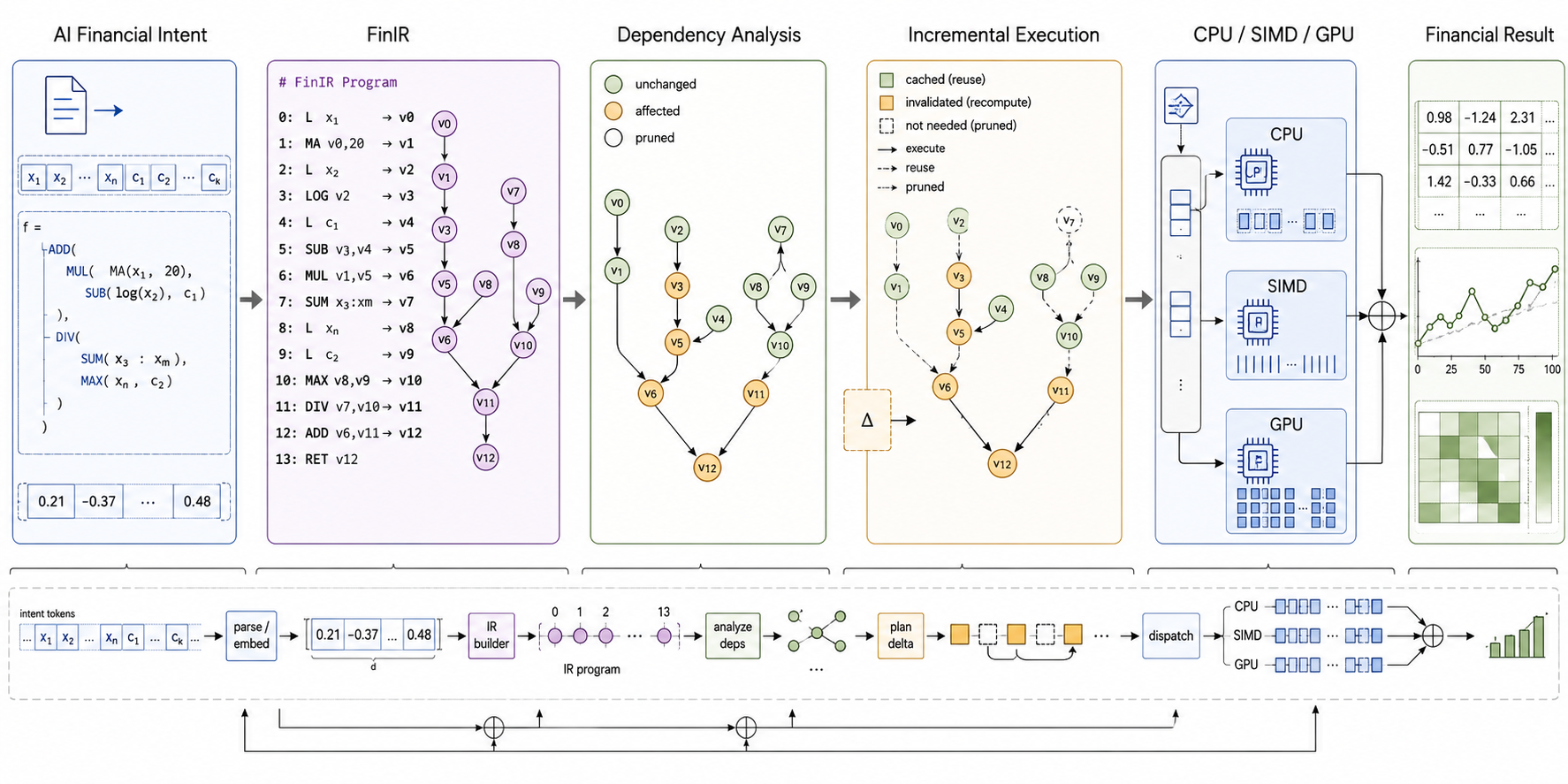

Financial Intent
      ↓
    FinIR
      ↓
Dependency Analysis
      ↓
Incremental Execution
      ↓
CPU / SIMD / GPU
      ↓
Financial Result
Install
pip install finir
python -c "import finir; print(finir.__version__)"
finir --help
finir doctor
CPU-first: pip install finir needs no GPU. Optional extras: pip install "finir[gpu]"
(CuPy GPU backend), pip install "finir[viz]" (Graphviz SVG rendering). Develop from
source with git clone https://github.com/Olyxee/finir && cd finir && pip install -e ".[dev]".
Quick start
from finir import FinancialModel

model = FinancialModel()

model.input("revenue", 500_000_000, currency="ZAR")
model.input("cogs", 300_000_000, currency="ZAR")
model.input("opex", 120_000_000, currency="ZAR")

model.define("gross_profit", "revenue - cogs")
model.define("ebitda", "gross_profit - opex")

model.evaluate()

scenario = model.what_if(cogs="+4%")

print(scenario["ebitda"])
Change one assumption and FinIR recomputes only the affected part of the graph. It never starts over:
Input changed:
  COGS

Recomputed:
  COGS → Gross Profit → EBITDA → Gross Margin → Cash Flow

Reused (from cache):
  Revenue, Payroll, Debt, Receivables, ...
Why FinIR
When an AI needs to compute "increase supplier costs 7% and extend payment terms 30→60 days," it usually translates that into arbitrary generated code: inefficient, non-deterministic, unaudited, and recomputed from scratch every turn. FinIR replaces that with a standard boundary:
financial intent → FinIR → deterministic, incremental financial execution
It understands financial semantics (revenue, COGS, gross margin, EBITDA, working capital, receivables/payables, free cash flow, NPV, unit economics, payment terms, …) and their computational dependencies, so it can recompute only what changed and reuse the rest.
What is a Financial IR?
An intermediate representation (IR) is just a structured, typed description of a computation that a compiler can analyze before running it. It's the same idea C compilers and TensorFlow graphs use, applied here to financial models instead of general code or tensors. FinIR's IR is a typed computation graph with a finance-native type system:
revenue      = input money[ZAR]
cogs         = input money[ZAR]
gross_profit = revenue - cogs        : money[ZAR]
gross_margin = gross_profit / revenue : ratio
Because the types carry financial meaning, not just numeric shape, FinIR can catch
mistakes at compile time: money - money → money (same currency, else an error);
money / money → ratio; money + days is a type error. See
docs/ir.md and
docs/type-system.md.
Architecture
Each stage below is a clean, separately-testable layer. An agent or developer never has to touch anything past the first arrow:
Agent / Developer API → FinIR Builder → Financial IR → Compiler Passes
  → Execution Plan → Incremental Runtime → Kernel Backend → CPU / SIMD / GPU
See docs/architecture.md.
Incremental execution
This is FinIR's core reason to exist. Changing one input invalidates only its downstream cone in the dependency graph; the next evaluation recomputes exactly those nodes and reuses everything else in O(1): a dict lookup, not a re-derived cache key. See docs/runtime.md and docs/caching.md.
Scenario engine
what_if, named scenarios, and vectorized run_scenarios over million-row
batches. See docs/scenarios.md.
Financial types
money[CCY], percentage, ratio, days, quantity, rate, series,
scenario, scalar, bool, enforced at compile time. See
docs/type-system.md.
Kernels
Arithmetic, corporate finance, working capital, time-value-of-money, and basic risk,
plus a @finir.kernel extension point. Deliberately small (not a quant library).
See docs/kernels.md.
Compiler passes
Validation, type checking, constant folding, CSE, dead-node elimination, dependency
pruning, scenario vectorization, fusion analysis, cache planning. Inspect with
finir compile model.finir --show-passes. See docs/compiler.md.
Agent integration
Core FinIR consumes structured intent (apply_intent); natural-language
interpretation is an optional IntentCompiler layer (a dependency-free
MockIntentCompiler ships for offline use): the model interprets, the runtime
computes, and that boundary is never blurred. See
docs/agent-integration.md
and, for the canonical NL → FinIR contract, docs/intent-contract.md.
CPU / GPU dispatch
CPU-first and fully usable with no optional dependencies. A workload-aware planner sends very large scenario batches to an optional CuPy GPU backend when present. See docs/backends.md.
Benchmarks
finir benchmark --full
python benchmarks/run_benchmarks.py         # iterative-reasoning workload -> benchmarks/results/
python benchmarks/public_benchmark.py       # incremental vs. full recompute across graph sizes
On the reference machine, the iterative-reasoning benchmark shows 1.7×–2.2× faster
turn-by-turn agent reasoning vs. full recompute (up to 99.6% cache hits), and
~1,000,000 scenarios in ~46 ms on CPU. A separate, independently-reproducible
benchmark (benchmarks/public_benchmark.py, run against the published finir==0.1.0
package) measures a different question (how the advantage scales with graph size)
and finds 15×–24× speedup holding across graphs from ~100 to ~100,000 nodes for a
single changed input, with cache reuse up to ~86%. All numbers are measured, never
hard-coded; see docs/performance.md
and benchmarks/results/ for full methodology and raw data.
Research
- research/experiment_001_incremental_financial_reasoning.md: incremental vs. full recompute
- research/experiment_002_backend_dispatch.md: CPU/GPU crossover (GPU unverified locally)
- research/prior_art.md: critical positioning vs. spreadsheets, incremental-computation systems, JAX/XLA/MLIR, QuantLib, planning engines, and more
We do not claim FinIR is a first or a breakthrough. The working hypothesis, that there is no widely-adopted open finance-specific IR designed as the execution boundary between AI financial intent and incremental computation, remains a hypothesis pending a formal prior-art review.
Extending FinIR
Custom kernels, backends, and templates; a stable JSON IR for other-language bindings. See docs/extending.md.
Roadmap
- Larger real-model benchmarks and agent-trace evaluation.
- Measured GPU dispatch thresholds on CUDA hardware.
- Optional lowering onto a tensor compiler (XLA/MLIR) for very large graphs.
- Language bindings (TypeScript/Rust) over the JSON IR.
- Autodiff / sensitivities as an optional layer.
Contributing
See CONTRIBUTING.md. Quality gates: ruff check .,
ruff format --check ., mypy src, pytest. CPU-only; no network for core tests.
Citation
See CITATION.cff.
Acknowledgements
Early research exploration was inspired by omni-modal scientific-reasoning systems (including work such as OmniScientist). FinIR is independent: no OmniScientist code and no runtime dependency on it.
License
Apache-2.0. See LICENSE.
2 maintainers


Metadata
2 maintainers
Release files for finir 0.1.1
For a detailed explanation of source distributions (sdists) and built distributions (wheels), please see the package formats documentation.
Source distribution (sdist)
| File | Size | Uploaded | |
|---|---|---|---|
| finir-0.1.1.tar.gz | 124.6 kB | Details |
Built distribution (wheel)
| File | Interpreter | ABI | Platform | Reset |
|---|---|---|---|---|
| finir-0.1.1-py3-none-any.whl | Python 3 | none | any | Details |
Total release size: 194.8 kB
Release files / finir-0.1.1.tar.gz
| Download URL | finir-0.1.1.tar.gz |
|---|---|
| Size | 124.6 kB |
| Tags | Source |
|
SHA-256 checksum How to use checksums |
af2ab08dd4465e3633199270db28df41d23b4502b605ba2d470de83c04541f56
|
|
BLAKE2b-256 checksum How to use checksums |
9abdba56d2a2c6df74b442aaf791428b782b1e984f158d94afe19e959e744e31
|
| Upload date | |
|
Uploaded using Trusted Publishing? What is trusted publishing? |
Yes |
| Uploaded via |
twine/7.0.0 CPython/3.13.14
|
Provenance
Provenance describes where a file came from. On PyPI, provenance is shared via attestations, which provide a verifiable record of the build or publishing details. View details, limitations and caveats.


PyPI Publish Attestation
PyPI verified that this artifact, at this checksum, originated from the publisher listed below.
Signed by GitHub Actions, verified by PyPI on Sep 5, 2026.
Transparency logRelease files / finir-0.1.1-py3-none-any.whl
| Download URL | finir-0.1.1-py3-none-any.whl |
|---|---|
| Size | 70.2 kB |
| Tags | Python 3 |
|
SHA-256 checksum How to use checksums |
50aab0c8a689b6d3d6e93cd5e25967bf99d117e5ab5658c62ab7fed112019c15
|
|
BLAKE2b-256 checksum How to use checksums |
1327e578fcbad157c22282f68ae40dfc6707eef9e4ba136b6fee0da28b0d7c18
|
| Upload date | |
|
Uploaded using Trusted Publishing? What is trusted publishing? |
Yes |
| Uploaded via |
twine/7.0.0 CPython/3.13.14
|
Provenance
Provenance describes where a file came from. On PyPI, provenance is shared via attestations, which provide a verifiable record of the build or publishing details. View details, limitations and caveats.
PyPI Publish Attestation
PyPI verified that this artifact, at this checksum, originated from the publisher listed below.
Signed by GitHub Actions, verified by PyPI on Sep 5, 2026.
Transparency log













