
Industrial-Grade Embedded IoT Firmware Security Analysis Engine

Project description
FirmLens
Industrial-Grade Embedded IoT Firmware Security Analysis Engine




Why FirmLens? The Genesis
Embedded firmware security tooling is often fragmented across:
- generic binary analysis tools
- emulation-based frameworks
- vendor-specific debugging utilities
While powerful in isolation, these approaches often lack deep awareness of ESP32 firmware structures such as partition tables, bootloader metadata, and ESP-IDF-specific layouts.
FirmLens was designed to address this gap by providing a focused analysis framework for ESP32-class firmware, combining static inspection with optional hardware-assisted workflows.
It provides an integrated approach that:
- Parses ESP32 firmware structures including partition tables, NVS regions, and bootloader metadata without requiring full-system emulation.
- Correlates static findings with external vulnerability intelligence sources, including CISA KEV and EPSS, where matches are available, to enrich vulnerability context beyond traditional CVSS scoring.
- Supports Hardware-in-the-Loop (HIL) testing workflows, enabling controlled input-based testing of connected devices in laboratory environments.
Beyond static analysis, the framework includes mechanisms to detect fault conditions during hardware interaction testing, such as reboot loops, exception traces, and memory corruption indicators. These outputs are mapped to CWE categories to support structured vulnerability reporting.
FirmLens is intended as a research-grade embedded security analysis framework, initially optimized for Espressif SoCs (ESP32, ESP32-S2/S3, ESP32-C3), with a modular architecture designed for future extension to other embedded platforms.
It is designed to support embedded security research workflows aligned with industry practices such as NIST SP 800-213 and ETSI EN 303 645, where applicable.
Scope
It is strictly intended for authorized security research, firmware analysis, and defensive testing in controlled environments.
System Architecture & Data Flow
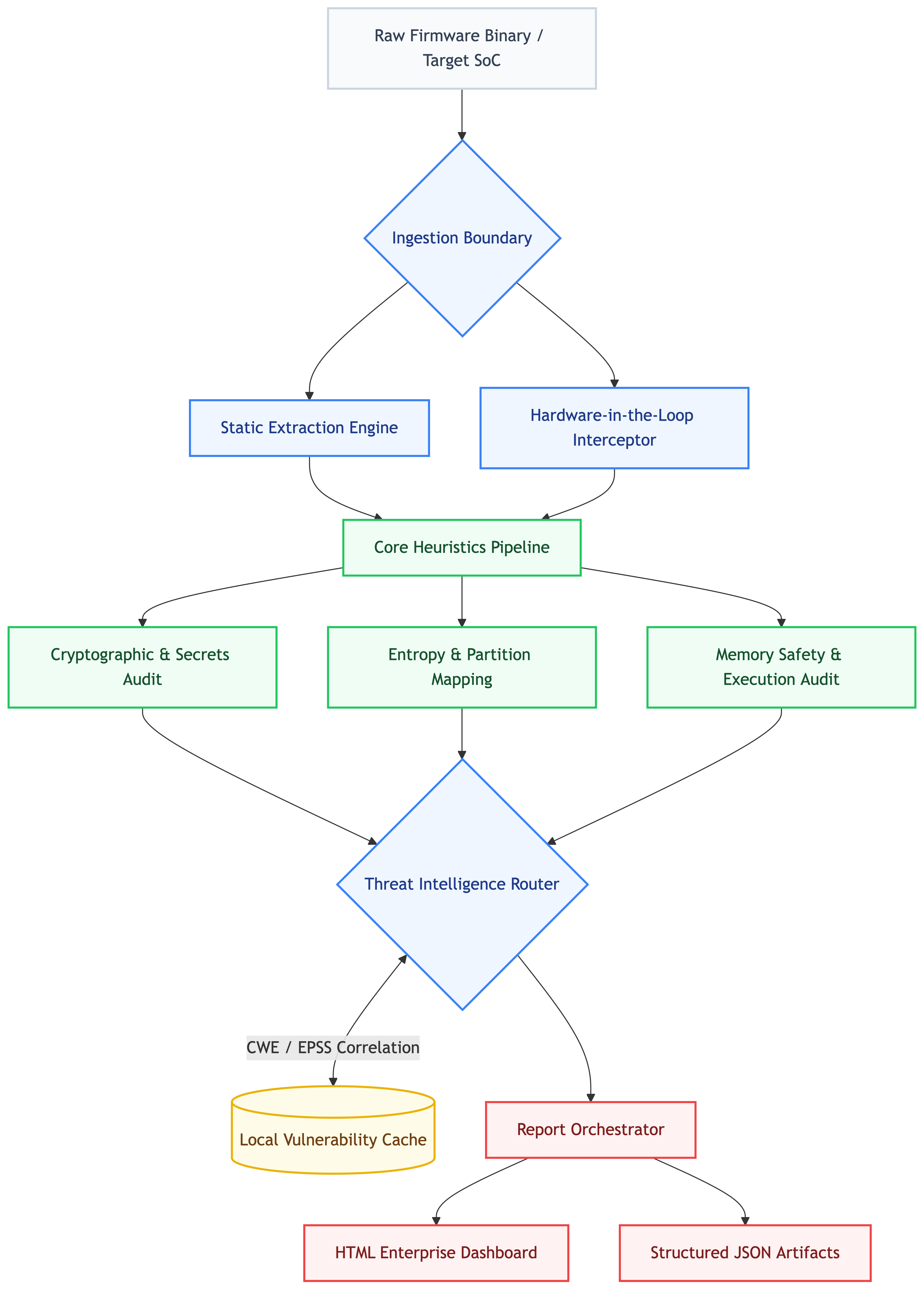
FirmLens uses a multi-stage firmware analysis pipeline designed for ESP32-class devices to process raw firmware binaries and extract structured security-relevant artifacts.
The pipeline performs:
- firmware partition discovery and parsing
- entropy-based binary structure mapping
- static string and configuration analysis
- optional correlation with external vulnerability intelligence sources such as CISA KEV and EPSS, where applicable
The output of each stage is normalized into structured reports (JSON/HTML) for downstream analysis, reporting, or integration into security workflows.
The system is optimized for Espressif ESP32-family firmware but is designed with a modular architecture that allows future extension to additional embedded architectures.
Comparative Analysis and Project Scope
The following comparison is provided for context, not as a claim of superiority over established tools. Each tool serves a different primary purpose:
| Feature | FirmLens | Binwalk | Firmadyne | Embark (EMBArk) |
|---|---|---|---|---|
| Primary Purpose | ESP32 security analysis | Generic firmware extraction | Linux firmware emulation | EMBA web dashboard |
| ESP32 Partition Table Parser | Semantic analysis | Signature extraction only | Not applicable | Not applicable |
| Live Hardware Extraction (UART) | Supported | Not supported | Not supported | Not supported |
| HIL Fuzzing (Serial/Network) | Supported | Not supported | Not supported | Not supported |
| CISA KEV + EPSS Correlation | Supported | Not supported | Not supported | Not supported |
| CI/CD HTML / JSON Reports | Supported | Not supported | Not supported | Supported (via EMBA) |
| Secure Boot / Flash Encryption Checks | Supported | Not supported | Not supported | Not supported |
Clarification: Binwalk is a widely-used, mature extraction tool that has added ESP32 signatures. FirmLens does not replace Binwalk—rather, it complements it by providing semantic, Espressif-specific security analysis that Binwalk does not attempt. Firmadyne targets Linux-based firmware and is not designed for ESP32's FreeRTOS environment. Embark is a web front-end for EMBA, not a standalone analysis engine.
FirmLens occupies a distinct niche: architectural semantic analysis for Espressif SoCs, combining static binary inspection, live hardware extraction, and HIL fuzzing into a unified pipeline.
Installation
FirmLens requires Python 3.10+ and relies on the Espressif esptool for physical hardware interactions.
Option 1: Install via PyPI (Stable Release)
The recommended installation method for production environments.
#Install
pip install firm-lens

#Upgrade
pip install --upgrade firm-lens
Option 2: Install from Source (Bleeding Edge)
For security researchers who want the latest dynamic intelligence feeds and hardware fuzzing updates directly from the repository.
git clone https://github.com/Srikanth-Rudrarapu/firm-lens
cd firm-lens
pip install -e .
Note on Hardware Drivers: For direct physical extraction and dynamic HIL fuzzing, ensure your host operating system has the appropriate USB-to-Serial bridge drivers installed (e.g., CP210x, FTDI).
Basic commands after installation
firm-lens
firm-lens --help
firm-lens --version
Initial Setup
Before executing the first pipeline scan, initialize the local relational threat intelligence database. This securely fetches and synchronizes the latest CISA KEV catalogs, EPSS probability scores, and CVE mapping arrays locally.
firm-lens init-db
Operational Usage
FirmLens is executed via a centralized Command Line Interface (CLI).
1. Static Deep Analysis
Executes deep static application auditing loops against target firmware binaries.
firm-lens analyze /path/to/target_firmware.bin -f all
Output Routing (-o flag):
- Default Behavior: If the
-oflag is omitted, FirmLens safely isolates artifacts to~/Downloads/FirmLens_Reports/Static/. - Explicit Output: You may specify a custom directory or exact filename using the
-oflag:firm-lens analyze /path/to/firmware.bin -o /custom/path/my_report -f all
2. Hardware Firmware Extraction
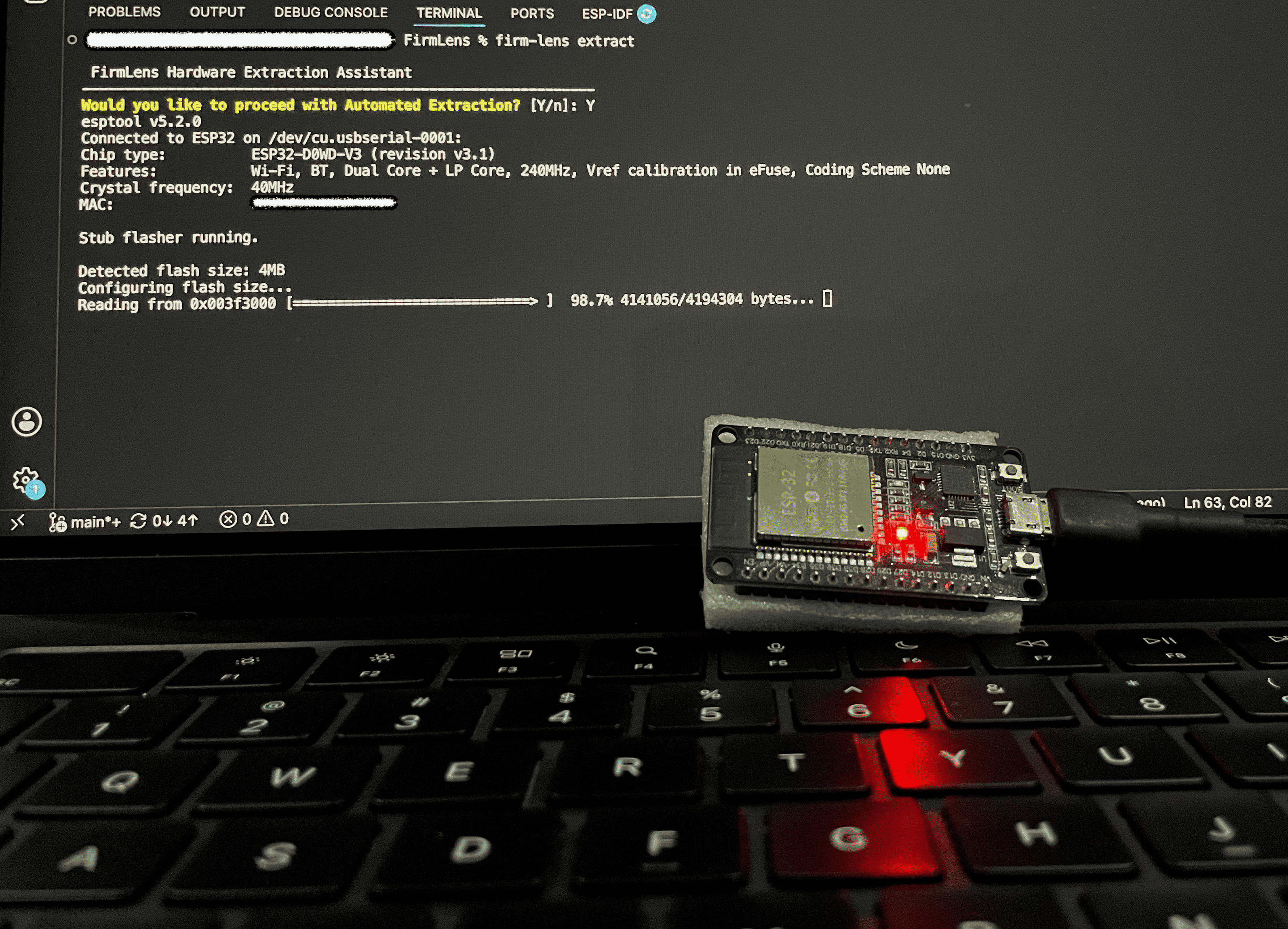
Automates real-time raw firmware image carving directly from a physically connected microcontroller chip over UART.
Physical Interconnect Configuration
Completed Extraction TTY Output Stream
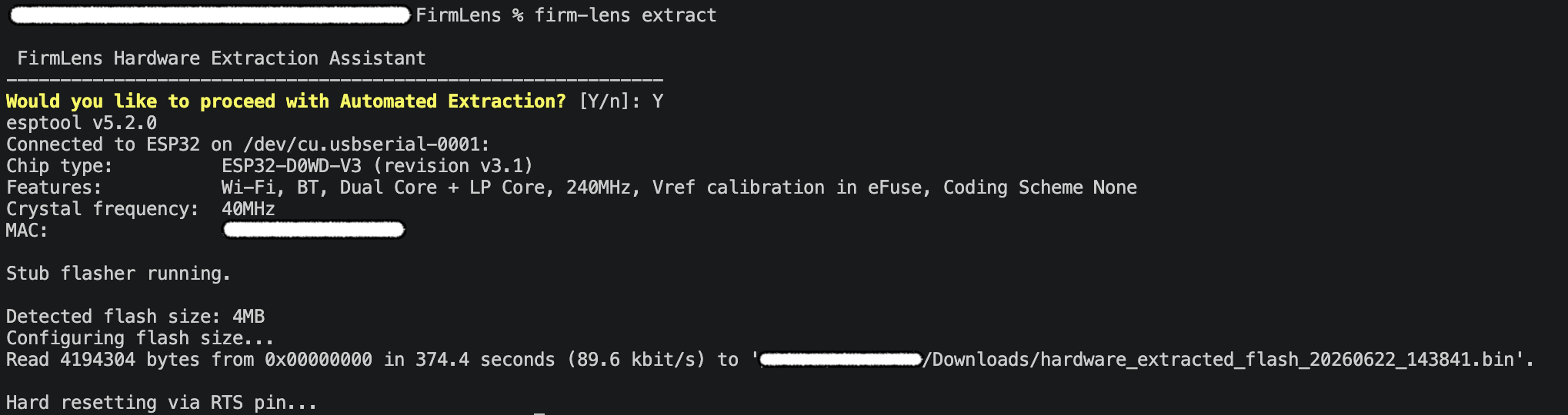
firm-lens extract --live-port /dev/cu.usbserial-0001 --chip esp32 --baud 115200
or
firm-lens extract
- Auto-Discovery: If
--live-port,--chipand--baudis omitted, the engine utilizes native PySerial routines to identify and mount the active USB bridge automatically. - Output Routing: Automatically writes the target payload to
~/Downloads/hardware_extracted_flash_[TIMESTAMP].binunless explicitly overridden via the-oflag.
3. Dynamic Hardware-in-the-Loop (HIL) Fuzzing
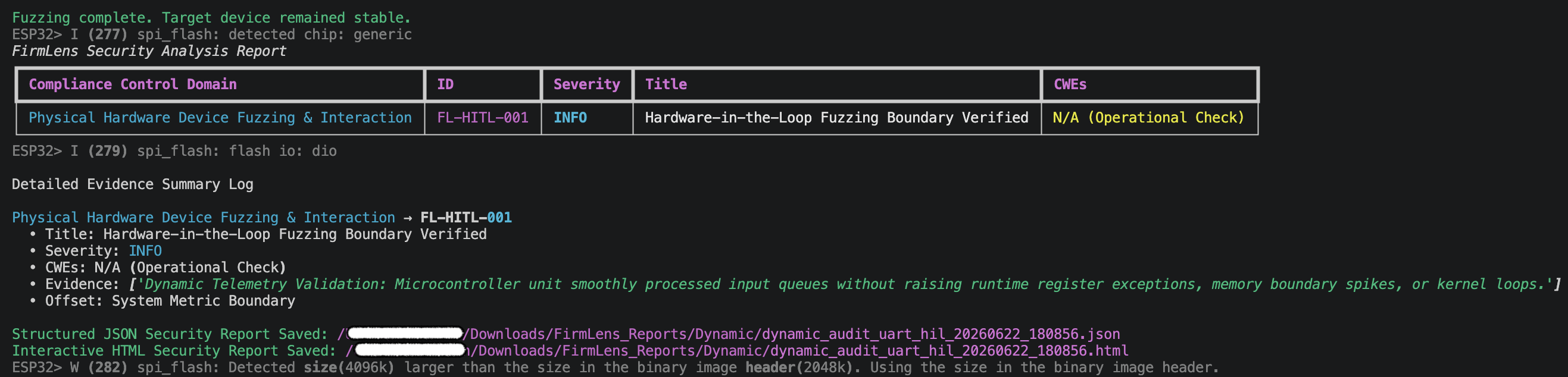
Executes live serial or network fuzzing against a connected device to test memory execution boundaries and capture hardware faults in real-time.
- Serial Payloads: Injects boundary‑crossing strings (10‑byte, 32‑byte, 100‑byte, and 1000‑byte overflow buffers) plus format string primitives (%x %x %s %n) to exercise boundary conditions associated with buffer overflow and format string weaknesses.
- Network Payloads: Sends oversized HTTP URIs, HTTP header format string injections, and raw TCP junk floods to the target’s TCP stack (port 80 by default).
- Crash Correlation: The serial_monitor continuously scans for Guru Meditation Errors, EXCCAUSE hardware exceptions, abrupt reboots (SW_CPU_RESET), and 414141 (ASCII overflow) memory patterns. Upon detection, the crash_parser maps the fault to CWE-120 (Buffer Overflow) or CWE-134 (Format String) and extracts the corrupted instruction pointer (EPC1).
# Serial UART Fuzzing
firm-lens dynamic -f all

# Network Boundary Fuzzing
firm-lens dynamic --target-ip 192.168.1.150 -f all
Output Routing (-o flag):
- Default Behavior: Dynamic audit artifacts are routed separately to
~/Downloads/FirmLens_Reports/Dynamic/to maintain data isolation from static scans. - Explicit Output: You may specify a custom directory or exact filename using the
-oflag:firm-lens dynamic --target-ip 192.168.1.150 -o /custom/path/my_dynamic_report -f all
4. Component Discovery
List all active heuristic software analyzers and hardware target domains currently loaded into the scanner subsystem.
firm-lens categories
Enterprise Reporting & Output Formats
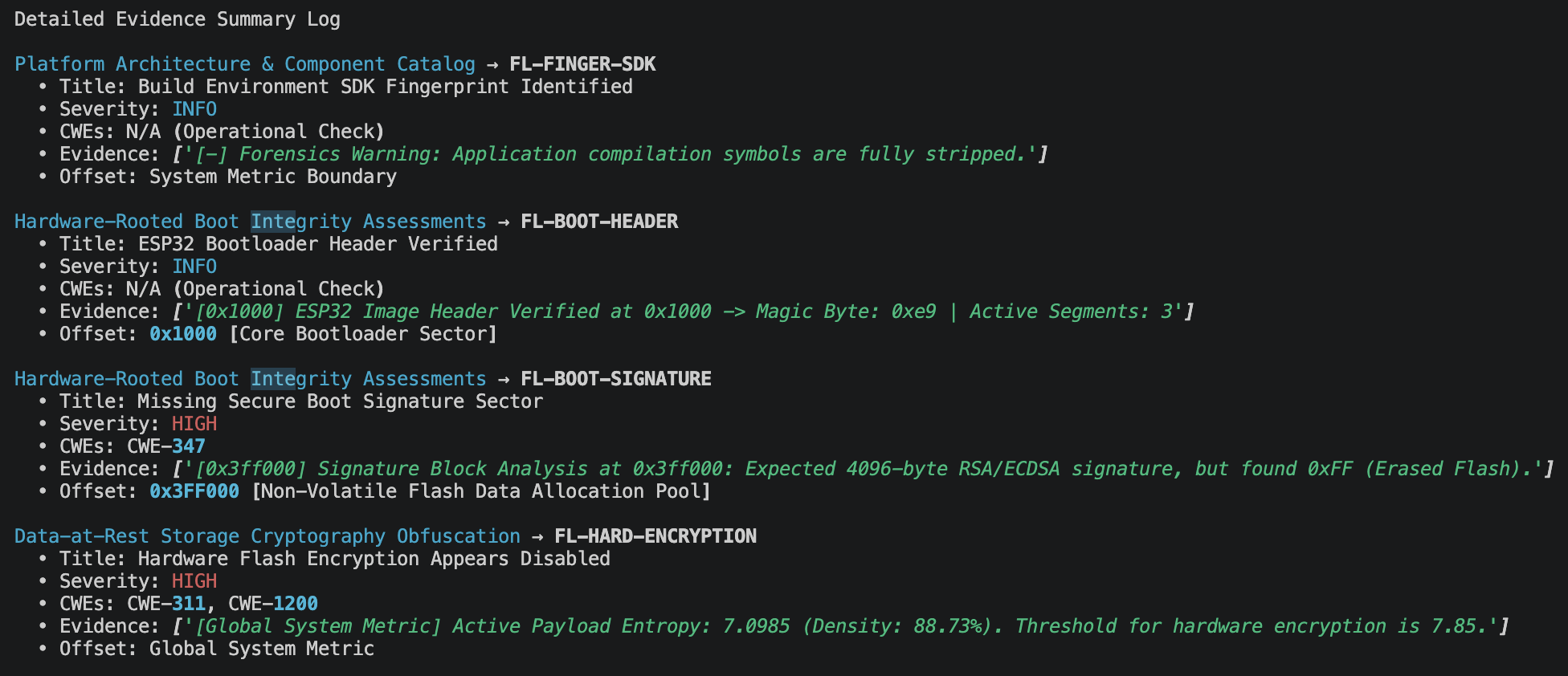
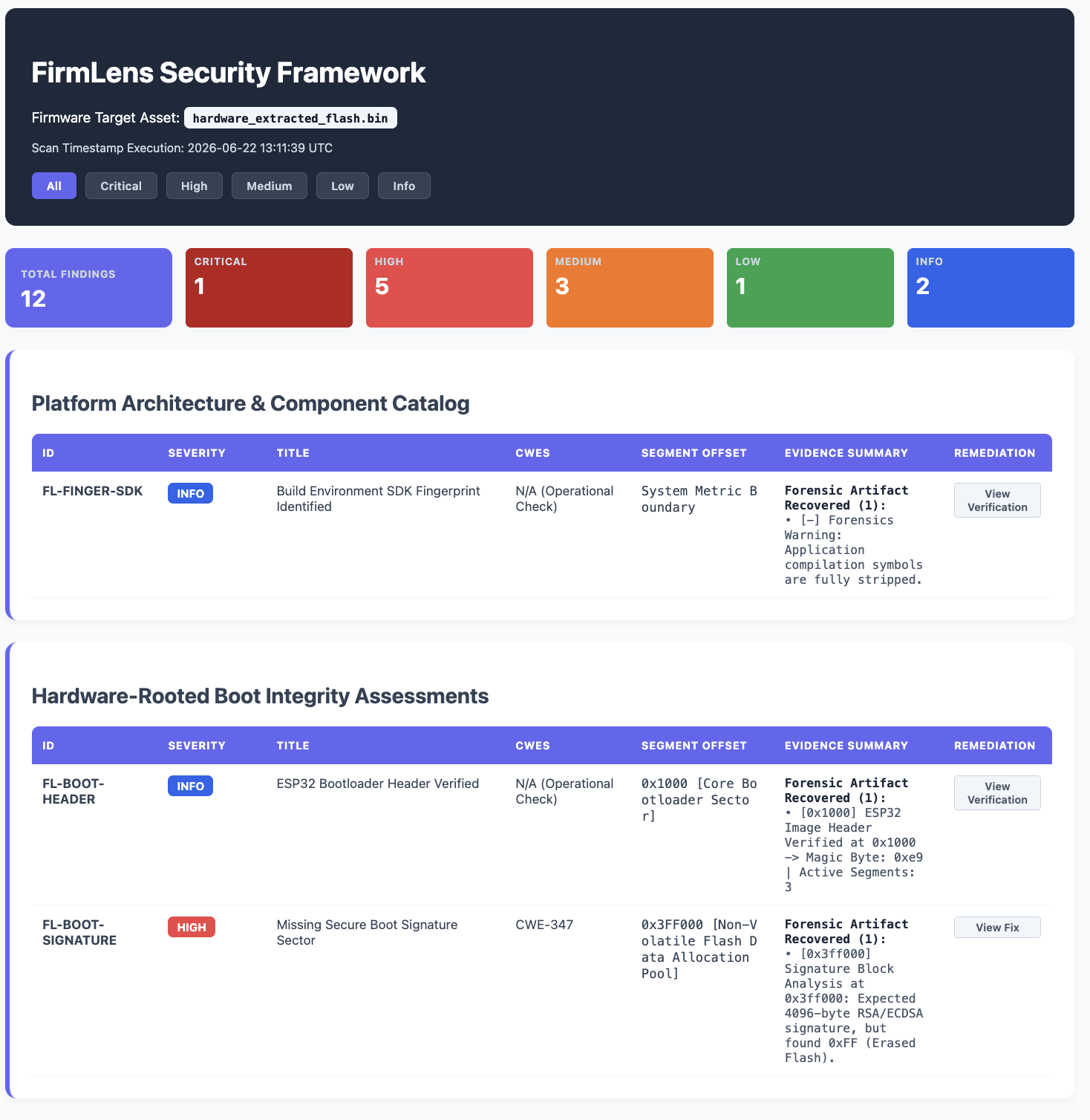
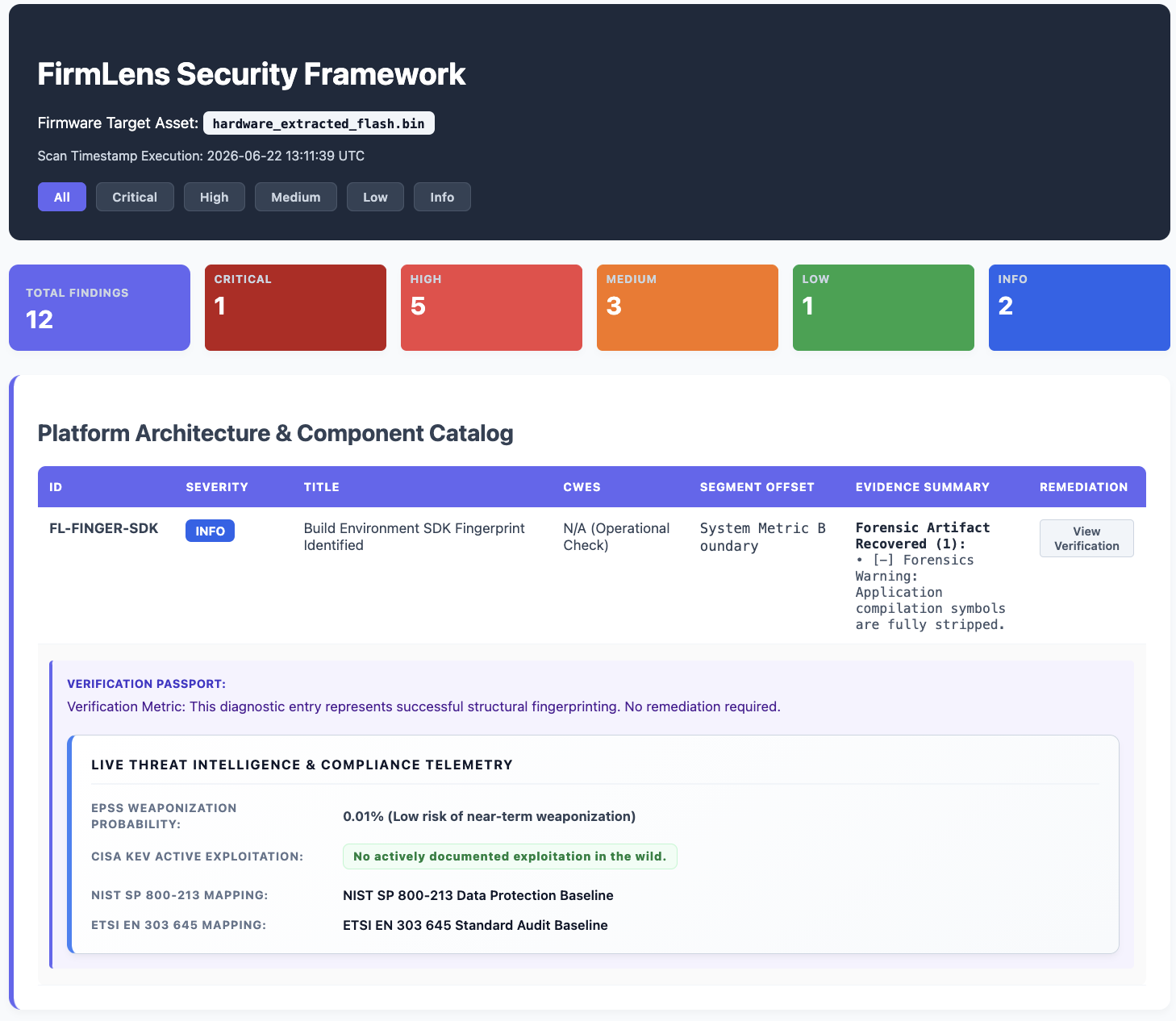
FirmLens provides high-fidelity reporting designed for enterprise security teams and CI/CD pipelines. Modifiers are passed via the -f or --format flag:
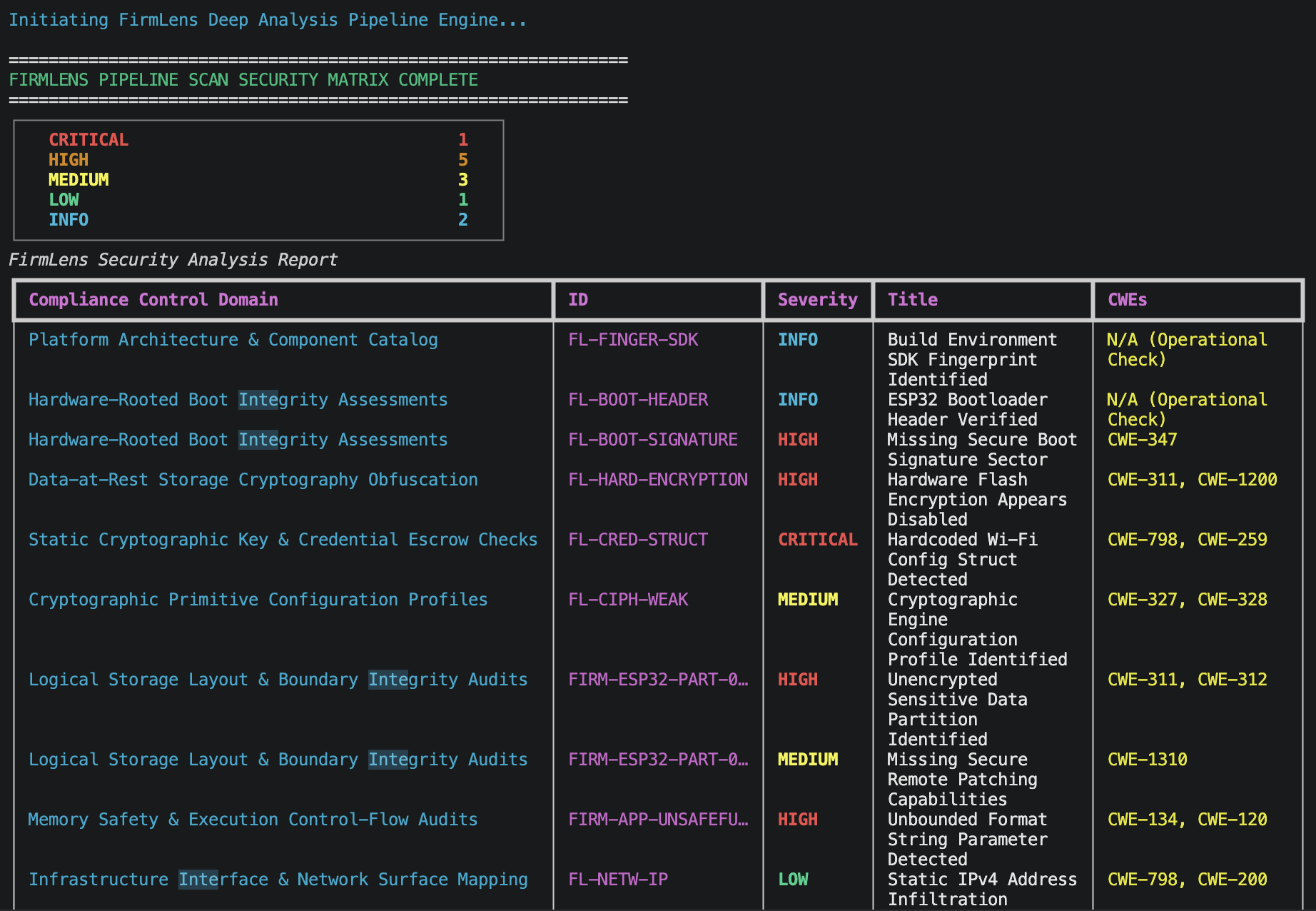
- Terminal (Default): Live execution tracking, offset mapping, and color-coded scoreboards printed directly to
stdout. - HTML (
-f html): Generates a client-side web dashboard containing interactive metrics, vulnerability offset tracking, and expandable engineering remediation blueprints. - JSON (
-f json): Outputs a clean, machine-readable payload designed for native ingestion by SIEM platforms and automated compliance gates. - Combined (
-f all): Compiles both the HTML and JSON file artifacts simultaneously.
Static Engine Reports
A. Terminal Execution Scoreboard
B. Interactive HTML Dashboard
C. CI/CD JSON Payload (SIEM Integration)
{
    "schema_version": "1.0.0",
    "scan_metadata": {
        "tool": "FirmLens",
        "target_asset": "hardware_extracted_flash.bin",
        "timestamp": "2026-06-22T13:11:39.602468",
        "telemetry_audit_vectors_enforced": 10,
        "total_security_anomalies_isolated": 12,
        "severity_distribution_scoreboard": {
            "Critical": 1,
            "High": 5,
            "Medium": 3,
            "Low": 1,
            "Info": 2
        }
    },
    "findings": [
        {
            "compliance_control_domain": "Static Cryptographic Key & Credential Escrow Checks",
            "id": "FL-CRED-STRUCT",
            "severity": "Critical",
            "title": "Hardcoded Wi-Fi Config Struct Detected",
            "cwes": [
                "CWE-798",
                "CWE-259"
            ],
            "is_vulnerability": true,
            "evidence": [
                "[0xa524] Memory Block -> SSID: 'TestSSID' | PSK: 'TESTPASSWORD123",
                "[0xc244] Memory Block -> SSID: 'ExampleSSID' | PSK: 'ExamplePassword",
                "[0xc2d0] Memory Block -> SSID: 'DemoNetwork' | PSK: 'DemoPassword123"
            ],
            "offsets": [
                "0xa524, 0xc244, 0xc2d0"
            ],
            "scope": "local",
            "remediation_blueprint": "Purge raw credential values, private keys, and API tokens from code strings. Migrate secret data into an independent, encrypted NVS partition block or handle configuration handshakes dynamically using runtime encrypted key exchanges. The exposed structures are located at offset(s): 0xa524, 0xc244, 0xc2d0.",
            "threat_intelligence_telemetry": {
                "active_exploitation": "active",
                "epss_score": 0.874,
                "nist_sp_800_213": "NIST SP 800-213 Data Protection Baseline",
                "etsi_en_303_645": "ETSI EN 303 645 Compliance Rule 5.1-1 (No Hardcoded Credentials)"
            }
        }
    ]
}
Dynamic Engine Reports
A. Terminal Execution Scoreboard
B. Interactive HTML Dashboard
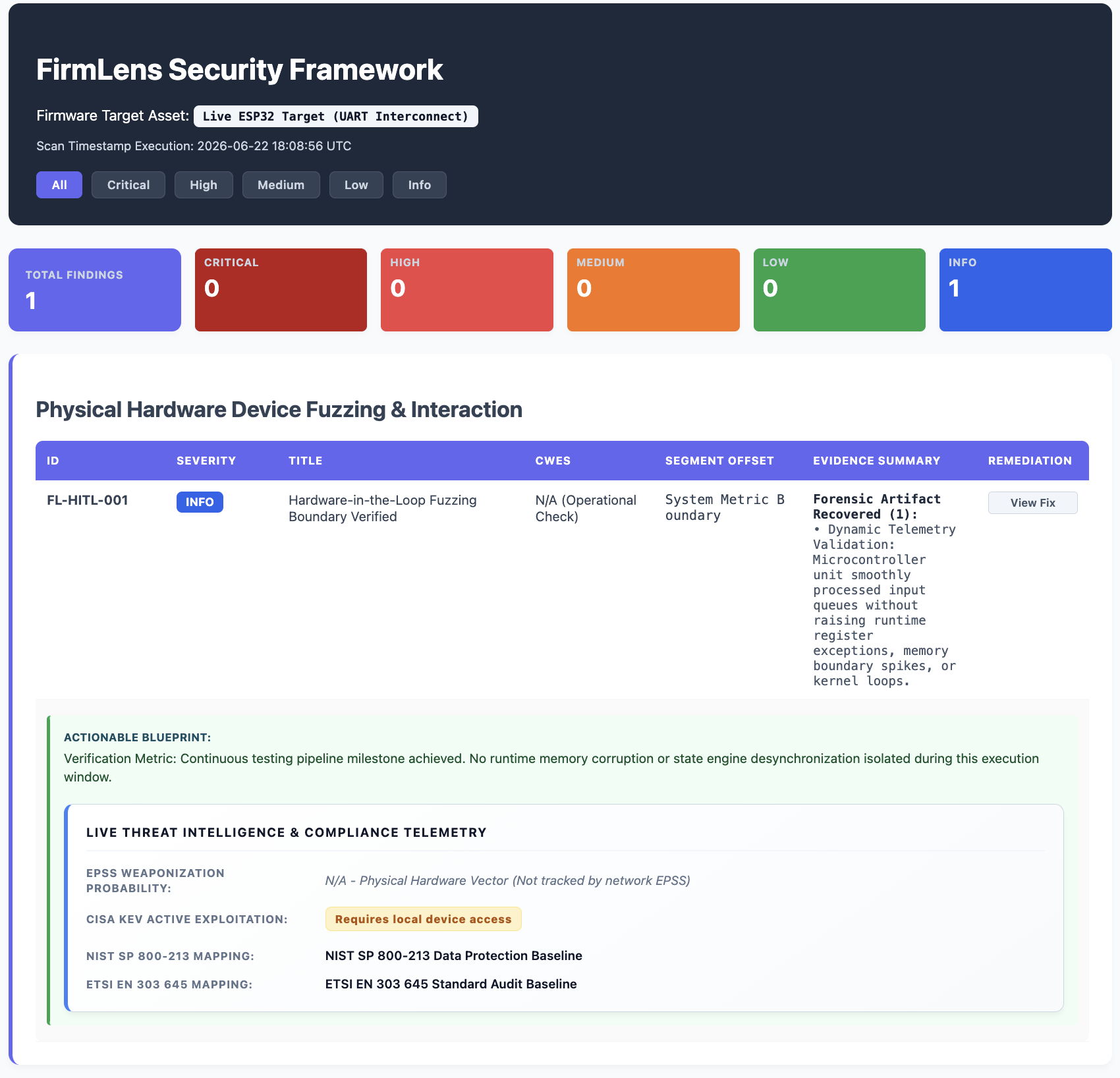
C. CI/CD JSON Payload (SIEM Integration)
{
    "schema_version": "1.0.0",
    "scan_metadata": {
        "tool": "FirmLens",
        "target_asset": "Live ESP32 Target (UART Interconnect)",
        "timestamp": "2026-06-22T18:08:56.359994",
        "telemetry_audit_vectors_enforced": 1,
        "total_security_anomalies_isolated": 1,
        "severity_distribution_scoreboard": {
            "Critical": 0,
            "High": 0,
            "Medium": 0,
            "Low": 0,
            "Info": 1
        }
    },
    "findings": [
        {
            "compliance_control_domain": "Physical Hardware Device Fuzzing & Interaction",
            "id": "FL-HITL-001",
            "severity": "Info",
            "title": "Hardware-in-the-Loop Fuzzing Boundary Verified",
            "cwes": [],
            "is_vulnerability": false,
            "evidence": [
                "Dynamic Telemetry Validation: Microcontroller unit smoothly processed input queues without raising runtime register exceptions, memory boundary spikes, or kernel loops."
            ],
            "offsets": [
                "System Metric Boundary"
            ],
            "scope": "global",
            "remediation_blueprint": "Verification Metric: Continuous testing pipeline milestone achieved. No runtime memory corruption or state engine desynchronization isolated during this execution window.",
            "threat_intelligence_telemetry": {
                "active_exploitation": "unsupported",
                "epss_score": null,
                "nist_sp_800_213": "NIST SP 800-213 Data Protection Baseline",
                "etsi_en_303_645": "ETSI EN 303 645 Standard Audit Baseline"
            }
        }
    ]
}
Versioning
FirmLens follows Semantic Versioning (SemVer).
- Major versions introduce significant architectural changes.
- Minor versions introduce new capabilities and analysis modules.
- Patch versions contain fixes, documentation improvements, and maintenance updates.
Citation
FirmLens is an open-source firmware security analysis framework. If you use FirmLens in research, publications, technical reports, or security assessments, please cite:
@software{FirmLens,
  author = {Rudrarapu, Srikanth},
  title = {FirmLens: Industrial-Grade Embedded IoT Firmware Security Analysis Engine},
  year = {2026},
  version = {1.0.2},
  url = {https://github.com/Srikanth-Rudrarapu/firm-lens}
}
Support the Project
If you found FirmLens useful for your security research or compliance auditing, consider giving the repository a star on GitHub. It helps the project gain visibility and supports ongoing open-source development.

Disclaimer
FirmLens is engineered strictly for authorized security research, compliance auditing, and defensive engineering. Ensure explicit legal authorization is granted prior to analyzing or interacting with target hardware.
License
Distributed under the MIT License. See LICENSE for more information.
Release history Release notifications | RSS feed


Download files
Download the file for your platform. If you're not sure which to choose, learn more about installing packages.
Source Distribution
Built Distribution
Filter files by name, interpreter, ABI, and platform.
If you're not sure about the file name format, learn more about wheel file names.
Copy a direct link to the current filters
File details
Details for the file firm_lens-1.0.2.tar.gz.
File metadata
- Download URL: firm_lens-1.0.2.tar.gz
- Upload date:
- Size: 64.1 kB
- Tags: Source
- Uploaded using Trusted Publishing? No
- Uploaded via: twine/6.2.0 CPython/3.14.5
File hashes
| Algorithm | Hash digest | |
|---|---|---|
| SHA256 |
75a019d8b4c31fa54b72ab94a714c3cfaa3af15d639a609309311d6757fc503e
|
|
| MD5 |
756cd65ab8c9fd5cfb3cf946e0ce2e01
|
|
| BLAKE2b-256 |
d53764e46c43ff978bb095cd6ee5dddc0287cbf206429d6e06d36c0e06d3d33c
|
File details
Details for the file firm_lens-1.0.2-py3-none-any.whl.
File metadata
- Download URL: firm_lens-1.0.2-py3-none-any.whl
- Upload date:
- Size: 72.5 kB
- Tags: Python 3
- Uploaded using Trusted Publishing? No
- Uploaded via: twine/6.2.0 CPython/3.14.5
File hashes
| Algorithm | Hash digest | |
|---|---|---|
| SHA256 |
e3f4041a2bfdef3d72123c945eae1a000b8785e1895566a21af0705032ae650f
|
|
| MD5 |
0929558cd8501cbb62bae9df79c5605d
|
|
| BLAKE2b-256 |
7f448fc64d67ec27f4e9d2e905c0558128a30e18acde9c1b4e2096f9c0400777
|






