

FixForward
Incident-to-PR autopilot powered by GitHub Copilot CLI.



One command to go from broken build to ready-to-merge PR.
pip install fixforward
When builds or tests fail, most devs lose time figuring out root cause and writing the fix. FixForward turns one command into a full recovery workflow:
fixforward run --open-pr
It detects failures, classifies the issue, asks GitHub Copilot CLI to generate a minimal patch, applies it on a safe branch, re-runs tests to verify, pushes the branch, and opens a ready-to-merge pull request — locally or automatically in CI.
New in v0.2.0 — it finally opens the PR
FixForward was always called an "incident-to-PR autopilot" — but until now it stopped one step short: it printed a PR description and made you push and open the PR by hand. v0.2.0 closes the loop.
v0.1 (before) v0.2 (now) Generate the fix ✅ ✅ Verify it passes ✅ ✅ Write the PR body ✅ ✅ Push the branch ❌ manual ✅ automatic Open the PR ❌ manual ✅ gh pr createLabel by confidence ❌ ✅ high / needs-review / low Run in CI ❌ laptop only ✅ GitHub Action The result: a red CI build can now become a labelled, verified fix PR without you touching your keyboard — see GitHub Action.
Demo
Diagnose: detect and classify the failing tests.

Ship: Copilot's fix, verified green, opened as a labelled PR — automatically.


How It Works
tests fail → parse output → classify failure → Copilot generates fix → apply on branch → verify → PR report
     │            │               │                    │                     │           │         │
   pytest     extract          regex             gh copilot -p          git branch    re-run   markdown
   npm test   failures       heuristics        "fix this bug..."      safe commit    tests    PR body
   cargo test                                                                        diff
- Detect — finds
pytest.ini,package.json, orCargo.tomlto identify your ecosystem - Run tests — executes the test suite and captures the raw output
- Parse — extracts individual test failures with file paths, line numbers, and error messages
- Classify — categorizes failures (dependency, syntax, assertion, API change, env mismatch, lint, flaky)
- Generate patch — sends failure context to GitHub Copilot CLI (
gh copilot -p) for a minimal fix - Apply — creates a
fixforward/auto-*branch, writes the fix, commits - Verify — re-runs the test suite, shows before/after comparison with confidence score
- Report — generates PR title and body with what changed and why
- Ship (new in v0.2.0, with
--open-pr) — pushes the branch and opens a real pull request viagh pr create, labelled by its confidence score
Screenshots
Full autopilot run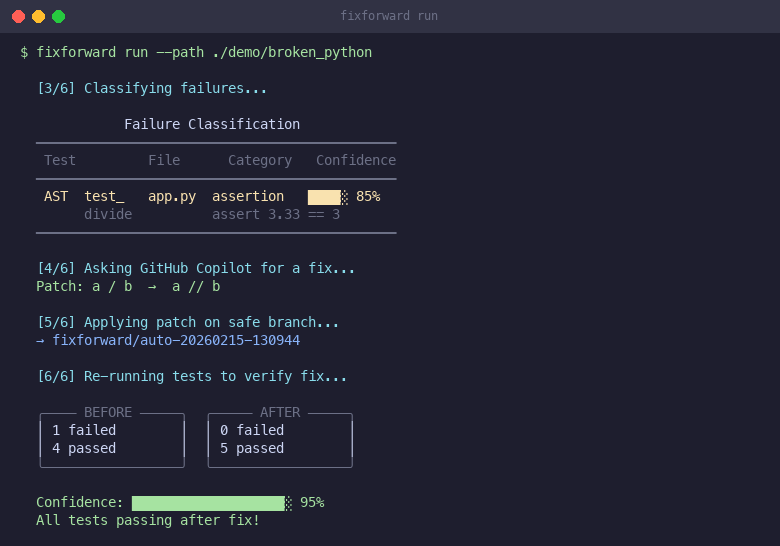 |
Diagnose mode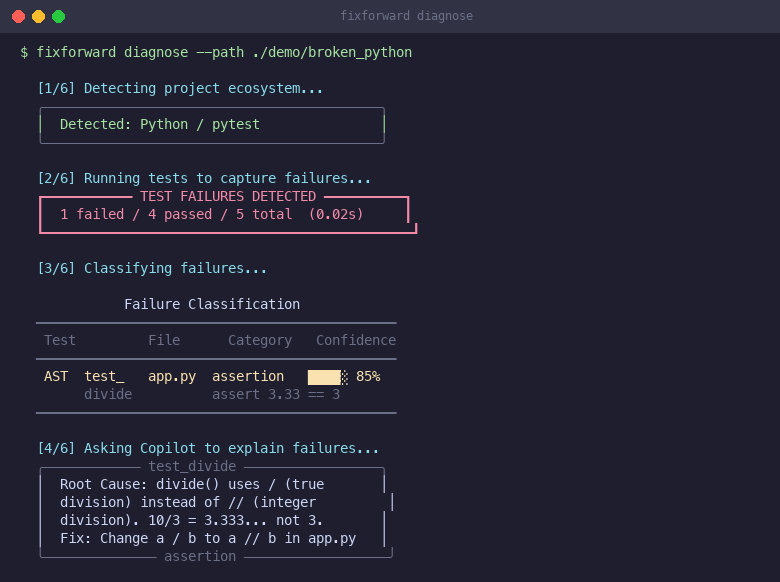 |
Dependency detection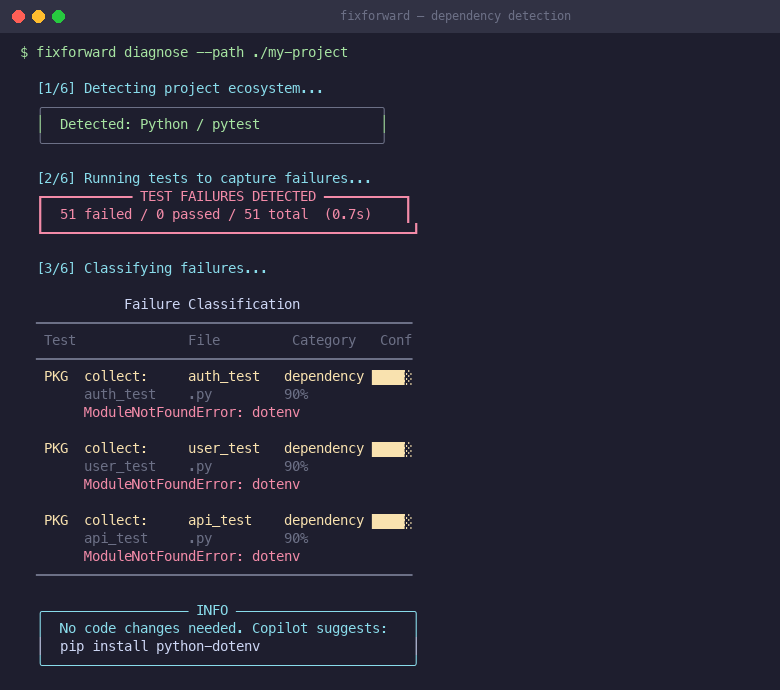 |
Node.js / Jest support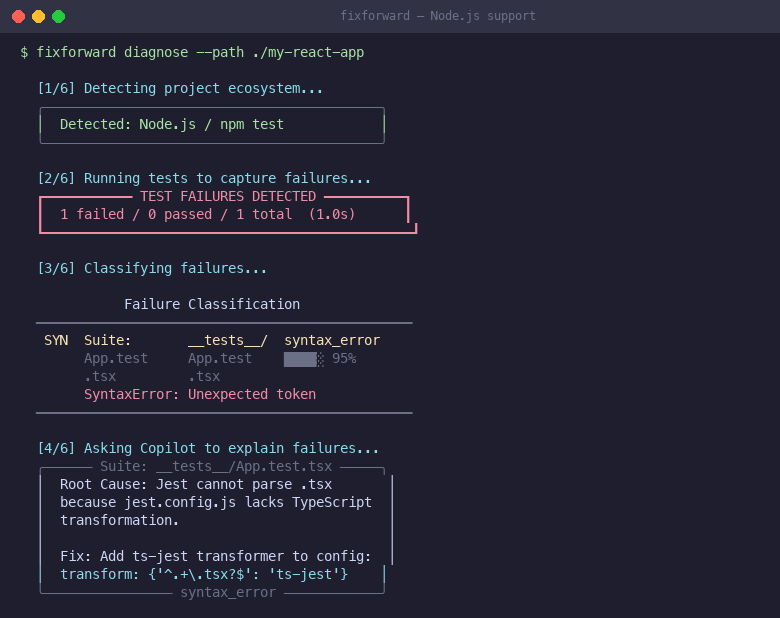 |
Supported Ecosystems
| Ecosystem | Test Command | Parser |
|---|---|---|
| Python | pytest --tb=long -v |
Extracts failures, tracebacks, assertion details |
| Node.js | npm test |
Supports Jest and Mocha output formats |
| Rust | cargo test |
Parses panics, assert_eq! failures, test summaries |
Features
| Feature | Description |
|---|---|
| Auto-detect | Identifies Python, Node, or Rust projects automatically |
| Smart classification | Categorizes failures: dependency, syntax, assertion, API change, env, lint, flaky |
| Copilot-powered fixes | Uses gh copilot -p to generate minimal patches |
| Safe branches | Always applies fixes on a fixforward/auto-* branch, never touches your working branch |
| Before/after verification | Re-runs tests and shows what changed |
| Confidence scoring | 0-100% score based on how many failures were fixed |
| PR report generation | Ready-to-use PR title and body in Markdown |
| Opens the PR for you ✨ | --open-pr pushes the branch and runs gh pr create automatically |
| Confidence labels ✨ | Tags each PR high-confidence / needs-review / low-confidence |
| Confidence gate ✨ | --min-confidence refuses to open a PR for low-trust fixes |
| Auto-merge ✨ | --auto-merge enables squash auto-merge for high-confidence fixes |
| GitHub Action ✨ | Drop into CI so failing builds open fix PRs by themselves |
| Dry-run mode | Preview the diagnosis without applying any changes |
| Rollback | One command to undo everything: fixforward rollback |
| Patch preview | See the exact diff before confirming |
Quick Start
pip install fixforward
Or install from source:
git clone https://github.com/stackmasteraliza/fixforward.git
cd fixforward
pip install -e .
Prerequisites
- Python 3.9+
- GitHub CLI (
gh) installed and authenticated - GitHub Copilot CLI —
gh copilotmust be available - Git installed and in PATH
Usage
# Full autopilot: detect, fix, verify, report
fixforward run

# Full autopilot AND open a pull request automatically
fixforward run --open-pr

# Non-interactive end-to-end + PR (great for CI / GitHub Actions)
fixforward ship --min-confidence 0.6

# Only open the PR when the verified fix is at least 70% confident
fixforward run --open-pr --min-confidence 0.7

# Open the PR as a draft, and enable auto-merge for high-confidence fixes
fixforward run --open-pr --draft-pr --auto-merge

# Specify a project path
fixforward run --path ~/projects/my-broken-app

# Dry run: see diagnosis without applying fixes
fixforward run --dry-run

# Diagnose only: detect and classify failures
fixforward diagnose --json

# Undo the last fix
fixforward rollback
You can also run it as a Python module:
python -m fixforward run --path ./my-project
CLI Options
fixforward run
| Flag | Description |
|---|---|
--path, -p |
Path to the project (default: .) |
--dry-run, -n |
Show diagnosis without applying fixes |
--no-confirm |
Skip the patch confirmation prompt |
--open-pr |
Push the fix branch and open a real pull request |
--draft-pr |
Open the pull request as a draft |
--auto-merge |
Enable squash auto-merge for high-confidence fixes |
--min-confidence |
Only open a PR when fix confidence ≥ this (0.0–1.0) |
--no-animate |
Disable loading animations |
--verbose |
Show raw Copilot CLI output |
fixforward ship
Non-interactive autopilot that always opens a PR — built for CI. Same flags as run --open-pr --no-confirm.
| Flag | Description |
|---|---|
--path, -p |
Path to the project (default: .) |
--min-confidence |
Only open a PR when fix confidence ≥ this (0.0–1.0) |
--draft-pr |
Open the pull request as a draft |
--auto-merge |
Enable squash auto-merge for high-confidence fixes |
--no-animate |
Disable loading animations |
fixforward diagnose
| Flag | Description |
|---|---|
--path, -p |
Path to the project (default: .) |
--json |
Output classification as JSON |
--no-animate |
Disable loading animations |
fixforward rollback
| Flag | Description |
|---|---|
--path, -p |
Path to the project (default: .) |
Try It Yourself
The repo includes ready-made broken demo projects you can test with:
Python demo (division bug)
# Clone the repo
git clone https://github.com/stackmasteraliza/fixforward.git
cd fixforward

# 1. See the bug — test_divide expects integer division but gets float
cat demo/broken_python/app.py

# 2. Diagnose the failure
fixforward diagnose --path demo/broken_python

# 3. Full autopilot — Copilot fixes a / b → a // b
fixforward run --path demo/broken_python

# 4. Undo and restore the broken state
fixforward rollback --path demo/broken_python
Node.js demo (truncation bug)
# truncate() produces ".." instead of "..."
fixforward diagnose --path demo/broken_node
Rust demo (off-by-one in clamp)
# clamp() uses >= instead of > for the max boundary
fixforward diagnose --path demo/broken_rust
Dry-run mode (safe, no changes)
fixforward run --path demo/broken_python --dry-run
This runs detection, test execution, and classification but stops before calling Copilot or modifying any files.
JSON output (for scripting)
fixforward diagnose --path demo/broken_python --json
Returns structured JSON with test name, file, line, category, confidence, and error message for each failure.
Run It in CI (GitHub Action)
This is what v0.2.0 was really about: FixForward no longer needs you at the keyboard. Add it to any repo and a failing build will open its own fix PR.
# .github/workflows/fixforward.yml
name: FixForward
on: [push, pull_request]

permissions:
  contents: write        # push the fix branch
  pull-requests: write   # open the PR

jobs:
  test-and-autofix:
    runs-on: ubuntu-latest
    steps:
      - uses: actions/checkout@v4
      - uses: actions/setup-python@v5
        with: { python-version: "3.x" }
      - run: pip install -r requirements.txt
      - id: tests
        run: pytest
        continue-on-error: true   # hand the failure to FixForward
      - name: FixForward
        if: steps.tests.outcome == 'failure'
        uses: stackmasteraliza/fixforward@v1
        with:
          min-confidence: "0.6"
          github-token: ${{ secrets.GITHUB_TOKEN }}
Action inputs
| Input | Default | Description |
|---|---|---|
path |
. |
Project directory to analyse |
min-confidence |
0.5 |
Only open a PR when the verified fix is at least this confident |
auto-merge |
false |
Enable squash auto-merge for high-confidence fixes |
draft |
false |
Open the PR as a draft |
github-token |
— | Token used to push the branch and open the PR (required) |
Note on Copilot in CI: generating fixes calls
gh copilot, which needs an account with GitHub Copilot access. In CI, provide a token for such an account (e.g. aCOPILOT_GH_TOKENsecret) — the defaultGITHUB_TOKENcan push and open PRs but cannot call Copilot. A ready-to-run example lives inexamples/fixforward-on-failure.ymland a live in-repo demo in.github/workflows/demo-autofix.yml.
Failure Categories
FixForward classifies failures using regex heuristics for instant, deterministic results:
| Category | Examples | Confidence |
|---|---|---|
| syntax_error | SyntaxError, IndentationError, Unexpected token |
95% |
| dependency | ModuleNotFoundError, Cannot find module, ImportError |
90% |
| api_change | AttributeError, TypeError (wrong args), has no member |
85% |
| assertion | AssertionError, assert_eq!, expect().toEqual() |
85% |
| env_mismatch | Version conflicts, missing commands, engine incompatible | 80% |
| lint | Flake8, ESLint, Clippy warnings | 75% |
| flaky_test | Timeouts, connection refused, intermittent | 60% |
Safety
FixForward is designed to be safe by default:
- Never modifies your working branch — all fixes go on
fixforward/auto-*branches - Stashes dirty state — if you have uncommitted changes, they're stashed and restored on rollback
- Patch preview — see the exact diff before confirming
- Dry-run mode — diagnose without touching anything
- One-command rollback —
fixforward rollbackrestores everything - State persistence — rollback info stored at
~/.fixforward/state.json
Built With GitHub Copilot CLI
This project was built using GitHub Copilot CLI as part of the GitHub Copilot CLI Challenge on DEV. Copilot CLI is central to the tool — it powers the actual fix generation via gh copilot -p:
# How FixForward uses Copilot CLI internally:
gh copilot -- -p "I have a python project with failing tests.
  The test test_divide in test_app.py fails with AssertionError:
  assert 3.333 == 3. Generate a minimal fix..." \
  --allow-all-tools --add-dir ./project --silent
Copilot CLI reads the source files, understands the context, and generates the smallest possible code change. FixForward then applies it, verifies it, and reports the result.
Copilot CLI prompts used
Fix generation prompt (sent via gh copilot -- -p):
I have a {ecosystem} project with failing tests. Generate a minimal fix.

FAILURES:
- [assertion] test_divide
  File: test_app.py
  Error: assert 3.3333333333333335 == 3

SOURCE FILES:
--- app.py ---
{file contents}

Generate the smallest possible code change to fix these failures.
Show the complete corrected file content for each file that needs changes.
Format each fix as:
FILE: <filepath>
```<complete corrected file content>```

Then explain what you changed and why.
Failure explanation prompt (used by fixforward diagnose):
Explain this test failure concisely:
Test: test_divide
File: test_app.py
Error: assert 3.3333333333333335 == 3
Category: assertion

What is the likely root cause and how should it be fixed?
Architecture
fixforward/
├── cli.py          # argparse CLI with run/ship/diagnose/rollback commands
├── detector.py     # Ecosystem detection + test runner (subprocess)
├── classifier.py   # Regex heuristic failure classification
├── copilot.py      # GitHub Copilot CLI integration (gh copilot -p)
├── patcher.py      # Safe branch creation + file patching
├── verifier.py     # Test re-run + confidence scoring
├── reporter.py     # PR title/body generation
├── shipper.py      # ✨ Push branch + gh pr create + confidence labels (the last mile)
├── display.py      # Rich-based terminal UI
├── state.py        # Rollback state persistence
└── parsers/
    ├── pytest_parser.py   # pytest output parser
    ├── npm_parser.py      # Jest/Mocha output parser
    └── cargo_parser.py    # cargo test output parser

action.yml                 # ✨ Composite GitHub Action
.github/workflows/         # ✨ CI self-tests + live auto-fix demo
tests/                     # ✨ Unit tests for shipping policy + PR reporting
Only dependency: rich — everything else is Python stdlib.
Requirements
- Python 3.9+
- Git installed and in PATH
- GitHub CLI (
gh) with Copilot access - Terminal with color support
MIT License — see LICENSE for details.
If you like this project, give it a star!
1 maintainer

Metadata
1 maintainer
Release files for fixforward 0.2.0
For a detailed explanation of source distributions (sdists) and built distributions (wheels), please see the package formats documentation.
Source distribution (sdist)
| File | Size | Uploaded | |
|---|---|---|---|
| fixforward-0.2.0.tar.gz | 38.2 kB | Details |
Built distribution (wheel)
| File | Interpreter | ABI | Platform | Reset |
|---|---|---|---|---|
| fixforward-0.2.0-py3-none-any.whl | Python 3 | none | any | Details |
Total release size: 75.4 kB
Release files / fixforward-0.2.0.tar.gz
| Download URL | fixforward-0.2.0.tar.gz |
|---|---|
| Size | 38.2 kB |
| Tags | Source |
|
SHA-256 checksum How to use checksums |
59c19ece4ab7fa4f9c93161dbe378e5cf705d769205a07d659b1eef06dd44da5
|
|
BLAKE2b-256 checksum How to use checksums |
9a2bd881b264be8f00de9049237ac06467048002d6594449aa2202c8662eba39
|
| Upload date | |
|
Uploaded using Trusted Publishing? What is trusted publishing? |
No |
| Uploaded via |
twine/6.2.0 CPython/3.14.2
|
Release files / fixforward-0.2.0-py3-none-any.whl
| Download URL | fixforward-0.2.0-py3-none-any.whl |
|---|---|
| Size | 37.1 kB |
| Tags | Python 3 |
|
SHA-256 checksum How to use checksums |
8fc1ec6f1491872fa94608698eb2dcac32ea8165519b4fd18fd5ff81b93936f9
|
|
BLAKE2b-256 checksum How to use checksums |
b267c7c27e2d262a7aa98d1820374056ac7d217eb6c2a9eb6efb6a9d7a14aaa4
|
| Upload date | |
|
Uploaded using Trusted Publishing? What is trusted publishing? |
No |
| Uploaded via |
twine/6.2.0 CPython/3.14.2
|














