
fixreprod
This is under review.
It is still undergoing improvement.
fixreprod is an indispensable tool to solve reproducibility problems in pseudorandom numbers by fixing all seeds and deterministic algorithms used in libraries of AI systems. The current version can take care of torch, tensorflow, gym and gymnasium with numpy, random and scipy. The program is expandable.
To run fixreprod, install it by the following command. ($) indicates the prompt from the system in the terminal.
$ pip install fixreprod
How to run fixreprod
For example, assume reinforcement_q_learning.py is a source code. Use grep command to generate test.py. test.py contains imported libraries which will be checked by fixreprod. The sed command sed '/^"""/,/^"""/d' removes comment lines from reinforcement_q_learning.py and saves it in reinfo.py. The first grep command removes comment lines with the first character of "#" from reinfo.py and save it in rein.py. The second grep command extracts imported libraries from rein.py and save it in test.py.
$ grep import reinforcement_q_learning.py >test.py
or To see the code only, run the following commands
$ sed '/^"""/,/^"""/d' reinforcement_q_learning.py >reinfo.py
$ grep -v '^#' reinfo.py >rein.py
$ grep import rein.py >test.py
Before running fixreprod, you must install all libraries used in the source code. In reinforcement_q_learning.py, gym, random, numpy, and torch must be installed.
Run fixrepdod and enter "test.py" for checking.
fixreprod will show the all seeds to be fixed to eliminate
reproducibility problems from your code.
9 seeds and 1 fixing deterministic algorithms are found
  in this example.

$ fixreprod
Enter the source code file name: test.py
env.action_space.seed(0)
env.reset(seed=0)
np.random.seed(0)
random.Random().seed(0)
random.seed(0)
torch.Generator().manual_seed(0)
torch.cuda.manual_seed(0)
torch.cuda.manual_seed_all(0)
torch.manual_seed(0)
torch.use_deterministic_algorithms(True)
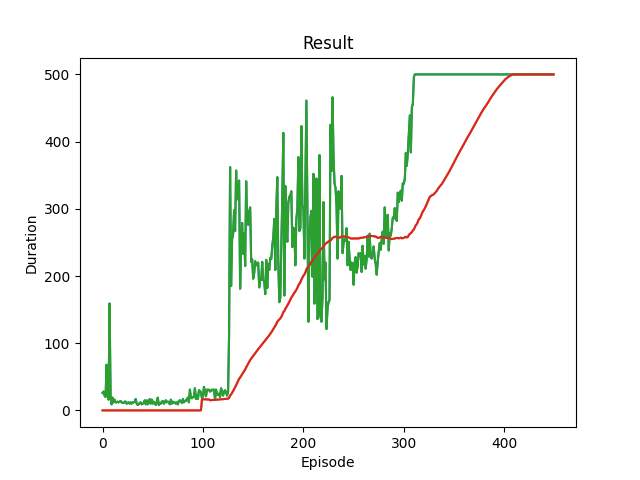
These generated codes should be embedded in the rein.py or reinforcement_q_learning.py. The following figure shows the reproducible result. When changing seed numbers, the different reproducible result can be obtained.
1 maintainer

Metadata
1 maintainer
Release files for fixreprod 0.0.11
For a detailed explanation of source distributions (sdists) and built distributions (wheels), please see the package formats documentation.
Source distribution (sdist)
| File | Size | Uploaded | Provenance | |
|---|---|---|---|---|
| fixreprod-0.0.11.tar.gz | 3.3 kB | Without provenance | Details |
Built distribution (wheel)
| File | Interpreter | ABI | Platform | Reset |
|---|---|---|---|---|
| fixreprod-0.0.11-py3-none-any.whl | Python 3 | none | any | Details |
Total release size: 6.9 kB
Release files / fixreprod-0.0.11.tar.gz
| Download URL | fixreprod-0.0.11.tar.gz |
|---|---|
| Size | 3.3 kB |
| Tags | Source |
|
SHA-256 checksum How to use checksums |
cfa2e15e9081ab4448c7801831a64476fc0f599c46b2949b4b36ce43c68d98d5
|
|
BLAKE2b-256 checksum How to use checksums |
57549eb80dbdfafe389a3e1bc59480607905829c99a0cbd1b1653c37dcb5a115
|
| Upload date | |
|
Uploaded using Trusted Publishing? What is trusted publishing? |
No |
| Uploaded via |
twine/5.0.0 CPython/3.8.12
|
Release files / fixreprod-0.0.11-py3-none-any.whl
| Download URL | fixreprod-0.0.11-py3-none-any.whl |
|---|---|
| Size | 3.6 kB |
| Tags | Python 3 |
|
SHA-256 checksum How to use checksums |
f64a89448a946de18184e9f7699974e53c313ed724e6f09d074c34c7f8b52c93
|
|
BLAKE2b-256 checksum How to use checksums |
0baa5fce7cf0e701b68f44d11a2af2b5acf04bbf4158dc59080c66cbc7a4ff20
|
| Upload date | |
|
Uploaded using Trusted Publishing? What is trusted publishing? |
No |
| Uploaded via |
twine/5.0.0 CPython/3.8.12
|
Security for fixreprod 0.0.11
Provenance
Provenance describes where a file came from. On PyPI, provenance is shared via attestations, which provide a verifiable record of the build or publishing details. View details, limitations and caveats.
No provenance found
None of the files in this release were uploaded with provenance metadata.
A note on package security
PyPI is a repository for distributing packages, not a service for auditing them. While third-party security researchers and our staff do their best to detect and remove malicious packages, PyPI cannot guarantee the quality, security or suitability of any given package.
To learn more about protecting yourself from malicious actors, visit our package security documentation.














