
How stable are natural-language unit tests for LLM evals? An empirical robustness study and mitigation library.

Project description
flakyjudge


How stable are natural-language unit tests for LLM evals?
Teams increasingly evaluate LLM outputs with natural-language unit tests — discrete assertions like "Does the response cite the refund window?" scored by a judge model (LMUnit, TICK, checklist evals). This project measures the reliability of that paradigm: if you reword the assertion without changing its meaning, does the verdict change?
📄 Tech report: report/report.md — methods, all results, practical guidance, limitations.
Experimental design frozen in PREREGISTRATION.md. Five judges across three families: gpt-4o, gpt-4o-mini, claude-sonnet-4-6, claude-haiku-4-5, llama-3.1-8b. ~24,000 scored triples, $19 total spend.
Findings
-
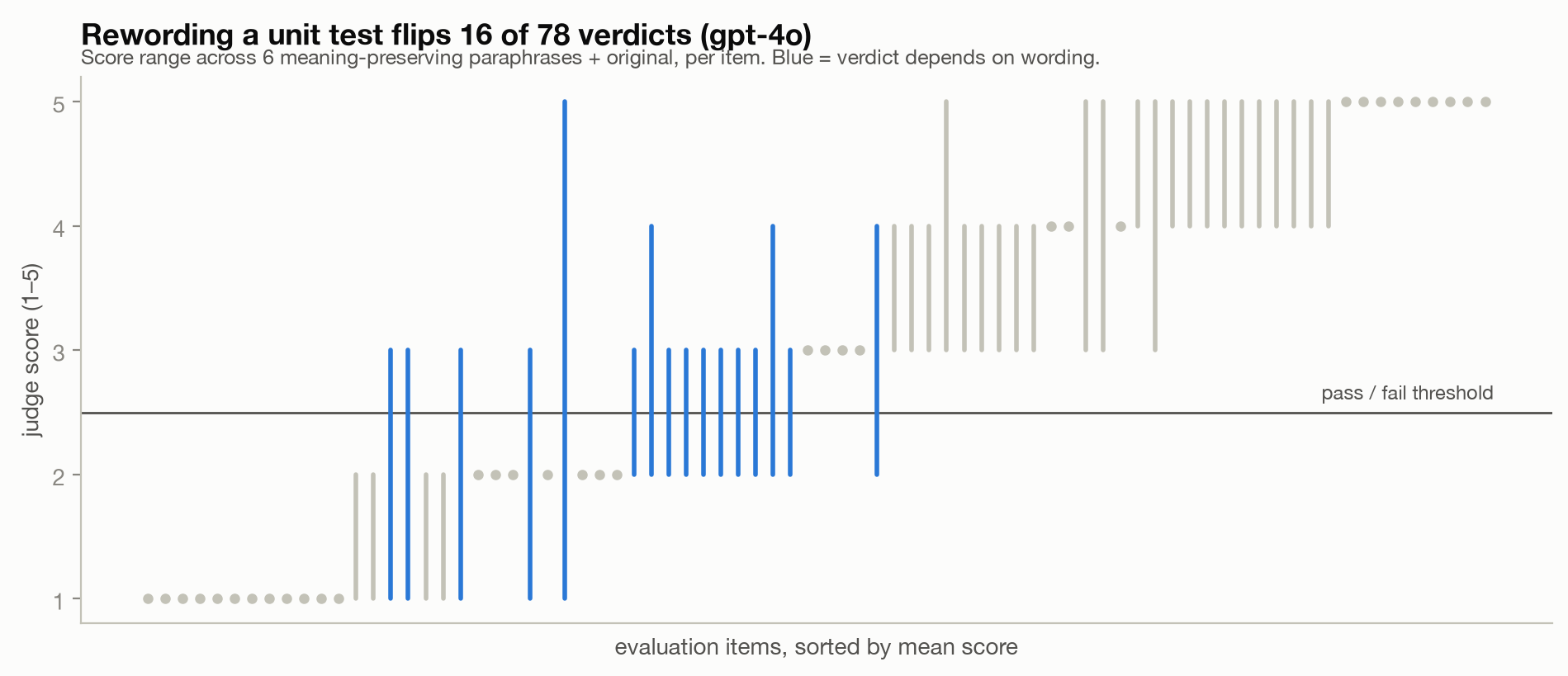
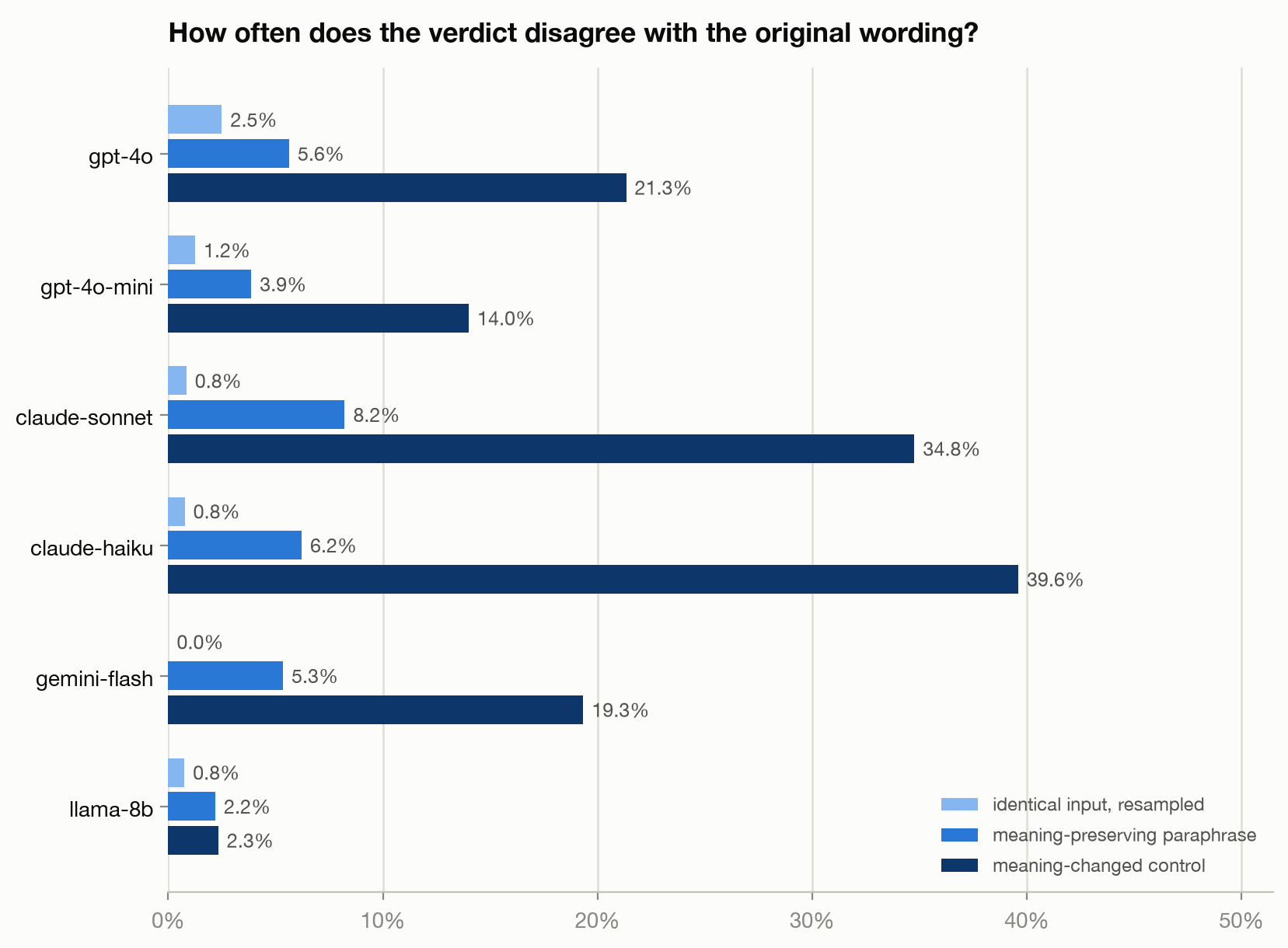
Rewording a unit test flips its pass/fail verdict on 14–25% of items (sonnet 25%, gpt-4o & haiku 20.5%, mini 14.1%) — 5–20× each judge's identical-input resampling noise floor (0.8–4%).
-
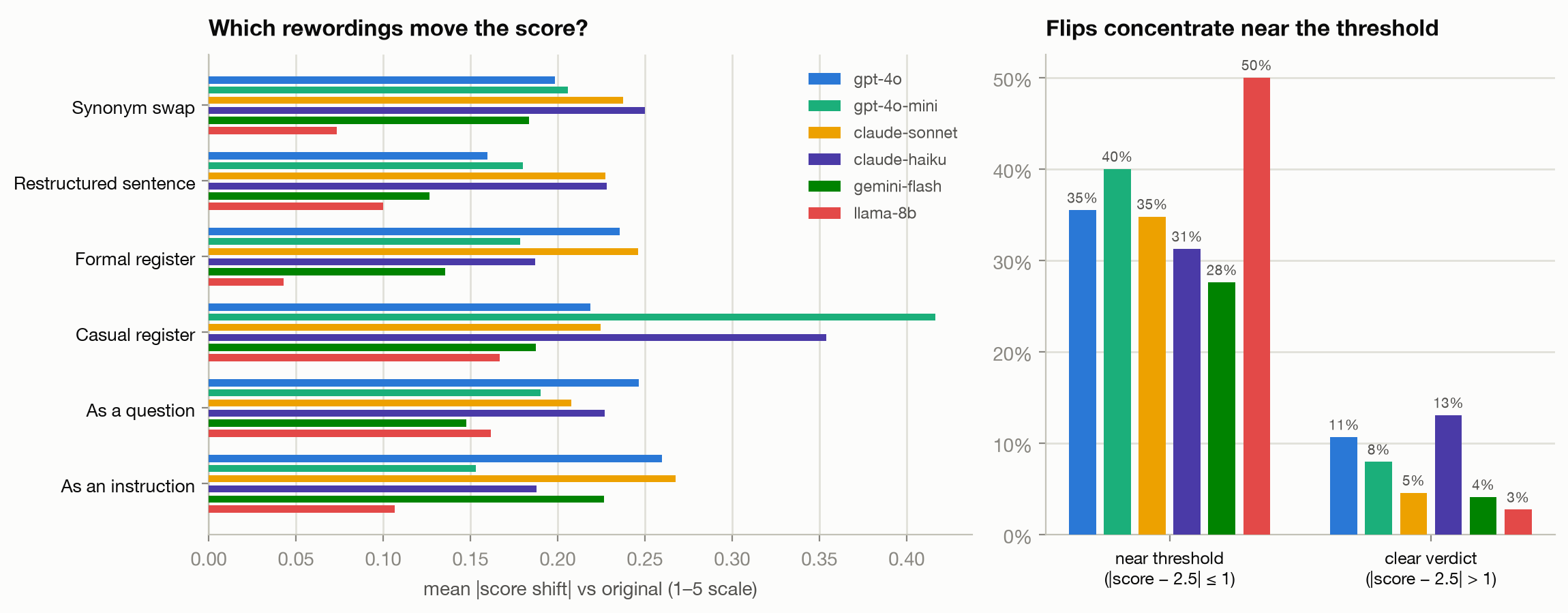
Criterion wording acts as a hidden decision threshold: flips concentrate ~3–7× on items whose scores sit near the pass/fail cut (29–40%) vs clear verdicts (5–13%).
-
"Stability" without validity is insensitivity — the controls catch it: llama-8b looks most stable under paraphrase (5% flips) but barely reacts to deliberately meaning-changed criteria either (1–3% vs Claude's 47–54%) — it isn't robust, it isn't reading the criterion. Every real judge shifts 3–4× more on controls than on true paraphrases.
-
The classic verbosity bias disappears under criterion-anchored judging, in every family: content-matched 1.8× padding produces no significant positive drift for any judge; gpt-4o rewards concision (+0.23, p=0.03) and Claude trends mildly negative. The length halo documented for holistic/pairwise judging does not survive decomposition.
-
The logprob-weighted scoring trick is a small-model story: it buys +0.01–0.02 Spearman for GPT-4o-class judges (CIs cross zero) but +0.23 for llama-8b (CI [+0.17, +0.29]) — rescuing it from ρ≈0.13 to ρ≈0.43. Expectation-scoring is what makes small judges usable.
-
Validity and stability don't come together: claude-sonnet is the most human-aligned judge (ρ=0.69 vs the 0.56 human-agreement ceiling) AND the most paraphrase-flippy (25%) — and the least format-compliant (~10% of calls ignore the bare-digit instruction; OpenAI judges: 0%).
-
Rubrics make judges harsher, not more valid: appending the FLASK rubric+reference shifts scores −0.25 to −0.29 with ~no correlation gain.
What this is
An empirical robustness study across 5 judge models in 3 families (GPT-4o, GPT-4o-mini, Claude Sonnet 4.6, Claude Haiku 4.5, Llama-3.1-8B) on FLASK and BiGGen-Bench items, plus a small library implementing the measurement tools and mitigations:
- E1 — judge-human correlation anchor; logprob-weighted vs. direct scoring
- E2 — identical-input noise floor (resampling + field-order stability)
- E3 — headline: paraphrase sensitivity of the unit-test criterion itself
- E4 — verbosity bias under criterion-anchored judging
Related work measures judge robustness at the response level (Judge Reliability Harness) and template level; this study targets the criterion level — the load-bearing assumption of the unit-test paradigm (LMUnit).
Use the mitigation: pip install flakyjudge
Our headline finding is that single-shot verdicts silently depend on how
you worded the assertion. ensemble_score() makes that visible: it scores
your criterion plus n auto-generated meaning-preserving rewordings and
reports the spread.
from flakyjudge import ensemble_score

r = ensemble_score(
    query="What is your refund policy?",
    response="You can return items within 30 days for a full refund.",
    unit_test="Does the response state the refund time window?",
    judge="gpt-4o-mini",        # or gpt-4o / claude-sonnet / claude-haiku,
    n_paraphrases=4,            #    or any flakyjudge.JudgeSpec
)
r.score    # 5.00 (mean across wordings; logprob-weighted where available)
r.stable   # True -> no wording flips the verdict
r.margin   # 2.50 (distance from threshold; <1 means borderline: distrust it)
Use it for gating/CI evals where a silent wording flip matters; responses are cached in ~/.flakyjudge/ so repeat runs are free.
Reproducibility
Every raw API response (including logprobs) is committed in a content-addressed cache, so all results and figures regenerate with zero API keys and zero dollars:
git clone https://github.com/ShivaSankeerth/flakyjudge && cd flakyjudge
uv sync
make cache-unpack   # inflate the committed API-response cache (19MB gz)
make figures
Development
uv sync --extra dev
make test    # pytest: metrics vs published worked examples, cache, providers
make lint    # ruff
License
MIT
Release history Release notifications | RSS feed


Download files
Download the file for your platform. If you're not sure which to choose, learn more about installing packages.
Source Distribution
Built Distribution
Filter files by name, interpreter, ABI, and platform.
If you're not sure about the file name format, learn more about wheel file names.
Copy a direct link to the current filters
File details
Details for the file flakyjudge-0.1.2.tar.gz.
File metadata
- Download URL: flakyjudge-0.1.2.tar.gz
- Upload date:
- Size: 23.3 kB
- Tags: Source
- Uploaded using Trusted Publishing? No
- Uploaded via: uv/0.11.24 {"installer":{"name":"uv","version":"0.11.24","subcommand":["publish"]},"python":null,"implementation":{"name":null,"version":null},"distro":{"name":"macOS","version":null,"id":null,"libc":null},"system":{"name":null,"release":null},"cpu":null,"openssl_version":null,"setuptools_version":null,"rustc_version":null,"ci":null}
File hashes
| Algorithm | Hash digest | |
|---|---|---|
| SHA256 |
8404f308dd616e11926eb386e6643b67d832cad78504826bc6ddad5130291f1c
|
|
| MD5 |
318c0f46ec3a2b916a5094dd2b5e1161
|
|
| BLAKE2b-256 |
27b4a1049c4242d6f67c298346ea4cd56c5db8a23ddc9f55281b5d76690b7442
|
File details
Details for the file flakyjudge-0.1.2-py3-none-any.whl.
File metadata
- Download URL: flakyjudge-0.1.2-py3-none-any.whl
- Upload date:
- Size: 25.2 kB
- Tags: Python 3
- Uploaded using Trusted Publishing? No
- Uploaded via: uv/0.11.24 {"installer":{"name":"uv","version":"0.11.24","subcommand":["publish"]},"python":null,"implementation":{"name":null,"version":null},"distro":{"name":"macOS","version":null,"id":null,"libc":null},"system":{"name":null,"release":null},"cpu":null,"openssl_version":null,"setuptools_version":null,"rustc_version":null,"ci":null}
File hashes
| Algorithm | Hash digest | |
|---|---|---|
| SHA256 |
dc0c0db795f02b1b4f2ab2b771adab51089736120fda87e42a3d88e189d9e40f
|
|
| MD5 |
b43d6e50fd82d0b56e0b2aae373e3d67
|
|
| BLAKE2b-256 |
b83099b498bd7996b9c07c564c5f314e06e0df152f41ce8af793bac33673c0bb
|






