
This release is a pre-release and may not be stable for production use.
flakytest


See where your test suite spends its time, why, and what to fix first.
Put flakytest in front of your test command: pytest, unittest or Django's manage.py test. It runs your tests
under a sampling profiler and tells you, for
every test, class and file, how much time goes to setup, the test itself and teardown, and inside those to the
database, password hashing, network calls, sleeps, fixtures, factories, imports… down to the line of your code that
causes it. Then it ranks what to fix, using the perf tricks for pytest, Django and SQLAlchemy that usually take
someone an afternoon of profiling to find.
Everything stays on your machine: no account, no upload. The report is a local HTML page, and everything in it is also available as Markdown and JSON for coding agents.
$ pip install flakytest
$ flakytest pytest
...
============================== flakytest profile ===============================
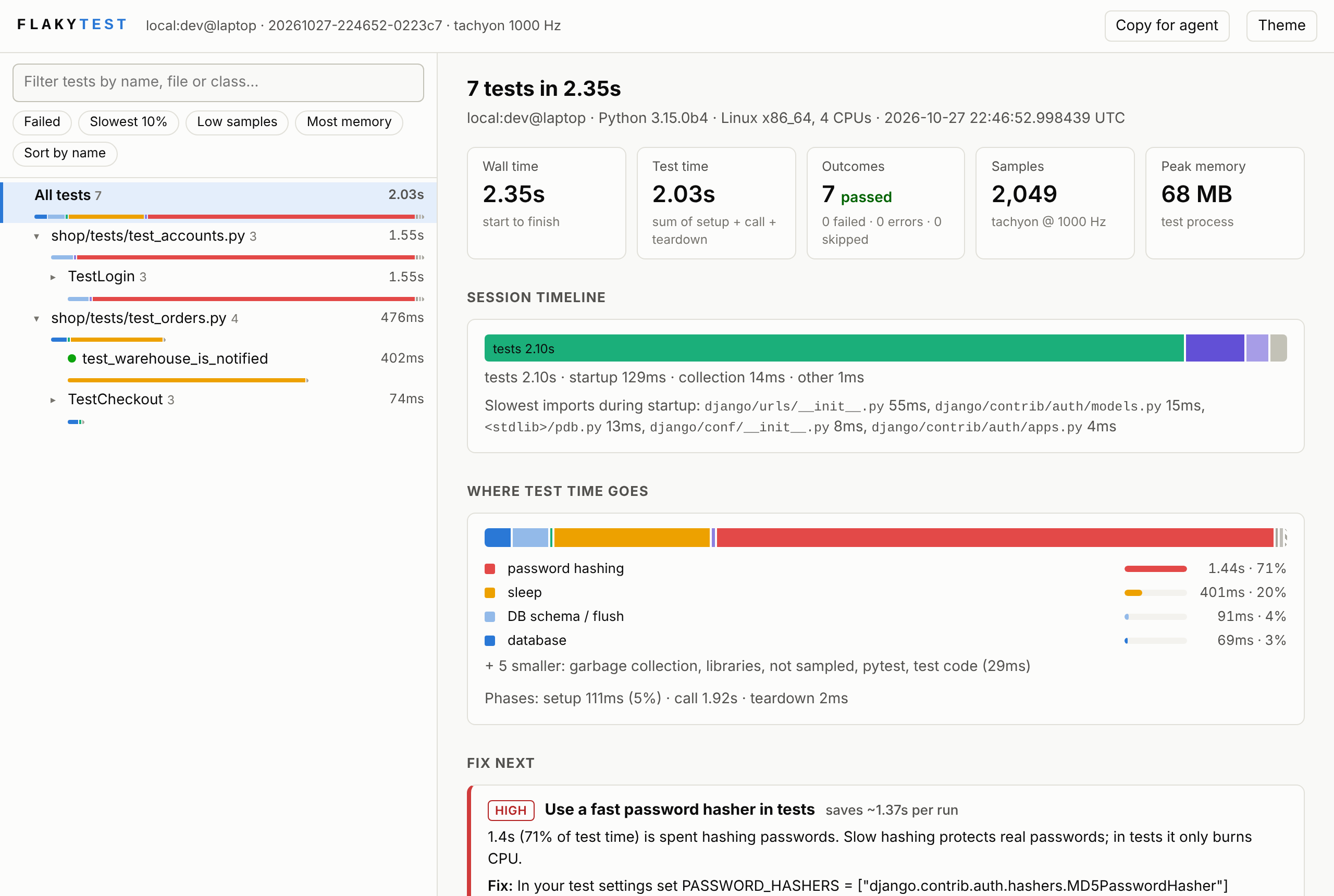
7 tests in 2.35s (test time 2.03s) · local:dev@laptop · Python 3.15.0 · tachyon @ 1000 Hz, 2,049 samples
Time goes to: password hashing 71% · sleep 20% · DB schema / flush 4% · database 3%
Slowest tests:
    485ms  shop/tests/test_accounts.py::TestLogin::test_profile_page  (password hashing 100%, test body in call 243ms, 22 queries)
    475ms  shop/tests/test_accounts.py::TestLogin::test_wrong_password  (password hashing 99%, test body in call 239ms, 6 queries)
    402ms  shop/tests/test_orders.py::test_warehouse_is_notified  (sleep 100%, test body in call 401ms, 2 queries)
     44ms  shop/tests/test_orders.py::TestCheckout::test_order_list  (database 98%, test body in call 31ms, 265 queries)
Fix next:
  1. [high] Use a fast password hasher in tests (~1.37s per run)
  2. [high] Create shared test data in setUpTestData instead of setUp (~530ms per run)
  3. [high] Tests are sleeping (~361ms per run)
Memory: peak 68 MB · most: shop/tests/test_accounts.py::TestLogin::test_profile_page needed 372 KB
Report: .flakytest/runs/20261027-224652-0223c7/index.html
  flakytest serve  ·  flakytest report --format markdown  (for agents)
============================== 7 passed in 2.11s ===============================
Install
pip install flakytest
On Python 3.15+ flakytest uses tachyon, the sampling profiler in the standard library. On older
Pythons it uses py-spy: pip install 'flakytest[py-spy]'. Without
either you still get exact durations, fixture times and query counts, just no breakdown inside tests.
Profile your tests
Run pytest the way you always do, with flakytest in front:
flakytest pytest                        # the whole suite
flakytest pytest tests/api -x           # every argument goes to pytest
flakytest pytest -n auto                # pytest-xdist works too: each worker is profiled
python -m flakytest pytest              # the same, without the console script
Plain pytest is untouched: flakytest only does something when you run your tests through it.
unittest and Django's test runner
No pytest? Put flakytest in front of python:
flakytest python -m unittest                        # unittest discovery
flakytest python -m unittest tests.test_orders -v   # every argument goes to unittest
flakytest python manage.py test                     # Django's test runner
flakytest python manage.py test --parallel auto     # each worker is profiled
flakytest python run_tests.py                       # any script that runs unittest tests
You get the same report. Tests are named like pytest's (shop/tests/test_orders.py::TestCheckout::test_list),
setUp, Django's per-test transaction and the test method are the setup and call phases, and setUpModule,
setUpClass (with Django's setUpTestData) and the test databases (django_db_setup) are fixtures that the
tests share. The suggestions use your runner's options, such as --keepdb and --parallel.
Every run writes .flakytest/runs/<run id>/ with:
index.html— the report. A list of every test grouped by file and class; click a test or a group to see where its time goes: setup/call/teardown, time by category, the pieces of work (fixtures,setUp, the test body, Django's transaction setup…), the hot lines in your code with their source, a call tree (pytest internals hidden), hot functions, fixtures, SQL queries and repeated queries (N+1), memory, and the suggestions that apply. Open it from disk, or withflakytest serve.profile.json— everything in the report, documented in docs/profile-format.md.profile.jsis the same data forindex.html, andsummary.jsonis what the next run compares itself with.
.flakytest/ ignores itself in git.
Memory
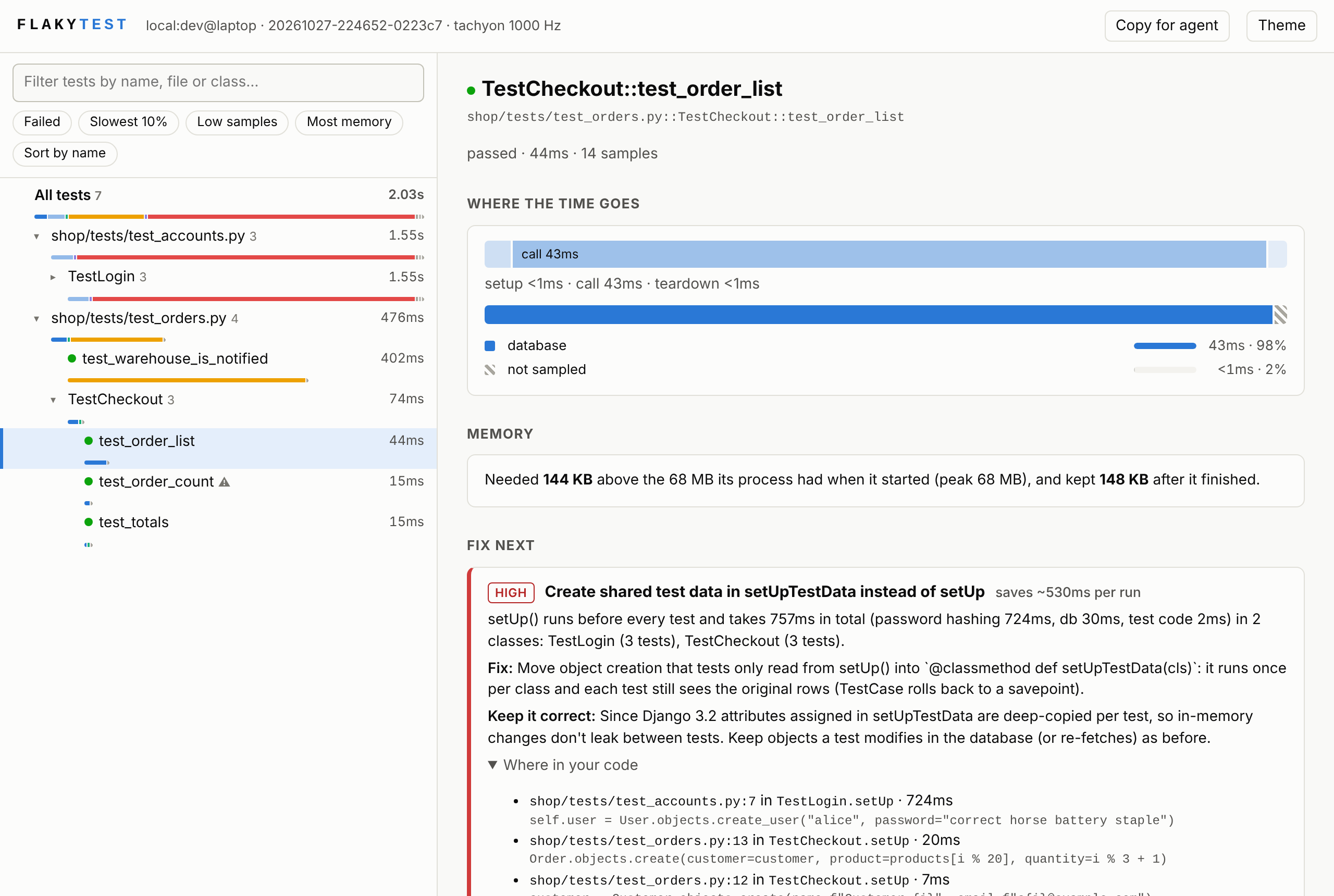
Every test's memory is measured too, in whichever process runs it (each pytest-xdist worker measures its
own tests): how much it needed above what its process already had (its peak), and how much it kept. The
report lists the tests that needed the most (the Most memory filter in the HTML report), each worker's
peak, and on Linux all workers added up over time, which is what a CI machine needs to avoid running out of
memory. A process that keeps growing gets a memory_growth warning naming the tests it grew in.
What a test needed and kept is private memory, measured from before its setup until the next test starts. A class, module or session fixture keeps its own memory (and its own queries): the test that happened to run it first isn't charged for it. The first test in each process and class, and tests that set up such a fixture, are left out of the tests that needed the most, since they pay for warming up.
Measuring costs well under a millisecond per test. Limitations:
- Exact per-test peaks need Linux, where the kernel's peak counter can be reset per test. On macOS and
Windows a test's peak is only known when it raised its process's peak, and
pip install psutiladds the memory at the start and end of every test. - Only the test processes are measured: a database server, a browser or subprocesses aren't included.
- "Kept" is noisy, since Python and the C allocator often keep freed memory for reuse; peaks are reliable.
What it suggests
Each suggestion comes with the time it costs per run, the lines of your code that trigger it, the tests it affects, and how to make the change without making the tests less trustworthy. Among them:
| Problem | Fix |
|---|---|
| PBKDF2/bcrypt/argon2 password hashing | a fast hasher in test settings, force_login instead of login |
| Migrations on every run | --reuse-db / --keepdb, --nomigrations |
TransactionTestCase flushing every table |
TestCase (transaction rollback) |
Data built in setUp for every test |
setUpTestData (once per class) |
| Expensive function-scoped fixtures | wider scope, or an expensive shared part + cheap reset |
SQLAlchemy create_all/drop_all per test |
schema once per session, SAVEPOINT rollback per test |
| Repeated queries (N+1) | select_related/prefetch_related, selectinload, assertNumQueries |
time.sleep in tests |
poll for the condition, mock the backoff, travel in time |
| Real network calls | responses/respx/pytest-httpx, vcrpy, pytest-socket |
| Redis/Memcached, Celery, subprocesses, browsers | in-memory cache, eager tasks, direct calls, shared browser |
| Factories and Faker | setUpTestData, build(), bulk creation, one Faker instance |
| freezegun, mock autospec | time-machine, patch once per class |
| Heavy imports, slow collection | testpaths, norecursedirs, imports out of module level |
| GC pauses | gc.freeze() after startup, higher thresholds |
| Serial suites on multi-core machines | pytest -n auto, --dist worksteal, manage.py test --parallel |
| pytest-cov's default tracer | COVERAGE_CORE=sysmon |
With coding agents
The report is written so an agent can act on it:
flakytest report                      # Markdown: where time goes, ranked fixes with file:line, slowest tests
flakytest report --test tests/test_orders.py::TestCheckout   # one test or a group, with its call tree
flakytest report --format json        # the same as JSON
flakytest compare                     # previous vs latest run: faster/slower tests, and correctness
flakytest compare flags tests whose outcome changed and tests that stopped running, so a speed-up that
deletes, skips or breaks tests doesn't go unnoticed. The report's Copy for agent button copies what
you're looking at as Markdown.
flakytest mcp is an MCP server (stdio) over your local runs, with get_report, get_test,
list_slow_tests, compare_runs and list_runs tools:
claude mcp add flakytest -- flakytest mcp
Options
These are pytest options, so they go with the rest: flakytest pytest --flakytest-rate 5000 tests/test_api.py.
With flakytest python they go before the script or -m: flakytest python --flakytest-rate 5000 manage.py test.
| Option | Environment | Default |
|---|---|---|
--flakytest-rate N |
FLAKYTEST_PROFILE_RATE |
1000 (tachyon; 500 above 10,000 tests), 500 (py-spy; 100 when pytest-xdist workers use every CPU) |
--flakytest-backend auto|tachyon|py-spy|none |
FLAKYTEST_PROFILE_BACKEND |
auto |
--flakytest-output DIR |
FLAKYTEST_PROFILE_DIR |
<rootdir>/.flakytest/runs |
FLAKYTEST_ENV |
the run's environment name: local:<user>@<host>, ci:github-actions:<job>, … |
If tests are too short for the sampling rate, the report says so and suggests a rate: rerun the tests you care
about with it, e.g. flakytest pytest --flakytest-rate 5000 tests/test_api.py. Suite-wide numbers and suggestions don't
need a high rate; a long test is sampled at a quarter of the rate once it has 200 samples.
How it works
pytest runs every test phase from CallInfo.from_call. flakytest wraps it (and under flakytest python
unittest's setUp, test method and tearDown, and Django's _pre_setup and _post_teardown) so each phase
runs inside a tiny generated function named after the test and phase (__flakytest_call_1f3a9c0d2b4e__). A
sampling profiler attached to the test process (from a separate process, at a lower priority than the tests)
captures that frame in every stack it samples, which attributes each sample to a test and phase exactly,
with no clock synchronisation, for tachyon and py-spy alike, and per worker. The measured durations stay the
source of truth; samples only decide how a phase's time is split. With tachyon, other threads are sampled while
the main thread waits, so work in a thread pool shows up as that work, not as "waiting".
Each test process builds its part of the profile when it finishes (pytest-xdist and Django workers at the same time) and the controller merges them. Every worker records its tests as they finish, so when one crashes the report says so and keeps them (or takes them from pytest's reports).
Fixture setup times are measured exactly with a pytest_fixture_setup wrapper, and Django
(execute_wrapper) and SQLAlchemy (engine events) queries are counted per test.
Permissions. Sampling profilers read another process's memory. On Linux flakytest allows its own
profiler to attach (prctl(PR_SET_PTRACER)), which is enough with the default ptrace_scope=1
(including GitHub Actions). In Docker you may need --cap-add SYS_PTRACE. On macOS profilers need
root: sudo -E flakytest pytest, or run the tests in a Linux container, which also gets you exact per-test memory:
docker run --rm -it --cap-add SYS_PTRACE -v "$PWD":/src -w /src python:3.15 \
  sh -c "pip install -r requirements.txt flakytest && flakytest pytest"
(with your project's install step). Tests that use services on your Mac reach them at host.docker.internal, or
with --network host where your Docker supports it. flakytest doctor checks your setup.
Optional: flakytest.dev
Everything above works locally and needs no account. flakytest.dev is an optional
service on top: set FLAKYTEST_SECRET_TOKEN (from a project there) and flakytest pytest (or flakytest python) uploads each run's profile, from developer machines and CI alike, so you can compare environments and see
trends over time. With pytest the token also turns on flaky test tracking: failures are recorded per environment,
and tests muted on flakytest.dev don't fail your build.
export FLAKYTEST_SECRET_TOKEN=****************************
flakytest pytest
What's uploaded is profile.json: test names, outcomes, durations, file paths relative to the project,
function names, source lines of the hot spots in your code, normalized SQL of repeated queries, the
environment name (local:<user>@<host> unless you set FLAKYTEST_ENV), git branch/commit and changed
file names. Set FLAKYTEST_UPLOAD=0 to keep profiles local while still tracking flaky tests. Its
documentation covers CI setup, flaky test classification and data retention.
License
flakytest is distributed under the terms of the MIT license.
1 maintainer

Metadata
1 maintainer
Release files for flakytest 2026.0b3
For a detailed explanation of source distributions (sdists) and built distributions (wheels), please see the package formats documentation.
Source distribution (sdist)
| File | Size | Uploaded | Provenance | Actions |
|---|---|---|---|---|
| flakytest-2026.0b3.tar.gz | 117.7 kB | With provenance | Details for flakytest-2026.0b3.tar.gz |
Built distribution (wheel)
| File | Interpreter | ABI | Platform | Actions Reset |
|---|---|---|---|---|
| flakytest-2026.0b3-py3-none-any.whl | Python 3 | none | any | Details for flakytest-2026.0b3-py3-none-any.whl |
Total release size: 245.6 kB
Release files / flakytest-2026.0b3.tar.gz
| Download URL | flakytest-2026.0b3.tar.gz |
|---|---|
| Size | 117.7 kB |
| Tags | Source |
|
SHA-256 checksum How to use checksums |
24a1eaf31e36d288d3e730580d8c12029e08fe92f90a3e450193427b0fb09267
|
|
BLAKE2b-256 checksum How to use checksums |
5e008772a341831223cd9065ec6b8ac3f9cab5a9024cd1b9185eace8ffc55a42
|
| Upload date | |
|
Uploaded using Trusted Publishing? What is trusted publishing? |
Yes |
| Uploaded via |
twine/7.0.0 CPython/3.13.14
|
Provenance
Provenance describes where a file came from. On PyPI, provenance is shared via attestations, which provide a verifiable record of the build or publishing details. View details, limitations and caveats.


PyPI Publish Attestation
PyPI verified that this artifact, at this checksum, originated from the publisher listed below.
Signed by GitHub Actions, verified by PyPI on Oct 30, 2026.
Transparency logRelease files / flakytest-2026.0b3-py3-none-any.whl
| Download URL | flakytest-2026.0b3-py3-none-any.whl |
|---|---|
| Size | 128.0 kB |
| Tags | Python 3 |
|
SHA-256 checksum How to use checksums |
8dea727da635aa11e7ec5e4b76dba18b499b72dc3c6adddd33ca5b8d9650b574
|
|
BLAKE2b-256 checksum How to use checksums |
9d6ddc69d989fba8e108663ef4f9700ed9fc25b4229a8e3ffa14309ce661d4e0
|
| Upload date | |
|
Uploaded using Trusted Publishing? What is trusted publishing? |
Yes |
| Uploaded via |
twine/7.0.0 CPython/3.13.14
|
Provenance
Provenance describes where a file came from. On PyPI, provenance is shared via attestations, which provide a verifiable record of the build or publishing details. View details, limitations and caveats.
PyPI Publish Attestation
PyPI verified that this artifact, at this checksum, originated from the publisher listed below.
Signed by GitHub Actions, verified by PyPI on Oct 30, 2026.
Transparency logSecurity for flakytest 2026.0b3
Provenance
Provenance describes where a file came from. On PyPI, provenance is shared via attestations, which provide a verifiable record of the build or publishing details. View details, limitations and caveats.
Full provenance
All 2 files in this release have been uploaded with provenance metadata.
Attestation for flakytest-2026.0b3.tar.gz
PyPI Publish Attestation
PyPI verified that this artifact, at this checksum, originated from the publisher listed below.
Signed by GitHub Actions, verified by PyPI on Oct 30, 2026.
Transparency logA note on package security
PyPI is a repository for distributing packages, not a service for auditing them. While third-party security researchers and our staff do their best to detect and remove malicious packages, PyPI cannot guarantee the quality, security or suitability of any given package.
To learn more about protecting yourself from malicious actors, visit our package security documentation.














