

FlashSinkhorn





Streaming Entropic Optimal Transport in PyTorch + Triton
FlashSinkhorn computes Sinkhorn OT using FlashAttention-style streaming—never materializing the n×m cost matrix—enabling O(nd) memory instead of O(n²); the multiscale backend also stores its block masks.
News
- v0.4.1: OT and derivative corrections, consistent TF32 coordinate rounding, and 15 Jupyter notebooks covering introductory lessons and applications. Available on PyPI and the Kernels Hub. See the release notes.
- 2026-10 Released v0.4.0: a multiscale backend for large 3-D point clouds (
SamplesLoss(backend="multiscale", tol=...)). - 2026-05 🎉 FlashSinkhorn accepted to ICML 2026 as an Oral (top 0.7%, 168 of ~24k submissions).
- 2026-04 Released v0.3.3.
- 2026-02 FlashSinkhorn (v0.3.0) released; preprint on arXiv.
- 2025-12 Initial release (v0.1.0).
Features
- FlashSinkhorn kernels — shifted-potential formulation inspired by FlashAttention. On A100 GPUs, achieves up to 32× forward-pass and 161× end-to-end speedups over state-of-the-art online baselines on point-cloud OT
- Fused Triton kernels for forward, gradient, and HVP
- GeomLoss-compatible API (
SamplesLoss) - Analytic gradients (no backprop through Sinkhorn iterations)
- Hessian-vector products via streaming CG solver
- C-transform / semi-dual OT — streaming hard-argmin Kantorovich c-transform with analytic Danskin gradients, for WPP and other semi-dual methods (
c_transform_fwd,c_transform_cost) - Half-cost support (
half_cost=True) to match GeomLoss's squared-Euclidean cost convention - Unbalanced/semi-unbalanced OT via
reachparameter - Large-D support (d > 1024) with tiled gradient kernel
- Early stopping with convergence threshold
- Multiscale backend (
SamplesLoss(backend="multiscale", tol=...)) for balanced, forward-only OT on large 3-D point clouds: Sinkhorn on Morton cells, then block-sparse fine updates as needed, until an empirical sampled marginal check passestol(otherwise it warns and returns its best candidate); see API.md for its options and measured limits
Install
Install or upgrade to v0.4.1 from PyPI:
pip install --upgrade flash-sinkhorn
To run the tutorials, install the notebook dependencies and clone the example files:
pip install --upgrade "flash-sinkhorn[notebooks]"
git clone https://github.com/ot-triton-lab/flash-sinkhorn.git
cd flash-sinkhorn
jupyter lab examples/getting_started/first_steps.ipynb
For the plotting scripts, use pip install --upgrade "flash-sinkhorn[examples]".
The examples use the installed package, which can be upgraded through pip.
Requirements: Python ≥3.9, PyTorch ≥2.5, Triton ≥3.1, CUDA 12.x.
The Hugging Face Kernels Hub also serves v0.4.1. Its kernels client downloads
the package on first use.
Quick Start
Basic Usage
import torch
from flash_sinkhorn import SamplesLoss

x = torch.randn(4096, 64, device="cuda")
y = torch.randn(4096, 64, device="cuda")

loss = SamplesLoss(loss="sinkhorn", blur=0.1, debias=True)
cost = loss(x, y)
Gradient Flow
x = torch.randn(4096, 64, device="cuda", requires_grad=True)
y = torch.randn(4096, 64, device="cuda")

loss = SamplesLoss(loss="sinkhorn", blur=0.1, debias=True)
cost = loss(x, y)
grad_x = torch.autograd.grad(cost, x)[0]  # Analytic gradient
Matching GeomLoss Conventions
Use half_cost=True to match GeomLoss's cost convention:
# FlashSinkhorn with GeomLoss's squared-Euclidean cost convention
flash_loss = SamplesLoss(loss="sinkhorn", blur=0.1, half_cost=True, debias=True)

# GeomLoss with the same pair-cost and debiasing conventions
# geomloss_loss = geomloss.SamplesLoss(loss="sinkhorn", p=2, blur=0.1, debias=True)
Iteration schedules and arithmetic precision can still produce numerical differences. See the conventions notebook for a controlled comparison.
Unbalanced OT
For matching with relaxed marginals:
loss = SamplesLoss(
    loss="sinkhorn",
    blur=0.1,
    debias=True,
    reach=1.0,  # Unbalanced OT with KL penalty
)
Semi-Unbalanced OT
Different constraints for source vs target:
loss = SamplesLoss(
    loss="sinkhorn",
    blur=0.1,
    reach_x=1.0,   # Relax source marginal
    reach_y=None,  # Keep target marginal strict (balanced)
)
Early Stopping
loss = SamplesLoss(
    loss="sinkhorn",
    blur=0.1,
    use_epsilon_scaling=False,
    eps=0.01,
    n_iters=100,
    threshold=1e-3,       # Stop when potential change < threshold
    inner_iterations=10,  # Check every N iterations
)
Hessian-Vector Product
x = torch.randn(4096, 64, device="cuda", requires_grad=True)
y = torch.randn(4096, 64, device="cuda")
v = torch.randn_like(x)

loss = SamplesLoss(loss="sinkhorn", blur=0.1, debias=False)
cost = loss(x, y)

# First-order gradient
grad_x = torch.autograd.grad(cost, x, create_graph=True)[0]

# HVP via double backward (uses streaming CG solver)
hvp = torch.autograd.grad((grad_x * v).sum(), x)[0]
Double backward currently supports derivatives with respect to x with debias=False, no gradient on y,
and no label cost. See the HVP notebook
for convergence checks and an optimization example.
Large 3-D Point Clouds (Multiscale Backend)
For balanced OT between large three-dimensional point clouds (forward only):
x = torch.rand(2**20, 3, device="cuda")   # (n, 3) point clouds
y = torch.rand(2**20, 3, device="cuda")

loss = SamplesLoss(loss="sinkhorn", blur=0.05, backend="multiscale", tol=5e-3)
cost = loss(x, y)
info = loss.last_multiscale_info   # info.accepted, info.stop, info.detail
The solve returns once an empirical sampled check finds the marginal residual below tol
(a stopping rule, not a bound); otherwise it warns and returns its best candidate with
info.accepted == False.
See API.md for its options and measured limits.
Examples
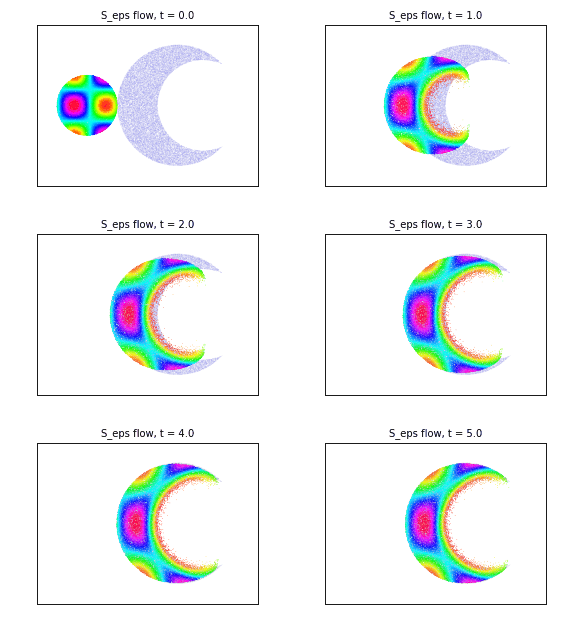
Start with From two point clouds to a differentiable loss,
then Choose parameters and check the result.
The gallery contains 15 notebooks: one executable introductory lesson, one parameter guide, and thirteen
applications. They combine explanations, code and labelled reference figures. Install
pip install --upgrade "flash-sinkhorn[notebooks]", clone the example files, and open jupyter lab
to run the code cells on a CUDA GPU. The
case gallery contains thirteen runnable
examples, from 10,000 points to millions: gradient flows, transport and attribute transfer, relaxed marginals,
labelled datasets, embeddings, batches, multiscale solves, Hessian-vector products and semi-discrete transport.
Reference figures come from previous script runs. Running the code cells produces fresh output and figures.
Each application also provides a .py script; notebooks are generated from the same sources.
Kernel Design
FlashSinkhorn is a reformulated Sinkhorn kernel that uses shifted potentials inspired by FlashAttention. It reduces bias vector loads by 67% and elementwise operations by 78% per tile, and improves scalability on OT-based downstream tasks.
How It Works
Standard Sinkhorn loads 3 bias vectors per tile (g, log_b, y²). FlashSinkhorn precomputes a single fused bias u = (g_shifted + eps*log(b)) / eps and uses raw coordinates with an inline scale factor, matching FlashAttention's score interface exactly.
Earlier Benchmarks (v0.3.0, d=64, A100-80GB, 100 iterations)
These measurements compare v0.3.0 with v0.2.0. To measure the current version on your hardware, use the benchmark commands.
Symmetric solver (vs v0.2.0 GeomLoss-style kernel):
| n | v0.2.0 | v0.3.0 | Speedup |
|---|---|---|---|
| 50,000 | 1730 ms | 1450 ms | 1.19x |
| 10,000 | 88 ms | 61 ms | 1.43x |
| 5,000 | 25 ms | 24 ms | 1.04x |
Alternating solver (vs v0.2.0 OTT-style kernel, 10 iterations):
| n | v0.2.0 | v0.3.0 | Speedup |
|---|---|---|---|
| 50,000 | 137.9 ms | 102.6 ms | 1.34x |
| 20,000 | 25.7 ms | 21.7 ms | 1.19x |
| 10,000 | 8.9 ms | 8.3 ms | 1.07x |
Low-Level API
Low-level FlashSinkhorn API:
from flash_sinkhorn.kernels import (
    sinkhorn_flashstyle_symmetric,     # Full symmetric solver
    sinkhorn_flashstyle_alternating,   # Full alternating solver
    apply_plan_vec_flashstyle,         # Transport plan @ vector (shifted potentials)
    apply_plan_mat_flashstyle,         # Transport plan @ matrix (shifted potentials)
)
from flash_sinkhorn.kernels.sinkhorn_flashstyle_sqeuclid import (
    flashsinkhorn_symmetric_step,      # Single fused iteration
)
API Reference
SamplesLoss
SamplesLoss(
    loss="sinkhorn",
    p=2,                      # Only p=2 supported (squared Euclidean)
    blur=0.05,                # Regularization: eps = blur^2
    debias=False,             # True: debiased Sinkhorn divergence
    half_cost=False,          # Use ||x-y||²/2 to match GeomLoss
    reach=None,               # Unbalanced OT (None = balanced)
    reach_x=None,             # Semi-unbalanced: source marginal
    reach_y=None,             # Semi-unbalanced: target marginal
    scaling=0.5,              # Epsilon annealing factor
    n_iters=None,             # Max iterations (None = use scaling)
    threshold=None,           # Early stopping threshold
    inner_iterations=10,      # Check convergence every N iters
    backend="symmetric",      # "symmetric", "alternating" or "multiscale"
    tol=None,                 # Multiscale only: target marginal residual (default 5e-3)
    allow_tf32=True,           # TF32 cost dot products
    truncate_tf32=None,        # Round centred coordinates; None follows allow_tf32
    autotune=True,             # Tune dense forward/first-derivative kernels on first use
)
With backend="multiscale", n_iters and threshold are rejected and scaling and inner_iterations do not
apply; tol sets the stopping point. backend="alternating" requires use_epsilon_scaling=False, eps and n_iters.
Low-Level API
# FlashSinkhorn (recommended)
from flash_sinkhorn.kernels import (
    sinkhorn_flashstyle_symmetric,
    sinkhorn_flashstyle_alternating,
    apply_plan_vec_flashstyle,
    apply_plan_mat_flashstyle,
)

# Legacy kernels (still available)
from flash_sinkhorn.kernels.sinkhorn_triton_geomloss_sqeuclid import (
    sinkhorn_geomloss_online_potentials_sqeuclid,
)
from flash_sinkhorn.kernels.sinkhorn_triton_grad_sqeuclid import (
    sinkhorn_geomloss_online_grad_sqeuclid,
)
from flash_sinkhorn.hvp import hvp_x_sqeuclid_from_potentials

# Multiscale backend (large 3-D point clouds)
from flash_sinkhorn.multiscale import preprocess_coordinates, check_limits, solve_multiscale
C-Transform / Semi-Dual OT
The non-entropic Kantorovich c-transform (hard argmin) and its differentiable
semi-dual objective — building blocks for the Wasserstein Patch Prior (WPP) and other
semi-dual OT methods. Like the Sinkhorn kernels, the n×m cost matrix is never
materialized (O(nd) memory), and gradients are analytic (no entropic smoothing).
import torch
from flash_sinkhorn import c_transform_fwd, c_transform_cost

x = torch.randn(4096, 64, device="cuda")     # source points [n, d]
y = torch.randn(2048, 64, device="cuda")     # target points [m, d]
psi = torch.randn(2048, device="cuda")        # dual potential on y [m]

# (1) Raw c-transform: values + argmin indices (non-differentiable)
#     c_i = min_j [ cost_scale * ||x_i - y_j||² - psi_j ]
c_values, argmin_idx = c_transform_fwd(x, y, psi, cost_scale=1.0)

# (2) Differentiable semi-dual objective (Danskin's theorem):
#     L(x, psi) = Σ_i a_i * c^psi(x_i) + Σ_j b_j * psi_j   (a, b default uniform)
x = x.requires_grad_(True)
psi = psi.requires_grad_(True)
loss = c_transform_cost(x, y, psi, cost_scale=1.0)
grad_x, grad_psi = torch.autograd.grad(loss, [x, psi])
Differentiable w.r.t. x and psi (not y). Use cost_scale=0.5 for the
||x-y||²/2 (GeomLoss) convention. With TF32 (the default) the coordinates are first
rounded to TF32; pass allow_tf32=False for the cells of the points as given. For the raw
streaming kernel, see flash_sinkhorn.kernels.c_transform_kernel.
Key Concepts
Cost Convention
- FlashSinkhorn default:
C(x,y) = ||x-y||² - GeomLoss p=2 default:
C(x,y) = ||x-y||²/2 - Use
half_cost=Trueto match GeomLoss
Memory Efficiency
FlashSinkhorn streams tiles of (x,y) and computes costs on-the-fly:
- Forward: O(nd) memory (no n×m cost matrix); the multiscale backend also stores its block masks
- Gradient: O(nd) memory (streaming accumulation)
- HVP: O(nd) memory (CG solver with streaming matvec)
Numerical Stability
- Online log-sum-exp with a running maximum, in exp2/log2
- Safe log/division guards against underflow
- TF32 is enabled by default for cost dot products.
truncate_tf32=Nonefollowsallow_tf32: dense backends round centred FP32/FP64 input coordinates to TF32 before padding, with an identity derivative for gradients and supported HVPs; fp16/bf16 inputs receive no additional rounding. Norms and dot products then use the same rounded cloud, with FP32 arithmetic error remaining. Settruncate_tf32=Falseto keep unrounded centred coordinates, orallow_tf32=Falsefor FP32 dot products and no default rounding. Multiscale always rounds and rejects either option set toFalse. - HVP (double backward) uses strict FP32 internally for numerical stability
Benchmarks
Compare FlashSinkhorn against GeomLoss (KeOps) and OTT-JAX.
Install benchmark dependencies:
pip install geomloss pykeops ott-jax jax[cuda12]
Run benchmarks:
# Forward pass benchmark
python -m flash_sinkhorn.bench.bench_forward --sizes 5000,10000,20000 --dims 64 --verify

# Backward pass benchmark
python -m flash_sinkhorn.bench.bench_backward --sizes 5000,10000,20000 --dims 64 --verify

# Quick test (small size)
python -m flash_sinkhorn.bench.bench_forward --sizes 5000 --dims 4 --verify

# Run only FlashSinkhorn (skip GeomLoss/OTT-JAX)
python -m flash_sinkhorn.bench.bench_forward --sizes 10000 --dims 64 --no-geomloss --no-ott
Results are saved to output/paper_benchmarks/forward/ and output/paper_benchmarks/backward/.
Hugging Face Kernels Hub
The Hub v1 package contains FlashSinkhorn 0.4.1. Install the client, then load the kernel:
pip install kernels
from kernels import get_kernel

flash_sinkhorn = get_kernel("yexf308/flash-sinkhorn", version=1)
loss = flash_sinkhorn.SamplesLoss(loss="sinkhorn", blur=0.1, debias=True)
version=1 selects the Hub kernel API version; it is separate from the Python package version 0.4.1.
The kernel runs on CUDA tensors and needs the same PyTorch and Triton dependencies as the source package.
Builds and uploads use the GitHub Actions workflow.
For local builds, use the builder revision pinned in
flake.nix and
the workflow,
following the kernel-builder instructions.
Citation
If you find FlashSinkhorn useful in your research, please cite our paper:
@inproceedings{ye2026flashsinkhorn,
  title={FlashSinkhorn: IO-Aware Entropic Optimal Transport on GPU},
  author={Ye, Felix X.-F. and Li, Xingjie and Yu, An and Chang, Ming-Ching and Chu, Linsong and Wertheimer, Davis},
  booktitle={Proceedings of the 43rd International Conference on Machine Learning (ICML)},
  note={Oral Presentation},
  year={2026},
  url={https://arxiv.org/abs/2602.03067}
}
License
MIT
1 maintainer

Metadata
1 maintainer
Release files for flash-sinkhorn 0.4.1
For a detailed explanation of source distributions (sdists) and built distributions (wheels), please see the package formats documentation.
Source distribution (sdist)
| File | Size | Uploaded | |
|---|---|---|---|
| flash_sinkhorn-0.4.1.tar.gz | 230.2 kB | Details |
Built distribution (wheel)
| File | Interpreter | ABI | Platform | Reset |
|---|---|---|---|---|
| flash_sinkhorn-0.4.1-py3-none-any.whl | Python 3 | none | any | Details |
Total release size: 484.9 kB
Release files / flash_sinkhorn-0.4.1.tar.gz
| Download URL | flash_sinkhorn-0.4.1.tar.gz |
|---|---|
| Size | 230.2 kB |
| Tags | Source |
|
SHA-256 checksum How to use checksums |
ae6bc06fc3a8dc9accb5328e5453324a91895011a0769c97e5197ae01626956d
|
|
BLAKE2b-256 checksum How to use checksums |
4dfbbb43b6760ad951c29b3b2ceb928f14b0492ab3759afc8182fe3011536d26
|
| Upload date | |
|
Uploaded using Trusted Publishing? What is trusted publishing? |
No |
| Uploaded via |
twine/6.2.0 CPython/3.9.21
|
Release files / flash_sinkhorn-0.4.1-py3-none-any.whl
| Download URL | flash_sinkhorn-0.4.1-py3-none-any.whl |
|---|---|
| Size | 254.7 kB |
| Tags | Python 3 |
|
SHA-256 checksum How to use checksums |
a12cb0cce68cb08afc15bde9b5b52a47f753669d9803652855a35bec208f4323
|
|
BLAKE2b-256 checksum How to use checksums |
53de5c42b4768fe5cba557838f0474ab3e8e7791ec91f1056145980b144f40a7
|
| Upload date | |
|
Uploaded using Trusted Publishing? What is trusted publishing? |
No |
| Uploaded via |
twine/6.2.0 CPython/3.9.21
|














