

Disk-to-GPU tensor loading at up to 18 GB/s — no GDS required
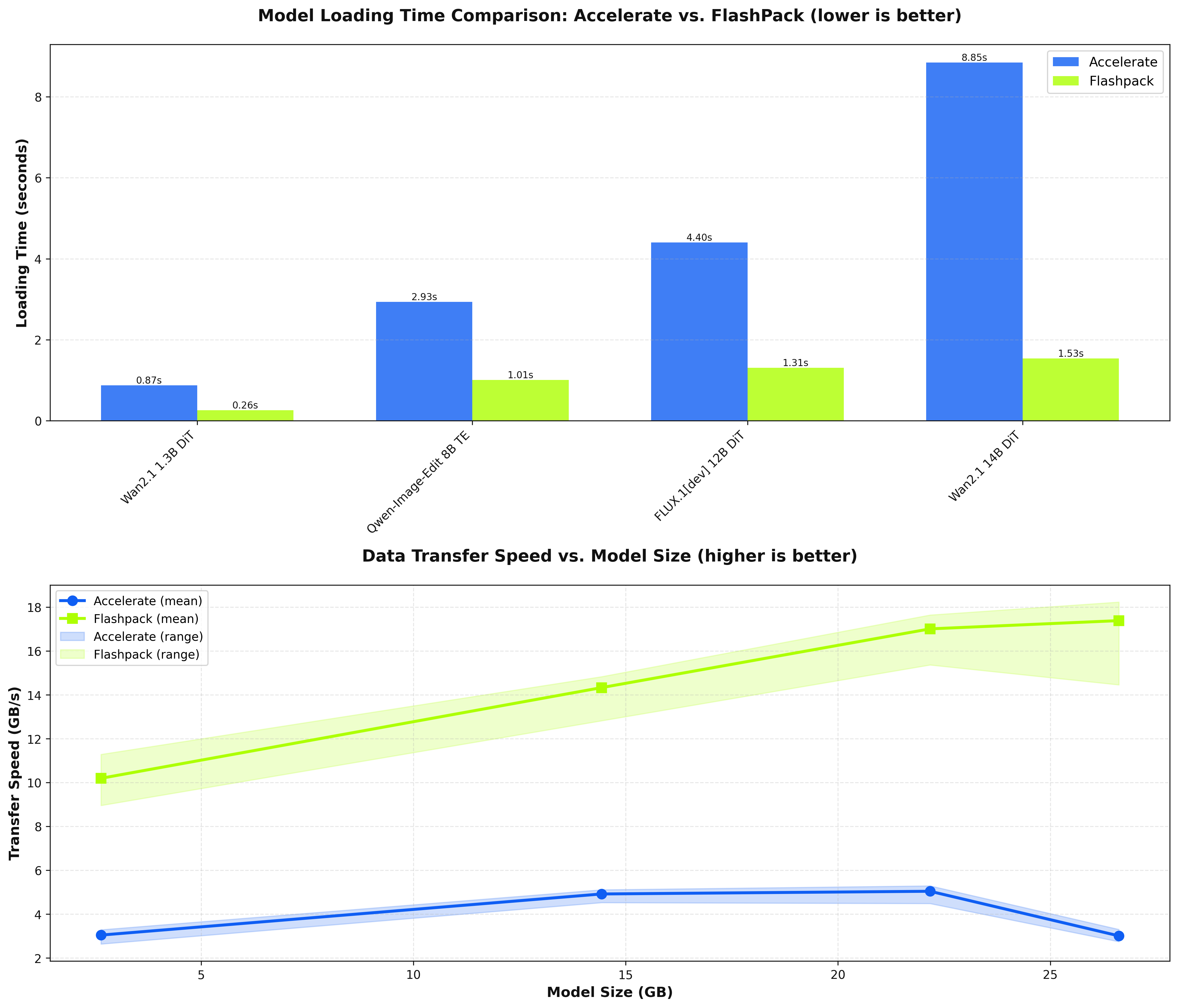
scripts/run_benchmark.py
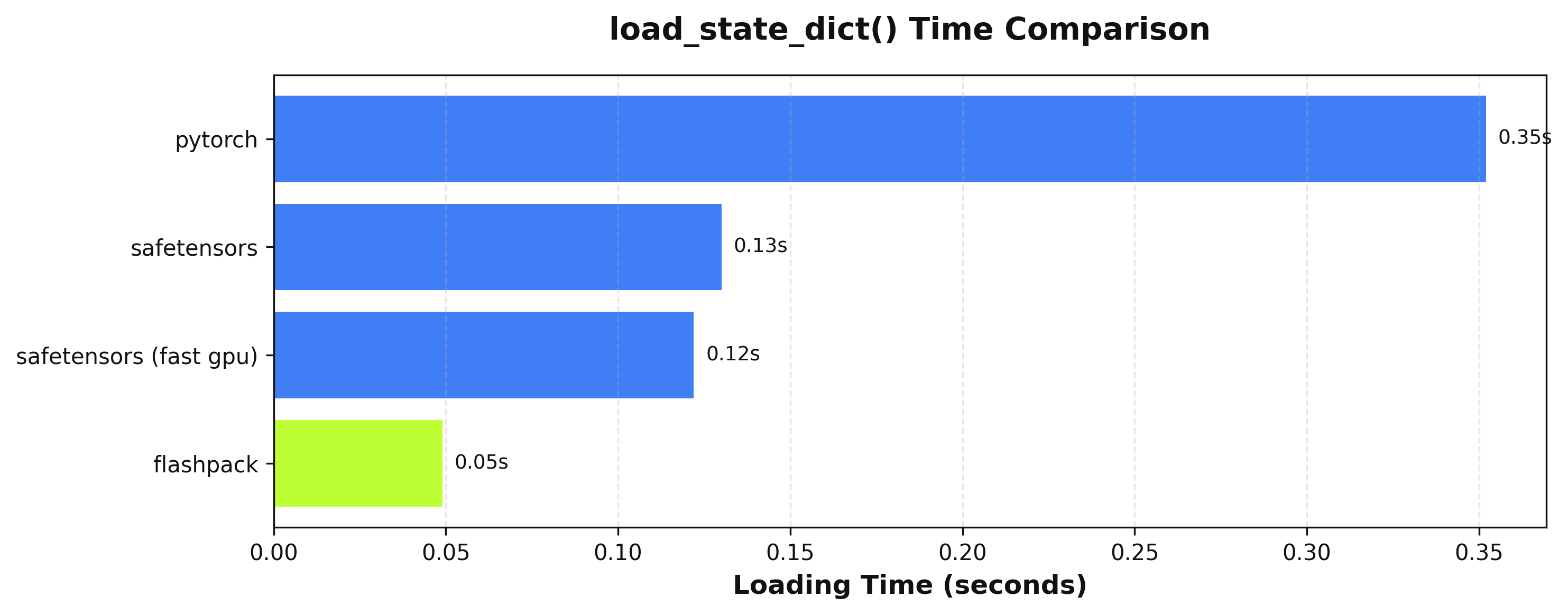
tests/test_speed_comparison.py
Updates
- 2026-08-11 (
v0.4.1): Sharded distributed read — on multi-GPU loads every rank reads its own 1/N of the pack and the shards are replicated over NVLink/fabric, removing the world-size read amplification. See Multi-GPU loading. - 2026-07-18 (
v0.4.0): Opt-in parallel CPU reads (FLASHPACK_CPU_PARALLEL_READ=1), fixed the O_DIRECT warm-cache gate, CI load benchmark. - 2026-07-17 (
v0.3.0/v0.3.1): Parallel reader — 16preadvthreads into pinned staging with overlapped async H2D copies, O_DIRECT when the page cache is cold. True-cold loads from network filesystems got 14–20× faster. - 2025-11-25: Multiple data types per checkpoint with no regressions in speed.
Installation
pip install flashpack
Requires Python ≥ 3.10 and PyTorch ≥ 2.0.
Production numbers
FlashPack is the weight loader for fal's serverless model fleet. Measured there — H100/H200/B200 nodes, pinned production packs on a network-backed (JuiceFS) weight store, every load bit-verified against its source:
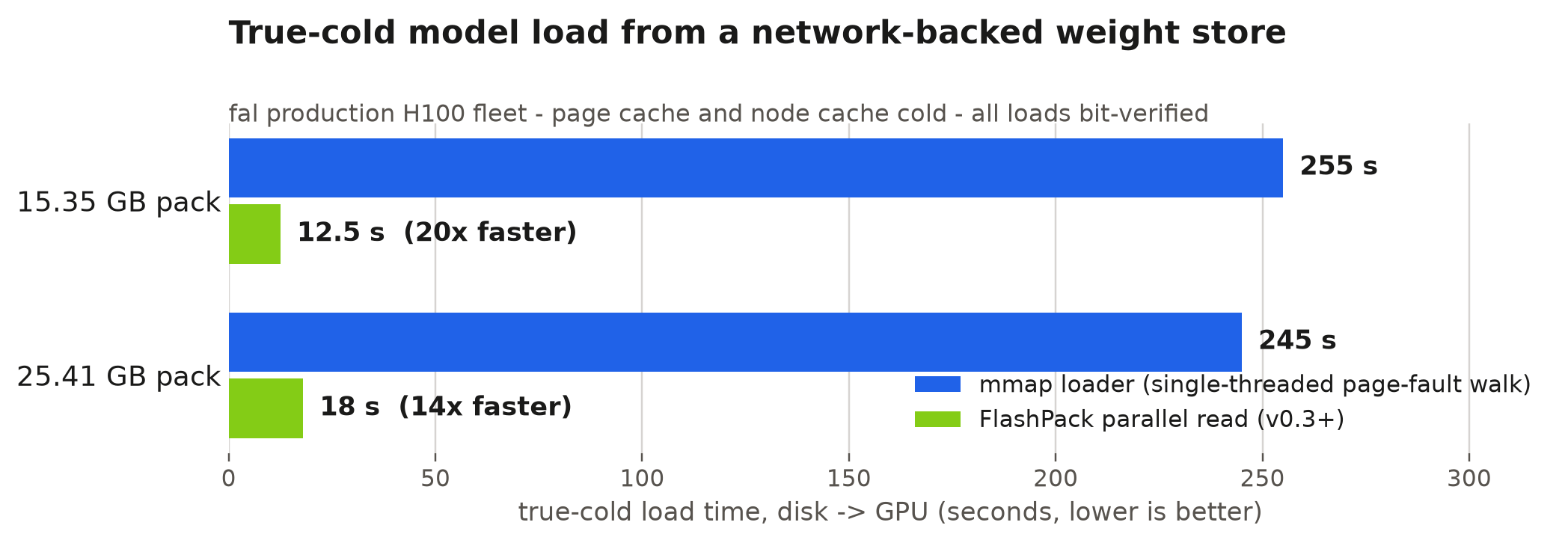
scripts/plot_fleet_coldstart.py
| Weight-store state | FlashPack (v0.3+ parallel reader) | vs. single-threaded mmap loading |
|---|---|---|
| Page cache hot | 10–18 GB/s (micro-benchmark above) | ~3.5× |
| Node NVMe cache warm, page cache cold | 5–12 GB/s sustained (each pack within ~10% of its own page-cache-hot rate) | 3–8× |
| Fully cold (bytes still in the object store) | 15.35 GB in 12.5 s / 25.41 GB in 18 s | 14–20× |
The last row is the serverless cold-start case: a fault-driven mmap walk over the same network filesystem ran at 0.06–0.10 GB/s (255 s and 245 s for those packs). More context in the fal FlashPack docs.
How it works
A .flashpack file lays every tensor out in large aligned contiguous macroblocks with
a small footer index — the whole file is read with a handful of long sequential I/Os
instead of one page fault per tensor. The reader runs 16 preadv threads, each with
its own pinned staging buffer and CUDA stream, so disk reads and host-to-device copies
overlap; tensors are reconstructed zero-copy on the GPU by aliasing the transferred
blocks. Reads use O_DIRECT when the page cache is actually cold (checked with
mincore) and buffered reads when it is warm, so hot loads run at memory speed while
cold loads skip the kernel page-cache copy entirely.
That is the same recipe GPUDirect Storage exists for — minus the parts that make GDS
hard to deploy: no kernel module, no filesystem allowlist, no PCIe topology tuning.
It works on any POSIX filesystem, including FUSE/network mounts, and degrades
gracefully (buffered parallel reads) where O_DIRECT is unavailable. The wins are
largest exactly where standard loaders are weakest: cold page caches, network-backed
storage, and many-shard checkpoints.
Multi-GPU loading
Loading the same pack on N ranks normally costs N full reads (the reader bypasses the
page cache, and even with it, network filesystems often re-read per process).
read_flashpack_file_distributed removes that amplification:
import flashpack

# rank 0 reads, everyone receives via broadcast
storage, metadata = flashpack.read_flashpack_file_distributed(
    "/path/to/model.flashpack", device="cuda",
)

# or: every rank reads 1/N of the payload, shards replicate over the fabric —
# the disk wall drops toward read_time / world_size
storage, metadata = flashpack.read_flashpack_file_distributed(
    "/path/to/model.flashpack", device="cuda", sharded=True,
)
The same paths are available from the model integrations, for ordinary BF16, FP32, and quantized packs alike:
model = MyFlashPackModel.from_pretrained_flashpack(
    "/path/to/repository",
    device="cuda",
    use_distributed_loading=True,
    distributed_sharded=True,  # omit for rank-0 read + broadcast
)
Two shard replication strategies ship (contiguous slabs with owner broadcasts, and
interleaved windows moved with one AllGather each); both are checksummed and
benchmarked in scripts/bench_distributed_shard_strategy.py — measure on your own
fabric before overriding the default. On an 8×H200 node a 14.5 GB fp8 pack loads
in ~0.65 s sharded, with the fabric moving 12.9 GB of replication in ~32–37 ms
depending on strategy.
Every read mode delivers the same bytes. sharded and use_distributed_loading
choose how the payload reaches the device, never which payload arrives, and
test_all_read_modes_agree_byte_for_byte pins that across all four paths on 8 ranks.
This matters when triage goes the other way: a distributed load is a tempting suspect
for a CUDA fault that shows up later in a model, and confirming or clearing it takes
minutes, not a bisect on real hardware —
- Read the same pack with
sharded=True, withsharded=False, and with plainread_flashpack_file, thentorch.equalthe storages on every rank. Different bytes are a flashpack bug; identical bytes clear the reader entirely. - If they match, build the model and diff its parameters against whatever loader you
are replacing. Any parameter left on
metais a packing gap, not a read bug. - Only then look at the caller. A fault that also reproduces with
distributed_sharded=False— or with flashpack removed — was never the read.
Tuning
The main knobs are environment variables; the defaults are the measured sweet spots on H100/H200-class nodes.
| Variable | Default | Effect |
|---|---|---|
FLASHPACK_PARALLEL_READ |
1 |
Kill switch: 0 falls back to the legacy single-threaded loader and disables sharded distributed reads (resolved from rank 0's environment) |
FLASHPACK_READ_THREADS |
16 |
Reader threads (each with its own pinned buffer + CUDA stream) |
FLASHPACK_READ_CHUNK_BYTES |
64 MiB |
Read/copy granularity |
FLASHPACK_DIRECT_IO |
auto | 0 forces buffered reads (escape hatch for filesystems where O_DIRECT misbehaves); auto uses O_DIRECT only when the page cache is cold |
FLASHPACK_CACHE_PINNED |
1 |
Keep pinned staging buffers cached between loads; 0 frees them |
FLASHPACK_CPU_PARALLEL_READ |
0 |
1 extends the parallel reader to CPU-target loads (default CPU path is lazy mmap views) |
FLASHPACK_SHARD_BYTES |
256 MiB |
Sharded distributed read, windows strategy only: bytes each rank reads per replication window |
FLASHPACK_SHARD_STRATEGY |
contiguous |
contiguous or windows (see src/flashpack/constants.py for the trade-off) |
Integration Guide
Mixins
Diffusers/Transformers
# Integration classes
from flashpack.integrations.diffusers import FlashPackDiffusersModelMixin, FlashPackDiffusionPipeline
from flashpack.integrations.transformers import FlashPackTransformersModelMixin

# Base classes
from diffusers.models import MyModel, SomeOtherModel
from diffusers.pipelines import MyPipeline

# Define mixed classes
class FlashPackMyModel(MyModel, FlashPackDiffusersModelMixin):
    pass

class FlashPackMyPipeline(MyPipeline, FlashPackDiffusionPipeline):
    def __init__(
        self,
        my_model: FlashPackMyModel,
        other_model: SomeOtherModel,
    ) -> None:
        super().__init__()

# Load base pipeline
pipeline = FlashPackMyPipeline.from_pretrained("some/repository")

# Save flashpack pipeline
pipeline.save_pretrained_flashpack(
    "some_directory",
    push_to_hub=False,  # pass repo_id when using this
)

# Load directly from flashpack directory or repository
pipeline = FlashPackMyPipeline.from_pretrained_flashpack("my/flashpack-repository")
Vanilla PyTorch
from flashpack import FlashPackMixin

class MyModule(nn.Module, FlashPackMixin):
    def __init__(self, some_arg: int = 4) -> None:
        ...

module = MyModule(some_arg = 4)
module.save_flashpack("model.flashpack")

loaded_module = module.from_flashpack("model.flashpack", some_arg=4)
Direct Integration
from flashpack import pack_to_file, assign_from_file

flashpack_path = "/path/to/model.flashpack"
model = nn.Module(...)

pack_to_file(model, flashpack_path, None)  # write state dict to file (None keeps source dtypes)
assign_from_file(model, flashpack_path)  # load state dict from file
CLI Commands
FlashPack provides a command-line interface for converting, inspecting, and reverting flashpack files.
flashpack convert
Convert a model to a flashpack file.
flashpack convert <path_or_repo_id> [destination_path] [options]
Arguments:
path_or_repo_id- Local path or Hugging Face repository IDdestination_path- (Optional) Output path for the flashpack file
Options:
| Option | Description |
|---|---|
--subfolder |
Subfolder of the model (for repo_id) |
--variant |
Model variant (for repo_id) |
--dtype |
Target dtype for the flashpack file. When omitted, no type changes are made |
--ignore-names |
Tensor names to ignore (can be specified multiple times) |
--ignore-prefixes |
Tensor prefixes to ignore (can be specified multiple times) |
--ignore-suffixes |
Tensor suffixes to ignore (can be specified multiple times) |
--use-transformers |
Load the path as a transformers model |
--use-diffusers |
Load the path as a diffusers model |
-v, --verbose |
Enable verbose output |
Examples:
# Convert a local model
flashpack convert ./my_model ./my_model.flashpack

# Convert from Hugging Face
flashpack convert stabilityai/stable-diffusion-xl-base-1.0 --subfolder unet --use-diffusers

# Convert with specific dtype
flashpack convert ./my_model ./my_model.flashpack --dtype float16
flashpack revert
Revert a flashpack file back to safetensors or torch format.
flashpack revert <path> [destination_path] [options]
Arguments:
path- Path to the flashpack filedestination_path- (Optional) Output path for the reverted file
Options:
| Option | Description |
|---|---|
-v, --verbose |
Enable verbose output |
Example:
flashpack revert ./my_model.flashpack ./my_model.safetensors
flashpack metadata
Print the metadata of a flashpack file.
flashpack metadata <path> [options]
Arguments:
path- Path to the flashpack file
Options:
| Option | Description |
|---|---|
-i, --show-index |
Show the tensor index |
-j, --json |
Output metadata in JSON format |
Examples:
# View basic metadata
flashpack metadata ./my_model.flashpack

# View metadata with tensor index
flashpack metadata ./my_model.flashpack --show-index

# Output as JSON
flashpack metadata ./my_model.flashpack --json
1 maintainer

Download files
Download the file for your platform. If you're not sure which to choose, learn more about installing packages.
Source Distribution
Built Distribution
Filter files by name, interpreter, ABI, and platform.
If you're not sure about the file name format, learn more about wheel file names.
Copy a direct link to the current filters
File details
Details for the file flashpack-0.4.4.tar.gz.
File metadata
- Download URL: flashpack-0.4.4.tar.gz
- Upload date:
- Size: 1.1 MB
- Tags: Source
- Uploaded using Trusted Publishing? Yes
- Uploaded via:
twine/7.0.0 CPython/3.13.14
File hashes
| Algorithm | Hash digest | |
|---|---|---|
| SHA256 |
d46bc49ac6c292c039b99c7b7d7bdb469e18ecb87038698566458fd0a3102c7d
|
|
| MD5 |
2690bb4c357b725923878cff01a44a47
|
|
| BLAKE2b-256 |
72b4d9d737e3b10ce18b52680b5702c70d33d663dfeee91fb7ca78d9338aba77
|
Provenance
The following attestation bundles were made for flashpack-0.4.4.tar.gz:
Publisher:
pypi.yaml on fal-ai/flashpack
-
Statement:
-
Statement type:
https://in-toto.io/Statement/v1 -
Predicate type:
https://docs.pypi.org/attestations/publish/v1 -
Subject name:
flashpack-0.4.4.tar.gz -
Subject digest:
d46bc49ac6c292c039b99c7b7d7bdb469e18ecb87038698566458fd0a3102c7d - Sigstore transparency entry: 2498845055
- Sigstore integration time:
-
Permalink:
fal-ai/flashpack@dc0e1fc8c6025dd0155a931f16e31829513ec2c0 -
Branch / Tag:
refs/tags/v0.4.4 - Owner: https://github.com/fal-ai
-
Access:
public
-
Token Issuer:
https://token.actions.githubusercontent.com -
Runner Environment:
github-hosted -
Publication workflow:
pypi.yaml@dc0e1fc8c6025dd0155a931f16e31829513ec2c0 -
Trigger Event:
release
-
Statement type:
File details
Details for the file flashpack-0.4.4-py3-none-any.whl.
File metadata
- Download URL: flashpack-0.4.4-py3-none-any.whl
- Upload date:
- Size: 64.3 kB
- Tags: Python 3
- Uploaded using Trusted Publishing? Yes
- Uploaded via:
twine/7.0.0 CPython/3.13.14
File hashes
| Algorithm | Hash digest | |
|---|---|---|
| SHA256 |
8f830d7f1f24f9977c4732b04d908f0ee68122fb4872812537f1c8ecc63a9556
|
|
| MD5 |
30e9db7c0e8b0366c17286065b48e94c
|
|
| BLAKE2b-256 |
75adb83823c37454dd04151a2eb477c1a6e4352b19907626319fe4bb1af9b375
|
Provenance
The following attestation bundles were made for flashpack-0.4.4-py3-none-any.whl:
Publisher:
pypi.yaml on fal-ai/flashpack
-
Statement:
-
Statement type:
https://in-toto.io/Statement/v1 -
Predicate type:
https://docs.pypi.org/attestations/publish/v1 -
Subject name:
flashpack-0.4.4-py3-none-any.whl -
Subject digest:
8f830d7f1f24f9977c4732b04d908f0ee68122fb4872812537f1c8ecc63a9556 - Sigstore transparency entry: 2498845062
- Sigstore integration time:
-
Permalink:
fal-ai/flashpack@dc0e1fc8c6025dd0155a931f16e31829513ec2c0 -
Branch / Tag:
refs/tags/v0.4.4 - Owner: https://github.com/fal-ai
-
Access:
public
-
Token Issuer:
https://token.actions.githubusercontent.com -
Runner Environment:
github-hosted -
Publication workflow:
pypi.yaml@dc0e1fc8c6025dd0155a931f16e31829513ec2c0 -
Trigger Event:
release
-
Statement type:







