
FlashSlice
Fused Triton kernels for the slice/deslice coupling of physics-attention, and the Transolver layer they accelerate.





FlashSlice is the companion code of “Does Transolver really need a Transformer?” (Wen & Mishra, 2026). The paper finds that Transolver's accuracy comes from the slice/deslice coupling between a full-resolution point stream and a small set of physics tokens, not from the self-attention among those tokens. This repository provides the two things needed to use that result:
- Kernels that compute slice and deslice as two streaming passes over the
points, without ever writing the
N × H × Gslice-weight tensor to memory. They reproduce eager PyTorch to within its own floating-point error, are bitwise deterministic, and train 1.35–1.7× faster in up to 25% less memory at the standard configuration and 4–6.5× faster in 85–96% less memory at large slice counts. - The Transolver model, with every ablation of the paper available as a single flag.
It is not a training framework: there is no trainer, data pipeline or config system, so the model and the kernels drop into an existing codebase.
Contents
- Installation
- Quick start
- How it works
- Performance
- Numerical precision
- Supported shapes
- Ablations and results
- Tests and benchmarks
- Citation
- License
Installation
pip install flashslice
# or, from source
git clone https://github.com/Shizheng-Wen/flashslice.git
cd flashslice && pip install -e .
Requirements: Python ≥ 3.9, PyTorch ≥ 2.4, Triton ≥ 3.0 and an NVIDIA GPU. Measurements were taken on two GPUs: an NVIDIA GH200 with PyTorch 2.5 and Triton 3.0 (the paper's numbers), and an NVIDIA RTX 4090 with PyTorch 2.8 and Triton 3.4.
Supported GPUs. Tile configurations are tuned per GPU class and picked automatically from the device's shared memory per block: a Hopper table (H100/GH200, swept on a GH200) and an Ada table (swept on an RTX 4090), which also serves other GPUs with less shared memory, such as consumer Ampere and the A100.
flashslice.kernels.tile_table()reports the class in use;set_tile_table(...)orFLASHSLICE_TILE_TABLEforces one. The defaultieeedot mode needs no tensor cores;tf32/bf16need Ampere or newer. For a new GPU, re-tune withbench/bench_kernels.pyandbench/pick_tiles.py.
Quick start
The model
import torch
from flashslice import Transolver

model = Transolver(
    space_dim=3, fun_dim=1, out_dim=4,   # coordinates, per-point inputs, outputs
    n_hidden=256, n_heads=8, n_layers=8,
    slice_num=32,                        # G, slices per head
    use_fused_slice=True,                # route slice/deslice through the kernels
).cuda()

x  = torch.randn(1, 200_000, 3, device="cuda")   # coordinates
fx = torch.randn(1, 200_000, 1, device="cuda")   # per-point inputs
y  = model(x, fx)                                # (1, 200000, 4)
use_fused_slice is an implementation switch, not a model change: outputs
match the eager path, and checkpoints are interchangeable in both directions.
The kernels on their own
x_mid (B, N, H, D) is what the slice weights are computed from, fx_mid
(B, N, H, DV) is what is pooled, W is the slot projection, b a per-slot
bias (or None) and tau (H,) the temperature.
from flashslice.kernels import fused_slice, fused_deslice

# slice, then deslice (Transolver's order); the deslice reuses the slice's statistics
z_num, s, stats = fused_slice(x_mid, fx_mid, W, b, tau, return_stats=True)
tokens = mix(z_num / (s + 1e-5)[..., None])                   # (B, H, G, DV)
out = fused_deslice(x_mid, W, b, tau, tokens, stats=stats)    # (B, N, H, DV)

# deslice, then slice (a persistent point stream)
out, stats = fused_deslice(x_mid, W, b, tau, tokens, return_stats=True)
z_num, s = fused_slice(x_mid, fx_mid, W, b, tau, stats=stats)
W may be shared (G, D), per head (H, G, D) or per sample and head
(B, H, G, D) (e.g. W = k(tokens)); its gradient is returned in the same
shape, and b follows likewise. DV may differ from D.
How it works
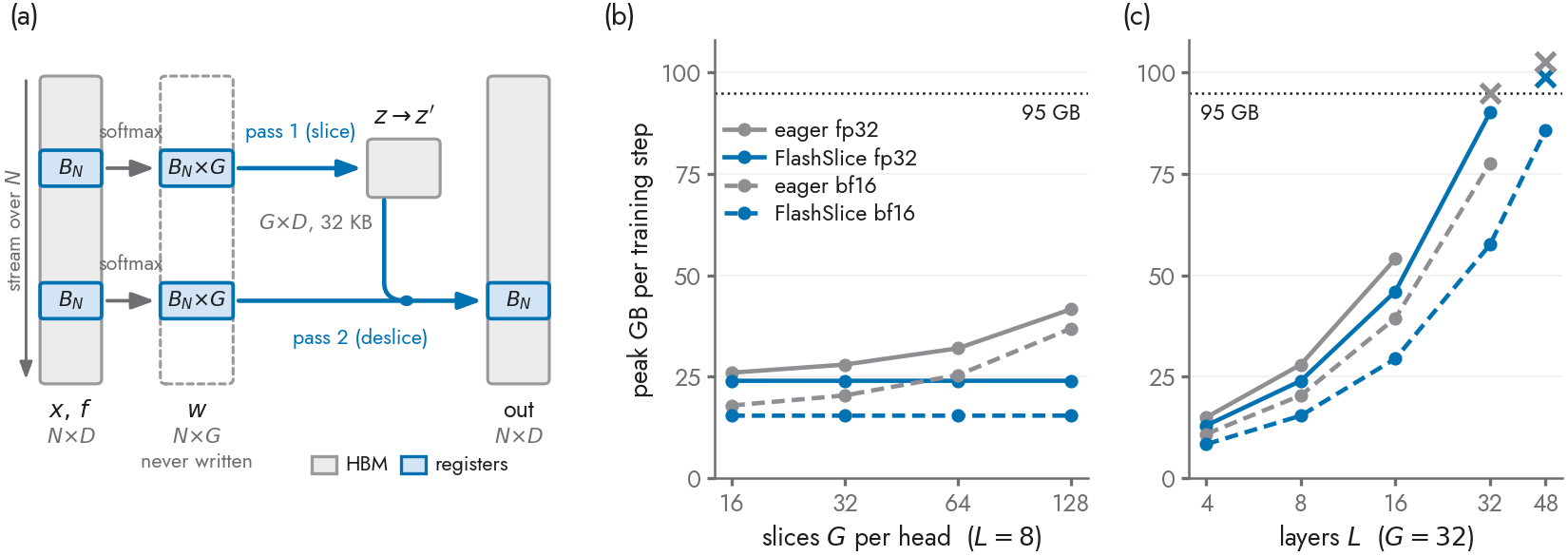
The eager layer materializes the slice weights w of shape (B, H, N, G) and
keeps them for the backward pass; for N in the millions this is the largest
activation of the layer and the only one that grows with G. FlashSlice
applies FlashAttention's trade to this pooling: each pass streams over the
points in tiles, forms the tile of w in registers, uses it and discards it,
and the backward pass recomputes it. The token state between the passes is
only H × G × D floats (32 KB at the standard configuration).
The kernels use no atomics, so two runs are bitwise identical, and they are
registered as PyTorch custom operators, so the model compiles into a single
torch.compile graph.
Performance
One GH200, eager PyTorch against FlashSlice, no compilation or activation
checkpointing. Full model (L=8, C=256, H=8, G=32):
| N | eager | FlashSlice | speedup | eager mem | FlashSlice mem | saved | |
|---|---|---|---|---|---|---|---|
| training, fp32 | 262k | 171 ms | 126 ms | 1.35× | 28.0 GB | 24.0 GB | 14% |
| training, bf16 | 262k | 143 ms | 93.1 ms | 1.53× | 20.4 GB | 15.4 GB | 24% |
| training, bf16 | 1M | 585 ms | 345 ms | 1.70× | 81.3 GB | 61.3 GB | 25% |
| inference, fp32 | 8.4M | 1944 ms | 1160 ms | 1.68× | 80.5 GB | 64.5 GB | 20% |
| inference, bf16 | 8.4M | 1420 ms | 932 ms | 1.52× | 60.5 GB | 44.5 GB | 26% |
| inference, bf16 | 12.6M | OOM | 1411 ms | — | — | 66.7 GB | — |
One layer (H=8, D=32) at large slice counts, bf16 inputs and dots:
| G | N | eager | FlashSlice | speedup | eager mem | FlashSlice mem | saved | |
|---|---|---|---|---|---|---|---|---|
| training | 256 | 262k | 47.5 ms | 11.9 ms | 3.98× | 13.7 GB | 2.0 GB | 85% |
| training | 256 | 1M | 293.7 ms | 45.5 ms | 6.45× | 54.5 GB | 8.1 GB | 85% |
| training | 512 | 262k | 90.6 ms | 20.0 ms | 4.53× | 26.7 GB | 2.0 GB | 92% |
| training | 512 | 1M | OOM | 80.3 ms | — | — | 8.1 GB | — |
| training | 1024 | 262k | 180.2 ms | 37.6 ms | 4.79× | 52.7 GB | 2.1 GB | 96% |
| inference | 256 | 4.2M | 157.3 ms | 53.2 ms | 2.95× | 68.0 GB | 8.3 GB | 88% |
What changes most is how the layer scales:
- Memory is flat in the slice count. From
G=16toG=128a bf16 training step stays at 15.4 GB with FlashSlice, while eager grows from 17.9 to 36.9 GB. One layer holds 2 GB whetherGis 48 or 1024. - Depth reaches further. Within 95 GB, FlashSlice trains 32 layers where eager fits 16 (fp32) and 48 where eager fits 32 (bf16).
- It composes with the usual tools. Against a
torch.compiled eager baseline the kernels still train 1.24–1.26× faster; with activation checkpointing they are 1.31–1.42× faster; sharded over four GPUs they train 16.8M points at 14.6M points/s, 2.6× the best achievable eager pipeline.
Sizing rule: fused memory scales with B·N and the number of layers, not with
G — about 8 GB per million points per layer for a bf16 training step and
2 GB per million for inference (H=8, D=32).
On an RTX 4090 (24 GB, torch 2.8, Triton 3.4, the Ada tile table), one
layer (H=8, D=32), eager against FlashSlice in the same process:
| G | N | eager | FlashSlice | speedup | eager mem | FlashSlice mem | saved | |
|---|---|---|---|---|---|---|---|---|
| training, fp32 | 32 | 262k | 66.1 ms | 16.5 ms | 4.01× | 2.5 GB | 2.0 GB | 21% |
| training, bf16 | 32 | 1M | 115.7 ms | 38.9 ms | 2.97× | 10.5 GB | 8.0 GB | 24% |
| training, fp32 | 64 | 262k | 80.3 ms | 18.1 ms | 4.45× | 4.3 GB | 2.0 GB | 53% |
| training, bf16 | 256 | 262k | 135.0 ms | 15.1 ms | 8.96× | 13.6 GB | 2.0 GB | 85% |
| training, bf16 | 1024 | 262k | OOM | 34.2 ms | — | — | 2.1 GB | — |
| inference, fp32 | 32 | 1M | 111.6 ms | 19.1 ms | 5.85× | 5.0 GB | 4.0 GB | 20% |
| inference, bf16 | 256 | 1M | 99.2 ms | 13.1 ms | 7.56× | 17.0 GB | 2.1 GB | 88% |
bf16 rows use bf16 dots. The Hopper table does not transfer: several of its
tiles exceed the 4090's 99 KB of shared memory, and among those that fit, the
tuned table is up to 4.1× faster (G=64, fp32 training step: 18.1 against
74.2 ms). Every case of bench/parity_test.py passes on this GPU. Two checks
of bench/parity_ops.py do not: the temperature gradient of the blocked
kernels with per-sample weights, slice-first order, lands at 2.8–3.4×
eager's error against the 2× gate (relative error ~2×10⁻⁵), with either tile
table, so it is a numerics difference of this GPU and Triton version rather
than a tiling one.
Kernels as the coupling of another model
The v0.2.0 extensions (per-sample weights, a value width apart from the
logits width, one-pass statistics, an online deslice) came from using the
kernels as the coupling of a point-cloud model whose slots are anchor points
of each sample (D=56, DV=32, H=8, N≈265k, bf16 dots). One coupling
round, forward and backward, on one GH200:
| G | v0.1.0 | v0.2.0 | |
|---|---|---|---|
| 256 | 30.8 ms | 14.6 ms | 2.1× |
| 1024 | 107 ms | 48.3 ms | 2.2× |
| 2048 | 208 ms | 93.1 ms | 2.2× |
In a 50k-step training run of that model, bf16 dots tracked a tf32
control at every step at 3.5× less step time.
Numerical precision
Inputs are fp32, or bf16 under torch.autocast; parameters stay fp32 and
accumulation is fp32 in every mode. The precision of the dots is chosen with
set_dot_mode(...) or the FLASHSLICE_DOT_MODE environment variable:
| mode | dots | error against fp64 | use it for |
|---|---|---|---|
ieee (default) |
fp32, on the FMA units | eager fp32's own | anything that must match eager |
tf32 |
value dots on tf32 tensor cores | ~5×10⁻⁴ on outputs | fp32 inputs at large G |
bf16v |
value dots bf16, logits fp32 | between the two | bf16 inputs |
bf16 |
all dots bf16 | eager bf16 autocast's own | bf16 training at large G |
tf32x3 |
each dot as three tf32 products | 3–7× eager fp32's | fp32 inputs at large G, when tf32 is too noisy |
The logits dot stays in fp32 below the bf16 level because the softmax
Jacobian amplifies noise in the slice weights. Every mode is held to a parity
gate against an fp64 reference: the fused error on every output and parameter
gradient must stay within 1.25× of eager fp32's error (2× of eager bf16's for
the bf16 modes), and two fused runs must agree bitwise. The learned
temperature, whose gradient cancels row by row in exact arithmetic, is the
most sensitive quantity and the one the gate watches most closely.
Supported shapes
Two kernel families sit behind use_fused_slice, and the layer picks one by
shape:
| family | shapes | how |
|---|---|---|
| single-tile | D, G powers of two in [16, 128], DV = D |
the whole slot axis fits one tile, so the softmax over G never leaves registers; tiles tuned per G |
| G-blocked | any G, D ≤ 256, any DV, weights per head or per sample |
one online pass saves the per-point softmax statistics (m, l) (2/G of w); every kernel then recomputes w one G-block at a time |
D > 256 falls back to the eager path visibly: the layer logs a warning,
sets use_fused_slice = False on the model and records the reason in
fused_slice_fallback, so an inert flag can never silently train the
baseline. set_kernel_mode("blocked") forces the blocked family (for timing
and parity runs), and set_block_g overrides its block size.
Ablations and results
Every variant of the paper is one flag on Transolver; at most one may be set
at a time.
| flag | what changes |
|---|---|
no_token_attention |
attention among the slice tokens becomes a per-token linear map; tokens no longer interact |
untie_slice_weights |
deslice gets its own projection and temperature |
share_slice_across_layers |
slice weights computed once at layer 1 and reused by every layer |
slice_once |
slice once → transformer on the G tokens → deslice once (no point stream) |
mlp_only |
the attention sublayer is removed entirely (pointwise model) |
use_fused_slice combines with every flag except share_slice_across_layers
and slice_once, which need the slice weights the kernels never materialize;
those combinations raise at construction.
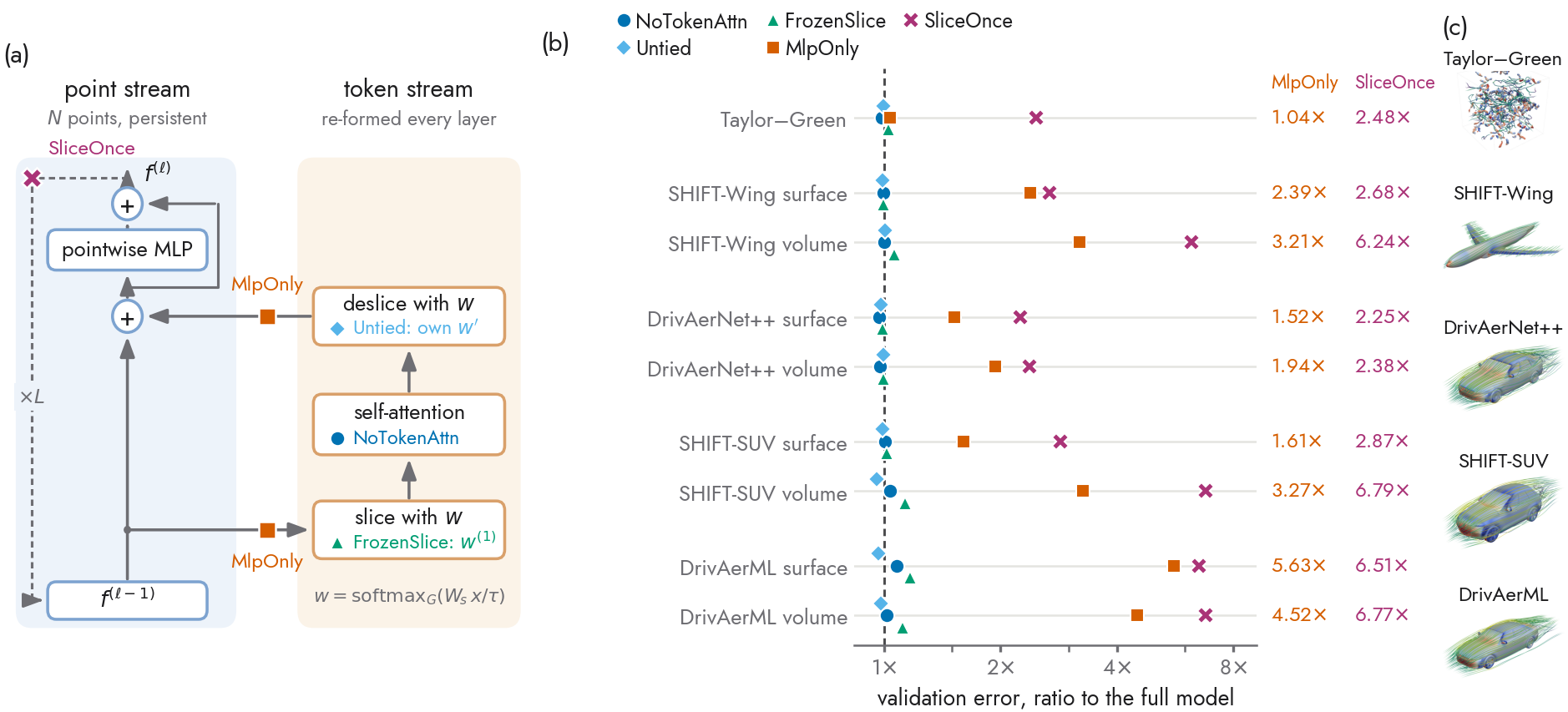
Best validation relative L¹ on nine benchmarks in fluid dynamics and industrial aerodynamics, with up to 1.3×10⁸ mesh points per sample. Baseline and NoTokenAttn are mean ± std over three seeds, the others one seed; bold marks the best per row. Three significant figures, standard deviations to one.
| benchmark | Baseline | NoTokenAttn | MlpOnly | Untied | FrozenSlice | SliceOnce |
|---|---|---|---|---|---|---|
| Taylor–Green | 0.0756 ±.0001 | 0.0745 ±.0001 | 0.0786 | 0.0755 | 0.0777 | 0.188 |
| SHIFT-Wing surface | 0.0580 ±.0005 | 0.0579 ±.0005 | 0.139 | 0.0576 | 0.0577 | 0.155 |
| SHIFT-Wing volume | 0.127 ±.0007 | 0.127 ±.0008 | 0.408 | 0.128 | 0.135 | 0.793 |
| DrivAerNet++ surface | 0.193 ±.005 | 0.188 ±.002 | 0.294 | 0.190 | 0.192 | 0.435 |
| DrivAerNet++ volume | 0.163 ±.0003 | 0.159 ±.001 | 0.315 | 0.162 | 0.162 | 0.386 |
| SHIFT-SUV surface | 0.157 ±.0007 | 0.157 ±.00003 | 0.252 | 0.156 | 0.159 | 0.449 |
| SHIFT-SUV volume | 0.0601 ±.0006 | 0.0624 ±.0009 | 0.197 | 0.0577 | 0.0683 | 0.408 |
| DrivAerML surface | 0.089 ±.001 | 0.096 ±.000 | 0.501 | 0.086 | 0.104 | 0.579 |
| DrivAerML volume | 0.110 ±.005 | 0.112 ±.004 | 0.497 | 0.108 | 0.123 | 0.745 |
- Token attention is removable. NoTokenAttn is within −2.6% to +1.8% of the baseline on seven benchmarks and at +3.8% and +7.9% on the other two, and it is the best variant on four (tied with the baseline on SHIFT-Wing volume).
- The coupling is not. Removing it (MlpOnly) costs 1.04–5.6×, and widening the pointwise model to 112% of the baseline's parameters closes almost none of that gap.
- Nor is the point stream. SliceOnce keeps the attention and has more parameters than the baseline, but collapses the points into token space after one slice; it is the worst variant everywhere, at 2.2–6.8×.
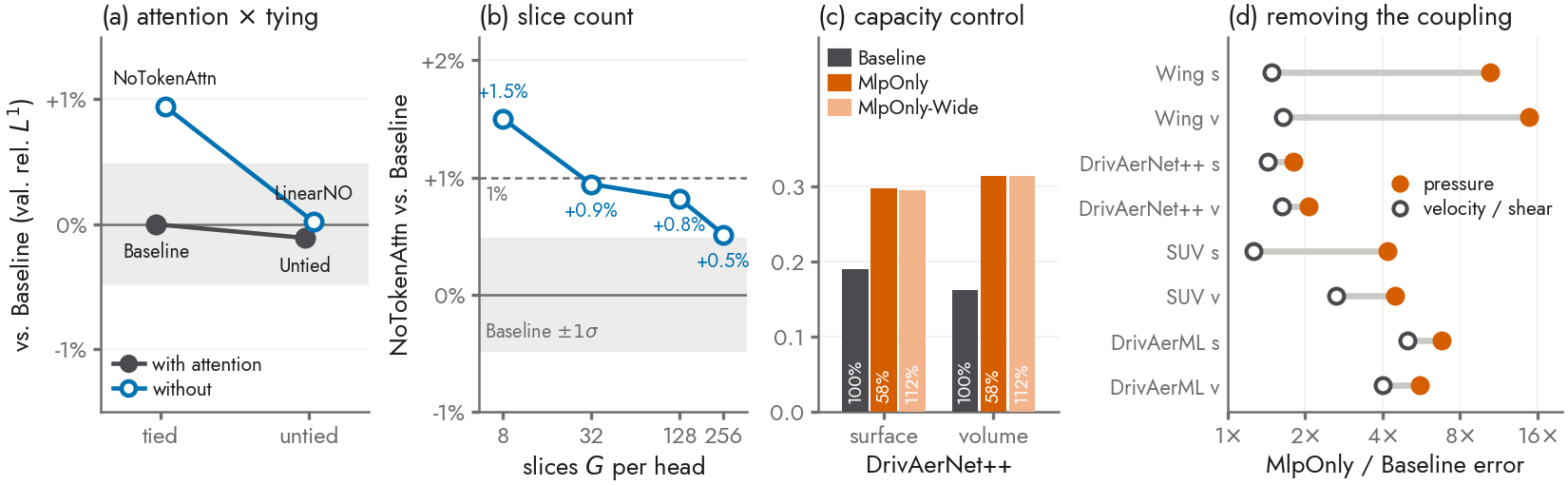
The controls behind these readings: (a) whether the projections are tied or untied does not interact with removing the attention; (b) NoTokenAttn stays within 1.5% of the baseline for every slice count from 8 to 256; (c) a wider pointwise model does not recover the coupling; (d) on every aerodynamic benchmark, removing the coupling hurts the pressure, the globally determined field, more than the velocity or wall shear beside it.
Tests and benchmarks
pytest tests/                                            # dims contract, routing, visible fallback, eager equivalence
python bench/parity_test.py                              # the layer: fused vs eager, fp64-referenced, both families
python bench/parity_ops.py                               # the ops: weight layouts, value widths, both call orders
python bench/bench_layer.py --slices 256 --dtype bf16    # one layer, eager vs fused, any shape
python bench/bench_kernels.py --defaults-only            # per-kernel time, bandwidth, TFLOP/s
python bench/bench_kernels.py --family blocked --slices 256   # tile sweep for the blocked kernels
python bench/pick_tiles.py bench/results/sweep_*.json    # sweep results -> tile-table entry
bench/README.md lists what each script measures and the pitfalls that
matter when timing these kernels. Tag v0.1.0 is the tree the paper's numbers
were measured on; CHANGELOG.md lists what main adds, and
ROADMAP.md what comes next.
Citation
If you use FlashSlice or build on its findings, please cite:
@article{wen2026transolver,
  title   = {Does Transolver really need a Transformer?},
  author  = {Wen, Shizheng and Mishra, Siddhartha},
  journal = {arXiv preprint arXiv:2609.32525},
  year    = {2026},
  url     = {https://arxiv.org/abs/2609.32525}
}
License
Apache License 2.0; see LICENSE.
The physics-attention layer, the MLP and the block structure derive from
Transolver (Copyright © 2024 THUML @
Tsinghua University), used under the MIT License; those files carry a header
saying so, and NOTICE reproduces the MIT notice in full. The Triton
kernels, the ablation flags and the instrumentation are original work.
LinearNO (Hu et al., AAAI 2026), which the paper compares against, is not
included; see the authors' release at https://github.com/HiPRL/LinearNO.
1 maintainer

Metadata
1 maintainer
Release files for flashslice 0.3.0
For a detailed explanation of source distributions (sdists) and built distributions (wheels), please see the package formats documentation.
Source distribution (sdist)
| File | Size | Uploaded | |
|---|---|---|---|
| flashslice-0.3.0.tar.gz | 54.2 kB | Details |
Built distribution (wheel)
| File | Interpreter | ABI | Platform | Reset |
|---|---|---|---|---|
| flashslice-0.3.0-py3-none-any.whl | Python 3 | none | any | Details |
Total release size: 102.8 kB
Release files / flashslice-0.3.0.tar.gz
| Download URL | flashslice-0.3.0.tar.gz |
|---|---|
| Size | 54.2 kB |
| Tags | Source |
|
SHA-256 checksum How to use checksums |
ac55e2b70b5a85ba7ce5393c13fe7fdaea0f3d2fe30efb928b7ff34a499b9537
|
|
BLAKE2b-256 checksum How to use checksums |
87efaf18aa60706aabf7a9e302a6f780abfdfe0c950381c3d5284fe16e2b7aa5
|
| Upload date | |
|
Uploaded using Trusted Publishing? What is trusted publishing? |
Yes |
| Uploaded via |
twine/7.0.0 CPython/3.13.14
|
Provenance
Provenance describes where a file came from. On PyPI, provenance is shared via attestations, which provide a verifiable record of the build or publishing details. View details, limitations and caveats.


PyPI Publish Attestation
PyPI verified that this artifact, at this checksum, originated from the publisher listed below.
Signed by GitHub Actions, verified by PyPI on Sep 29, 2026.
Transparency logRelease files / flashslice-0.3.0-py3-none-any.whl
| Download URL | flashslice-0.3.0-py3-none-any.whl |
|---|---|
| Size | 48.6 kB |
| Tags | Python 3 |
|
SHA-256 checksum How to use checksums |
3649bebb5a3e9b32507674194ce5fb3271ef101e30909f29c12eda38d4b63f77
|
|
BLAKE2b-256 checksum How to use checksums |
40d0559b3e444bc8522cc6171b12642a1fad91767c5a2aacff38fc36961b0e01
|
| Upload date | |
|
Uploaded using Trusted Publishing? What is trusted publishing? |
Yes |
| Uploaded via |
twine/7.0.0 CPython/3.13.14
|
Provenance
Provenance describes where a file came from. On PyPI, provenance is shared via attestations, which provide a verifiable record of the build or publishing details. View details, limitations and caveats.
PyPI Publish Attestation
PyPI verified that this artifact, at this checksum, originated from the publisher listed below.
Signed by GitHub Actions, verified by PyPI on Sep 29, 2026.
Transparency log













