
Flask Toolkits

Installation
pip install flask-toolkits
Description
Flask toolkits implements and provides several features from FastAPI like:
- Automatic API documentation (define the function and we'll generate the
swagger/openapispec for you) - Passing parameters through
view/routerfunction which is unable inFlaskbefore - Easy Middleware setup
- Parameters and schema validation using
Pydantic - Response classes that could return any type of data without worried to get error
- much more..
Changelogs
- v0.0
- First Upload
- v0.1
- Integration with flask-http-middleware
- pydantic support for JSON arguments and validation
- Multiple response type generator
- Added
JSONResponseclass to replacejsonifyroles in send dictionary data with encoding improvements.
- v0.2
- Supported enumeration API documentation
- Added support for type hint from
typing's generic (ex:Optional,Union,List) - Fixed input parameter validations
- v0.3
- Support
FileandForminput parameters validation and automatic swagger. - Added constraint feature for parameters (ex: limit, max/min length, greater/less than, equals than etc)
- Support
- v0.4
- Support
Authorizationheader in openapi spec. - Added
Authorizationprocessing function for security and can be used asloginorauth.
- Support
- v0.5
- Support
add_url_ruleandroutefor endpoint definition - Support auto swagger for multiple methods in a single endpoints
- Support
- v0.6
- Support
aliason endpoint parameters (path, query, header, etc) to enable non-pythonic terms of parameter names
- Support
- v0.7
- support response structure generator function to helps creating the response schema and examples
Key Tools inside this toolkit
- Automatic API documentation (
swagger/openapi) - Request-Response direct HTTP middleware (
flask-http-middleware) - Automatic parameters validation (
pydantic) - Response generator (JSON, Plain Text, HTML)
Automatic Parameters Validation
The original Blueprints class from flask can't insert most of arguments inside endpoint.
Here our APIRouter allows you to have arguments inside your endpoint
from typing import Optional
from flask_toolkits import APIRouter, Body, Header, Query
from flask_toolkits.responses import JSONResponse


router = APIRouter("email", import_name=__name__, static_folder="/routers/email", url_prefix="/email")


@router.post("/read", tags=["Email Router"])
def get_email(
    id: int,
    name: Optional[str],
):
    return JSONResponse({"id": id, "name": name})
Automatic API Documentation
Here our APIRouter allows you to auto-documenting your endpoint through AutoSwagger.
Define the new router using APIRouter class, lets put it in another pyfile
email_view.py
from typing import Optional
from flask_toolkits import APIRouter, Body, Header, Query
from flask_toolkits.responses import JSONResponse


router = APIRouter("email", import_name=__name__, static_folder="/routers/email", url_prefix="/email")


@router.post("/read", tags=["Email Router"])
def get_email(
    id: int = Body(),
    name: Optional[str] = Body(None),
    token: int = Header(),
    race: Optional[str] = Query(None)
):
    return JSONResponse({"id":id, "name": name})
main.py
from flask import Flask
from flask_toolkits import AutoSwagger

from email_view import router as email_router


app = Flask(__name__)

auto_swagger = AutoSwagger()

app.register_blueprint(email_router)
app.register_blueprint(auto_swagger)


if __name__ == "__main__":
    app.run()
then you can go to http://localhost:5000/docs and you will found you router is already documented
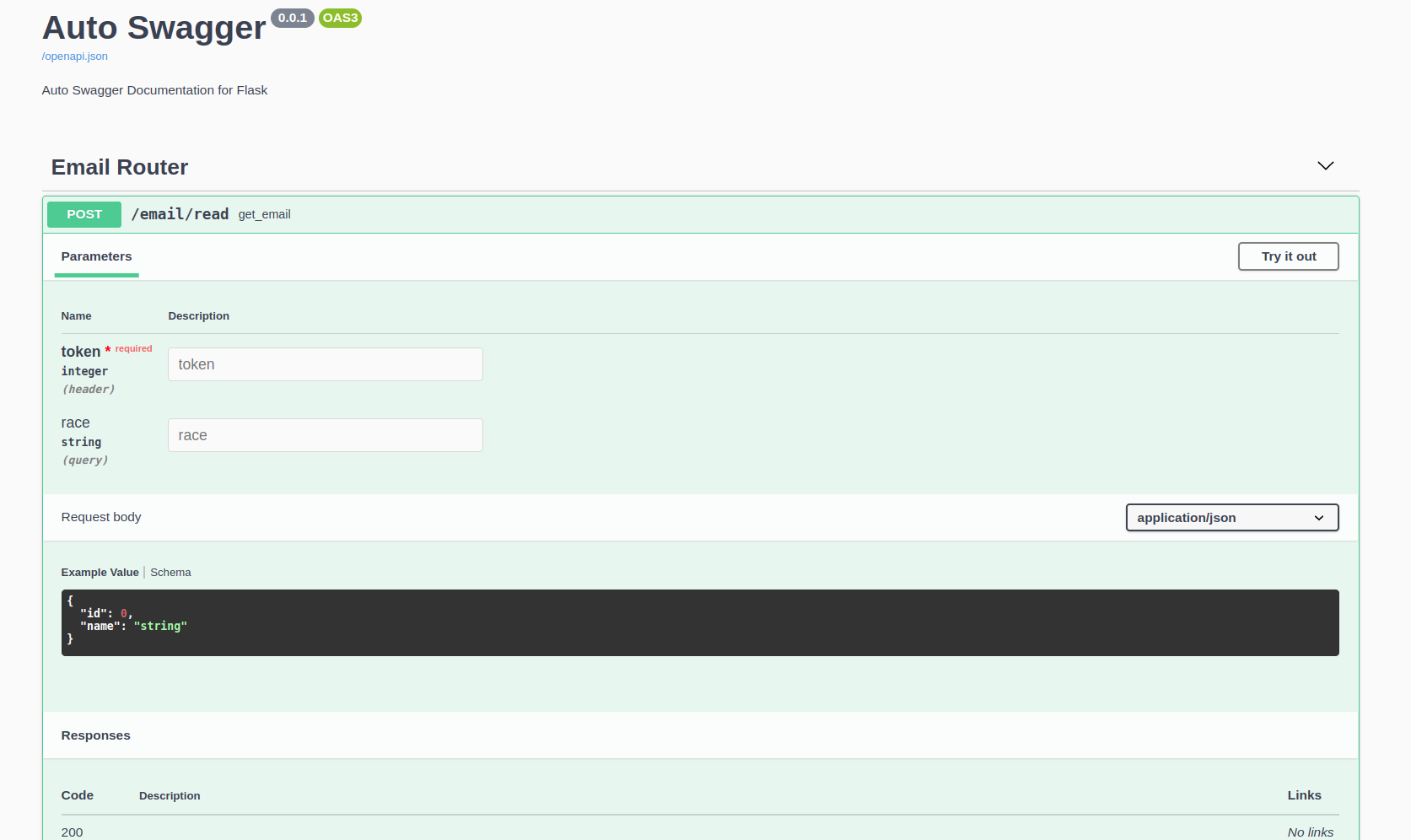
Supported Field Parameters
flask-toolkits provide multiple field parameters such as Header, Query, Body, Path, File, Form
Easy Security Scheme Setup and Documentation
flask-toolkits helps you to define your security scheme for authorization easier than before. In advance this also give you automated documentation.
Basic Usage
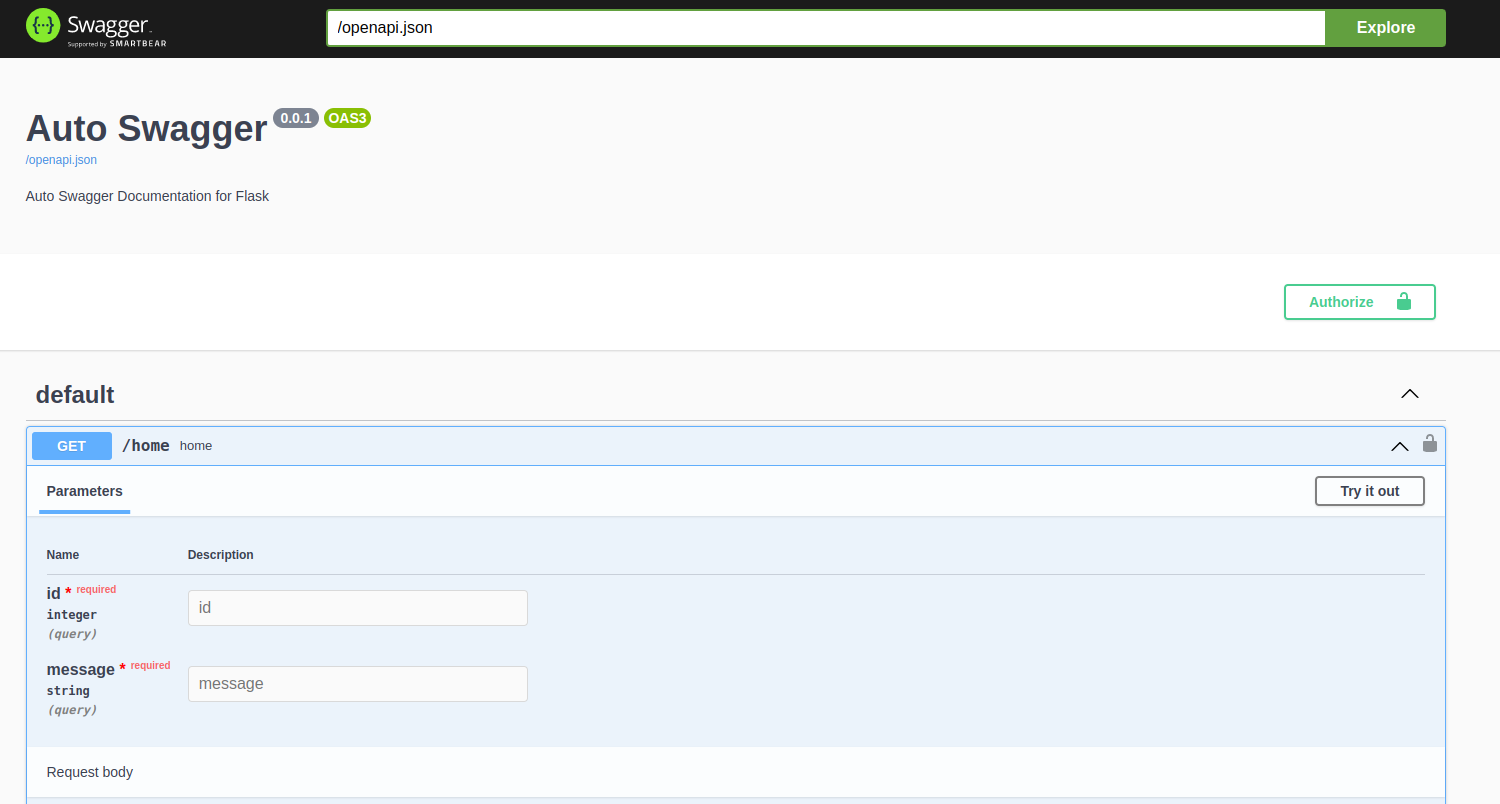
lets assume you have your own bearer security schema. You just have to create a new instance of HTTPBearerSecurity() to enable automatic documentation on it.
from flask import request
from flask_toolkits import APIRouter
from flask_toolkits.security import HTTPBearerSecurity

router = APIRouter("api", __name__)

@router.get("/home", security=HTTPBearerSecurity())
def home(message: str):
    if my_security_scheme(request):
        return JSONResponse({"message": message})
    return JSONResponse({"message": "invalid authorization"})
this is how it looks like
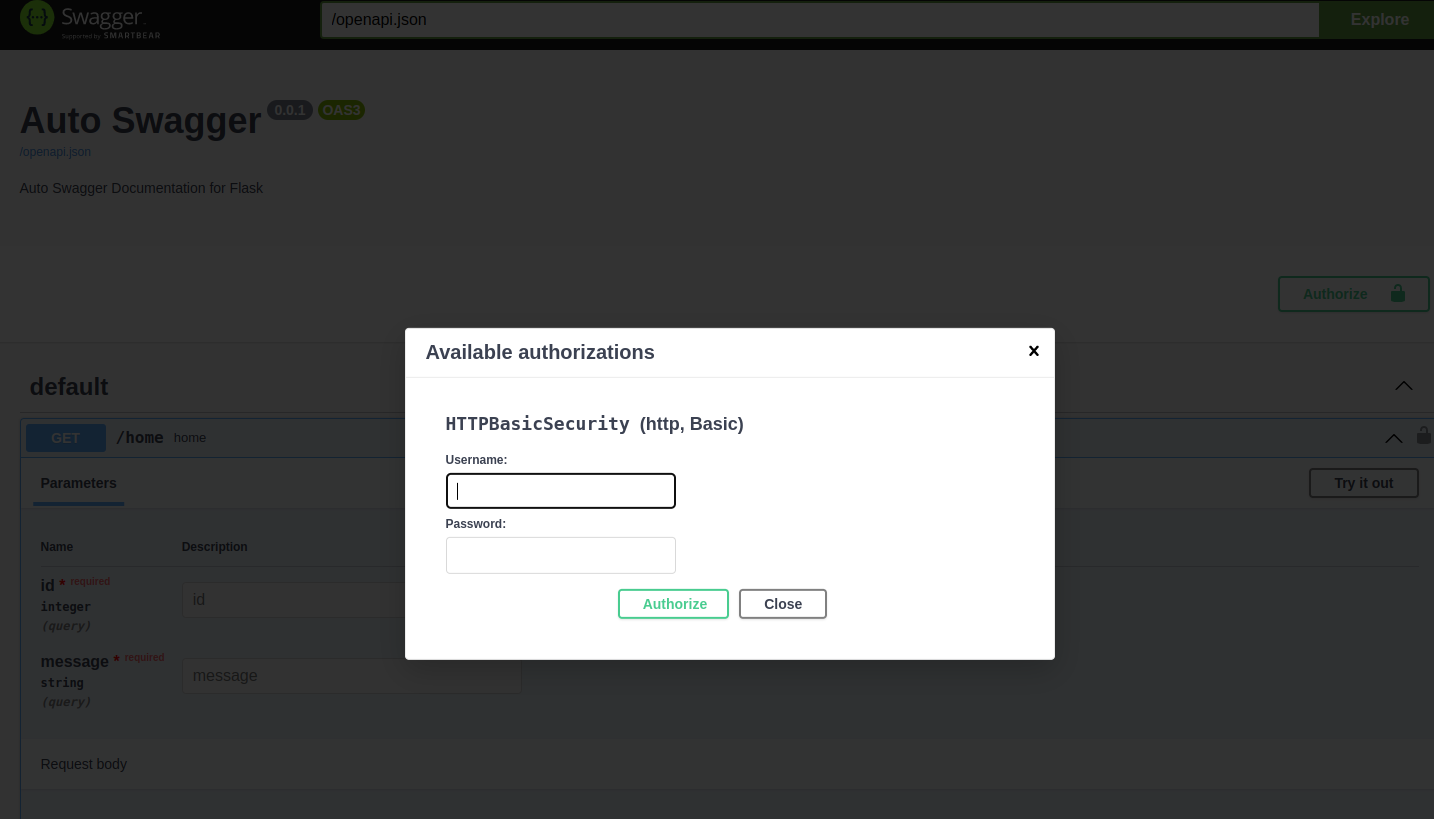
on you clicked it
Define your own security scheme
If you want to define your own security scheme you can follow below guidance
from flask import request
from flask_toolkits import APIRouter
from flask_toolkits.security import HTTPBearerSecurity

class JWTBearer(HTTPBearerSecurity):
    def __init__(self):
        super().__init__()

    def __call__(self, req):
        data = self.get_authorization_data(req)
        if data != "abcdefghij":
            raise Exception("This is not good")
        return req

router = APIRouter("api", __name__)

@router.get("/home", security=JWTBearer())
def home(message: str):
    if my_security_scheme(request):
        return JSONResponse({"message": message})
    return JSONResponse({"message": "invalid authorization"})
Overriding __call__ method inside the subclass would define your security schema for the routers that are using your security scheme
Define to all endpoints in a router
Just pass it to APIRouter and all its endpoint will use that security scheme!
router_with_bearer = APIRouter("api", __name__, security=JWTBearer())
but don't worries! You can also override it by just defining in the router decorator!
@router_with_bearer.get("/home", security=AnotherBearerSecurity())
def home():
    return {"message": "hello"}
Parameter Alias
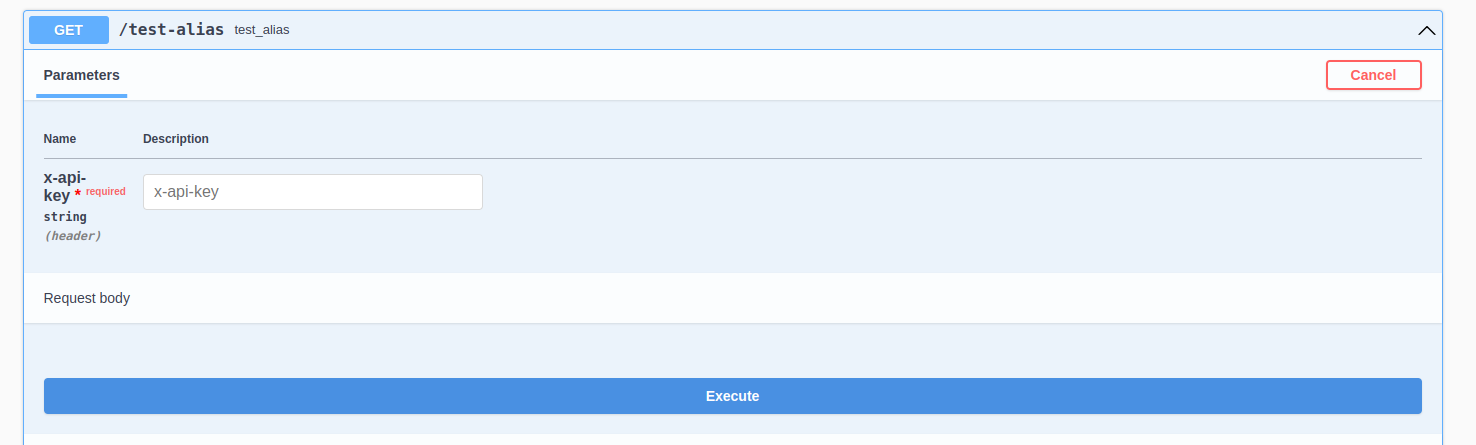
In case you have non-pythonic terms with unicode character (-, +, _, =) for your paramter names, you can apply the alias into the parameters easily
@app.get("/test-alias")
def test_alias(
    apikey: str = Header(alias="x-api-key")
):
    return JSONResponse({"apikey": apikey})
here you will also have your swagger is defined with that alias
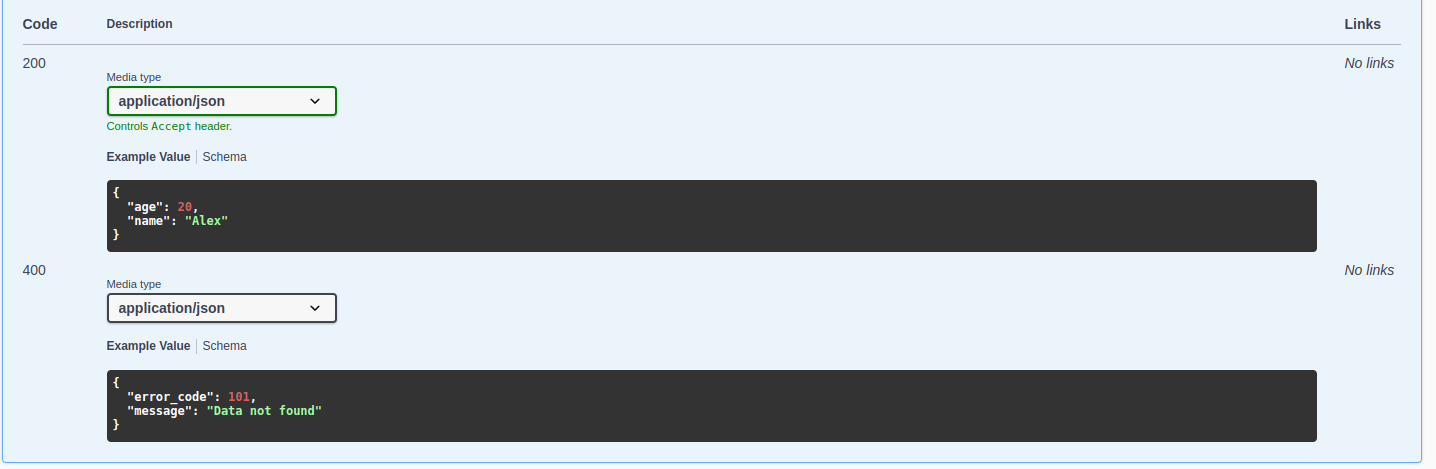
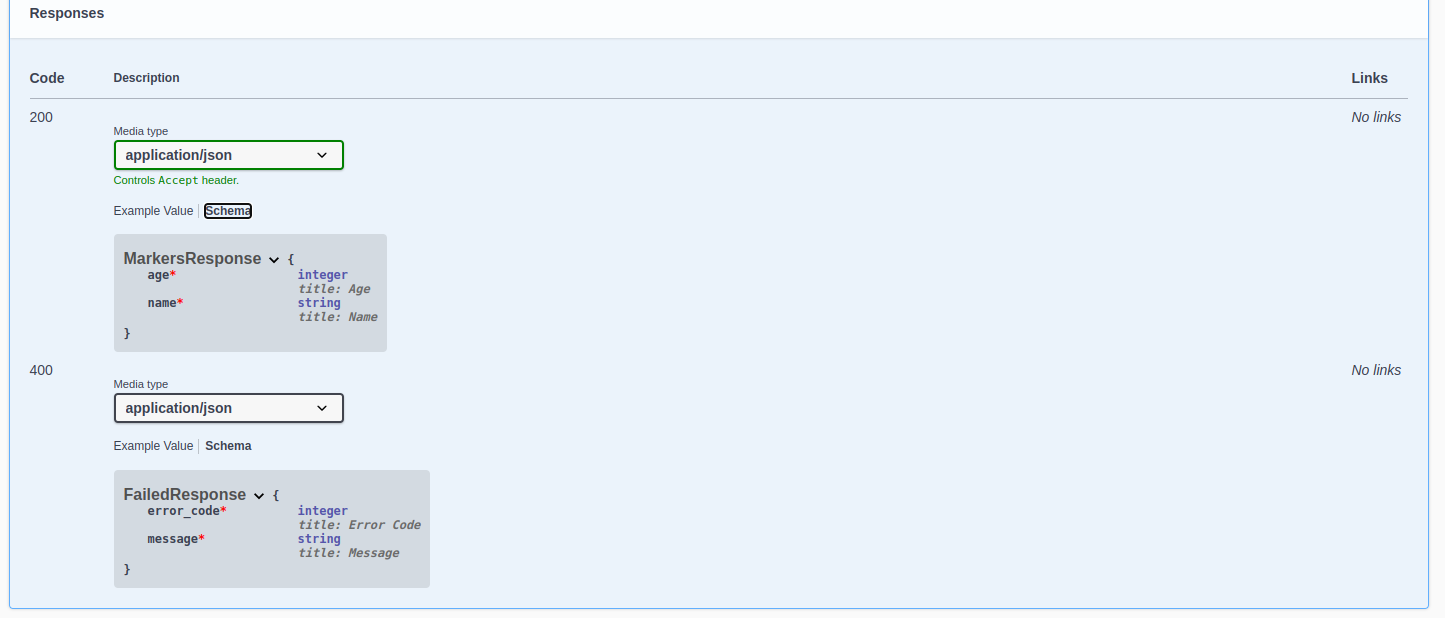
Response Structure
Creating the response example and schema easily by just defining the class and pass it to create_response_example or accessing as_response() from BaseSchema objects
from flask_toolkits.responses import response_json_example


class PersonResponse(BaseSchema):
    name: str
    age: int

class FailedResponse(BaseSchema):
    message: str
    error_code: int

@router.route(
    '/hello_world/<first>/<int:number>', tags=["My Hello"],
    responses={
        200: response_json_example(PersonResponse(name="Alex", age=20)),
        400: FailedResponse(message="Data not found", error_code=101).as_response()
    },
)
def hello_world(
    name: str = Query(),
    age: int = Query()
):
    resp = {
        "name": name,
        "age": age
    }

    return JSONResponse(resp)
Multiple HTTP Methods in a single endpoint
add_url_rule and route method for Flask's App or Blueprints object are now supported. This also allows you to have multiple HTTP methods in a single endpoint function
@app.route("/test-multiple-method", methods=["GET", "POST", "PUT", "DELETE", "PATCH"])
def go_multi_method(
    name: str = Body()
):
    return JSONResponse({"result": name})
Here you will get null if you hit it using GET but you'll get the value on you hit with other methods that support Body. You won't loose your validation since it only applied for methods that support that kind of params.
Request-Response direct HTTP middleware
import time
from flask import Flask
from flask_toolkits.middleware import MiddlewareManager, BaseHTTPMiddleware

app = Flask(__name__)

class MetricsMiddleware(BaseHTTPMiddleware):
    def __init__(self):
        super().__init__()

    def dispatch(self, request, call_next):
        t0 = time.time()
        response = call_next(request)
        response_time = time.time()-t0
        response.headers.add("response_time", response_time)
        return response

app.wsgi_app = MiddlewareManager(app)
app.wsgi_app.add_middleware(MetricsMiddleware)

@app.get("/health")
def health():
    return {"message":"I'm healthy"}
1 maintainer

Metadata
1 maintainer
Release files for flask-toolkits 0.7.10
For a detailed explanation of source distributions (sdists) and built distributions (wheels), please see the package formats documentation.
Source distribution (sdist)
| File | Size | Uploaded | |
|---|---|---|---|
| flask-toolkits-0.7.10.tar.gz | 1.0 MB | Details |
Built distribution (wheel)
| File | Interpreter | ABI | Platform | Reset |
|---|---|---|---|---|
| flask_toolkits-0.7.10-py3-none-any.whl | Python 3 | none | any | Details |
Total release size: 2.0 MB
Release files / flask-toolkits-0.7.10.tar.gz
| Download URL | flask-toolkits-0.7.10.tar.gz |
|---|---|
| Size | 1.0 MB |
| Tags | Source |
|
SHA-256 checksum How to use checksums |
82519db56181ab450f23f1650f4a04e17b268419fce1caa8448c199848dd8fdc
|
|
BLAKE2b-256 checksum How to use checksums |
330d665a8e57d4f6d94e14095a852c5e3e3b8d49178d06f3da8121d084389615
|
| Upload date | |
|
Uploaded using Trusted Publishing? What is trusted publishing? |
No |
| Uploaded via |
twine/4.0.2 CPython/3.11.2
|
Release files / flask_toolkits-0.7.10-py3-none-any.whl
| Download URL | flask_toolkits-0.7.10-py3-none-any.whl |
|---|---|
| Size | 1.0 MB |
| Tags | Python 3 |
|
SHA-256 checksum How to use checksums |
95eec867fc900b27a86d84d616f2cf5eda9b622dce7095d334a6626ce4a87e76
|
|
BLAKE2b-256 checksum How to use checksums |
3d39f885d5c9365d8786d61d4ecb3cf26accdbc6be128ec47baa68f3451511af
|
| Upload date | |
|
Uploaded using Trusted Publishing? What is trusted publishing? |
No |
| Uploaded via |
twine/4.0.2 CPython/3.11.2
|














