




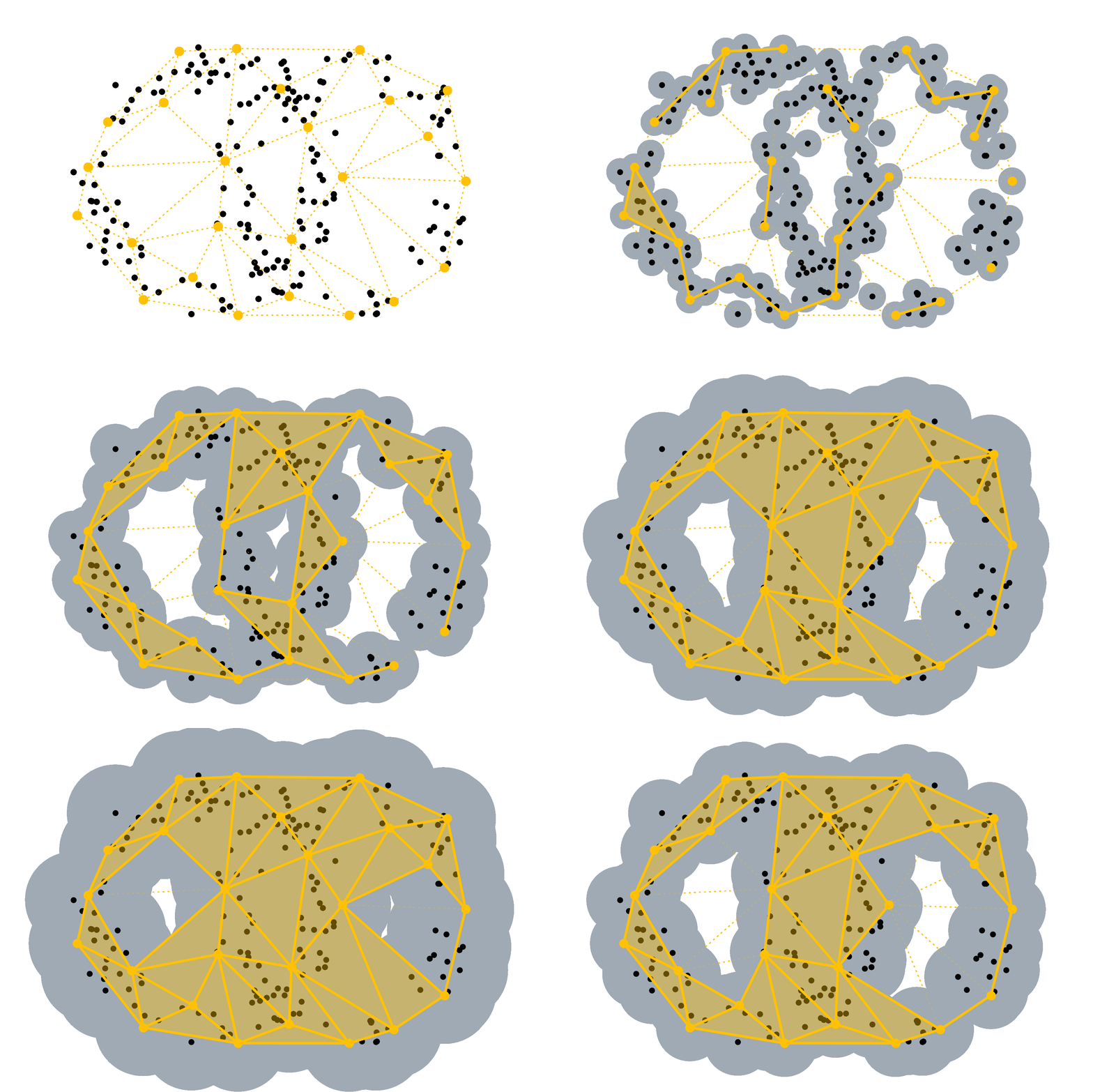
Flooder
flooder is a Python package for constructing a lightweight filtered simplicial complex-the Flood complex-on Euclidean point cloud data, leveraging state-of-the-art GPU computing hardware, for subsequent persistent homology (PH) computation (using gudhi).
Currently, flooder allows computing Flood PH on millions of points in 3D (see Usage), enabling previously computationally infeasible large-scale applications of PH on point clouds. While flooder is primarily intended for 3D Euclidean point cloud data, it also works with Euclidean point cloud data of moderate dimension (e.g., 4,5,6). For theoretical guarantees of the Flood complex, including algorithmic details, see Citing.
Setup
Currently, flooder is available on pypi with wheels for Unix-based platforms. To install, type the following command into your environment (we do recommend a clean new Anaconda environment, e.g., created via conda create -n flooder-env python=3.9 -y):
pip install flooder
Local/Development build
In case you want to contribute to the project, we recommend checking out the flooder GitHub repository, and setting up the environment as follows:
git clone https://github.com/plus-rkwitt/flooder
conda create -n flooder-env python=3.9 -y
conda activate flooder-env
pip install -r requirements.txt
The previous commands will install all dependencies, such as torch, gudhi, numpy, fpsample and scipy. Once installed, you can run our examples from within the top-level flooder folder (i.e., the directory created when doing git clone) via
PYTHONPATH=. python examples/example_01_cheese_3D.py
Alternatively, you can also do a pip install -e . for a local editable build. Note that the latter command will already install all required dependencies (so, there is no need to do a pip install -r requirements.txt).
Optional dependencies
In case you want to plot persistence diagrams, we recommend using persim, which can be installed via
pip install persim
Usage
In the following example, we compute Flood PH on 2M points from a standard multivariate Gaussian in 3D, using 1k landmarks, and finally plot the diagrams up to dimension 2. You could, e.g., just copy-paste the following code into a Jupyter notebook (note that, in case you just checked out the GitHub repository and did not do a pip install flooder, the notebook would need to be in the top-level directory for all imports to work).
from flooder import (
    generate_noisy_torus_points,
    flood_complex,
    generate_landmarks)

DEVICE = "cuda"
n_pts = 1_000_000  # Number of points to sample from torus
n_lms = 1_000      # Number of landmarks for Flood complex

pts = generate_noisy_torus_points(n_pts).to(DEVICE)
lms = generate_landmarks(pts, n_lms)

stree = flood_complex(pts, lms, return_simplex_tree=True)
stree.compute_persistence()
ph = [stree.persistence_intervals_in_dimension(i) for i in range(3)]
Importantly, one can either call flood_complex with the already pre-selected
(here via FPS) landmarks, or one can just specify the number of desired landmarks, e.g.,
via
n_lms = 1_000
stree = flood_complex(pts, n_lms, return_simplex_tree=True)
Related Projects
If you are looking for fast implementations of (Vietoris-)Rips PH, see
ripser, or the GPU-accelerated ripser++, respectively. In addition gudhi supports, e.g., computing Alpha PH also on fairly large point clouds (see the examples/example_01_cheese_3D.py for a runtime comparison).
License
The code is licensed under an MIT license.
Citing
Please cite our NeurIPS 2025 paper (in press now) in case you find flooder useful for your applications. Read the arXiv preprint here.
@inproceedings{graf2025floodcomplex,
      title={The Flood Complex: Large-Scale Persistent Homology on Millions of Points},
      author={Graf, Florian and Pellizzoni, Paolo and Uray, Martin and Huber, Stefan and Kwitt, Roland},
      year={2025},
      booktitle={NeurIPS},
}
1 maintainer

Metadata
1 maintainer
Release files for flooder 1.0.1
For a detailed explanation of source distributions (sdists) and built distributions (wheels), please see the package formats documentation.
Source distribution (sdist)
| File | Size | Uploaded | Provenance | |
|---|---|---|---|---|
| flooder-1.0.1.tar.gz | 35.2 kB | Without provenance | Details |
Built distribution (wheel)
| File | Interpreter | ABI | Platform | Reset |
|---|---|---|---|---|
| flooder-1.0.1-py3-none-any.whl | Python 3 | none | any | Details |
Total release size: 70.5 kB
Release files / flooder-1.0.1.tar.gz
| Download URL | flooder-1.0.1.tar.gz |
|---|---|
| Size | 35.2 kB |
| Tags | Source |
|
SHA-256 checksum How to use checksums |
11a4b44e49492a0a9f6014e3859029dd0c2185568949e704cad075ad0fdae395
|
|
BLAKE2b-256 checksum How to use checksums |
b7f92bf0c92990f4f29095f5a83277c4afe1ce0d880974fd9c6ac2d0193e2534
|
| Upload date | |
|
Uploaded using Trusted Publishing? What is trusted publishing? |
No |
| Uploaded via |
twine/6.1.0 CPython/3.9.23
|
Release files / flooder-1.0.1-py3-none-any.whl
| Download URL | flooder-1.0.1-py3-none-any.whl |
|---|---|
| Size | 35.3 kB |
| Tags | Python 3 |
|
SHA-256 checksum How to use checksums |
7fae01fcfc76b6e0b2bfea45a59952c828da99cf4b993d8833b60b405860a925
|
|
BLAKE2b-256 checksum How to use checksums |
bb045d77e53de2de585cde891b1fc5bcad8cf0c7feef91f3d25546e2f76e011d
|
| Upload date | |
|
Uploaded using Trusted Publishing? What is trusted publishing? |
No |
| Uploaded via |
twine/6.1.0 CPython/3.9.23
|
Security for flooder 1.0.1
Provenance
Provenance describes where a file came from. On PyPI, provenance is shared via attestations, which provide a verifiable record of the build or publishing details. View details, limitations and caveats.
No provenance found
None of the files in this release were uploaded with provenance metadata.
A note on package security
PyPI is a repository for distributing packages, not a service for auditing them. While third-party security researchers and our staff do their best to detect and remove malicious packages, PyPI cannot guarantee the quality, security or suitability of any given package.
To learn more about protecting yourself from malicious actors, visit our package security documentation.














