
FLOR

Flor (for "fast low-overhead recovery") is a record-replay system for deep learning, and other forms of machine learning that train models on GPUs. Flor was developed to speed-up hindsight logging: a cyclic-debugging practice that involves adding logging statements after encountering a surprise, and efficiently re-training with more logging. Flor takes low-overhead checkpoints during training, or the record phase, and uses those checkpoints for replay speedups based on memoization and parallelism.
FlorDB integrates Flor, git and sqlite3 to manage model developer's logs, execution data, versions of code, and training checkpoints. In addition to serving as an experiment management solution for ML Engineers, FlorDB extends hindsight logging across model trainging versions for the retroactive evaluation of iterative ML.
FlorFlow will extend FlorDB to support Dataflow operations.
Flor, FlorDB, and FlorFlow are software developed at UC Berkeley's RISE Lab.
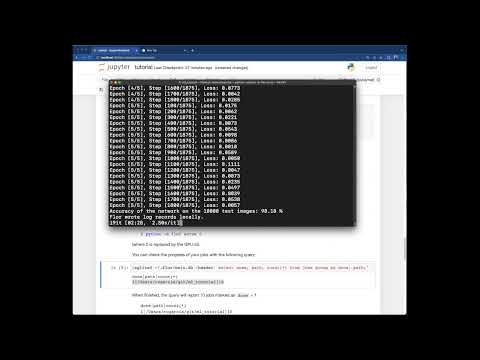
You can follow along yourself by starting a Jupyter server from this directory and opening tutorial.ipynb.
Installation
pip install florflow
Getting Started
We start by selecting (or creating) a git repository to save our model training code as we iterate and experiment. Flor automatically commits your changes on every run, so no change is lost. Below we provide a sample repository you can use to follow along:
$ git clone git@github.com:ucbepic/ml_tutorial
$ cd ml_tutorial/
Run the train.py script to train a small linear model,
and test your florflow installation.
$ python train.py
Flor will manage checkpoints, logs, command-line arguments, code changes, and other experiment metadata on each run (More details below). All of this data is then expesed to the user via SQL or Pandas queries.
View your experiment history
From the same directory you ran the examples above, open an iPython terminal, then load and pivot the log records.
$ python -m flor dataframe

        projid               tstamp  filename device seed hidden epochs batch_size     lr print_every accuracy correct
0  ml_tutorial  2023-08-28T15:04:07  train.py    cpu   78    500      5         32  0.001         500    97.71    9771
1  ml_tutorial  2023-08-28T15:04:35  train.py    cpu    8    500      5         32  0.001         500    98.01    9801
Run some more experiments
The train.py script has been prepared in advance to define and manage four different hyper-parameters:
$ cat train.py | grep flor.arg
hidden_size = flor.arg("hidden", default=500)
num_epochs = flor.arg("epochs", 5)
batch_size = flor.arg("batch_size", 32)
learning_rate = flor.arg("lr", 1e-3)
You can control any of the hyper-parameters (e.g. hidden) using Flor's command-line interface:
$ python train.py --kwargs hidden=75
Application Programming Interface (API)
Flor is shipped with utilities for serializing and checkpointing PyTorch state, and utilities for resuming, auto-parallelizing, and memoizing executions from checkpoint.
The model developer passes objects for checkpointing to flor.checkpointing(**kwargs),
and gives it control over loop iterators by
calling flor.loop(name, iterator) as follows:
import flor
import torch

hidden_size = flor.arg("hidden", default=500)
num_epochs = flor.arg("epochs", 5)
batch_size = flor.arg("batch_size", 32)
learning_rate = flor.arg("lr", 1e-3)

trainloader: torch.utils.data.DataLoader
testloader:  torch.utils.data.DataLoader
optimizer:   torch.optim.Optimizer
net:         torch.nn.Module
criterion:   torch.nn._Loss

with flor.checkpointing(model=net, optimizer=optimizer):
    for epoch in flor.loop("epoch", range(num_epochs)):
        for data in flor.loop("step", trainloader):
            inputs, labels = data
            optimizer.zero_grad()
            outputs = net(inputs)
            loss = criterion(outputs, labels)
            loss.backward()
            flor.log("loss", loss.item())
            optimizer.step()
        eval(net, testloader)
As shown,
we wrap both the nested training loop and main loop with flor.loop so Flor can manage their state. Flor will use loop iteration boundaries to store selected checkpoints adaptively, and on replay time use those same checkpoints to resume training from the appropriate epoch.
Logging API
You call flor.log(name, value) and flor.arg(name, default=None) to log metrics and register tune-able hyper-parameters, respectively.
$ cat train.py | grep flor.arg
hidden_size = flor.arg("hidden", default=500)
num_epochs = flor.arg("epochs", 5)
batch_size = flor.arg("batch_size", 32)
learning_rate = flor.arg("lr", 1e-3)

$ cat train.py | grep flor.log
        flor.log("loss", loss.item()),
The name(s) you use for the variables you intercept with flor.log and flor.arg will become a column (measure) in the full pivoted view (see Viewing your exp history).
Publications
To cite this work, please refer to the Multiversion Hindsight Logging paper (pre-print '23).
FLOR is open source software developed at UC Berkeley. Joe Hellerstein (databases), Joey Gonzalez (machine learning), and Koushik Sen (programming languages) are the primary faculty members leading this work.
This work is released as part of Rolando Garcia's doctoral dissertation at UC Berkeley, and has been the subject of study by Eric Liu and Anusha Dandamudi, both of whom completed their master's theses on FLOR. Our list of publications are reproduced below. Finally, we thank Vikram Sreekanti, Dan Crankshaw, and Neeraja Yadwadkar for guidance, comments, and advice. Bobby Yan was instrumental in the development of FLOR and its corresponding experimental evaluation.
- Multiversion Hindsight Logging for Continuous Training. R Garcia, A Dandamudi, G Matute, L Wan, JE Gonzalez, JM Hellerstein, K Sen. pre-print on ArXiv, 2023.
- Hindsight Logging for Model Training. R Garcia, E Liu, V Sreekanti, B Yan, A Dandamudi, JE Gonzalez, JM Hellerstein, K Sen. The VLDB Journal, 2021.
- Fast Low-Overhead Logging Extending Time. A Dandamudi. EECS Department, UC Berkeley Technical Report, 2021.
- Low Overhead Materialization with FLOR. E Liu. EECS Department, UC Berkeley Technical Report, 2020.
License
FLOR is licensed under the Apache v2 License.
1 maintainer

Metadata
1 maintainer
Release files for florflow 3.3.3
For a detailed explanation of source distributions (sdists) and built distributions (wheels), please see the package formats documentation.
Source distribution (sdist)
| File | Size | Uploaded | Provenance | Actions |
|---|---|---|---|---|
| florflow-3.3.3.tar.gz | 30.6 kB | Without provenance | Details for florflow-3.3.3.tar.gz |
Built distribution (wheel)
| File | Interpreter | ABI | Platform | Actions Reset |
|---|---|---|---|---|
| florflow-3.3.3-py3-none-any.whl | Python 3 | none | any | Details for florflow-3.3.3-py3-none-any.whl |
Total release size: 63.4 kB
Release files / florflow-3.3.3.tar.gz
| Download URL | florflow-3.3.3.tar.gz |
|---|---|
| Size | 30.6 kB |
| Tags | Source |
|
SHA-256 checksum How to use checksums |
4e621c50278e80cb593d415321cd3a0dccbb29ec8f7ad2924b784b12cbb6318c
|
|
BLAKE2b-256 checksum How to use checksums |
0d219eeb7fdcc94adb2e0a6b67943f32f6d91ec9336f9618db0de686eadaeb45
|
| Upload date | |
|
Uploaded using Trusted Publishing? What is trusted publishing? |
No |
| Uploaded via |
twine/4.0.2 CPython/3.11.5
|
Release files / florflow-3.3.3-py3-none-any.whl
| Download URL | florflow-3.3.3-py3-none-any.whl |
|---|---|
| Size | 32.9 kB |
| Tags | Python 3 |
|
SHA-256 checksum How to use checksums |
dd46caf47a8151b9ab666daf998c7643f1809de5f8bf6e7fa19d30b28c6fb7a1
|
|
BLAKE2b-256 checksum How to use checksums |
8cfe196daaf3903e49f8e4073a8e56e8a1e6a362d92dda0cc5030e0e3fa6d414
|
| Upload date | |
|
Uploaded using Trusted Publishing? What is trusted publishing? |
No |
| Uploaded via |
twine/4.0.2 CPython/3.11.5
|
Security for florflow 3.3.3
Provenance
Provenance describes where a file came from. On PyPI, provenance is shared via attestations, which provide a verifiable record of the build or publishing details. View details, limitations and caveats.
No provenance found
None of the files in this release were uploaded with provenance metadata.
A note on package security
PyPI is a repository for distributing packages, not a service for auditing them. While third-party security researchers and our staff do their best to detect and remove malicious packages, PyPI cannot guarantee the quality, security or suitability of any given package.
To learn more about protecting yourself from malicious actors, visit our package security documentation.














