
Welcome to flowchem






Flowchem is an application to simplify the control of instruments and devices commonly found in chemistry labs. Flowchem acts as unifying layer exposing devices using different command syntax and protocols under a single API.
Overview
Using flowchem is simple.
You just need to create a configuration file with the connection details for your devices and run flowchem.
The flowchem app then:
- reads the configuration file with the devices to be controlled and their settings;
- creates connections with each device and ensures a reproducible state at start-up;
- provides access to the capabilities of each device (such as pumping, heating etc...) via a web interface.
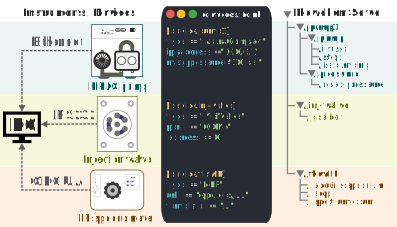
Since flowchem leverages web technologies, flowchem devices can be controlled directly with a web browser or by clients written in different languages and from almost any operative system, including Android and iOS. A set of python clients interfacing with the flowchem API are also provided and used in examples.
Supported devices
Currently, the following instruments are supported:
- Pumps (Knauer P2.1, Harvard Apparatus Elite 11, Hamilton ML600)
- Valves (ViciValco and Knauer)
- Thermostat (Huber)
- Analytical instruments (Magritek Spinsolve benchtop NMR and Mettler Toledo FlowIR)
- General purpose sensors from Phidgets
- ... and more! We are open to contributions!
- If you want to add support for a new device, read how to do that in the documentation.
Install flowchem
To install flowchem, ensure you have Python >= 3.11 installed, then run:
pip install flowchem
Documentation
You can find more information on installation and use in the documentation online at ReadTheDocs.io.
License
This project is released under the terms of the MIT License: a short and simple permissive license with conditions only requiring preservation of copyright and license notices. Licensed works, modifications, and larger works may be distributed under different terms and without source code.
Questions
For questions about this project, fell free to open an issue on GitHub, or reach out by email.
2 maintainers


Metadata
2 maintainers
Release files for flowchem 1.1.6
For a detailed explanation of source distributions (sdists) and built distributions (wheels), please see the package formats documentation.
Source distribution (sdist)
| File | Size | Uploaded | |
|---|---|---|---|
| flowchem-1.1.6.tar.gz | 241.5 kB | Details |
Built distribution (wheel)
| File | Interpreter | ABI | Platform | Reset |
|---|---|---|---|---|
| flowchem-1.1.6-py3-none-any.whl | Python 3 | none | any | Details |
Total release size: 582.4 kB
Release files / flowchem-1.1.6.tar.gz
| Download URL | flowchem-1.1.6.tar.gz |
|---|---|
| Size | 241.5 kB |
| Tags | Source |
|
SHA-256 checksum How to use checksums |
bf5bbe287c82783a42e54f83cbc6a73a96f184d66660d48a511af1272ed678db
|
|
BLAKE2b-256 checksum How to use checksums |
0e427785ded53e3de6cb7144b2de92f0d109876e4e4a93e8b16ca79cac910770
|
| Upload date | |
|
Uploaded using Trusted Publishing? What is trusted publishing? |
Yes |
| Uploaded via |
twine/7.0.0 CPython/3.13.14
|
Provenance
Provenance describes where a file came from. On PyPI, provenance is shared via attestations, which provide a verifiable record of the build or publishing details. View details, limitations and caveats.


PyPI Publish Attestation
PyPI verified that this artifact, at this checksum, originated from the publisher listed below.
Signed by GitHub Actions, verified by PyPI on Oct 13, 2026.
Transparency logRelease files / flowchem-1.1.6-py3-none-any.whl
| Download URL | flowchem-1.1.6-py3-none-any.whl |
|---|---|
| Size | 340.9 kB |
| Tags | Python 3 |
|
SHA-256 checksum How to use checksums |
af72001e583d85948794ff86b55ed0fca7b7d25991b832396bffce691c0fbec3
|
|
BLAKE2b-256 checksum How to use checksums |
5ae100d627d1beded0c383811ccb4420106bde521b7ed9603277bca9218c5378
|
| Upload date | |
|
Uploaded using Trusted Publishing? What is trusted publishing? |
Yes |
| Uploaded via |
twine/7.0.0 CPython/3.13.14
|
Provenance
Provenance describes where a file came from. On PyPI, provenance is shared via attestations, which provide a verifiable record of the build or publishing details. View details, limitations and caveats.
PyPI Publish Attestation
PyPI verified that this artifact, at this checksum, originated from the publisher listed below.
Signed by GitHub Actions, verified by PyPI on Oct 13, 2026.
Transparency log













