
Flux-CLI
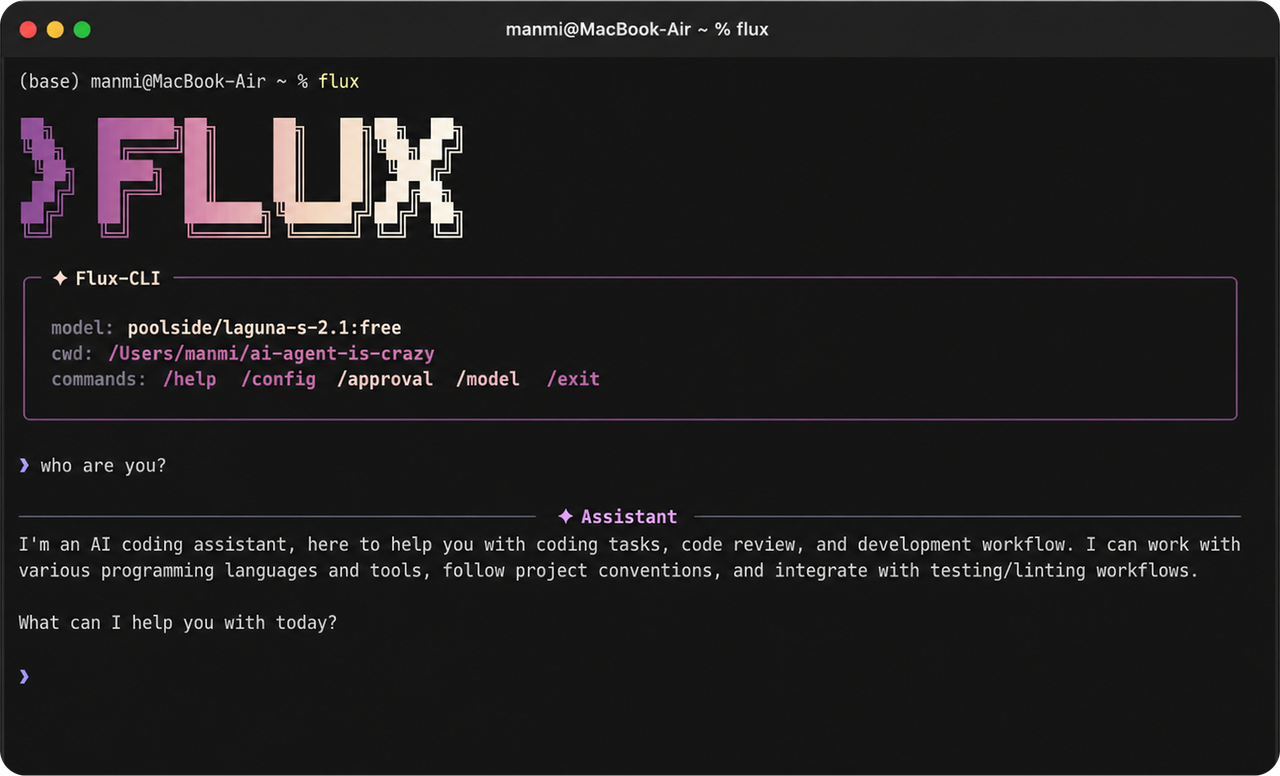
An AI coding agent built from scratch — inspired by Claude Code CLI and Gemini CLI — featuring full multi-tool orchestration, streaming responses, sub-agent delegation, MCP server integration, dynamic lifecycle hooks, safety approval policies, and a styled Rich terminal UI with gradient ASCII branding.
Project Aim
This project is a learning initiative designed to understand and implement core concepts behind intelligent coding agents:
- How AI agents reason about problems and select appropriate tools
- Multi-tool orchestration — deciding which tools to use and in what order
- Iterative refinement — analyzing code, identifying issues, and autonomously refactoring
- Streaming capabilities — real-time response generation and token consumption
- Lifecycle Hook System — shell-based event triggers (
on_start,on_success,on_error,pre_tool_use,post_tool_use,on_compaction) - Safety & Approval Policies — user confirmation for mutating operations (
on-request,auto,yolo) - Error handling & resilience — retry logic, exponential backoff, graceful degradation
- Context management — intelligent conversation history with automatic compression
- Extensible tool system — plugin architecture with built-in, sub-agent, and MCP tools
Features & Architecture
1. LLM Client (AsyncOpenAI Integration)
- Async OpenAI client with lazy initialization
- Support for streaming and non-streaming responses
- Stream event architecture (
StreamEvent,TextDelta,TokenUsage) - Tool call streaming — incremental
TOOL_CALL_START,TOOL_CALL_DELTA,TOOL_CALL_COMPLETEevents - Error handling with retry logic:
- Rate limit handling with exponential backoff
- Connection error recovery
- API error catching and reporting
- Configurable API key via
.envor system config - Support for different LLM providers (OpenRouter, OpenAI, local models via configurable base URL)
2. Response & Agent Event System
- Event-driven architecture with
AgentEventandAgentEventType - Lifecycle:
AGENT_START->TEXT_DELTAx N ->TOOL_CALL_START/COMPLETEx N ->TEXT_COMPLETE->AGENT_END - Error propagation through event system (
AGENT_ERROR) - Full agentic loop with multi-turn tool calling
- Maximum turns enforcement with graceful error reporting
3. Lifecycle Hook System
- Configurable event hooks via
.flux-cli/config.toml - 6 Trigger Points:
on_start: Triggered when an agent turn beginson_success: Triggered when an agent successfully finisheson_error: Triggered on exceptions, API failures, or tool execution errorspre_tool_use: Triggered before a tool executespost_tool_use: Triggered after a tool completeson_compaction: Triggered when context compression occurs
- Environment Variable Context: Passes
FLUX_HOOK_EVENT,FLUX_MODEL,FLUX_CWD,FLUX_TOOL_NAME,FLUX_TOOL_ARGS,FLUX_TOOL_SUCCESS,FLUX_TOOL_OUTPUT,FLUX_AGENT_RESPONSEto hook processes - Cross-Platform Execution: Windows
shlex.quotebash/cmd execution support with clean process tree cleanup (taskkill /F /T /PID)
4. Safety & Approval System
- Pydantic-validated
ApprovalPolicyenum:ON_REQUEST,AUTO,YOLO - Interactive confirmation modal for mutating operations (
write_file,edit,shell) - File diff preview inside approval requests
5. Session & Configuration Management
Sessionclass orchestrating client, tools, context, and MCP- Multi-level TOML configuration loading: System Config -> Project Config -> CLI Overrides
- Auto-detection of
AGENT.mdfiles for custom developer instructions - Persistent user memory across sessions stored in OS user data directory
6. Context & Compression Engine
ContextManagerwith token tracking (viatiktoken)- System prompt construction with identity, environment, tool guidelines, security
- Automatic context compression trigger at 80% of context window limit
ChatCompactorchild LLM summarization with structured continuation prompts- Smart tool output pruning (protects recent outputs, prunes older ones)
7. Built-in Tools (11 Core Tools)
| Tool | Kind | Description |
|---|---|---|
read_file |
READ | Read text files with line numbers, offset/limit, binary detection |
write_file |
WRITE | Create/overwrite files with automatic parent directory creation |
edit |
WRITE | Precise surgical text replacement with uniqueness checks |
shell |
SHELL | Command execution with timeout, blocked command safety, environment control |
list_dir |
READ | Directory listing with hidden file toggle |
grep |
READ | Regex search across files with case-insensitive option |
glob |
READ | File pattern matching with recursive ** support |
web_search |
NETWORK | DuckDuckGo web search integration |
web_fetch |
NETWORK | HTTP fetch with automatic fallback to proxy on 403/5xx |
todos |
MEMORY | Session-scoped task tracking (add/complete/list/clear) |
memory |
MEMORY | Persistent user memory stored across sessions |
8. Sub-Agents & MCP Protocol
SubAgentTool: Spawns isolated child agents (codebase_investigator,code_reviewer)MCPManager: Model Context Protocol integration with stdio and SSE transport support
9. Styled Terminal UI (TUI)
- Multi-stop color gradient horizontal ASCII logo renderer (
#e7aafb->#a191f8->#8bcefc->#7fe4eb) - Windows UTF-8 reconfigure and VT100/ANSI legacy rendering support
- Rich theme styling (
AGENT_THEME) with custom tool panels, status indicators, syntax highlighting (dracula), and diff rendering - Interactive slash command dashboards (
/help,/config,/model,/approval,/stats,/tools,/mcp,/clear,/exit)
Project Structure
flux/
├── main.py                      # CLI entry point, Click commands, interactive REPL loop
├── agent/
│   ├── agent.py                # Agent orchestrator with multi-turn agentic loop & hook triggers
│   ├── events.py               # AgentEvent & AgentEventType definitions
│   └── session.py              # Session lifecycle (Client, Registry, Context, MCP, Hooks)
├── client/
│   ├── llm_client.py           # AsyncOpenAI client wrapper with streaming & retries
│   └── response.py             # StreamEvent, TextDelta, TokenUsage, ToolCall models
├── config/
│   ├── config.py               # Pydantic Config, ModelConfig, HookConfig, MCPServerConfig
│   └── loader.py               # Multi-level TOML loader & AGENT.md detection
├── context/
│   ├── compaction.py           # ChatCompactor context summarization engine
│   └── manager.py              # ContextManager history, token tracking, tool pruning
├── hooks/
│   ├── hook_system.py          # Cross-platform process execution & environment builder
│   └── manager.py              # HookManager event router
├── prompts/
│   └── system.py               # Dynamic system prompt builder
├── safety/
│   └── policy.py               # ApprovalPolicy enum (on-request, auto, yolo)
├── tools/
│   ├── base.py                 # Tools ABC, ToolInvocation, ToolResult, FileDiff, ToolKind
│   ├── registry.py             # ToolRegistry with built-in & MCP lookup
│   ├── discovery.py            # Custom tool discovery from .flux-cli/tools/
│   ├── subagent.py             # SubAgentTool & pre-defined sub-agents
│   ├── builtin/                # Core built-in tools (read, write, edit, shell, grep, glob, etc.)
│   └── mcp/                    # MCP client & tool adapters
├── ui/
│   └── tui.py                  # Rich TUI, gradient banner, tool panels, command dashboards
├── utils/
│   ├── errors.py               # AgentError, ConfigError
│   ├── paths.py                # Path resolution & binary file detection
│   └── text.py                 # Token counting (tiktoken) & text truncation
├── pyproject.toml              # PyPI package manifest & executable entry points
├── requirements.txt            # Project dependencies
├── ARCHITECTURE.md             # Detailed technical architecture guide
└── README.md
Setup & Usage
Prerequisites
- Python 3.10+
- OpenRouter API key (or any OpenAI-compatible provider)
Installation (Local Development)
# Clone the repository
git clone https://github.com/manmit-s/flux-cli.git
cd flux-cli

# Create and activate virtual environment
python -m venv .venv

# On Windows:
.venv\Scripts\activate
# On macOS/Linux:
source .venv/bin/activate

# Install dependencies
pip install -r requirements.txt
Installing via Pip / Pipx (When Published)
# Recommended for CLI tools:
pipx install flux-cli-ai

# Or via standard pip:
pip install flux-cli-ai

# Launch directly from anywhere in your terminal:
flux
Configuration
Create a .env file in your workspace:
API_KEY=your_api_key_here
BASE_URL=https://openrouter.ai/api/v1  # Optional, default for OpenRouter
Or configure your global settings at ~/.config/flux-cli/config.toml (macOS/Linux) or %APPDATA%\flux-cli\config.toml (Windows):
[model]
name = "nvidia/nemotron-3-super-120b-a12b"
temperature = 0.7
context_window = 128000

max_turns = 50

[approval]
policy = "on-request"

[hooks]
enabled = true
on_start = "echo 'Agent starting...'"
on_error = "echo 'Agent encountered an error'"

[shell_environment]
exclude_patterns = ["*KEY", "*TOKEN", "*SECRET"]
Interactive Slash Commands
While in interactive mode (flux), you can run:
| Command | Action |
|---|---|
/help |
Show interactive help dashboard |
/config |
Show current active configuration |
/model <name> |
Switch LLM model at runtime |
/approval <mode> |
Change safety approval policy (on-request, auto, yolo) |
/stats |
View session token usage & turn metrics |
/tools |
List all registered built-in and MCP tools |
/mcp |
View MCP server connections |
/clear |
Clear active conversation history |
/exit or /quit |
Exit the CLI session |
Credits & Acknowledgments
Inspired by and learning from:
- Rivaan Ranawat — Educator and open-source agent innovator
- Claude Code CLI & Gemini CLI — Design aesthetics & agent orchestration inspiration
1 maintainer

Metadata
1 maintainer
Release files for flux-cli-ai 0.2.0
For a detailed explanation of source distributions (sdists) and built distributions (wheels), please see the package formats documentation.
Source distribution (sdist)
| File | Size | Uploaded | |
|---|---|---|---|
| flux_cli_ai-0.2.0.tar.gz | 62.1 kB | Details |
Built distribution (wheel)
| File | Interpreter | ABI | Platform | Reset |
|---|---|---|---|---|
| flux_cli_ai-0.2.0-py3-none-any.whl | Python 3 | none | any | Details |
Total release size: 136.6 kB
Release files / flux_cli_ai-0.2.0.tar.gz
| Download URL | flux_cli_ai-0.2.0.tar.gz |
|---|---|
| Size | 62.1 kB |
| Tags | Source |
|
SHA-256 checksum How to use checksums |
ca6f35100ff2fd603618c0a40e3d2095a9ac2b2c7e33c096a5534013f041bdac
|
|
BLAKE2b-256 checksum How to use checksums |
6629617ab49c3b420a1f13faa8dc8f836b49cc86840976b3350bf45fc8c86b52
|
| Upload date | |
|
Uploaded using Trusted Publishing? What is trusted publishing? |
Yes |
| Uploaded via |
twine/7.0.0 CPython/3.13.14
|
Provenance
Provenance describes where a file came from. On PyPI, provenance is shared via attestations, which provide a verifiable record of the build or publishing details. View details, limitations and caveats.


PyPI Publish Attestation
PyPI verified that this artifact, at this checksum, originated from the publisher listed below.
Signed by GitHub Actions, verified by PyPI on Aug 4, 2026.
Transparency logRelease files / flux_cli_ai-0.2.0-py3-none-any.whl
| Download URL | flux_cli_ai-0.2.0-py3-none-any.whl |
|---|---|
| Size | 74.5 kB |
| Tags | Python 3 |
|
SHA-256 checksum How to use checksums |
ef3a13ecf4a140a750ed954e7efaca3afd53bef43a937809aca429c09be4857b
|
|
BLAKE2b-256 checksum How to use checksums |
34befc53e90642e7b6f2be8fb7fa7634ae0f912d891cbf9c6dfc675e8c6e6b17
|
| Upload date | |
|
Uploaded using Trusted Publishing? What is trusted publishing? |
Yes |
| Uploaded via |
twine/7.0.0 CPython/3.13.14
|
Provenance
Provenance describes where a file came from. On PyPI, provenance is shared via attestations, which provide a verifiable record of the build or publishing details. View details, limitations and caveats.
PyPI Publish Attestation
PyPI verified that this artifact, at this checksum, originated from the publisher listed below.
Signed by GitHub Actions, verified by PyPI on Aug 4, 2026.
Transparency log













