

FluxRouter
Dynamic, complexity-aware LLM routing layer
Classifies queries by complexity to dynamically dispatch fast or strong models; optimizing cost and latency without sacrificing response quality.


Why FluxRouter?
Routing every prompt to a frontier model like qwen-27b or llama-70b is wildly expensive, 70% of production LLM queries (simple facts, basic syntax checks, short summaries) can be answered flawlessly by lightweight 8B models at 1/10th the cost.
Conversely, locking your application to a small fast model leads to hallucinations and incomplete reasoning on difficult architectural, algorithmic, or debugging prompts.
FluxRouter solves this dilemma with Cascade Routing:
- Ultra-fast Classification (5ms): Embeds the query on CPU using
all-MiniLM-L6-v2and classifies complexity intosimple,medium, orcomplexvia k-NN anchor matching. - Direct High-Margin Routing: Confident simple queries bypass LLM judging entirely to hit the fast model (
llama-3.1-8b-instant); complex queries route directly to the strong model (qwen/qwen3.6-27b). - Smart LLM-As-Judge Cascade: Borderline queries invoke a lightweight LLM judge on the fast model's response. If the response score is $\le 3/5$, FluxRouter automatically escalates to the strong model.
Architecture Overview
                          ┌──────────────────────────┐
                          │  Incoming User Query     │
                          └────────────┬─────────────┘
                                       │
                                       ▼
                          ┌──────────────────────────┐
                          │   ComplexityClassifier   │
                          │   (MiniLM L2 + k-NN)     │
                          └────────────┬─────────────┘
                                       │
            ┌──────────────────────────┼──────────────────────────┐
            │ (Simple & Margin ≥ 0.04) │ (Complex & Margin ≥ 0.04)│ (Medium / Low Margin)
            ▼                          ▼                          ▼
  ┌──────────────────┐       ┌──────────────────┐       ┌──────────────────┐
  │    Fast Model    │       │   Strong Model   │       │   Fast Model     │
  │ llama-3.1-8b-inst│       │  qwen/qwen3.6-27b│       │ (Initial Attempt)│
  └──────────────────┘       └──────────────────┘       └─────────┬────────┘
                                                                  │
                                                                  ▼
                                                        ┌──────────────────┐
                                                        │  Fast LLM Judge  │
                                                        └─────────┬────────┘
                                                                  │
                                            ┌─────────────────────┴─────────────────────┐
                                            │ Judge Score ≥ 4/5   │ Judge Score ≤ 3/5  │
                                            ▼                     ▼                     ▼
                                  ┌──────────────────┐  ┌──────────────────┐  ┌──────────────────┐
                                  │  Keep Fast Resp  │  │ Escalate Query   │  │   Strong Model   │
                                  │  (judge_passed)  │  │ (judge_escalate) │  │  qwen/qwen3.6-27b│
                                  └──────────────────┘  └──────────────────┘  └──────────────────┘
Web Dashboard

Benchmark Results
Evaluated on a stratified benchmark of 30 representative queries across coding, system architecture, debugging, summarization, and general QA (blind LLM-as-judge scoring 1–5):
| Configuration | Queries | Total Cost ($) | Cost / Query ($) | Avg Latency | Mean Quality | Strong Usage Rate | Cascade Escalation Rate | Fast Calls | Strong Calls |
|---|---|---|---|---|---|---|---|---|---|
always_fast |
30 | $0.00226 | $0.000075 | 1,754 ms | 4.77 / 5 | 0.0% | n/a | 30 | 0 |
always_strong |
12 | $0.01064 | $0.000887 | 3,104 ms | 5.00 / 5 | 100.0% | n/a | 0 | 12 |
fluxrouter |
30 | $0.01006 | $0.000335 | 3,735 ms | 4.90 / 5 | 26.7% | 3.3% | 22 | 8 |
Per-Query Comparison Highlights
- FluxRouter vs
always_strong: Substantial cost reduction per query ($0.000335 vs $0.000887 average) while maintaining 4.90 / 5 mean response quality (a negligible quality delta of -0.10/5). - Strong Model Usage vs. Escalation Rate: 26.7% Total Strong Model Usage (8/30 queries used the strong model). 7 queries were classified as
complexand routed directly to the strong model, while 1 query was escalated via the cascade evaluation mechanism (3.3% cascade escalation rate). - FluxRouter vs
always_fast: +0.13 / 5 Quality Gain over fast-only models by routing complex multi-step and architectural prompts to the strong model.
Known Limitations & Design Considerations
- Medium Tier Fuzziness:
The medium complexity band is inherently continuous. Prompts on the boundary between simple and medium may occasionally be routed directly to the fast model if the classifier margin exceeds
0.04. - Escalation Sensitivity:
Fast models (
llama-3.1-8b-instant) are surprisingly capable on structured coding tasks, scoring $\ge 4/5$ on many medium queries. Consequently, escalation to the strong model only triggers when the fast response is incomplete, truncated, or erroneous. - Model Selection Rationale (
qwen/qwen3.6-27b):qwen/qwen3.6-27bis configured as the default strong model overllama-3.3-70b-versatile. On Groq's free/on-demand tier,llama-3.3-70b-versatilehas a 100,000 Tokens-Per-Day (TPD) quota limit.qwen/qwen3.6-27bprovides a 500,000 TPD daily quota while matching 70B-class reasoning quality.
Installation & Quickstart
# 1. Install in editable mode
git clone https://github.com/sid-stack001/FluxRouter.git
cd fluxrouter
pip install -e .

# 2. Interactive setup: configures Groq API key and defaults in ~/.fluxrouter/config.yaml
fluxrouter init

# 3. Route your first prompt
fluxrouter route "What is the capital of France?"
Integration Paths
1. Command Line Interface (CLI)
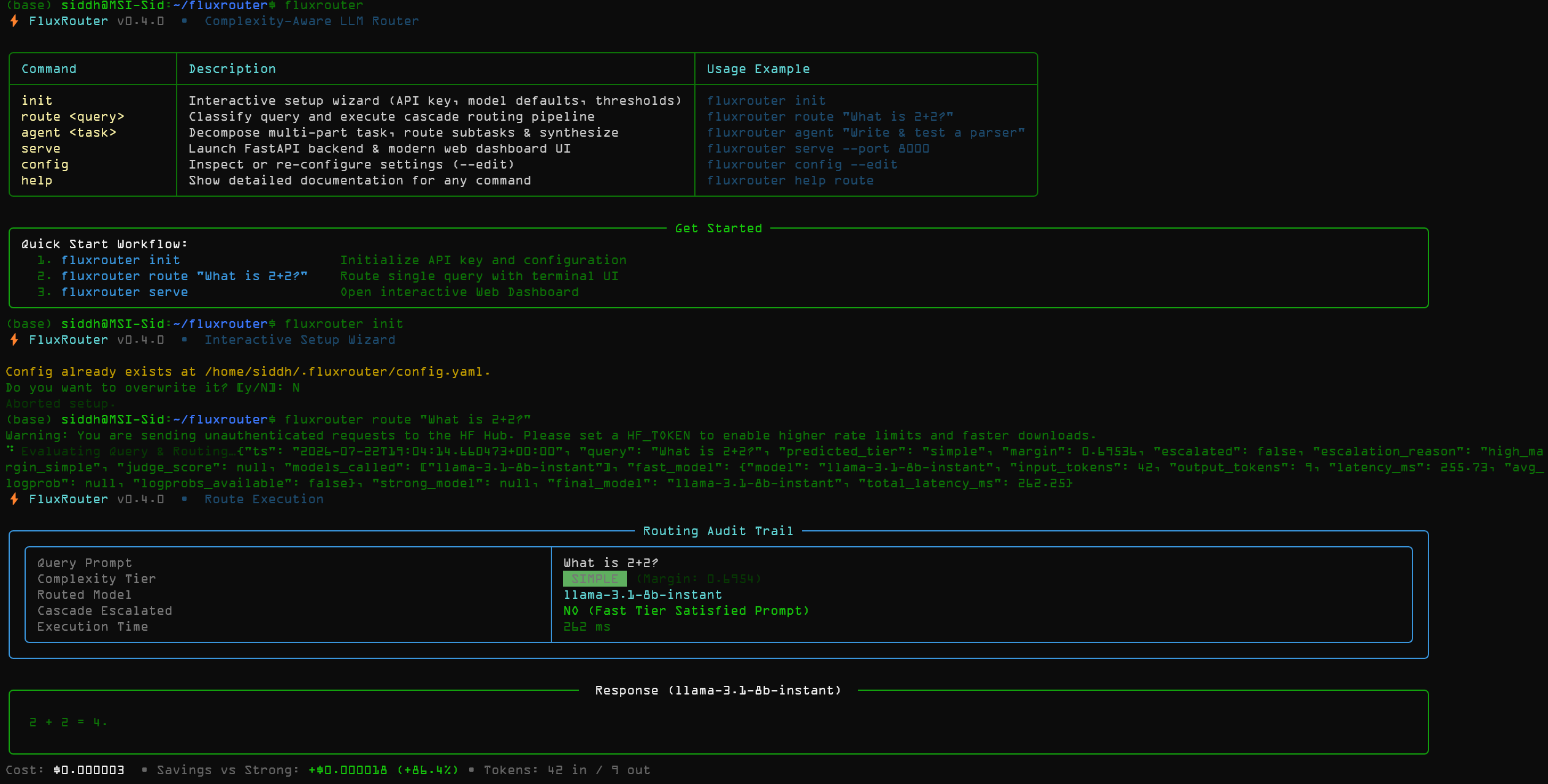
# Direct routing with Rich terminal formatting
fluxrouter route "Explain the CAP theorem in distributed systems"

# Raw JSON output for pipeline automation
fluxrouter route "Write a Python function to merge two sorted lists" --json

# Agent task orchestration (decompose → route subtasks → synthesize)
fluxrouter agent "Write a Python function to reverse a string, add docstrings, and write unit tests"

# Interactive configuration manager
fluxrouter config --show
2. OpenAI-Compatible API Proxy Server
Exposes an OpenAI-compatible /v1/chat/completions endpoint, so it can be used as a drop-in backend anywhere you'd normally point the standard openai SDK, including most agent frameworks that support custom OpenAI-compatible base URLs (e.g. LangChain, AutoGen). Tested directly with the openai Python SDK; framework-specific integration not yet verified.
fluxrouter serve --port 8000
from openai import OpenAI

client = OpenAI(
    base_url="http://localhost:8000/v1",
    api_key="none",  # Auth handled by FluxRouter
)

response = client.chat.completions.create(
    model="fluxrouter",  # Dynamic complexity routing
    messages=[{"role": "user", "content": "Architect a real-time collaborative editor."}]
)
print(response.choices[0].message.content)
3. Native Python SDK (In-Process)
from fluxrouter import FluxRouter

# Automatically loads configuration from ~/.fluxrouter/config.yaml
router = FluxRouter()

# In-process routing with zero HTTP overhead
decision = router.route("Derive the backpropagation equations for a conv layer.")
print(f"Tier: {decision.predicted_tier} | Escalated: {decision.escalated}")
print(decision.final_response.text)
Roadmap
- Multi-Provider Adapters: native support for Anthropic, OpenAI, and local Ollama models, using the existing (currently Groq-only) adapter pattern.
- Semantic Query Caching: Redis-backed vector cache to serve identical/similar historical queries instantly at zero model cost.
- Circuit Breaker & Failover: Automatic health monitoring and instant failover to secondary model providers on API rate limits (HTTP 429).
- Rich TUI Dashboard: Real-time interactive terminal dashboard tracking live token cost, request rate, and tier distribution.
- Daemon Mode & Multi-Tenant Support: Background service deployment with multi-tenant API key management.
License
This project is licensed under the MIT License.
1 maintainer

Metadata
1 maintainer
Release files for fluxrouter 0.1.1
For a detailed explanation of source distributions (sdists) and built distributions (wheels), please see the package formats documentation.
Source distribution (sdist)
| File | Size | Uploaded | |
|---|---|---|---|
| fluxrouter-0.1.1.tar.gz | 497.2 kB | Details |
Built distribution (wheel)
| File | Interpreter | ABI | Platform | Reset |
|---|---|---|---|---|
| fluxrouter-0.1.1-py3-none-any.whl | Python 3 | none | any | Details |
Total release size: 554.5 kB
Release files / fluxrouter-0.1.1.tar.gz
| Download URL | fluxrouter-0.1.1.tar.gz |
|---|---|
| Size | 497.2 kB |
| Tags | Source |
|
SHA-256 checksum How to use checksums |
fbaab8cff92f9d710836bec7b3b6560c505fc1a7a910f8d29ec7574b3d2fa01f
|
|
BLAKE2b-256 checksum How to use checksums |
71e7d4b9a4e50170b173fbcfecb63d19bc82c3acad477560ad00ddee5599a890
|
| Upload date | |
|
Uploaded using Trusted Publishing? What is trusted publishing? |
No |
| Uploaded via |
twine/6.2.0 CPython/3.11.15
|
Release files / fluxrouter-0.1.1-py3-none-any.whl
| Download URL | fluxrouter-0.1.1-py3-none-any.whl |
|---|---|
| Size | 57.3 kB |
| Tags | Python 3 |
|
SHA-256 checksum How to use checksums |
b84b4333c8998f8808d9da8b4d21c9bbb2b80823282f0d63ce2b718f021f0931
|
|
BLAKE2b-256 checksum How to use checksums |
cce6423f96eacd5a6344fee967e29385589d06840ae5682b15da4b8c8ccdb93f
|
| Upload date | |
|
Uploaded using Trusted Publishing? What is trusted publishing? |
No |
| Uploaded via |
twine/6.2.0 CPython/3.11.15
|














