
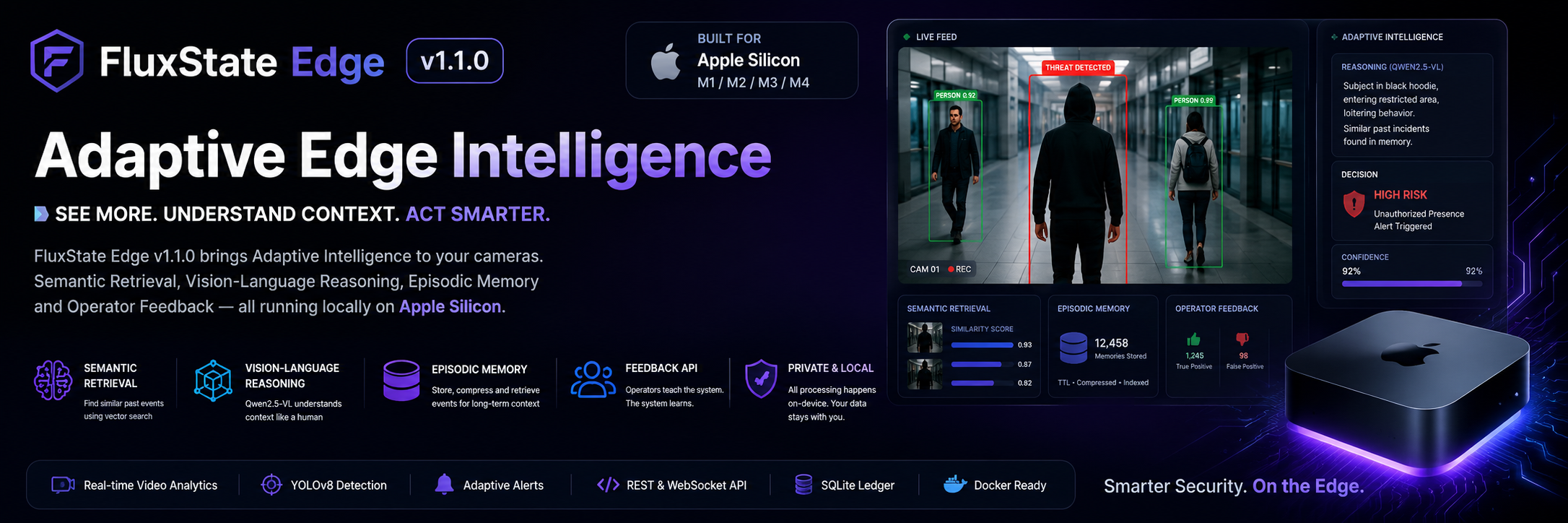
🦅 FluxState Edge SDK
Privacy-Preserving Contextual Edge Video Analytics for Enterprise Security


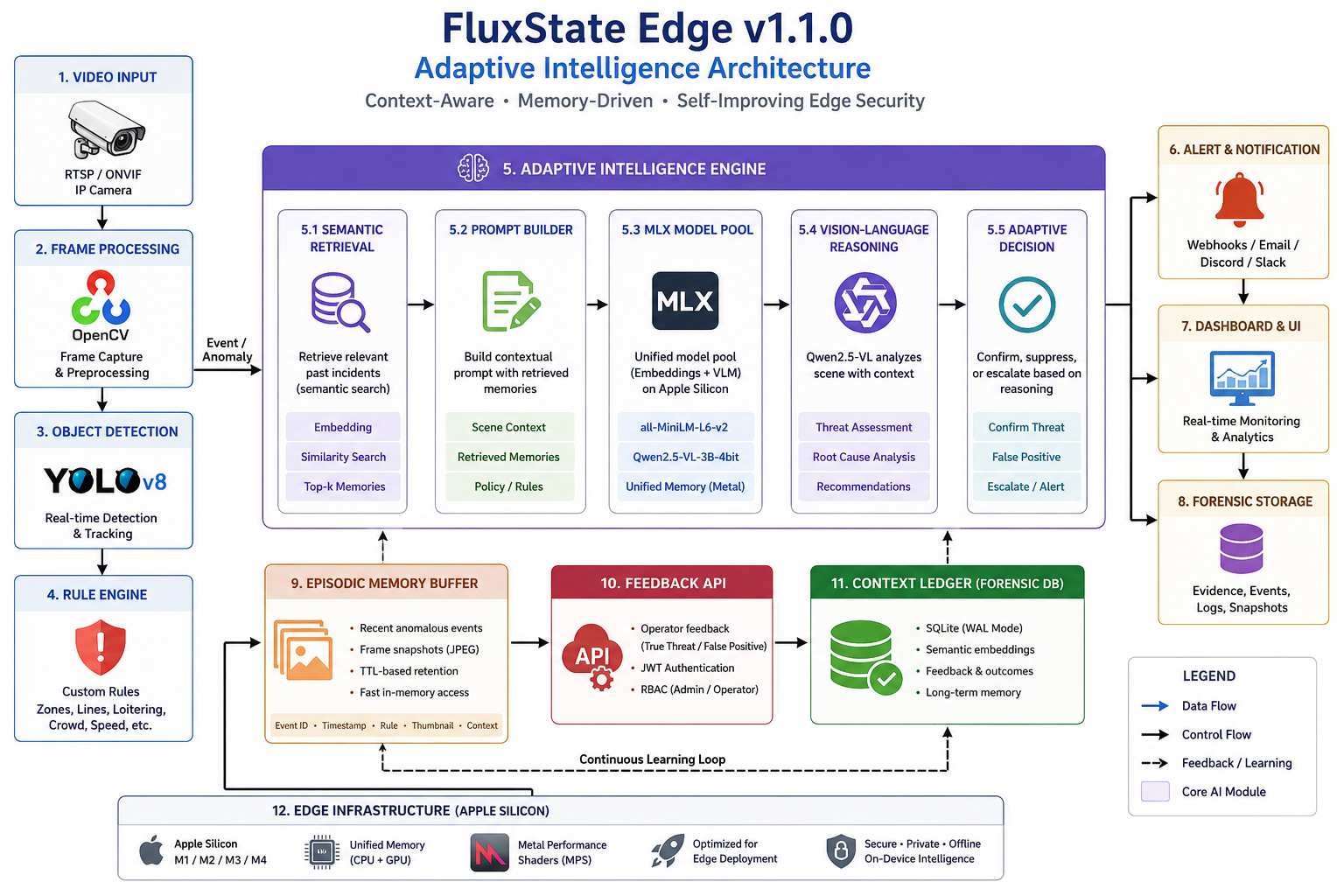
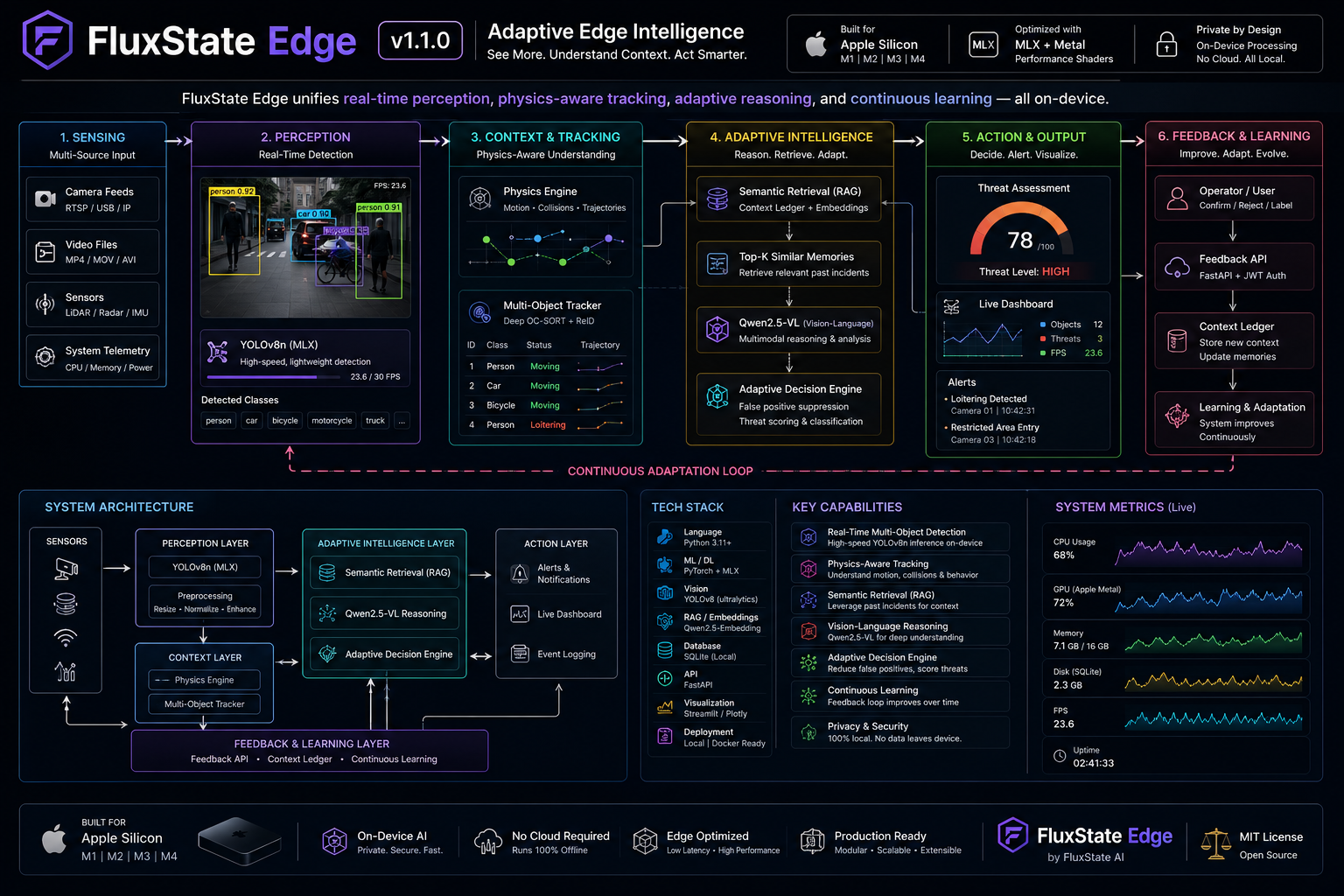
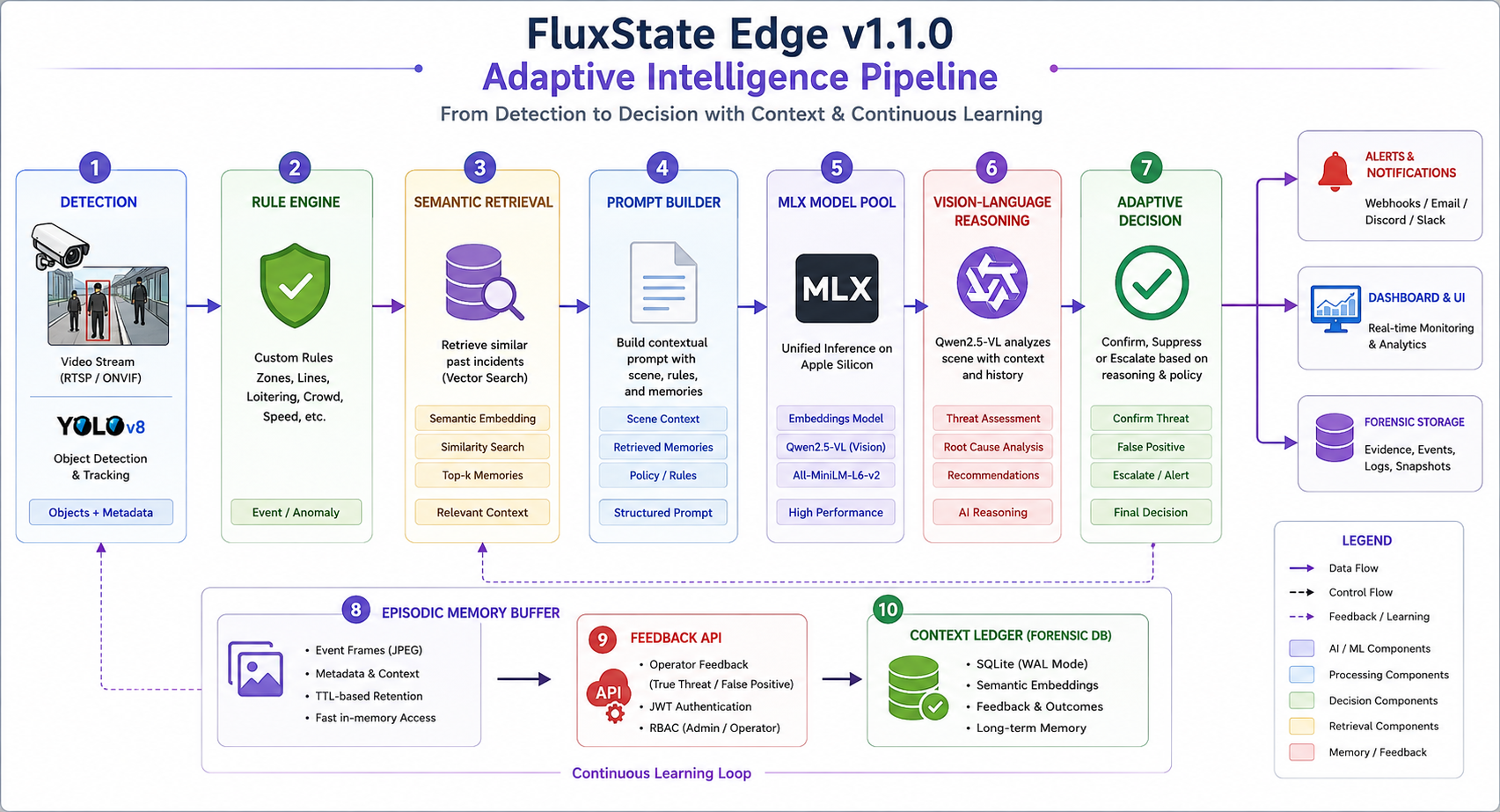
FluxState Edge is an extensible, camera-agnostic video analytics SDK designed for direct integration into proprietary security backends. It processes RTSP streams locally on the edge, extracting behavioral metadata via object detection, 3D skeletal posing, audio processing, and VLM semantic reasoning with our v1.1 Adaptive Intelligence layer.
🚀 Quick Install
pip install fluxstate-security
🎥 Installation Demo
See the SDK installation and verification in under a minute.
▶️ Watch Installation Demo (Google Drive)
⚡ System Capabilities
| Capability | Technical Implementation |
|---|---|
| 🧠 Agentic VLM Reasoner | Runs Vision-Language Models (e.g., Qwen2.5-VL) locally via MLX on Apple Silicon unified memory for deep contextual scene understanding. Bypasses cloud APIs entirely. |
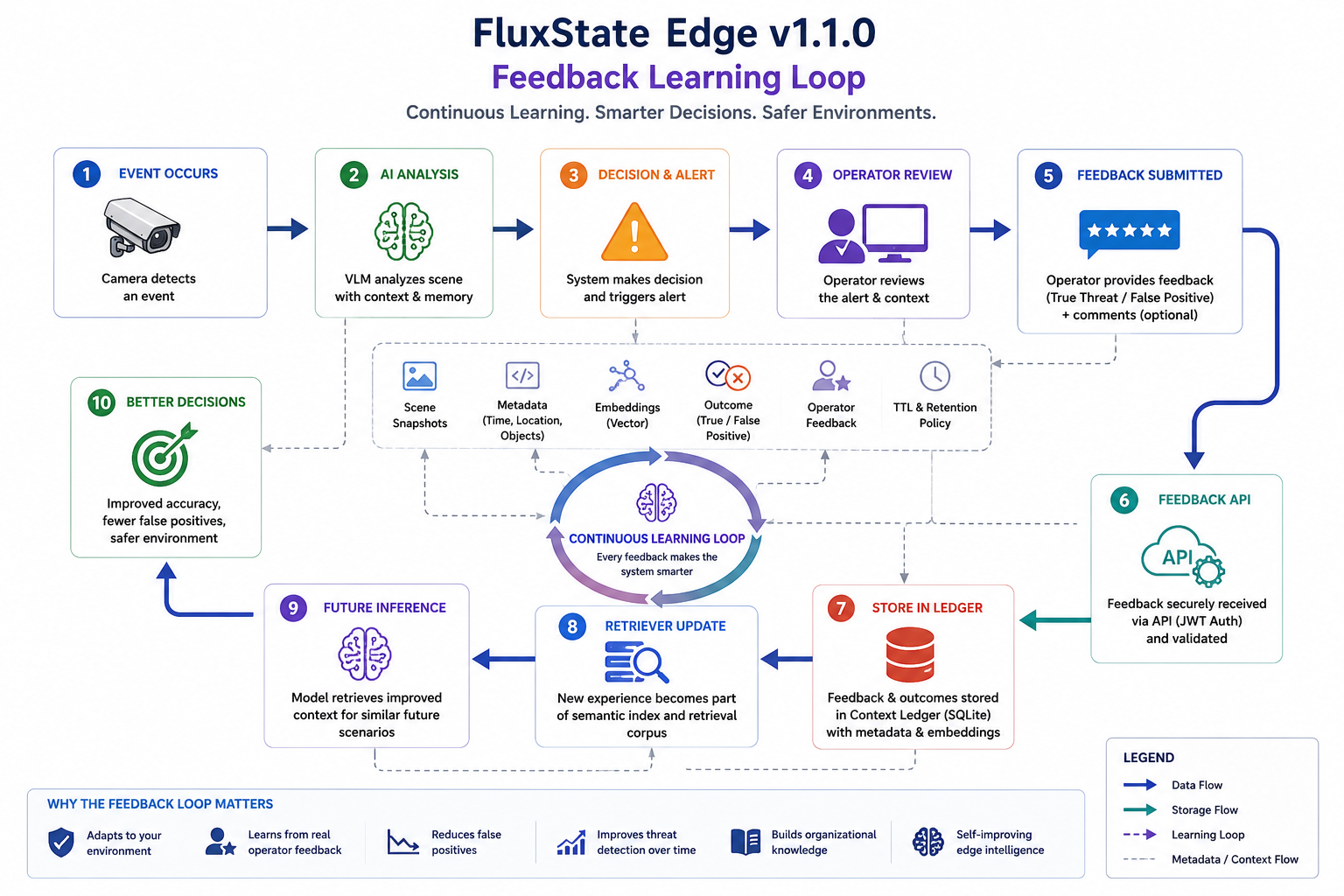
| 🔄 Adaptive Intelligence (v1.1) | Seamlessly loads and unloads MLX models (MLXModelPool) to manage unified memory. Provides a Feedback API to suppress false positives on-device without retraining. |
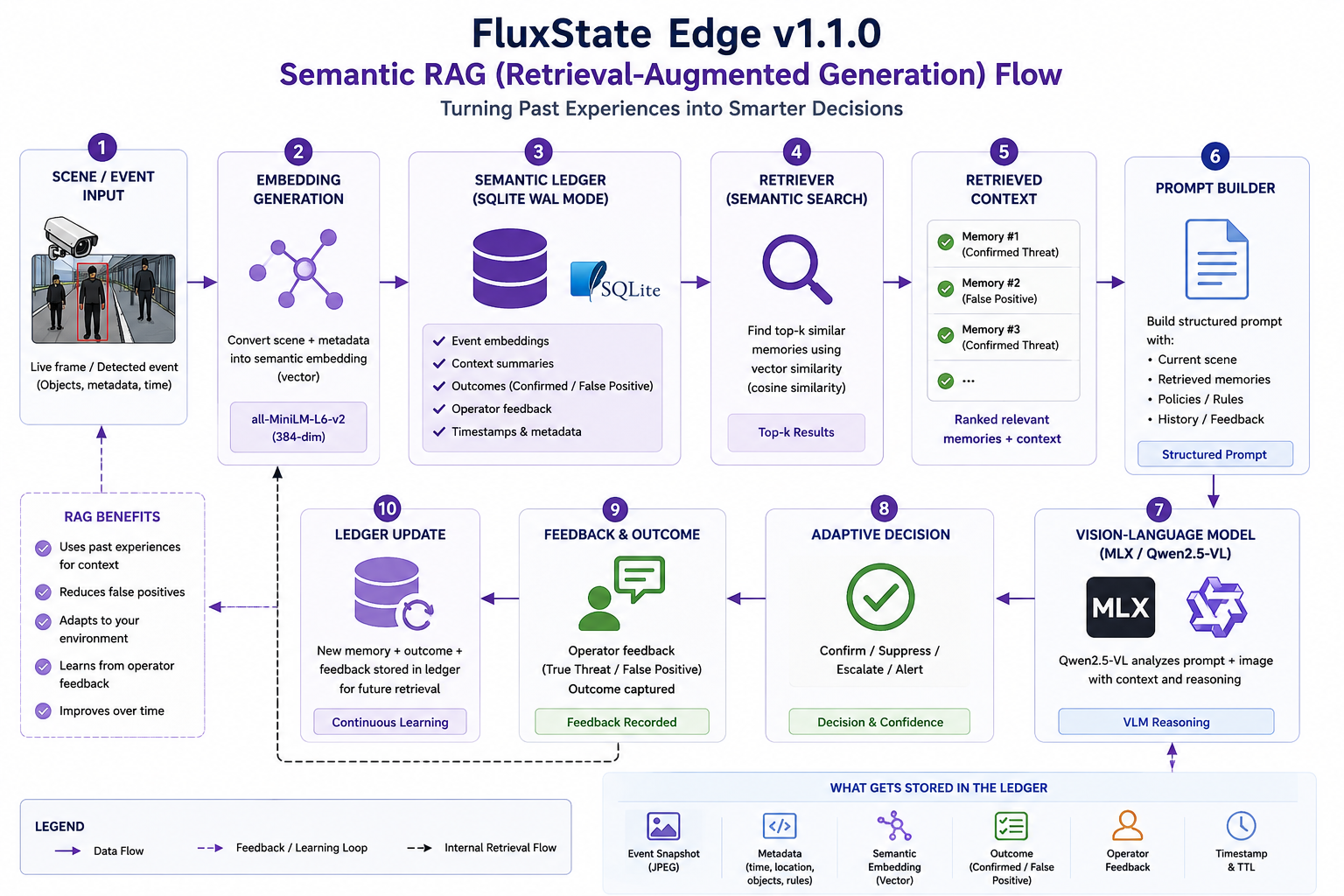
| 📚 Semantic Retrieval (RAG) | Embeds scene telemetry and queries an on-device ContextLedger using cosine similarity to inject historical context into the VLM prompt. |
| ⏱️ Episodic Memory | Buffers the last 10 minutes of scene states (EpisodicMemoryBuffer) with O(1) operations, allowing delayed asynchronous operator feedback. |
| 🎯 Tactical Visual Grounding | Automatically injects high-contrast red bounding boxes over anomalies. This guides the VLM toward the detected region, reducing irrelevant reasoning and improving contextual grounding. |
| 🛡️ Privacy-by-Design | Actively zeroes out image buffers post-inference via C-level memset. Designed with privacy-first principles to prevent sensitive pixel data from lingering in the system heap. |
| 🗄️ Temporal Forensics | Behavioral anomalies are serialized into a local SQLite database (fluxstate_security/core/forensics.py), creating a searchable text-based ledger of physical events. |
| 📹 Hardware Agnostic | Ingests existing IP cameras via standard RTSP URLs. No proprietary recording hardware required. |
| 🐳 Edge Containerization | Ships with a highly optimized Dockerfile for enterprise edge deployments (Kubernetes/Docker Swarm), permanently locking native OS dependencies. |
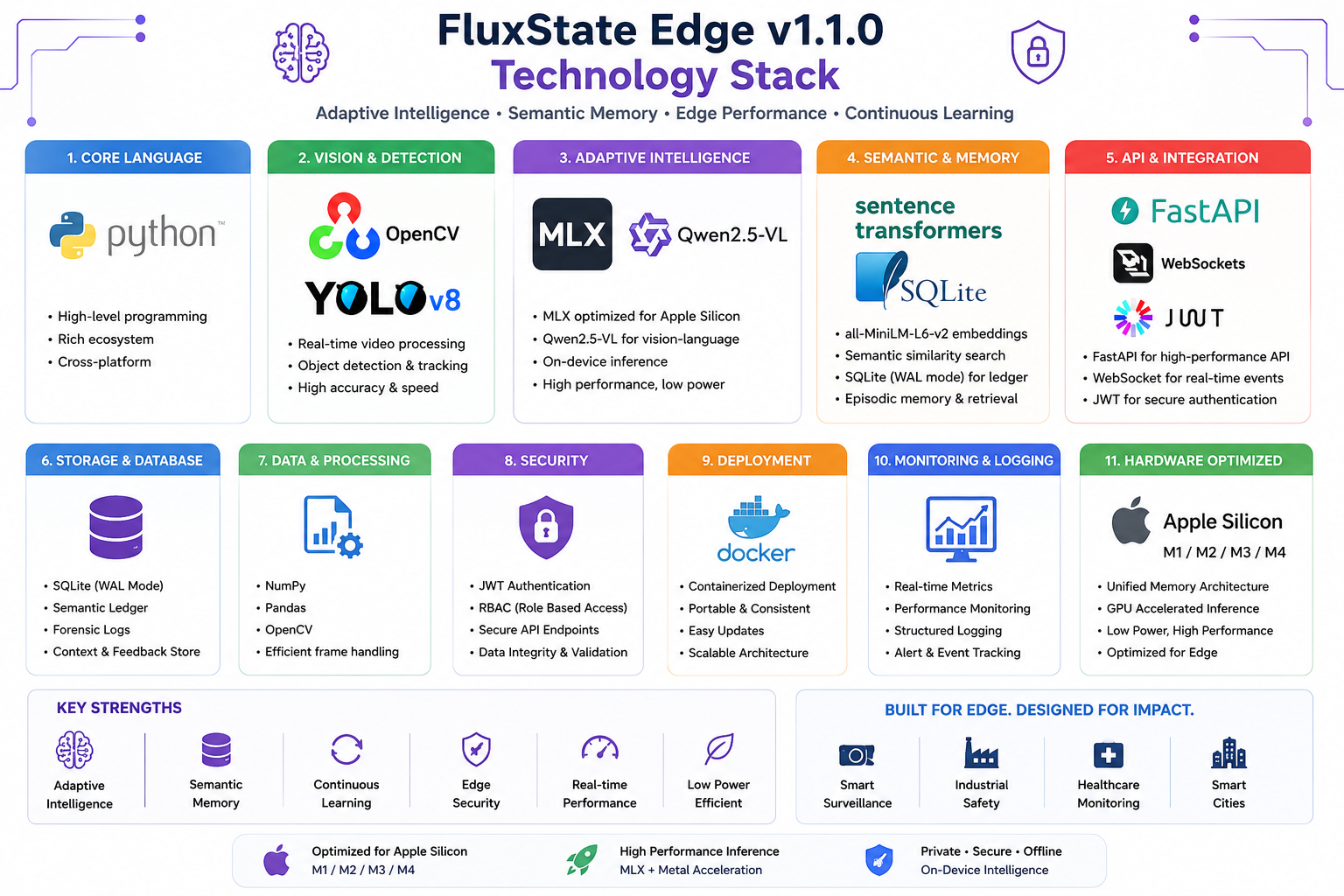
🖼️ Architectural Vision & Use Cases
Sub-Pipelines
🛠️ Minimal SDK Integration
FluxState is designed to fade into the background. Drop it into your existing backend and attach a webhook.
import time
from fluxstate_security import FluxStateNode

# 1. Initialize the SDK
sdk = FluxStateNode()

# 2. Define your integration hook
def handle_threat(event_payload):
    print(f"\n[INTEGRATION BUS] Escalating to VMS...")
    print(f"Target Identity: {event_payload['entities']}")
    print(f"Behavioral Vector: {event_payload['context_log']}")
    print(f"Feedback Event ID: {event_payload.get('event_id', 'None')}")

# 3. Bind the hook
sdk.on_threat_detected = handle_threat

# 4. Deploy Headlessly (Runs as a background daemon)
sdk.start_headless_daemon()
sdk.start_api_server(port=8000) # Starts the JSON API & Feedback loop

try:
    while True: time.sleep(1)
except KeyboardInterrupt:
    sdk.stop() # 5. Clean shutdown
📦 Deployment Strategies
Option A: Enterprise Docker Deployment (Recommended)
For production environments, use the provided Docker container to guarantee system dependencies (Tesseract, PortAudio) are perfectly locked across the cluster.
docker build -t fluxstate-security .
docker run -d --name fluxstate-security fluxstate-security
Option B: Local Python Development
pip install fluxstate-security

# macOS dependencies
brew install tesseract portaudio

# Linux dependencies
sudo apt-get install tesseract-ocr libportaudio2 libportaudiocpp0 portaudio19-dev
🧪 Forensics & Testing
FluxState ships with an automated pytest suite covering the Forensic SQLite ledger, semantic retrievers, and JSON intelligence policies.
pytest tests/
📡 API Reference
POST /api/v2/feedback
Submit operator feedback to adapt the system. Payload:
{
  "event_id": "uuid-string",
  "human_label": "FALSE_POSITIVE",
  "operator_id": "guard-123",
  "operator_role": "admin"
}
1 maintainer

Metadata
1 maintainer
Release files for fluxstate-security 1.1.0
For a detailed explanation of source distributions (sdists) and built distributions (wheels), please see the package formats documentation.
Source distribution (sdist)
| File | Size | Uploaded | |
|---|---|---|---|
| fluxstate_security-1.1.0.tar.gz | 41.9 kB | Details |
Built distribution (wheel)
| File | Interpreter | ABI | Platform | Reset |
|---|---|---|---|---|
| fluxstate_security-1.1.0-py3-none-any.whl | Python 3 | none | any | Details |
Total release size: 77.1 kB
Release files / fluxstate_security-1.1.0.tar.gz
| Download URL | fluxstate_security-1.1.0.tar.gz |
|---|---|
| Size | 41.9 kB |
| Tags | Source |
|
SHA-256 checksum How to use checksums |
c16accb06da9d3907455442cb0c9bdb23b204430f87781996c808ce61954657b
|
|
BLAKE2b-256 checksum How to use checksums |
1882ced3dad12c4fda34812c4b7cf69f79137d10531446fc90f5f64ab6b68098
|
| Upload date | |
|
Uploaded using Trusted Publishing? What is trusted publishing? |
Yes |
| Uploaded via |
twine/6.1.0 CPython/3.13.12
|
Provenance
Provenance describes where a file came from. On PyPI, provenance is shared via attestations, which provide a verifiable record of the build or publishing details. View details, limitations and caveats.


PyPI Publish Attestation
PyPI verified that this artifact, at this checksum, originated from the publisher listed below.
Signed by GitHub Actions, verified by PyPI on Jul 6, 2026.
Transparency logRelease files / fluxstate_security-1.1.0-py3-none-any.whl
| Download URL | fluxstate_security-1.1.0-py3-none-any.whl |
|---|---|
| Size | 35.1 kB |
| Tags | Python 3 |
|
SHA-256 checksum How to use checksums |
f16e8f1bff4fcffe0b8617133b1a24aafeb62b5681f7595573bf6f42c9c8381e
|
|
BLAKE2b-256 checksum How to use checksums |
8f3172c9c3aa56fedd0c44cef75a8d7238ca7fd02b64d548bc53689717abb50b
|
| Upload date | |
|
Uploaded using Trusted Publishing? What is trusted publishing? |
Yes |
| Uploaded via |
twine/6.1.0 CPython/3.13.12
|
Provenance
Provenance describes where a file came from. On PyPI, provenance is shared via attestations, which provide a verifiable record of the build or publishing details. View details, limitations and caveats.
PyPI Publish Attestation
PyPI verified that this artifact, at this checksum, originated from the publisher listed below.
Signed by GitHub Actions, verified by PyPI on Jul 6, 2026.
Transparency log













