

News
- [2026/10] FlyWheel 0.3.0 is released: sliding window attention that skips masked tiles (up to 1.47x over Splash and 2.25x over RPA v3 on 16K windowed prefill, TPU v6e), sliding window and softcap on the paged KV cache, and ReplaySSM decode for GDN/KDA linear attention (up to 1.48x on decode and 2.18x on 4-token speculative verify).
- [2026/10] FlyWheel 0.2.0 is released: faster chunked prefill, prefix caching and decode over a paged KV cache, now ahead of RPA v3 on TPU v7x (up to 2.32x on chunked prefill and 1.14x on decode).
- [2026/10] Added TPU v7x benchmark results for MHA/GQA softmax attention. Thanks to @lk-chen for testing and contributing the results!
- [2026/09] FlyWheel 0.1.0 is released: flash-attn-style softmax attention (forward and backward, varlen, KV cache) and fused GDN/KDA linear attention kernels for TPU.
About
FlyWheel is an attention kernel library for TPU developed by heavyball-research, implemented in JAX Pallas. It provides high-performance implementations of MHA, MQA/GQA and linear attention.
Install
pip install flywheel-tpu            # CPU, Pallas interpret mode
pip install "flywheel-tpu[tpu]"     # TPU VM, adds jax[tpu]>=0.11.0
From source, with uv (needed for the benchmarks and end-to-end evaluation below):
git clone https://github.com/heavyball-research/flywheel-tpu.git && cd flywheel-tpu
uv sync --extra tpu     # plain `uv sync` off TPU
source .venv/bin/activate
The benchmarks below run in this venv. The numbers in this README were measured
with jax[tpu]==0.11.0 and libtpu==0.0.44, the stack tpu-inference runs.
How to use flywheel
The main functions implement scaled dot product attention (softmax(Q @ K^T * softmax_scale) @ V), with the same names and arguments as flash-attn, taking and returning JAX arrays:
from flywheel_tpu import flash_attn_func, flash_attn_varlen_func, flash_attn_with_kvcache
All inputs must be bfloat16. dropout_p, alibi_slopes, deterministic,
return_attn_probs and attention_chunk are accepted for compatibility and
raise NotImplementedError on any non-default value. interpret=True runs
the Pallas TPU interpreter, e.g. on CPU.
flash_attn_func(q, k, v, dropout_p=0.0, softmax_scale=None, causal=False,
                window_size=(-1, -1), attention_chunk=None, softcap=0.0,
                alibi_slopes=None, deterministic=False, return_attn_probs=False,
                return_softmax_lse=False, interpret=False, head_dim=None,
                token_major=False, *, rotary_cos=None, rotary_sin=None,
                rotary_interleaved=False, rotary_k=True, heads_outer_fold=False):
"""Unlike flash-attn, the default layout is head-major, (batch, nheads, seqlen, headdim),
which is the kernel's own layout, so no operand is relaid out.
Supports multi-query and grouped-query attention (MQA/GQA) by passing in KV with fewer heads
than Q. Note that the number of heads in Q must be divisible by the number of heads in KV.
If causal=True, the causal mask is aligned to the bottom right corner of the attention matrix.
If the row of the mask is all zero, the output will be zero (and lse -inf).
If window_size != (-1, -1), implements sliding window local attention. Query at position i
will only attend to keys between
[i + seqlen_k - seqlen_q - window_size[0], i + seqlen_k - seqlen_q + window_size[1]] inclusive.
seqlen_q may be any length. seqlen_k must be a multiple of 128 unless causal=True or
window_size[1] == 0.
jax.grad runs the Pallas backward kernel for MHA and MQA/GQA with causal or full masks.
window_size, softcap, rotary and heads_outer_fold are forward-only: their gradient raises
NotImplementedError.

Arguments:
    q: (batch_size, nheads, seqlen_q, headdim)
    k: (batch_size, nheads_k, seqlen_k, headdim)
    v: (batch_size, nheads_k, seqlen_k, headdim_v). headdim_v may differ from headdim.
        With token_major=True, q/k/v are (batch_size, seqlen, nheads * headdim).
    softmax_scale: float. The scaling of QK^T before applying softmax.
        Default to 1 / sqrt(headdim).
    causal: bool. Whether to apply causal attention mask (e.g., for auto-regressive modeling).
    window_size: (left, right). If not (-1, -1), implements sliding window local attention.
    softcap: float. Anything > 0 activates softcapping attention:
        tanh(softmax_scale * q @ k^T / softcap) * softcap.
    return_softmax_lse: bool. Whether to also return the logsumexp of the scaled, masked
        attention scores.
    head_dim: int. Required with token_major=True, where the fused last axis alone does not
        give the head split: a multiple of 128, or 64 for MHA with an even nheads.
    token_major: bool. See above.
    rotary_cos [optional]: (seqlen_ro, headdim / 2), in q's dtype or float32. The cos of the
        rotary embedding applied to q and k inside the kernel. headdim must be divisible by 16.
        k is rotated at positions 0 .. seqlen_k - 1 and q from seqlen_k - seqlen_q on, so
        seqlen_q <= seqlen_k.
    rotary_sin [optional]: (seqlen_ro, headdim / 2). Similar to rotary_cos.
    rotary_interleaved: bool. Only applicable if rotary_cos and rotary_sin are passed in.
        If True, rotary embedding will combine dimensions 0 & 1, 2 & 3, etc. If False,
        rotary embedding will combine dimensions 0 & headdim / 2, 1 & headdim / 2 + 1
        (i.e. GPT-NeoX style).
    rotary_k: bool. If False, only q is rotated.
    heads_outer_fold: bool. q/k/v and out are (nheads, batch_size, seqlen, headdim) instead.
        Forward-only, with no return_softmax_lse and only q-only rotary (rotary_k=False).
Return:
    out: (batch_size, nheads, seqlen_q, headdim_v), or (batch_size, seqlen_q,
        nheads * headdim_v) with token_major=True.
    softmax_lse [optional, if return_softmax_lse=True]: (batch_size, nheads, seqlen_q), float32.
        The natural-log logsumexp of each row of the scaled, masked attention scores.
"""
flash_attn_varlen_func(q, k, v, cu_seqlens_q, cu_seqlens_k, max_seqlen_q, max_seqlen_k,
                       dropout_p=0.0, softmax_scale=None, causal=False, window_size=(-1, -1),
                       softcap=0.0, alibi_slopes=None, deterministic=False,
                       return_attn_probs=False, return_softmax_lse=False, interpret=False,
                       head_dim=None, token_major=False, block_sizes=None, *,
                       rotary_cos=None, rotary_sin=None, rotary_interleaved=False,
                       rotary_k=True, block_table=None, seqused_k=None, num_active=None):
"""Attention over sequences packed along the token axis. Unlike flash-attn, the default layout
is head-major, (nheads, total, headdim), which is the kernel's own layout, so no operand is
relaid out.
causal and window_size are bottom-right aligned per sequence, as in flash_attn_func. A row
with no visible key is unspecified, so causal needs seqlen_k >= seqlen_q for every sequence.
Rotary uses per-sequence positions. Forward-only: jax.grad raises NotImplementedError.

Arguments:
    q: (nheads, total_q, headdim), where total_q = total number of query tokens in the batch.
    k: (nheads_k, total_k, headdim), where total_k = total number of key tokens in the batch.
    v: (nheads_k, total_k, headdim_v).
        With token_major=True, q/k/v are (total, nheads * headdim).
    cu_seqlens_q: (batch_size + 1,), int. The cumulative sequence lengths of the sequences
        in the batch, used to index into q. May be traced. Rows past cu_seqlens_q[-1] are
        padding that never attends or is attended.
    cu_seqlens_k: (batch_size + 1,), int. The cumulative sequence lengths of the sequences
        in the batch, used to index into k and v.
    max_seqlen_q: int. Maximum query sequence length in the batch. Must be static: it only
        caps the kernel's block sizes and is bucketed to a power of two, so an underestimate
        is slow, not wrong.
    max_seqlen_k: int. Maximum key sequence length in the batch. Must be static, as above.
        The rotary tables must cover it.
    block_sizes [optional]: (block_q, block_kv, block_q_compute, block_kv_compute). Pins the
        forward tiles instead of the tuned or analytic ones; block_q and block_kv must be
        multiples of 128.
    block_table [optional]: (batch_size, max_num_blocks_per_seq), int. Reads k as a paged KV
        cache, read-only: one merged (num_blocks, page_block_size, 2 * nheads_k, headdim)
        cache whose token rows interleave each KV head's K row and V row, [k0, v0, k1, v1,
        ...], with v and cu_seqlens_k None. page_block_size and headdim are multiples of 128;
        any nheads_k. q stays head-major; token_major and rotary_k=True are not supported,
        and window_size takes a right bound of -1 or 0 only (causal forces 0).
    seqused_k [optional]: (batch_size,), int. With block_table, each sequence's kv length,
        its new tokens included, which the cache must already hold; max_seqlen_k bounds it.
    num_active [optional]: int, may be traced. With block_table, only the first num_active
        sequences attend; rows past the last of them return out = 0 and lse = -inf.
    The other arguments are as in flash_attn_func.
Return:
    out: (nheads, total_q, headdim_v), or (total_q, nheads * headdim_v) with token_major=True.
    softmax_lse [optional, if return_softmax_lse=True]: (nheads, total_q), float32.
"""
flash_attn_with_kvcache(q, k_cache, v_cache, k=None, v=None, *, cache_seqlens,
                        cache_batch_idx=None, block_table=None, num_active=None,
                        cu_seqlens_q=None, softmax_scale=None, causal=False,
                        window_size=(-1, -1), softcap=0.0, return_softmax_lse=False,
                        interpret=False):
"""
If k and v are not None, they are appended to the cache after each row's cache_seqlens
entries, and attention runs against the updated cache, all in 1 kernel. This is useful for
incremental decoding: pass in the cache from the previous step and the new keys/values of
the current step.

JAX arrays are immutable, so unlike flash-attn the updated cache is returned. The function
is jitted with k_cache and v_cache donated, so the update happens in place in HBM; rebind
the returned caches and do not reuse the old ones. Under an outer jax.jit, donate the caches
on that jit instead.

If you pass in k / v, you must make sure that the cache is large enough to hold the new
values. For example, the KV cache could be pre-allocated with the max sequence length, and
you can use cache_seqlens to keep track of the current sequence lengths of each sequence in
the batch.

Unlike flash_attn_func, q is token-major, as in flash-attn. Decode is q with seqlen_q = 1;
seqlen_q > 1 or a packed q with cu_seqlens_q runs chunked prefill against the cache, which
needs the paged cache (block_table): the new tokens are appended, then flash_attn_varlen_func's
paged kernel attends the updated pages. The contiguous cache serves single-token decode only.

Supports MQA/GQA as flash_attn_func does. The paged cache takes any nheads_k; the contiguous
cache needs nheads_k even or 1, because its cache load packs two bf16 heads into one u32 lane.

If causal=True, the causal mask is aligned to the bottom right corner of each request's
attention matrix, as in flash_attn_func. A decode row with nothing to attend returns out = 0
and lse = -inf; on multi-token and packed calls, as in flash_attn_varlen_func, a row with no
visible key is unspecified.

If window_size != (-1, -1), implements sliding window local attention. Multi-token and
packed calls take a window right bound of -1 or 0 only (causal forces 0).

Arguments:
    q: (batch_size, seqlen_q, nheads, headdim), or (total_q, nheads, headdim) with
        cu_seqlens_q.
    k_cache: (batch_size_cache, seqlen_cache, nheads_k, headdim) if there's no block_table,
        seqlen_cache a multiple of 128,
        or (num_blocks, page_block_size, 2 * nheads_k, headdim) if there's a block_table
        (i.e. paged KV cache). The paged cache merges K and V: each token row interleaves
        each KV head's K row and V row, [k0, v0, k1, v1, ...] (RPA v3's head order).
        page_block_size must be a multiple of 128.
    v_cache: (batch_size_cache, seqlen_cache, nheads_k, headdim) if there's no block_table,
        or None if there's a block_table.
    k [optional]: (batch_size, seqlen_new, nheads_k, headdim), or (total_q, nheads_k, headdim)
        with cu_seqlens_q. If not None, we concatenate k with k_cache, starting at the
        indices specified by cache_seqlens. Pass k and v together.
    v [optional]: Similar to k.
    cache_seqlens: int, or (batch_size,), int. The sequence lengths of the KV cache before
        the append.
    cache_batch_idx [optional]: (batch_size,), int. The indices used to index into the KV
        cache. If None, we assume that the batch indices are [0, 1, 2, ..., batch_size - 1].
        Contiguous cache only.
    block_table [optional]: (batch_size, max_num_blocks_per_seq), int. Maps each row's
        positions to cache pages. Pages an append writes must be private to the request.
    num_active [optional]: int. The leading rows that are real requests; later rows are
        skipped, and their out / lse are 0 / -inf on multi-token and packed calls but
        unspecified on single-token decode.
    cu_seqlens_q [optional]: (batch_size + 1,), int. Nondecreasing query boundaries from 0 to
        at most total_q; buffer padding past cu_seqlens_q[-1] returns out = 0 and lse = -inf.
    softmax_scale, causal, window_size, softcap: as in flash_attn_func.
    cache_seqlens, cache_batch_idx, block_table, num_active and cu_seqlens_q may be traced.

Return:
    out: (batch_size, seqlen_q, nheads, headdim), or (total_q, nheads, headdim) with
        cu_seqlens_q.
    softmax_lse [optional, if return_softmax_lse=True]: (batch_size, nheads, seqlen_q), or
        (nheads, total_q) with cu_seqlens_q, float32.
    k_cache, v_cache: the updated caches, or the updated merged kv_cache alone if there's a
        block_table. The full return is (out, [softmax_lse,] k_cache, v_cache) or
        (out, [softmax_lse,] kv_cache).
"""
To see the implementation of these functions, check flash_attn_interface.py.
The linear-attention layers of hybrid models, Gated DeltaNet (GDN, e.g. Qwen3-Next) and Kimi Delta Attention (KDA, e.g. Kimi Linear), each run as one fused kernel: causal depthwise conv1d + silu over the packed qkv projection, then the chunked delta rule, over a ragged serving batch whose per-request conv and recurrent states live in slot caches:
from flywheel_tpu.linear_attention import fused_conv1d_gdn, fused_conv1d_kda
Both are inference-only (no backward pass), take bfloat16 activations, and are
jitted with conv_state and recurrent_state donated: rebind the returned
caches and do not reuse the old ones.
fused_conv1d_gdn(qkv, b, a, conv_state, recurrent_state, conv_weight, conv_bias,
                 a_log, dt_bias, query_start_loc, state_indices, distribution,
                 seq_lens, read_state_indices, read_offsets=None, *, n_kq, n_v,
                 d_k, d_v, kernel_size, num_spec_tokens=0, zero_initialize_out=True,
                 compute_precision=jnp.float32, decode_tile_size=4,
                 mixed_tile_size=128, compute_chunk_size=64):
"""Per token t of a sequence, after the conv1d + silu, with one (d_k, d_v) state S per
value head:
    q_t = l2norm(q_t) / sqrt(d_k),  k_t = l2norm(k_t)
    beta_t = sigmoid(b_t),  g_t = -exp(a_log) * softplus(a_t + dt_bias)
    S_t = exp(g_t) * S_{t-1} + beta_t * k_t (v_t - exp(g_t) * S_{t-1}^T k_t)^T
    o_t = S_t^T q_t
Supports grouped value heads: n_v must be divisible by n_kq, and value head h reads
q/k head h // (n_v / n_kq).
Sequences are packed along the token axis as in flash_attn_varlen_func, decodes first. A
sequence with no prior context (seq_lens equal to its new token count) starts from a zero
state, so its slots may hold garbage.

Arguments:
    qkv: (num_tokens, dim), bfloat16, dim = 2 * n_kq * d_k + n_v * d_v. q, k and v
        concatenated along the last axis in that order, each (nheads * headdim).
    b: (num_tokens, n_v). The input to beta.
    a: (num_tokens, n_v). The input to the decay gate.
    conv_state: (num_slots, kernel_size - 1, dim). The last kernel_size - 1 conv inputs
        of each slot. Slot 0 is the null block for padded or invalid tokens.
    recurrent_state: (num_slots, n_v, d_k, d_v). The state S of each slot, same null block.
    conv_weight: (dim, 1, kernel_size). The depthwise conv weight.
    conv_bias [optional]: (dim,).
    a_log: (n_v,). The per-head log decay scale.
    dt_bias: (n_v,). The bias of the decay gate.
    query_start_loc: (num_seqs + 1,), int. The cumulative token counts of the sequences,
        used to index into qkv, like cu_seqlens_q.
    state_indices: (num_seqs,), int. The slot each sequence writes its final state to.
        With num_spec_tokens > 0, the base of each request's num_spec_tokens + 1
        consecutive slots.
    distribution: (3,), int32. [decode_end, prefill_end, mixed_end]. Sequences
        [0, decode_end) are single-token decodes, or verify windows of up to
        num_spec_tokens + 1 tokens; [decode_end, mixed_end) are prefills or chunked
        prefills; sequences from mixed_end on are skipped.
    seq_lens: (num_seqs,), int. The length of each sequence including its new tokens.
    read_state_indices: (num_seqs,), int. The slot each sequence reads its initial state
        from. Equals state_indices unless prefix caching resumes from a cached state block.
    read_offsets [optional]: (num_seqs,), int32. Required if num_spec_tokens > 0: the
        number of accepted tokens minus 1 from the last verify step. A windowed sequence
        reads its state from read_state_indices[s] + read_offsets[s] and writes the state
        after window position t to state_indices[s] + t.
    n_kq, n_v: int. The number of q/k heads and of value heads.
    d_k, d_v: int. The q/k and value head dims.
    kernel_size: int. The conv kernel size, between 2 and 17.
    num_spec_tokens: int. The speculative draft tokens per request; 0 gives plain
        one-token decode.
    zero_initialize_out: bool. Whether to zero the output rows past the last real token,
        which no sequence owns.
    compute_precision: dtype. The dtype of the in-kernel math.
    decode_tile_size: int. Sequences per decode tile.
    mixed_tile_size: int. Tokens per prefill tile, a multiple of compute_chunk_size.
    compute_chunk_size: int. Tokens per chunked delta-rule step: a multiple of 16 larger
        than kernel_size - 1; above 64 a multiple of 64, above 256 of 256, and so on.
Return:
    (conv_state, recurrent_state): The updated caches, in their input dtypes.
    out: (num_tokens, n_v * d_v), bfloat16.
    The full return is ((conv_state, recurrent_state), out).
"""
fused_conv1d_kda(qkv, b, g, conv_state, recurrent_state, conv_weight, conv_bias,
                 a_log, dt_bias, query_start_loc, state_indices, distribution,
                 seq_lens, read_state_indices, read_offsets=None, *, n_kq, n_v,
                 d_k, d_v, kernel_size, num_spec_tokens=0, zero_initialize_out=True,
                 compute_precision=jnp.float32, decode_tile_size=4,
                 mixed_tile_size=128, compute_chunk_size=64, lower_bound=None,
                 beta_is_activated=False):
"""The gated delta rule of fused_conv1d_gdn with one decay gate per key channel: the log
decay d_t is (n_v, d_k) per token, computed from the raw gate g_t, and decays the state
row-wise:
    d_t = -exp(a_log) * softplus(g_t + dt_bias), or, with lower_bound,
          lower_bound * sigmoid(exp(a_log) * (g_t + dt_bias))
    S_t = diag(exp(d_t)) S_{t-1} + beta_t * k_t (v_t - (diag(exp(d_t)) S_{t-1})^T k_t)^T

Arguments:
    g: (num_tokens, n_v * d_k), bfloat16. The raw gate, head-major like q and k. It
        replaces fused_conv1d_gdn's a.
    a_log: (n_v,). The per-head log decay scale.
    dt_bias: (n_v * d_k,). The per-channel bias of the decay gate.
    lower_bound [optional]: float. A finite negative bound on the log decay, switching the
        gate to the sigmoid form above.
    beta_is_activated: bool. Whether b already holds beta, skipping its sigmoid.
    The other arguments and the return are as in fused_conv1d_gdn.
"""
For decode, fused_conv1d_gdn_replay and fused_conv1d_kda_replay run
ReplaySSM (Liou et al., 2026): a decode
sequence keeps its recurrent state as a checkpoint plus up to replay_window
records of its recent tokens, computes its outputs from them without
materializing the state, and writes a new checkpoint only when the records
would overflow. Speculative tokens commit by moving replay_lens, so the
recurrent state needs no per-position checkpoints. The paper implements GDN
(and Mamba-2) in vLLM; the KDA variant is our extension. Their arguments are
documented in their docstrings.
Their implementations are in gdn/wrapper.py and kda/wrapper.py, with tests in tests/linear_attention/.
Benchmarks
Softmax attention
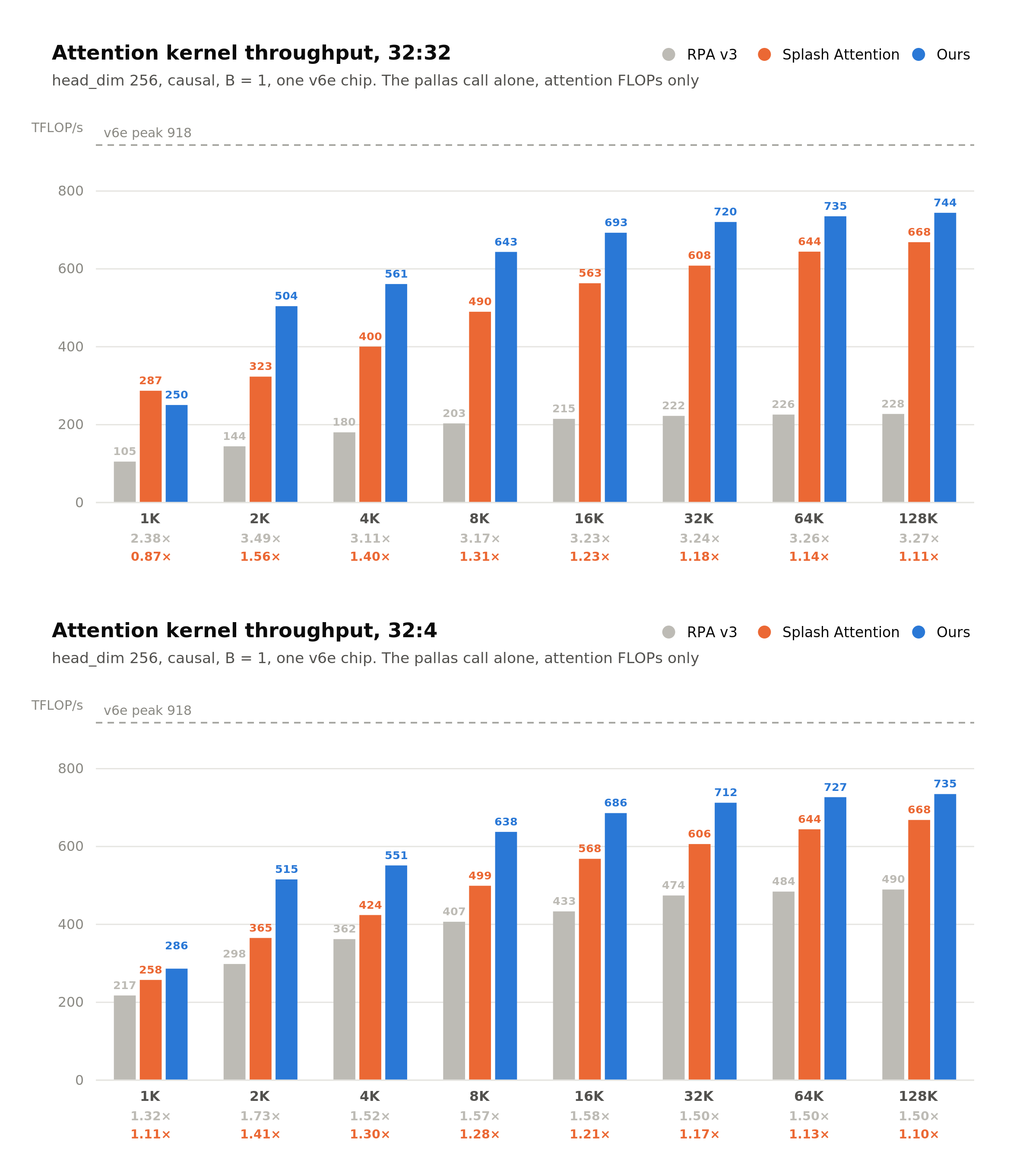
Causal prefill on one v6e chip, head_dim 256, B = 1, for 32:32 (MHA) and 32:4 (GQA) heads. The rows under each sequence length are our speedup over RPA v3 (gray) and Splash Attention (orange).
The same benchmark on v7x is in README_v7x.md.
Every number in the figure comes from
benchmarks/softmax_attention/. Each cell
times a whole attention block under one jax.jit, from hidden states
x (B, T, d_model) to hidden states out, with d_model = heads × head_dim:
- qkv projection: one einsum per q, k and v, each emitting the layout its kernel takes, as vLLM's attention layer does;
- layout: whatever relayout XLA could not fold into the projection;
- the attention kernel;
- output projection.
| Backend | Kernel input | Kernel |
|---|---|---|
| flywheel | (B, heads, T, head_dim) | flash_attn_func |
| Splash Attention | (B · heads, T, head_dim) | make_splash_mha_single_device |
| RPA v3 | (B · T, heads, head_dim) and a paged KV cache | ragged_paged_attention, which also writes the cache |
Each cell yields two numbers:
- Block level: the median wall clock of the jitted block, from
back-to-back calls with one sync per round
(
common/timing.py). - Kernel level, which the figure plots: the cell reruns 3 calls under
jax.profiler, andsegments.pyreads the device events of that same executable from the trace. Every leaf op goes into one segment by what it is: the Pallas call intoattn_kernel, pure data movement (copy, transpose, reshape, slice, pad, dtype conversion, ...) intolayout, and the rest intoqkv_projorout_projby itsjax.named_scope. Anything left is reported asother. The figure's throughput is attention FLOPs /attn_kerneltime, with attention FLOPs = 4 · B · T² · heads · head_dim, halved for causal; the speedup rows are ratios of these throughputs.
Both baselines are loaded from their pinned submodules, with no install, and
each loaded file is checked against its SHA-256 at the pin:
tpu-inference's RPA v3
at 4420cae and Tokamax's Splash Attention
at 84e5f36. Their block configs come from rpa_tuned_v6e.json and
splash_tuned_v6e.json next to the script, searched earlier per
(heads, heads_k, head_dim, mask, T) at B = 1 on v6e, with tuners that are not
in this repo. On a v7x chip the script reads rpa_tuned_v7x.json and
splash_tuned_v7x.json instead, searched with
tune_blocks.py. No chip
stands in for another: on one with no tables of its own, the two baselines
are an error until --rpa-table and --splash-table name a table. The
tables cover every cell of the figure. A cell outside them
runs RPA's get_default_block_sizes or Tokamax's heuristic config instead,
and its JSONL record says so in block_source / config_source. flywheel
runs its own block-size lookup inside flywheel_tpu.
To reproduce the figure, sequentially on one v6e chip:
git submodule update --init third_party/tpu-inference third_party/tokamax
benchmarks/softmax_attention/attention_block.sh results/benchmark/softmax_attention
The defaults are the figure's grid: RPA v3, Splash Attention and flywheel,
32 q heads with 32 or 4 kv heads, head_dim 256, causal, B = 1, T from 1K to
128K. IMPLS, HEADS, HEADS_K, HEAD_DIM, MASK and SEQLENS override
them. The output directory gets benchmark.jsonl, benchmark.log and one
profiler trace per cell under traces/, which XProf opens. At the end the
script prints the kernel-level table the figure plots and the block-level
split, which shows the layout work RPA v3 does before its kernel runs and
flywheel and Splash Attention do not need. Rerunning into the same directory
measures every cell again, and the last ok record of each cell wins.
To time one cell, reprint the tables, or re-split a directory of traces:
PYTHONPATH=. uv run --no-sync python benchmarks/softmax_attention/attention_block.py \
    --impl flywheel --heads 32 --heads-k 4 --head-dim 256 --seq 8192 \
    --output results/benchmark/softmax_attention/benchmark.jsonl \
    --trace results/benchmark/softmax_attention/traces
PYTHONPATH=. uv run --no-sync python benchmarks/softmax_attention/report.py \
    results/benchmark/softmax_attention/benchmark.jsonl
PYTHONPATH=. uv run --no-sync python benchmarks/softmax_attention/segments.py \
    results/benchmark/softmax_attention/traces
Only fixed-shape prefill is benchmarked; the varlen and KV-cache APIs have no benchmark entrypoint.
Linear attention
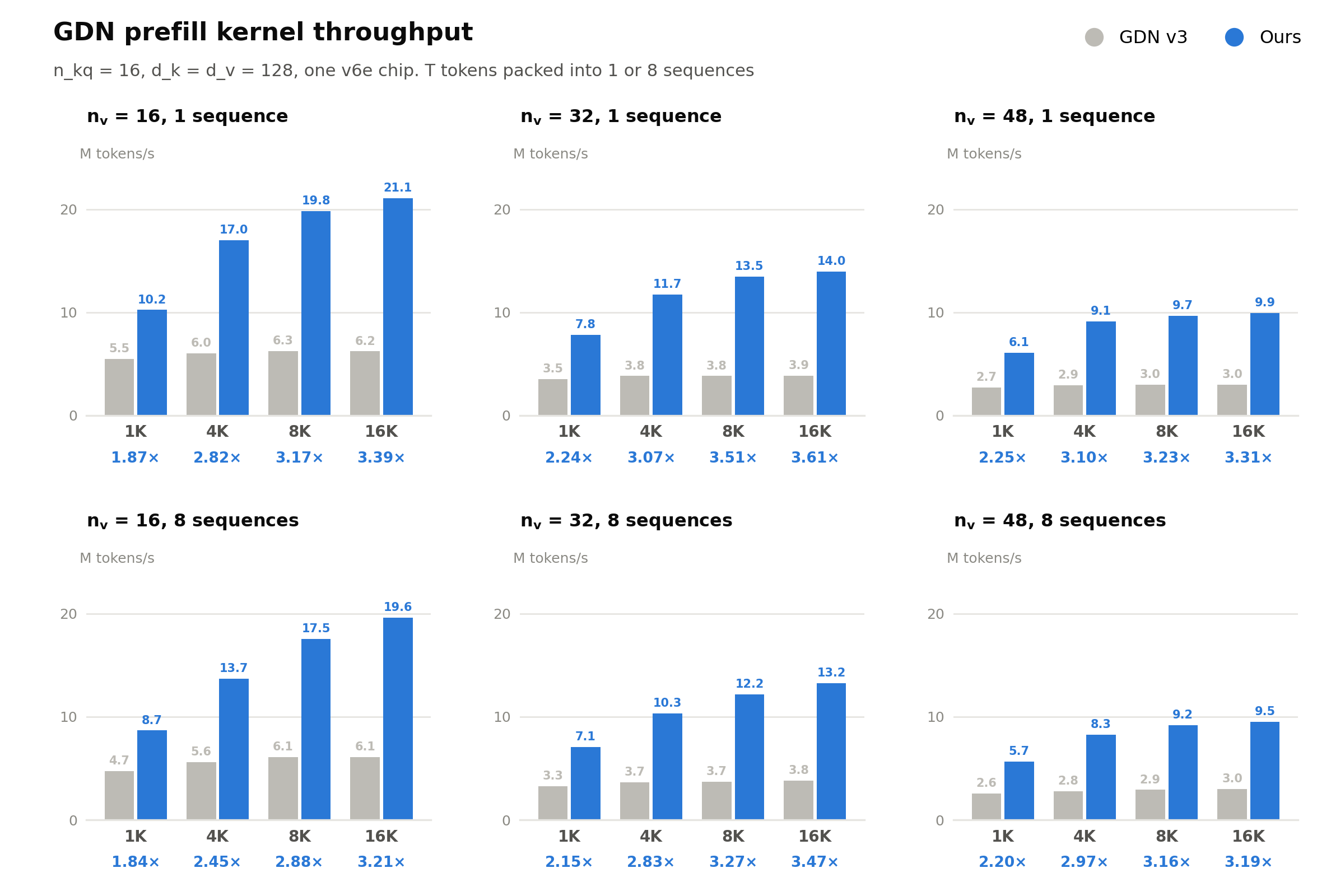
GDN prefill on one v6e chip, n_kq = 16 and d_k = d_v = 128, with T tokens
packed into 1 or 8 sequences. The row under each sequence length is our
speedup over the vendored gdn_v3 baseline (gray).
For GDN and KDA kernels, the vendored baselines live in
benchmarks/linear_attention/baseline_kernel/. The GDN benchmark compares
gdn_v3 with our fused kernel by default; KDA's --impl baseline times the
chunked forward baseline, while --pkgs times fused kernels:
PYTHONPATH=. uv run --no-sync python benchmarks/linear_attention/benchmark/bench_gdn_fwd.py \
    --output results/gdn_fwd.json
PYTHONPATH=. uv run --no-sync python benchmarks/linear_attention/benchmark/bench_kda_fwd.py \
    --pkgs flywheel_tpu.linear_attention.kda --output results/kda_fwd.json
PYTHONPATH=. uv run --no-sync python benchmarks/linear_attention/benchmark/bench_kda_fwd.py \
    --impl baseline --output results/kda_fwd_baseline.json
End-to-end evaluation
vLLM backend (tpu-inference)
The vLLM TPU backend is upstream
tpu-inference pinned as the
third_party/tpu-inference submodule, plus patches/tpu-inference.patch,
which routes attention and GDN/KDA linear attention to the kernels in this
repo. On a TPU VM, from a checkout of this repo (needs
just and uv):
# 1. Check out the pinned tpu-inference and apply the patch.
just tpu-inference-apply

# 2. Clone vLLM at the commit the pinned tpu-inference is validated against.
git clone https://github.com/vllm-project/vllm.git ../vllm
git -C ../vllm checkout "$(cat third_party/tpu-inference/.buildkite/vllm_lkg.version)"

# 3. Install vLLM, the patched tpu-inference, and flywheel_tpu into one venv.
sudo apt-get update && sudo apt-get install -y libopenblas-base libopenmpi-dev libomp-dev
uv venv vllm_env --python 3.12 && source vllm_env/bin/activate
(cd ../vllm && uv pip install -r requirements/tpu.txt --torch-backend=cpu \
  && VLLM_TARGET_DEVICE=tpu uv pip install -e . --no-build-isolation)
uv pip install -e third_party/tpu-inference -e .
The kernels are off by default and switched on per attention family:
USE_FLYWHEEL_TPU_KERNEL=1 \
USE_FLYWHEEL_TPU_LINEAR_KERNEL=1 \
vllm serve Qwen/Qwen3-4B
USE_FLYWHEEL_TPU_KERNEL replaces RPA v3 for softmax attention and
USE_FLYWHEEL_TPU_LINEAR_KERNEL replaces the GDN/KDA kernels of hybrid
models. A configuration a kernel cannot serve fails instead of falling back
to the upstream kernel.
To change the backend, edit third_party/tpu-inference in place (the patch
stays uncommitted on top of the pin) and run just tpu-inference-export to
write the changes back into the patch. just tpu-inference-bump <rev> moves
the pin to a newer upstream commit and re-applies the patch with a 3-way
merge, stopping on conflicts.
Setup
On every host, with the venv of the vLLM backend section activated:
eval/setup.sh deps
eval/setup.sh model
eval/setup.sh ruler
eval/setup.sh babilong --lengths "128k 256k"
eval/setup.sh videomme
The runs themselves are offline. Each sweep runs its points one after
another and skips the ones that already finished, so an interrupted sweep
picks up where it stopped. Results go to ~/eval-logs/<eval> unless --out
names another directory, and --tp-size (default 8) sets the tensor
parallelism. These commands and scripts assume a single host that holds every
chip of the run (e.g. a v6e-8 at the default --tp-size 8); on a machine of
several hosts, adapt them by hand and start Ray first, as in the multi-host
example below:
eval/ruler/run_ruler_sweep.sh --seqlens "4096 32768 131072"
eval/babilong/run_babilong_sweep.sh --lengths "128k 256k"
eval/videomme/run_videomme_sweep.sh --frames "1024 2048"
To run on multiple hosts:
eval/setup.sh babilong --lengths 512k    # on the host that runs the eval
ray start --head --port=6379             # on the host that runs the eval
ray start --address=<head ip>:6379       # on every other host
eval/babilong/run_babilong_sweep.sh --lengths 512k --cp-size 2 --enable-sp \
    --yarn-factor 2 --multihost --out ~/eval-logs/babilong
eval/ruler/run_ruler_sweep.sh --seqlens 524288 --cp-size 2 --enable-sp \
    --yarn-factor 2 --multihost --out ~/eval-logs/ruler
Start Ray without USE_FLYWHEEL_TPU_* or RPA_V3_* set: the driver's kernel
switches reach the Ray workers only where a node does not already set them.
Citation
If you use FlyWheel in your research, please cite:
@misc{bao2026flywheel,
  title        = {FlyWheel: Attention Kernels for TPU},
  author       = {Zishuo Bao and Zeshen Zhang and Yucheng Lu},
  year         = {2026},
  howpublished = {\url{https://github.com/heavyball-research/flywheel-tpu}},
  note         = {Version 0.3.0}
}
1 maintainer

Metadata
1 maintainer
Release files for flywheel-tpu 0.3.0
For a detailed explanation of source distributions (sdists) and built distributions (wheels), please see the package formats documentation.
Source distribution (sdist)
| File | Size | Uploaded | Provenance | |
|---|---|---|---|---|
| flywheel_tpu-0.3.0.tar.gz | 207.9 kB | Without provenance | Details |
Built distribution (wheel)
| File | Interpreter | ABI | Platform | Reset |
|---|---|---|---|---|
| flywheel_tpu-0.3.0-py3-none-any.whl | Python 3 | none | any | Details |
Total release size: 432.5 kB
Release files / flywheel_tpu-0.3.0.tar.gz
| Download URL | flywheel_tpu-0.3.0.tar.gz |
|---|---|
| Size | 207.9 kB |
| Tags | Source |
|
SHA-256 checksum How to use checksums |
888eef4974cb967e9c980ed35a5261febe6e9f21bb0aae0d6076b556f24864b9
|
|
BLAKE2b-256 checksum How to use checksums |
77895a13696e23df4b118702b3fbced5b1bfdf563a7bd727bf64e9747565a3c3
|
| Upload date | |
|
Uploaded using Trusted Publishing? What is trusted publishing? |
Yes |
| Uploaded via |
uv/0.13.3 {"installer":{"name":"uv","version":"0.13.3","subcommand":["publish"]},"python":null,"implementation":{"name":null,"version":null},"distro":{"name":"Ubuntu","version":"24.04","id":"noble","libc":null},"system":{"name":null,"release":null},"cpu":null,"openssl_version":null,"setuptools_version":null,"rustc_version":null,"ci":true}
|
Release files / flywheel_tpu-0.3.0-py3-none-any.whl
| Download URL | flywheel_tpu-0.3.0-py3-none-any.whl |
|---|---|
| Size | 224.6 kB |
| Tags | Python 3 |
|
SHA-256 checksum How to use checksums |
eef8a06f095b458a58b34fc7520d005c72f23b09fb30359c91d5683c40435eed
|
|
BLAKE2b-256 checksum How to use checksums |
b90cf82915085fe8e24b030d716fb9d57ac2d72b82628c29f9a5689a5a520e6e
|
| Upload date | |
|
Uploaded using Trusted Publishing? What is trusted publishing? |
Yes |
| Uploaded via |
uv/0.13.3 {"installer":{"name":"uv","version":"0.13.3","subcommand":["publish"]},"python":null,"implementation":{"name":null,"version":null},"distro":{"name":"Ubuntu","version":"24.04","id":"noble","libc":null},"system":{"name":null,"release":null},"cpu":null,"openssl_version":null,"setuptools_version":null,"rustc_version":null,"ci":true}
|
Security for flywheel-tpu 0.3.0
Provenance
Provenance describes where a file came from. On PyPI, provenance is shared via attestations, which provide a verifiable record of the build or publishing details. View details, limitations and caveats.
No provenance found
None of the files in this release were uploaded with provenance metadata.
A note on package security
PyPI is a repository for distributing packages, not a service for auditing them. While third-party security researchers and our staff do their best to detect and remove malicious packages, PyPI cannot guarantee the quality, security or suitability of any given package.














