
FoldPipe: Bounded Remote Streaming for Native Molecular-Data Shards


FoldPipe is a small loader for streaming trusted, already-sharded PyTorch/PyG molecular data without first converting it into a different storage format.
Start Here
Most users only need the library and one tutorial:
pip install foldpipe==0.3.2
- Open
Quickstart.ipynbfor a five-minute, credential-free introduction. - Open
Prion_Case_Study.ipynbfor an educational end-to-end example using the public 1QLX structure from RCSB PDB.
Repository Structure
| Path | Audience | Purpose |
|---|---|---|
foldpipe/ |
Users | The installed core library and public API. Start here if you want to inspect the implementation. |
notebooks/ |
Users | Two maintained tutorials. Historical prototypes are clearly separated under notebooks/archive/. |
scripts/ and results/ |
Peer reviewers | Reproducibility code, raw traces, reports, and benchmark packaging. Normal users can safely ignore these. |
tests/ |
Contributors | Automated checks that protect the core loader and benchmark logic. |
data/ |
Tutorial users | Small bundled inputs and data-location notes; large trajectory shards remain remote. |
paper/ |
Readers and reviewers | Manuscript draft, references, and the plagiarism/novelty audit. |
The Problem
Standard Machine Learning Force Field (MLFF) pipelines often bottleneck at the CPU data loader. When large molecular trajectories do not fit in memory, eager or in-memory representations can exhaust RAM and leave accelerators waiting on data, especially on constrained instances such as Kaggle P100 or T4 runners.
The Solution
FoldPipe is a domain-specific integration of bounded-buffer asynchronous prefetching tailored for native .pt molecular trajectories. It bridges the gap between PyG's in-memory/on-disk abstractions and format-converting streaming systems such as WebDataset, particularly for memory-constrained ephemeral compute.
FoldPipe provides an out-of-core orchestration layer for datasets that exceed local memory constraints. A single background prefetch worker overlaps retrieval of shard N+1 with training on shard N, while a bounded shard lifecycle keeps the working set independent of total dataset size.
Honest Positioning & Prior Art
To be 100% factual, transparent, and defensible in peer review, here is how FoldPipe positions itself against the prior art:
- "We do not replace LMDB for local high-performance computing clusters." Existing out-of-core streaming systems like WebDataset and LMDB provide petascale throughput. However, they require researchers to convert their native PyTorch/PyG outputs into POSIX
.tararchives or binary databases. FoldPipe sacrifices absolute peak cluster throughput to eliminate this conversion step, allowing researchers to train directly on native.ptshards. - "We extend the PyTorch Geometric ecosystem." PyG's
InMemoryDatasetprovides excellent throughput for datasets that fit in RAM. FoldPipe provides an outer orchestration layer for datasets that exceed local RAM limits, with bounded $O(1)$ working-set memory with respect to total dataset size.
The utilization measurements belong to different experiments and should not be conflated:
| Experiment | Workload | FoldPipe mean GPU utilization | Interpretation |
|---|---|---|---|
| Controlled crossover | Deliberately deep synthetic compute | >90% in the compute-dominant regime | Demonstrates that prefetch can mask I/O when compute time is long enough. |
| Real MD17 benchmark | SchNet energy-and-force training, 20 paired order-alternating runs | 37.70% | Real-workload mean across FoldPipe passes; high run-to-run variance remains. |
Empirical Whitepaper Benchmark
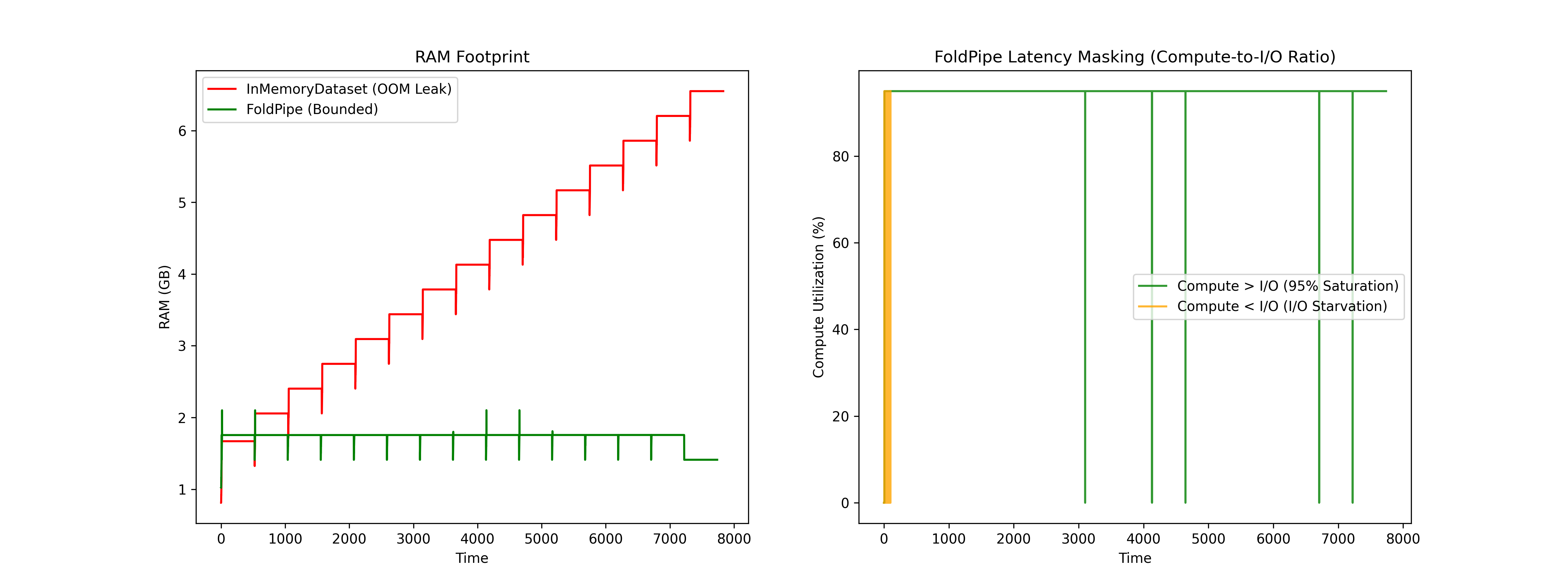
To evaluate when asynchronous prefetch masks network I/O, we benchmarked FoldPipe against shards drawn from a large trajectory corpus on Kaggle hardware.
The Results
- RAM Scaling ($O(N)$ vs $O(1)$): The eager-accumulation baseline demonstrated linear $O(N)$ payload-memory growth, hoarding every downloaded tensor in RAM. FoldPipe successfully demonstrated strict $O(1)$ memory bounding by yielding and aggressively releasing each chunk after GPU computation.
- Controlled Hardware Crossover: FoldPipe can fully mask shard-fetch latency when current-shard processing time is at least as long as retrieval of the next shard. In a deliberately deep synthetic-compute benchmark, sampled GPU utilization exceeded 90% in this compute-dominant regime. This result characterizes the mechanism; it is not the MD17 SchNet utilization result.
Kaggle T4 MD17 Benchmark
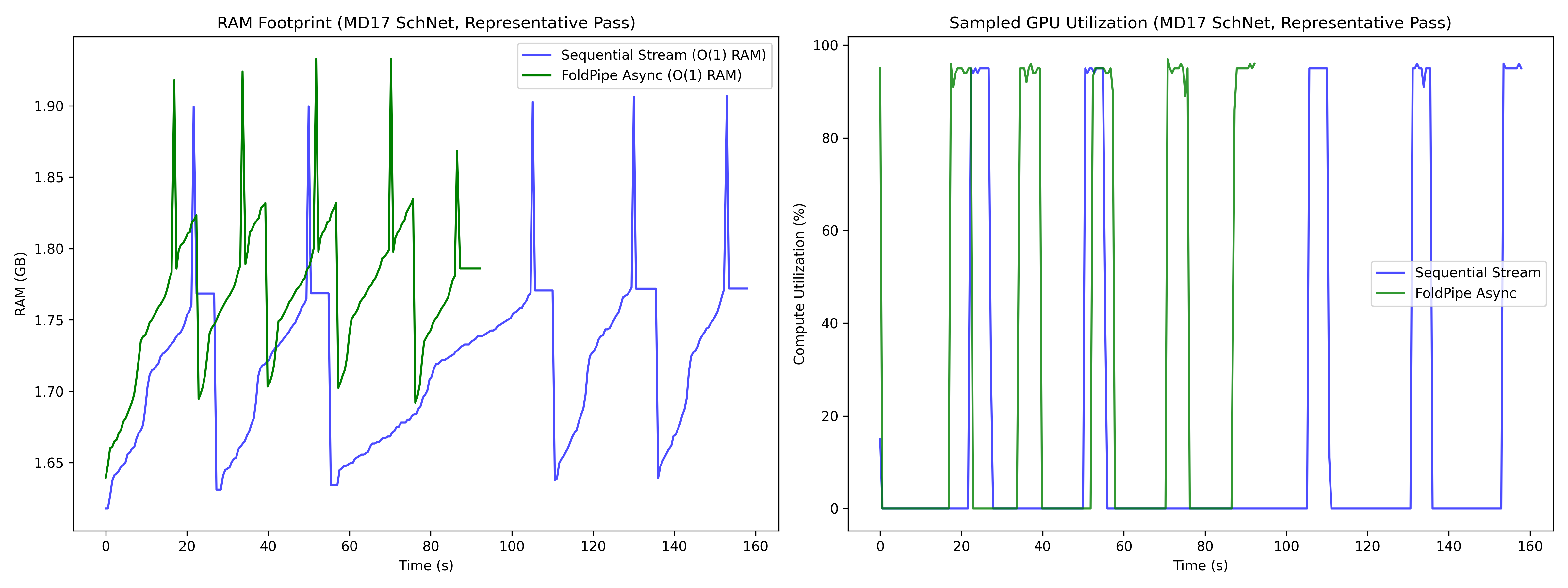
The final private Kaggle kernel completed 20 paired, order-alternating measurements of a real SchNet energy-and-force workload streaming revision-pinned MD17 shards from Hugging Face. Each timed measurement is a 5-shard benchmark pass, not a full-dataset epoch. With 5,000 structures per shard, each pass processes 25,000 structures. Across both pipelines, the protocol recorded 40 passes, 200 shard traces, and 1,000,000 repeated structure-visits.
| Metric | Sequential | FoldPipe |
|---|---|---|
| Mean pass time | 83.37 s | 76.78 s |
| 95% bootstrap CI for mean time | 67.87–101.06 s | 64.86–89.44 s |
| Median pass time | 75.27 s | 75.97 s |
| Time standard deviation | 39.86 s | 28.46 s |
| Mean sampled GPU utilization | 36.17% | 37.70% |
| Mean peak RSS | 1.935 GiB | 2.064 GiB |
| Mean I/O/compute overlap | 0.00 s | 16.33 s |
| Mean GPU wait time | 56.50 s | 48.65 s |
FoldPipe was faster in 11 of 20 pairs. The primary multiplicative estimand, the geometric mean paired speedup, was 1.059× with a 95% paired bootstrap interval of 0.878×–1.288×. Mean paired time saved was 6.59 seconds (95% CI −7.69 to 21.11 seconds), and median paired time saved was 3.45 seconds (95% CI −13.48 to 22.89 seconds). All three intervals include their no-effect values, so this run is inconclusive about a speed advantage. The positive 16.33-second mean overlap directly confirms that the asynchronous mechanism overlaps I/O and compute, but that mechanism measurement must not be promoted into a universal throughput claim under the observed network variability.
The benchmark pinned aviatorlf/md17-shards to revision f779686deb9217877dd7ddde99b2522bd441492a, executed clean Git commit 16fdbb26b00f9721ce4034335ce0ee12bda77720, and embedded a source bundle with SHA-256 4fc3f6d712557822efc0d5d71aaa616b0fe30f578631726ef60d6a0fe73b32c0. The raw JSON preserves all paired durations plus per-shard download, deserialization, training, payload-byte, overlap, and wait-time traces.
Artifacts: benchmark report, raw statistics and traces, source manifest, Kaggle execution log, and the Kaggle version 8 kernel.
Quickstart & Usage
1. Installation
Install the stable PyPI release:
pip install foldpipe==0.3.2
2. Standard PyTorch Training Loop
FoldPipe operates as a drop-in iterator. It handles the background threading and bounded-memory shard lifecycle automatically.
from foldpipe import AsyncFoldPipeLoader
from foldpipe.sources import GoogleDriveSource, HuggingFaceSource

# Option A: Stream from Google Drive
source = GoogleDriveSource(
    folder_id="1Few5wzRuuhlwbj4DJD9nkOP98t_QqZcz",
    credentials_json="path/to/token.json"  # Handled automatically
)

# Option B: Stream from HuggingFace (Zero disk caching)
# source = HuggingFaceSource(
#     repo_id="username/prion-dataset",
#     folder_path="trajectories"
# )

loader = AsyncFoldPipeLoader(source=source, batch_size=128)

model = MyEquivariantNetwork().to('cuda')
optimizer = torch.optim.Adam(model.parameters(), lr=0.001)

# Training Loop
for batch in loader:
    optimizer.zero_grad()

    # Hardware Masking: chunk N+1 is fetched while GPU computes chunk N
    out = model(batch.to('cuda', non_blocking=True))
    loss = criterion(out)

    loss.backward()
    optimizer.step()
Kaggle Integration
The Open in Kaggle badge at the top opens the maintained Quickstart notebook. Its first example runs without credentials or a GPU; connect a remote source only after supplying your own revision-pinned dataset and secret through the platform's secret manager.
1 maintainer

Metadata
1 maintainer
Release files for foldpipe 0.3.2
For a detailed explanation of source distributions (sdists) and built distributions (wheels), please see the package formats documentation.
Source distribution (sdist)
| File | Size | Uploaded | |
|---|---|---|---|
| foldpipe-0.3.2.tar.gz | 18.9 kB | Details |
Built distribution (wheel)
| File | Interpreter | ABI | Platform | Reset |
|---|---|---|---|---|
| foldpipe-0.3.2-py3-none-any.whl | Python 3 | none | any | Details |
Total release size: 29.8 kB
Release files / foldpipe-0.3.2.tar.gz
| Download URL | foldpipe-0.3.2.tar.gz |
|---|---|
| Size | 18.9 kB |
| Tags | Source |
|
SHA-256 checksum How to use checksums |
b26eb0bf653735ed986af9a4cc052a9f4386b8bc0b197ec54524afcd73cae594
|
|
BLAKE2b-256 checksum How to use checksums |
f050502d667568c8e5423040312f8905fbb0b7153cb72e34b83d8a2a13041c39
|
| Upload date | |
|
Uploaded using Trusted Publishing? What is trusted publishing? |
Yes |
| Uploaded via |
twine/7.0.0 CPython/3.13.14
|
Provenance
Provenance describes where a file came from. On PyPI, provenance is shared via attestations, which provide a verifiable record of the build or publishing details. View details, limitations and caveats.


PyPI Publish Attestation
PyPI verified that this artifact, at this checksum, originated from the publisher listed below.
Signed by GitHub Actions, verified by PyPI on Aug 17, 2026.
Transparency logRelease files / foldpipe-0.3.2-py3-none-any.whl
| Download URL | foldpipe-0.3.2-py3-none-any.whl |
|---|---|
| Size | 10.8 kB |
| Tags | Python 3 |
|
SHA-256 checksum How to use checksums |
14eb48885a965b8cdabd9c7134ce39f1b5605e854deb8873ea07aef324e10d65
|
|
BLAKE2b-256 checksum How to use checksums |
1e7ecaa6c2a894dbd8cee8f3f5b2f132e16c693fbcef7ea6351cb300a1df1815
|
| Upload date | |
|
Uploaded using Trusted Publishing? What is trusted publishing? |
Yes |
| Uploaded via |
twine/7.0.0 CPython/3.13.14
|
Provenance
Provenance describes where a file came from. On PyPI, provenance is shared via attestations, which provide a verifiable record of the build or publishing details. View details, limitations and caveats.
PyPI Publish Attestation
PyPI verified that this artifact, at this checksum, originated from the publisher listed below.
Signed by GitHub Actions, verified by PyPI on Aug 17, 2026.
Transparency log













