
forkreduce
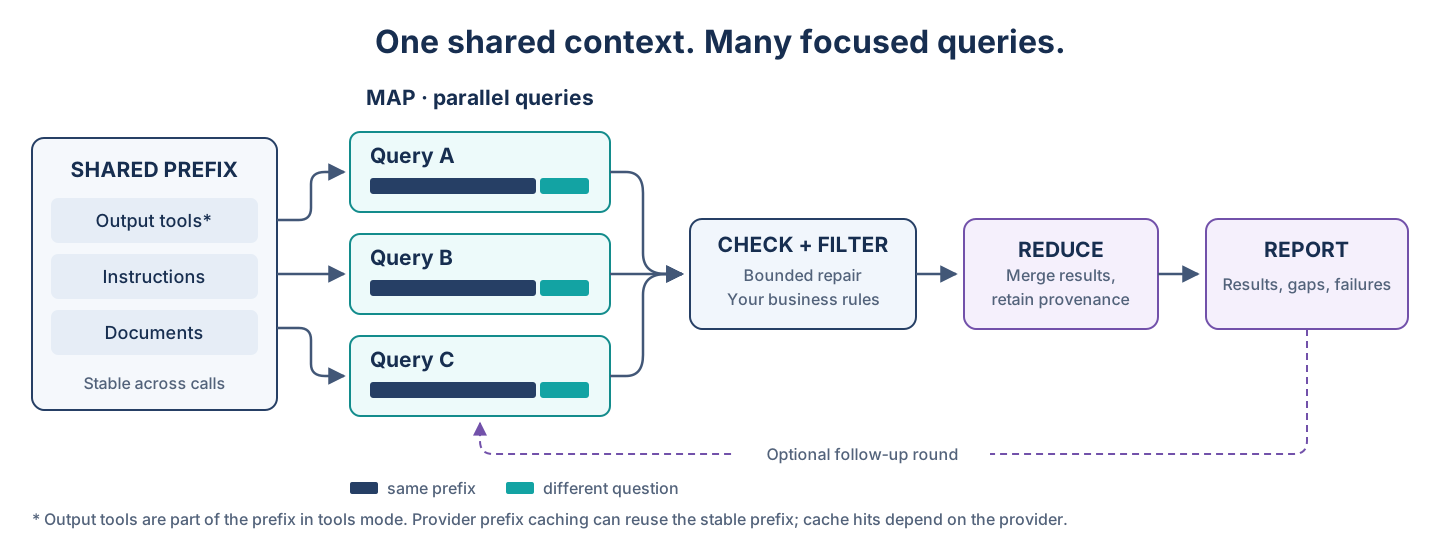
forkreduce is a small Python framework, built on Pydantic AI, for the case where many LLM queries share one long context.
Installation
Requires Python 3.11 or newer.
pip install forkreduce
The Temporal adapter is optional: pip install "forkreduce[temporal]". The core package never imports it.
Quick start
Ask two questions about the same document (map), then merge the answers into a summary with provenance (reduce). This example calls a real model; first configure an OpenAI-compatible endpoint:
export OPENAI_API_KEY="your-api-key"
export OPENAI_MODEL="your-model-name"
# Optional for a custom endpoint:
# export OPENAI_BASE_URL="https://your-provider.example/v1"
import asyncio
from pydantic import BaseModel
from forkreduce import Query, Traced, build, openai_compatible_model


class Answer(BaseModel):
    text: str


class Summary(Traced):
    text: str


async def main() -> None:
    session = build(
        openai_compatible_model(),
        documents="Eligible titles: Science Digest and River Almanac. Deadline: 30 April 2026.",
        instructions="Answer only from the document.",
        outputs=[Answer, Summary],
    )
    result = await (
        session.map([
            Query(id="titles", tail="Which titles are eligible?", output=Answer),
            Query(id="deadline", tail="What is the deadline?", output=Answer),
        ])
        .reduce(output=Summary, instructions="Combine both answers into one concise summary.")
        .run()
    )
    if result.merged is not None:
        print(result.merged.text)
    if result.failures:
        print(result.failures)


asyncio.run(main())
Example output (wording depends on the model):
Eligible titles are Science Digest and River Almanac; the deadline is 30 April 2026.
Provide the documents and instructions once at build(). Map and reduce share that prefix; only their query tails change. Register both output types up front; Summary inherits provenance tracking from Traced, and the merged result is available as result.merged. By default, the first map query finishes as a warmup before the rest run concurrently. Actual cache hits depend on the provider. For an offline example with no API key, see the TestModel example below.
Full workflow example
Add citation checks, bounded repair, a business filter, and a merge. TestModel generates test data to demonstrate the API flow, not real document extraction.
The notice below is fictional. Northbridge is not a real city, and the titles and quantities are invented.
import asyncio
from pydantic import BaseModel, Field
from pydantic_ai.models.test import TestModel

from forkreduce import (
    Block,
    CitationCheck,
    CitationRepair,
    Document,
    Query,
    Traced,
    build,
)


class Answer(BaseModel):
    """One fact from the notice."""

    text: str
    quote: str
    block_id: str


class Finding(Traced):
    topic: str
    summary: str
    source_ids: list[str] = Field(default_factory=list)


class FindingList(BaseModel):
    """Merged findings."""

    items: list[Finding]


notice = Document(
    doc_id="nb-lib-2026-per",
    title="Northbridge Public Library 2026 periodical subscription notice",
    blocks=[
        Block(block_id="titles", text="Eligible titles are the Northbridge Science Digest and the River Almanac."),
        Block(block_id="deadline", text="Offers must reach the front desk by 30 April 2026."),
    ],
)


async def main() -> None:
    # TestModel needs no network. Pass any pydantic-ai Model in production.
    session = build(
        TestModel(custom_output_args={"text": "see notice", "quote": "Eligible titles", "block_id": "titles"}),
        documents=notice,
        instructions="Answer only from the notice. Cite a quote and its block_id.",
        outputs=[Answer, FindingList],
    )
    result = await (
        session.map([Query(tail="Which titles are eligible?", output=Answer, id="titles")])
        .check(CitationCheck(), repair=CitationRepair(max_rounds=2))
        .filter(lambda item: bool(item.quote))
        .reduce(output=FindingList, instructions="Merge the cited facts.")
        .run()
    )
    print(result.failures, result.cache_hit_rate)


asyncio.run(main())
examples/run_offline.py is a fuller script: a FunctionModel walks map, citation check, a coverage policy, and gap-fill against the same notice.
Why
A long document plus a short question is a bad unit of work when you have dozens of questions. Sending the document on every call spends the same input tokens again, and the answers do not share a schema or a way to say where they came from.
Prefix caching changes the cost shape. Providers that cache a stable prompt prefix charge much less, and answer much faster, for the tokens they have already seen. That only works when the prefix is byte-for-byte stable: same tools, same instructions, same documents, and a tail that varies. forkreduce's job is to keep that prefix frozen and to give the map/reduce steps around it a place to live.
The framework does not know your domain. It will not decide that a missing "deadline" is fatal or that a citation failure should be dropped. It reports the facts and runs the action your policy returns.
Concepts
| Piece | What it is |
|---|---|
| Session | Built by build(). Holds the frozen prefix, the output types, the model, and the execution policy. |
| Prefix | Instructions + cleaned documents + the end marker, and (in tools mode) the tool set. Hashed for cache identity. |
| Query | A tail, an expected output type, and optional message history for continuing a branch. |
| Map | Many queries on one session. The first batch can warm the cache before concurrency opens. |
| Check / repair | A check reports problems. A repair may continue the branch, and code copies back only the allowed fields. |
| Filter | Your predicate. Outputs that fail it stay on the run and are left out of the reduce. |
| Reduce | One or more queries on the same prefix. Entries carry source_ids. A coverage policy decides what to do with gaps. |
| Follow-up | A hook between rounds. The built-in GapFill asks for missing leads and turns them into the next map. |
Query and reduce flow
flowchart TB
    context["Shared context<br/>Tools · instructions · documents"]

    subgraph map["Map · parallel queries"]
        direction LR
        q1["Question A"]
        q2["Question B"]
        q3["Question C"]
    end

    context --> q1
    context --> q2
    context --> q3

    q1 --> check["Check and bounded repair · optional"]
    q2 --> check
    q3 --> check
    check --> filter["Business filter · optional"]
    filter --> reduce["Reduce · merge results, retain provenance"]
    reduce --> result["Results and reports<br/>Covered · uncovered · failures"]

    result -.->|"Follow-up · optional: generate new questions"| map

    style check stroke-dasharray: 5 5
    style filter stroke-dasharray: 5 5
What sits in the cache prefix
flowchart LR
    subgraph prefix["Frozen prefix (hashed)"]
        tools["Output tool set<br/>name, description, JSON schema"]
        instructions["Instructions"]
        docs["Cleaned documents"]
        marker["===END_FIXED_DOCUMENTS==="]
        tools --> instructions --> docs --> marker
    end
    tail["Query tail<br/>+ repair / reduce / gap text"]
    prefix --> tail
    tail --> model["Model call"]
In prompted mode the tool list is empty. The expected schema is appended to the tail, so it is not part of the prefix.
Tool set
flowchart TB
    session["One Agent, one tool set, registered at build()"]
    session --> answer["Answer"]
    session --> leads["LeadList"]
    session --> findings["FindingList"]
    session --> reasons["DiscardExplanations"]
    q1["Query expects Answer"] --> session
    q2["Reduce expects FindingList"] --> session
    q3["RequireReason expects DiscardExplanations"] --> session
Every output type you will ask for, including DiscardExplanations if a policy may request reasons, is registered up front. A later call that names an unregistered type raises UnregisteredOutputError before any model call. In tools mode, a reply that uses a different registered tool is a validation failure and is retried.
API by concept
Session and build
session = build(
    model,                          # any pydantic-ai Model
    documents=notice,               # str, sequence of str, Block, Document, or a sequence of those
    instructions="...",
    outputs=[Answer, FindingList],  # unique BaseModel subclasses; tool name is the class name
    output_mode="tools",            # or "prompted"
    policy=Policy(concurrency=8, retries=2),
    warmup=True,
    executor=None,                  # default LocalExecutor(policy)
)
session.prefix_hash is a SHA-256 of a canonical JSON document: version, output mode, instructions, cleaned documents, and each tool's name, description, and schema. Rebuilding the same session produces the same hash. Changing a tool schema, the instructions, or the document text changes the hash.
documents accepts a string (one block, id b1), a sequence of strings (b1, b2, ...), or Block / Document values. Text is stripped of control characters before it is rendered or hashed. The rendered prefix ends with a line ===END_FIXED_DOCUMENTS===.
Query and QueryResult
query = Query(
    tail="Which titles are eligible?",
    output=Answer,          # must be registered
    id="titles",            # assigned q1, q2, ... when omitted
    history=None,           # None starts at the prefix; previous.messages continues a branch
    meta={},
    round=0,
)
result = await session.ask(query)
# or
results = await session.fork([query, other])
QueryResult fields:
| Field | Meaning |
|---|---|
query_id |
The query id. |
output |
The parsed model, or None on failure. |
messages |
Full branch transcript (all_messages()), so you can continue it. |
prefix_hash |
The session hash this call used. |
usage |
pydantic-ai RunUsage for this result, including retries. |
cache_hit_tokens |
cache_read_tokens, or details["prompt_cache_hit_tokens"] when the first is zero. |
attempts |
How many model calls this result took. |
failure |
A Failure, or None. |
round |
Plan round, starting at 1 inside Plan.run. |
elapsed_ms |
Wall time summed across attempts. |
needs_review |
Set when repair was exhausted and the policy says to keep the output flagged. |
dropped |
Set when the output is kept on the run but excluded from reduce. |
check_failures |
Problems the check still reports. |
Passing a history that does not start with the rendered documents emits PrefixMismatchWarning and still runs. The framework does not guess whether you meant a new branch.
session.map(queries) returns a lazy Plan. session.reduce(...) runs a reduce immediately and returns a ReduceOutcome.
Check and repair
CitationCheck walks nested models and lists. For each quote / block_id pair (those field names are the default) it reports:
empty_quoteorempty_block_idunknown_blockwhen the id is not in the session documentsquote_not_foundwhen the quote is not a substring of that block after whitespace is collapsed
Matching is case-sensitive.
CitationRepair(max_rounds=2, allowed_fields=("quote", "block_id")) continues the same branch and asks for the same output type. Whatever the model returns, apply deep-copies the original object and copies only the allowed fields at each failing path. Other fields stay as they were. There is no separate repair schema, so the tool set does not change.
session.map(queries).check(
    CitationCheck(),
    repair=CitationRepair(max_rounds=2),
    on_failure="needs_review",  # or "drop" or "fail"
)
on_failure overrides Policy.repair_failure for items that still fail when repair stops:
needs_reviewkeeps the output and flagsneeds_reviewdropexcludes it from the reduce and leaves it on the runfailrecords a permanent failure, skips the reduce, and does not start later rounds
The default is needs_review.
A custom check is a callable (output, *, documents) -> list[CheckFailure]. A custom repair implements max_rounds, build_query, and apply.
Filter
.filter(lambda item: bool(item.quote))
Predicates are AND-ed. A rejected output remains on RunResult.results and is not passed to the reduce. The framework ships no deterministic reducer; filtering is your hook.
Semantic reduce and coverage
A reduce is a normal query on the same session, so it hits the same prefix. The tail lists each input as id: ... plus its JSON, and asks for source_ids copied from those ids.
class ExplainUncovered:
    def decide(self, report):
        if report.uncovered:
            return RequireReason(tuple(report.uncovered))
        return Accept()

session.map(queries).reduce(
    output=FindingList,                 # registered, and entries must carry source_ids
    instructions="Merge the notice into one list.",
    coverage=ExplainUncovered(),
    max_batch=200,                      # larger inputs become a tree of reduces
    max_rounds=3,                       # bound on coverage Retry
)
Provenance (the default check) requires every traced entry to cite ids that exist. Unknown ids land in invalid_refs. Entries with no source_ids land in untraced. Both are retried inside the batch, up to Policy.retries, with a hint to cite only the given ids. A failed model call is not asked again here; the executor already retried it.
ReduceReport always lists:
| Field | Meaning |
|---|---|
covered |
Input ids that appear in some source_ids. |
uncovered |
Input ids that do not. Present even when the policy accepts. |
invalid_refs |
Cited ids that are not in the input. |
untraced |
JSON paths of entries that declare no source ids. |
reasons |
DiscardExplanation rows after RequireReason. |
kind |
"reduce" by default. |
CoveragePolicy.decide(report) returns an action. The framework executes it:
| Action | Effect |
|---|---|
Accept() |
Keep the merge. Uncovered ids stay on the report. This is the default (AcceptUncovered). |
RequireReason(items) |
Continue the reduce branch and ask for DiscardExplanations. The type must already be registered. |
Retry(items, hint) |
Reduce again. An empty items retries every original id; otherwise only those ids. hint is appended to the tail. |
Fail(reason) |
Stop. ReduceOutcome.fatal is set and the reason is stored. |
Drop is not a reduce action. It is used by citation-failure handling and by gap-fill lead policies.
More than max_batch inputs are reduced in a tree. Intermediate nodes get alias ids. Before the coverage policy runs, those aliases are expanded back to the original ids on the returned objects. The message history still contains the model's raw tool arguments, which may show the alias ids.
Traced is a pydantic base with source_ids: list[str]. Subclass it, or declare your own source_ids field. If a subclass redeclares the field, give it a default so the model can omit it only when you mean that; the provenance check still treats a missing or empty list as untraced.
Follow-up and gap-fill
def more(state, session):
    if state.round >= 2:
        return []
    return [Query(tail="What is still missing?", output=Answer)]

session.map(queries).reduce(output=FindingList).followup(more, max_rounds=2)
followup(fn, max_rounds=2) calls fn(state, session) after each round except the last. max_rounds counts map rounds, including the first. An empty list ends the run. Without followup, a plan runs a single round.
RoundState carries round, results, outputs, merged, report, plus failures and side_results for calls the hook itself makes. Items that declare a round field are stamped with the map round when the round index is greater than zero.
GapFill is a built-in strategy:
gap = GapFill(
    lead_output=LeadList,          # registered; reads .leads or .items
    item_output=Answer,            # registered; one query per new lead
    scopes=[Scope("delivery", "how a sealed offer is delivered")],
    instructions="Report blocks in this scope that the merge does not already cite.",
)
It asks once per scope, on the same prefix. Leads whose position (block_id by default) is already present on the merged output are skipped. A LeadPolicy then sees a LeadReport and may Accept, Drop specific positions, or Fail. The default is AcceptLeads.
Concurrency, retries, budget
Policy(
    concurrency=8,             # semaphore around model calls
    retries=2,                 # extra attempts after the first
    retry_backoff=0.5,         # seconds; doubles each transport retry, capped by max_backoff
    max_backoff=8.0,
    budget=Budget(
        max_requests=100,
        max_input_tokens=None,
        max_output_tokens=None,
        max_total_tokens=None,
    ),
    repair_failure="needs_review",
    budget_policy=None,        # callable(BudgetReport) -> Accept | Fail | ...
    context_limit=None,        # per-call window in estimated tokens; None skips the local warning
    context_reserve=None,      # prefix headroom; None means min(limit, max(4096, limit // 4))
)
Failure classes:
| Kind | Examples | What happens |
|---|---|---|
validation |
Wrong tool, schema mismatch, UnexpectedModelBehavior, UsageLimitExceeded |
Retried immediately, up to the bound. |
transport |
HTTP 408, 409, 425, 429, and 5xx; timeouts; connection errors | Retried with exponential backoff. |
permanent |
Other 4xx, UserError, provider context_overflow, anything unrecognized |
Not retried. Returned on the result. |
budget |
A ceiling was already crossed | Not retried. |
Each model call is built with pydantic-ai retries=0 and UsageLimits(request_limit=1). forkreduce owns the retry loop, so a validation error does not become a hidden inner retry. Failed calls are never removed from the run.
warmup=True (the default) runs the first query of the first fork / map batch to completion before starting the rest, so the provider can store the prefix. There is no extra dummy request. Later forks on that session run fully concurrent. ask does not warm up by itself.
Token budgets are cumulative. When any token ceiling is set, model calls are serialized even if concurrency is greater than 1. A call is refused only when completed calls have already reached the ceiling. The one in-flight call that crosses a ceiling is allowed, because its size is known only after it returns, and nothing else starts until that usage is recorded. Overshoot is at most that one call, not one call per concurrent slot. Request-count budgets stay concurrent: each call reserves one request before it is sent. A call blocked before it is sent reports attempts=0 and does not reserve a request.
A response that fails validation is still billed. Its token usage is read from the captured model response and added to the budget and to QueryResult.usage. A transport failure that never produces a response has no tokens to recover; the reserved request still counts. budget_policy may return Accept to force a blocked call through, or Fail to block with your reason. The default blocks.
Context limit
Policy.context_limit is the model context window in estimated tokens, separate from the cumulative budget above. The estimate is one token per four characters, rounded up, over the instructions, the tool schemas, the documents (or the continuation history), and the query tail. It is not the provider's tokenizer. The provider is the source of truth: a local estimate never blocks build(), ask, fork, or map, and the prompt is not truncated or split into chunks.
When a limit is set and the estimate is over the usable window, forkreduce emits ContextEstimateWarning (a UserWarning) and logs the same message on the forkreduce.context logger, then sends the request anyway.
- At
build(), the frozen prefix warns whenprefix_estimate > context_limit - reserve. The warning is stored onSession.context_warning. - At
ask/fork/map, a query warns when the full estimate (prefix or history, plus the tail) is greater thancontext_limit. The warning is stored onQueryResult.context_warningand listed onRunResult.context_warnings. The prefix warning is also copied ontoRunResult.context_warning.
Each warning records estimated_tokens, limit, and reserve. Equality is inside the window. context_limit=None skips the local warning even if context_reserve is set.
context_reserve is prefix headroom, in the same estimated tokens. None (the default) means min(context_limit, max(4096, context_limit // 4)). 4096 tokens leaves room for a real tail and a structured reply on an 8k–16k window (half of 8k, a quarter of 16k). On a larger window, a quarter of context_limit is the larger of the two, so a prefix that crowds out the per-query work still warns. The value is capped at context_limit, so a window smaller than 4096 treats the whole window as headroom and warns on any non-empty prefix estimate without going negative. Set an integer, including 0, to replace the formula. 0 warns on the prefix only when the prefix itself exceeds the full window. The reserve is not subtracted again for a request warning, because that estimate already includes the tail; it is still recorded on the warning.
A provider that rejects the prompt for context length (HTTP 400 whose body says the maximum context length was exceeded) is a non-retryable Failure with code context_overflow and detail["where"] == "provider". When the body includes the figures, the message reports those (reported 9000 tokens exceeds context limit 8192). Chunked map-then-reduce is not part of v0.1.
RunResult.usage is a UsageSummary: request count, input and output tokens, cache-hit tokens, elapsed milliseconds, a per-round breakdown, and cache_hit_rate (cache_hit_tokens / input_tokens). Map calls and their repairs are folded onto the map QueryResult so tokens are counted once. Reduce calls are added from the individual calls, not from a second summed copy.
Continuing a branch
first = await session.ask(Query(tail="Which titles?", output=Answer, id="titles"))
follow = await session.ask(Query(
    tail="Now quote the deadline as well.",
    output=Answer,
    id="titles-more",
    history=first.messages,
))
history is the full branch, prefix included. Repair and RequireReason use the same mechanism.
Models
Pass any pydantic-ai Model, including TestModel and FunctionModel. For an OpenAI-compatible server:
from forkreduce import openai_compatible_model

model = openai_compatible_model()  # OPENAI_MODEL or FORKREDUCE_MODEL, OPENAI_API_KEY, OPENAI_BASE_URL
The OpenAI client is constructed with max_retries=0. forkreduce does the retrying.
Temporal (optional)
import forkreduce does not import temporalio. The adapter is forkreduce.contrib.temporal and needs pip install "forkreduce[temporal]".
Each query is one activity. The activity calls Session.run_once (a single attempt) and raises ApplicationError. non_retryable follows Failure.retryable: validation and transport stay retryable; permanent failures and budget exhaustion do not. temporal_retry_policy(policy) sets maximum_attempts to policy.retries + 1.
The idempotency key is forkreduce:{prefix_hash}:{query_id} via activity_id. Register the built session on the worker with register_session(session) before the workflow runs. Registering another session with the same prefix hash but a different model or policy raises ForkReduceError; call unregister_session first. The same fingerprint may replace the session. The workflow payload carries the prefix hash, the tail, the output name, and the retry budget (max_attempts, backoff), not the model. MapQueriesWorkflow uses that budget. query_activity_input(session, ...) copies Policy.retries + 1 into max_attempts. Without a message store, pass the previous activity's messages_json back as history_json to continue a branch.
Large transcripts should not be activity return values. Pass a MessageStore to set_message_store. With a store, the activity returns messages_ref and leaves messages_json empty. Without one, messages are inlined, which is fine for tests and a poor fit for real histories. InMemoryMessageStore is process-local.
MapQueriesWorkflow fans the activities out. It does not call the model itself. Deterministic decisions (coverage math, lead filtering) can run in the workflow after the activities return; model calls stay in activities.
from forkreduce.contrib.temporal import (
    InMemoryMessageStore,
    MapQueriesWorkflow,
    QueryActivityInput,
    register_session,
    run_query_activity,
    set_message_store,
    temporal_retry_policy,
)

register_session(session)
set_message_store(InMemoryMessageStore())
Caching caveats
Fixed schema. Tool definitions are part of the prefix. Providers render tools before messages, and forkreduce does not add tools later. A new output type, a renamed field, or a changed description changes prefix_hash and misses the cache for every query, not just the one with the new tail. Literal enums need an "other" (or similar) escape so one unexpected value does not force a schema change later.
Control characters. Some providers reject tool-call JSON that contains raw control characters. forkreduce strips C0 controls other than tab, newline, and carriage return, and strips DEL, before rendering and hashing. The hash of a document with a null byte matches the hash of that document without it.
Warmup. The first request creates the cache entry. warmup=True finishes that request before the rest of the first batch starts. Firing the whole batch at once can miss the cache on every call.
Cache expiry. Providers expire prefix caches on their own schedule (often on the order of minutes of idle time, sometimes longer). forkreduce cannot refresh a cache it does not own. A later batch after a long gap may miss, pay full input price, and then hit again. The hash still tells you whether you sent the same prefix.
History. Continuing a branch sends the prior question and answer as well as the prefix. That also hits a prefix cache, including the earlier turns, as long as those bytes are unchanged. Timestamps and run ids are not part of the prefix check; the check compares the rendered document text.
Prompted mode. output_mode="prompted" puts no tools on the agent. The schema of the expected type is appended to the tail only, so different queries can use different registered types without busting the prefix. The tool-mode cache is more stable when every call shares one tool list, which is why "tools" is the default.
FAQ
Does the reduce have to use the same output type as the map? No. It must be one of the types registered at build(). Map queries and the reduce can differ.
What if the model cites an id I never sent? It is invalid_refs. The batch retries up to the policy bound. If the model keeps inventing ids, they stay on the report and the default policy still accepts the merge. A stricter policy can Fail or Retry.
Are uncovered items deleted? No. Accept keeps them on ReduceReport.uncovered. Use RequireReason when a person should see why they were left out.
Can I reduce without a plan? Yes. await session.reduce(items, output=FindingList, id_of=...).
Where do API keys live? Only in the environment, or in arguments you pass to openai_compatible_model. This repository has no .env and no embedded keys.
Does core import Temporal? No. A subprocess that imports forkreduce does not load temporalio.
Development and testing
From a checkout:
pip install -e ".[dev]"
ruff check src tests examples && ruff format --check src tests examples
mypy
pytest
Examples run offline with no key:
python examples/run_offline.py
A live OpenAI-compatible endpoint is optional. The process exits immediately when OPENAI_API_KEY is unset.
OPENAI_API_KEY=... OPENAI_MODEL=... OPENAI_BASE_URL=... python examples/run_live.py
FORKREDUCE_MODEL is accepted as another name for the model.
Releasing
PyPI publishes from a git tag. .github/workflows/release.yml builds the sdist and wheel, checks them, and uploads with Trusted Publishing. The repository has no PyPI token. The publisher is the pypi environment on 426ai/forkreduce, workflow release.yml.
- Set the same version in
pyproject.toml(version) andsrc/forkreduce/__init__.py(__version__). - Commit that change on
main. - Tag that commit and push the tag:
git tag vX.Y.Z
git push origin vX.Y.Z
The tag is v plus the version string: 0.1.0 is v0.1.0. The workflow fails when they differ. You can also run the Release workflow by hand from the Actions tab, but only on an existing v* tag.
Roadmap
v0.1.0 is the first public cut: one session, local execution, citation check/repair, semantic reduce with coverage actions, gap-fill, usage stats, and an optional Temporal activity wrapper.
Not in this version, and reasonable later:
- more built-in checks than citations
- a durable
MessageStoreimplementation (object storage, a database) - streaming partial results
- explicit cache-warmup metrics separated from the first real query
- a second workflow runtime behind the same
Executorprotocol - opt-in chunked map-then-reduce when a prompt is larger than the context window (the local estimate only warns; a provider context-length error still fails the call)
License
MIT. See LICENSE.
1 maintainer

Metadata
1 maintainer
Release files for forkreduce 0.1.0
For a detailed explanation of source distributions (sdists) and built distributions (wheels), please see the package formats documentation.
Source distribution (sdist)
| File | Size | Uploaded | Provenance | |
|---|---|---|---|---|
| forkreduce-0.1.0.tar.gz | 89.3 kB | Without provenance | Details |
Built distribution (wheel)
| File | Interpreter | ABI | Platform | Reset |
|---|---|---|---|---|
| forkreduce-0.1.0-py3-none-any.whl | Python 3 | none | any | Details |
Total release size: 147.5 kB
Release files / forkreduce-0.1.0.tar.gz
| Download URL | forkreduce-0.1.0.tar.gz |
|---|---|
| Size | 89.3 kB |
| Tags | Source |
|
SHA-256 checksum How to use checksums |
a1147ff9c77370e9ee6384cc2982cf313b0d072fa3c8518fd94ee95509ebdb02
|
|
BLAKE2b-256 checksum How to use checksums |
60e9db0251f030f301518ba7cc8d821698879343c39bdee76509f76cc8d87ad2
|
| Upload date | |
|
Uploaded using Trusted Publishing? What is trusted publishing? |
Yes |
| Uploaded via |
twine/7.0.0 CPython/3.13.14
|
Release files / forkreduce-0.1.0-py3-none-any.whl
| Download URL | forkreduce-0.1.0-py3-none-any.whl |
|---|---|
| Size | 58.2 kB |
| Tags | Python 3 |
|
SHA-256 checksum How to use checksums |
d3c6773721577b01ffc8e3a3cde82559305d3925068a9c73d0282f91bc062a89
|
|
BLAKE2b-256 checksum How to use checksums |
5012e909ba402b00eb0ef7f9bb327f59ecb8b40b9be5aa2340f232c707b0394c
|
| Upload date | |
|
Uploaded using Trusted Publishing? What is trusted publishing? |
Yes |
| Uploaded via |
twine/7.0.0 CPython/3.13.14
|
Security for forkreduce 0.1.0
Provenance
Provenance describes where a file came from. On PyPI, provenance is shared via attestations, which provide a verifiable record of the build or publishing details. View details, limitations and caveats.
No provenance found
None of the files in this release were uploaded with provenance metadata.
A note on package security
PyPI is a repository for distributing packages, not a service for auditing them. While third-party security researchers and our staff do their best to detect and remove malicious packages, PyPI cannot guarantee the quality, security or suitability of any given package.













