
Fornix
Project memory for AI coding sessions. Lives in the repo, travels with the code.
Quick start · Four operations · Compare · Store & server docs · Skill protocol · PyPI



Memory that branches, merges and gets reviewed with the code.
Shared by every model that opens the repo, consulted on every prompt. No hub, no account, no API key.
Read why →
Every AI session starts from zero. Yesterday's decision gets re-argued, last week's gotcha gets hit again, and the convention nobody wrote down gets broken by the next model to touch the code. Hosted memory tools fix this with a service outside the repo, so when the code moves, the memory does not.
fornix puts the memory in the repo. A teammate gets it by pulling, a branch carries its own decisions, a pull request reviews a decision next to the change that caused it. Any model, any MCP client.
| 📦 Store | .fornix/memories/*.jsonl, one fact per line, committed. Git is the history. |
| 🔌 Server | An MCP server over that store. Four tools, a sqlite-vec index for semantic recall, no model inside. |
| 🔁 Discipline | A skill and a hook that make the session recall before it answers and capture after it acts, every prompt, until told to stop. |
| 🌿 Branches with the code | Check out a branch or an old tag and you get the memory that was true there, not whatever a central store believes today. |
| 🤝 Any model, any client | Claude writes a memory, Codex reads it, Gemini corrects it. Same store, same file. |
Use fornix
🧑💻 I work in one repoOne command installs the store, the server, the skill and the hook into the repo. Restart Claude Code, turn sync on, done. |
🗂️ My editor is open on many reposOne store per repo, registered into the workspace folder above them. Each repo syncs on its own. |
🔧 I use Codex, Gemini, Cursor, or want an APIAny MCP client gets the same four tools. There is also an HTTP service with a JSON API. .fornix/setup.sh --codex --gemini
|
|
Quick start
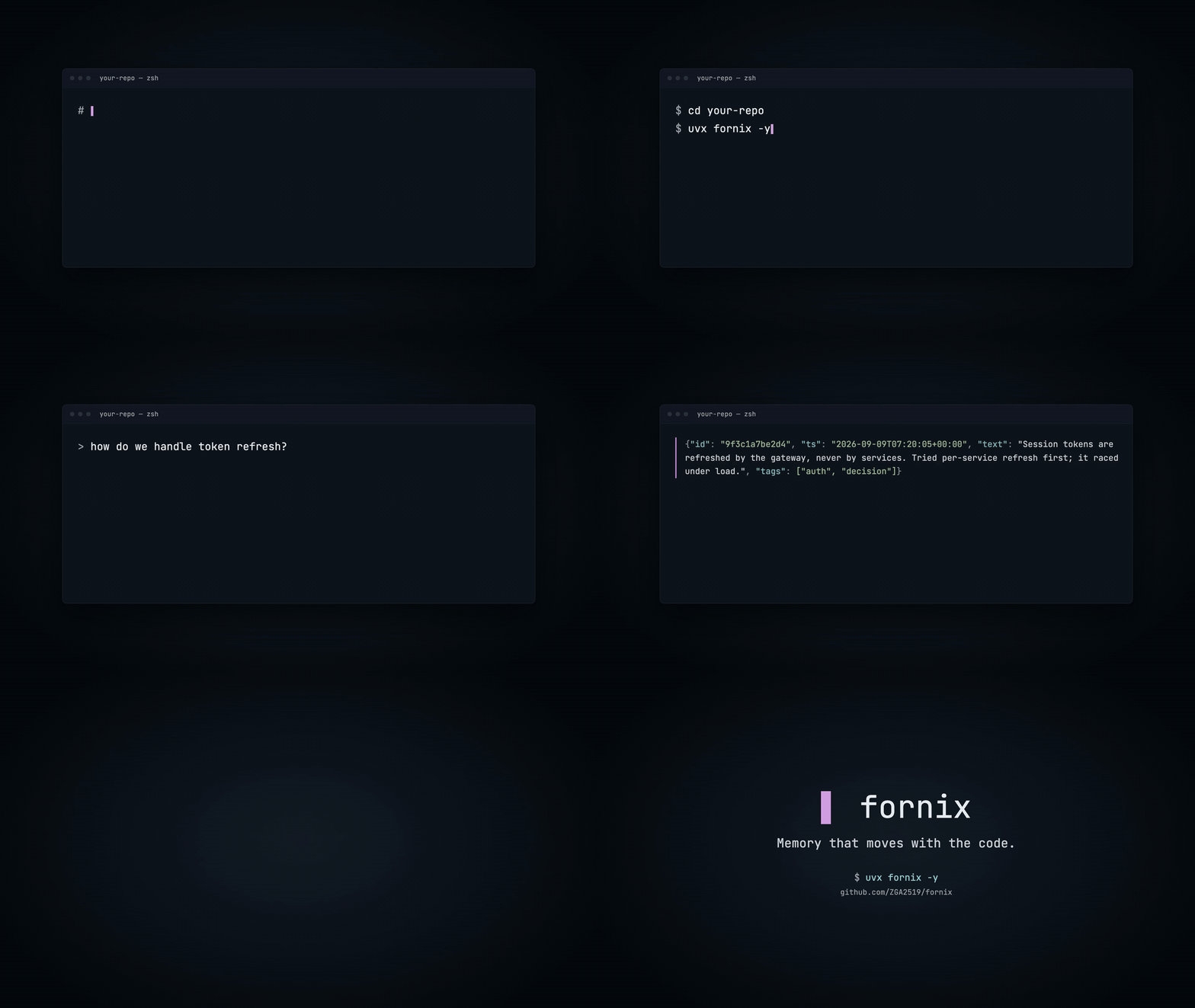
cd your-repo
uvx fornix -y
Restart Claude Code, approve the fornix server when asked, then:
/context-start-sync
That is the whole setup. Needs uv and git.
Drop the -y to be asked about the target, the hook and the other clients instead
of taking the defaults.
What landed in the repo
| path | what |
|---|---|
.fornix/ |
the store and the MCP server, with an empty memories/main.jsonl |
.mcp.json |
the fornix server entry, merged into whatever was there |
.claude/skills/context-sync/ |
the skill that drives the per-prompt loop |
.claude/commands/context-*.md |
/context-start-sync, /context-start-sync-readonly, /context-stop-sync |
.claude/hooks/context-sync.sh + settings.json |
a UserPromptSubmit hook that re-arms the loop every prompt, so it survives compaction |
.agent/ |
the same skill and commands under the vendor-neutral tree some agents read |
Commit .fornix/memories/. Everything else under .fornix/ is gitignored.
Re-run the command any time to update an install; memories/ is never touched.
How it works
Once sync is on, every prompt runs the same loop:
- Recall. Before answering, the model runs one
selectwith a query built from the intent of your prompt and treats the hits as ground truth for this repo. If a stored decision contradicts what it was about to do, it says so instead of quietly overwriting it. - Act. Your prompt gets answered as usual.
- Capture. After acting, it writes the durable facts it learned, one per call, correcting older memories in place rather than appending near-duplicates.
Every prompt ends with one quiet line:
context: 6 recalled · 1 written
A memory is one JSON line:
{"id": "9f3c1a7be2d4", "ts": "2026-09-09T07:20:05+00:00", "text": "Session tokens are refreshed by the gateway, never by services. Tried per-service refresh first; it raced under load.", "tags": ["auth", "decision"], "source": ""}
Durable, so it gets written: a decision and why, the option that lost, a hard constraint, a gotcha and its workaround, a convention the code does not reveal, a stated preference. Not durable, so it does not: transient state, file contents, anything re-derivable by reading the repo, general knowledge. Never: credentials, tokens, personal data. The store is committed and pushed.
Three commands
| command | does |
|---|---|
/context-start-sync |
recall and capture on every prompt |
/context-start-sync-readonly |
recall only, writes nothing, ever. For someone else's repo, or a branch whose decisions are not settled |
/context-stop-sync |
final flush of anything durable, then off |
The four operations
Any MCP client gets the same four tools. Scopes are named JSONL files; main is the shared default.
| tool | args | does |
|---|---|---|
select |
query, scope=main, k=8, tags |
Semantic search, best first, each with a score. Empty query lists the k newest. |
write |
text, scope=main, tags, source, id |
Save one fact. Pass an existing id to replace that memory in place. |
compress |
scope, ids, summary, threshold=0.92 |
ids + summary: fold those memories into one. Neither: merge near-duplicates, newest kept. |
isolate |
scope, seed_from, query, k, tags |
Open a private scope, optionally seeded with the top k hits from another. |
A sub-task or a sub-agent that will generate a lot of throwaway reasoning gets
isolate("task-x", seed_from="main", query=...), works in that scope, then
compress("main", ids, summary) folds the useful residue back.
Many repos in one window
One store per repo, but the editor is usually open on the folder above several. From that folder:
uvx fornix --set-root # finds every repo with a .fornix/ up to 5 levels down, asks which join
or inside each repo, .fornix/setup.sh --set-root ... Either way the repo adds
itself to that folder's .mcp.json as fornix-<repo> with an
absolute path, and copies the skill, commands and hook into the folder's .claude/.
Stores stay separate on purpose: one repo's decisions are not another's. Sync is
per repo too, so one repo can be capturing while another is read-only and the rest
are off.
Other clients
Claude Code · Codex · Gemini CLI · Antigravity · VS Code · Cursor · Windsurf · Cline · Zed · Claude Desktop · any MCP client
Claude Code reads .mcp.json and is done. Everything else is one command away,
and setup.sh ships inside .fornix/ so teammates without this repo have it:
.fornix/setup.sh                      # asks: which clients, which workspace folder
.fornix/setup.sh --codex --gemini     # also --claude --agy --vscode
.fornix/setup.sh --print              # just list the commands
Manual configuration
Clients configured by file (Cursor, Windsurf, Cline, Zed, Claude Desktop) take
this under mcpServers:
"fornix": {"command": "uv", "args": ["run", "--directory", "/abs/path/to/repo/.fornix", "python", "-m", "context_store.server", "mcp"]}
As a service
A JSON API with docs at /docs and MCP at /mcp:
uv run --directory .fornix python -m context_store.server serve     # http://127.0.0.1:8765
curl -s localhost:8765/select -d '{"query":"how is auth done"}' -H 'content-type: application/json'
Other ways to install
All of these are the same installer with the same flags. uvx fetches the release
tag from GitHub, so it needs git; the rest run from a checkout.
uvx fornix /path/to/repo -y                 # a repo other than the current one
uvx fornix --no-hook                        # skill only, no hook
uvx fornix --codex --vscode                 # register those clients as you go
uvx --from git+https://github.com/ZGA2519/fornix fornix   # track main

git clone https://github.com/ZGA2519/fornix && cd fornix
./install.sh /path/to/repo        # POSIX sh, the original
python3 setup.py /path/to/repo    # the same wizard in Python, runs in cmd.exe too
uv run fornix --help      # everything the installer accepts
How it compares
Three other shapes exist. Each is better than this at something; none of them is memory that moves with the code.
AGENTS.md / CLAUDE.md |
hosted memory (Mem0, Zep, Supermemory) |
local memory server (MemPalace, Basic Memory, ai-memory) |
fornix | |
|---|---|---|---|---|
| committed in the repo | ✓ | ✗ | ✗ | ✓ |
| branches and merges with the code | ✓ | ✗ | ✗ | ✓ |
| reviewed in a pull request | ✓ | ✗ | ✗ | ✓ |
| a teammate gets it by pulling | ✓ | ✗ account | ✗ hub or sync | ✓ |
| retrieved per prompt, not loaded whole | ✗ | ✓ | ✓ | ✓ |
| recall the model cannot skip | ✓ always in context | ✗ tool call | ~ skill or session hook | ✓ per-prompt hook |
| no API key, no network | ✓ | ✗ | ~ varies | ✓ |
| any model, any client | ~ convention | ~ | ✓ | ✓ |
| nothing to run but the agent | ✓ | ✗ | ✗ server | ✓ |
Two rows are the ones that matter.
A teammate gets it by pulling. A hub gives everyone the same memory, but it
gives everyone the latest memory. Check out a colleague's branch or a tag from
three months ago and the hub still describes main. Here the memory is at the
same commit as the code in front of you.
Recall the model cannot skip. Every memory server is a tool the model calls
when it happens to think of it, which on a long session is less and less, right
when memory matters most. AGENTS.md solves that by being permanently in
context, and pays for it in tokens on every turn whether or not it is relevant.
The hook here re-arms a fixed recall loop on every prompt and survives
compaction, so recall is per-prompt and scoped to the prompt.
Why it is shaped like this
Memory is part of the repo. A branch has its own memory. A pull request
reviews the memory along with the code. git blame on a decision works. Merge
conflicts in a JSONL are trivial: keep both sides, ids are unique, run compress().
Checking out an old tag gives you the context that was true then, not whatever a
central store believes today.
Sharing is git pull. No hub to deploy, no account, no sync daemon, no
access control to maintain: if someone can clone the repo, they have the memory,
offline, in the same commit as the code it describes. Revoking access is
revoking repo access.
No model inside the server. Summaries in compress come from whichever model
is calling. Claude writes a memory, Codex reads it, Gemini corrects it. Same store,
same file.
The index is disposable. index.db is a sqlite-vec index rebuilt from the JSONL
whenever they drift. Delete it freely. Embeddings come from
BAAI/bge-small-en-v1.5 via fastembed, about 30 MB, downloaded on first run;
CONTEXT_EMBED_MODEL picks another.
The skill solves when, the hook makes it stick. A memory server on its own
gets called whenever the model happens to think of it, which on a long session
means less and less. The skill turns it into a fixed per-turn loop. The hook
re-injects that loop on every prompt for as long as .fornix/.sync-on exists,
so compaction cannot erode it.
What it is not
- Not a token reducer. It adds a few hundred tokens a turn. It saves work, not context window. Pair it with something that curates which files the session sees if that is the problem you have.
- No temporal model. Git gives you history, not queryable validity windows. If you need "this fact was true between these dates," Zep's temporal graph is built for that and this is not.
- No cross-repo graph. One store per repo, deliberately. A graph over everything your organisation knows is a different product.
- Repo scale, not org scale. JSONL plus a sqlite-vec index is right for thousands of memories, not millions.
- The write gate is still a discipline, not a solver. The skill defines what
is durable and the model applies it. A store nobody prunes still decays; that is
what
compressis for.
Under the hood
your prompt
    │
    ├── hook            re-arms the skill every prompt while .fornix/.sync-on exists
    ├── skill           select() before answering · write() after acting
    │
    └── MCP server      .fornix/context_store/server.py, stdio or HTTP
            │
            ├── store       .fornix/memories/<scope>.jsonl, committed, git is the history
            └── index       .fornix/index.db, sqlite-vec, gitignored, rebuilt when it drifts
.fornix/
  memories/<scope>.jsonl    the store, committed
  index.db                  sqlite-vec index, gitignored, rebuilt when it drifts
  context_store/store.py    the four operations
  context_store/server.py   MCP over stdio, or HTTP with a JSON API
  setup.sh                  client registration and workspace folders
skills/context-sync/        the skill, commands and hook the installer copies
install.sh · setup.py       the installer, twice
Tests: uv run --group dev pytest inside .fornix/ for the store,
python3 test_setup.py at the root for the installer.
Releasing
Bump version in pyproject.toml, push to main. The workflow in
.github/workflows/publish.yml tags v<version>, builds and publishes to PyPI with
trusted publishing. A push that does not change the version does nothing.
Links
Memory that moves with the code.
1 maintainer

Metadata
1 maintainer
Release files for fornix 0.2.0
For a detailed explanation of source distributions (sdists) and built distributions (wheels), please see the package formats documentation.
Source distribution (sdist)
| File | Size | Uploaded | |
|---|---|---|---|
| fornix-0.2.0.tar.gz | 20.7 kB | Details |
Built distribution (wheel)
| File | Interpreter | ABI | Platform | Reset |
|---|---|---|---|---|
| fornix-0.2.0-py3-none-any.whl | Python 3 | none | any | Details |
Total release size: 36.9 kB
Release files / fornix-0.2.0.tar.gz
| Download URL | fornix-0.2.0.tar.gz |
|---|---|
| Size | 20.7 kB |
| Tags | Source |
|
SHA-256 checksum How to use checksums |
66f6417955427a217a853081b96f1223dfcf0be99a1971023e6c3da545219b5d
|
|
BLAKE2b-256 checksum How to use checksums |
f06f22a6915e22986ca93e043d1665a0a7fe469e746bcf2d23a901d53095f2d8
|
| Upload date | |
|
Uploaded using Trusted Publishing? What is trusted publishing? |
Yes |
| Uploaded via |
uv/0.12.23 {"installer":{"name":"uv","version":"0.12.23","subcommand":["publish"]},"python":null,"implementation":{"name":null,"version":null},"distro":{"name":"Ubuntu","version":"24.04","id":"noble","libc":null},"system":{"name":null,"release":null},"cpu":null,"openssl_version":null,"setuptools_version":null,"rustc_version":null,"ci":true}
|
Release files / fornix-0.2.0-py3-none-any.whl
| Download URL | fornix-0.2.0-py3-none-any.whl |
|---|---|
| Size | 16.2 kB |
| Tags | Python 3 |
|
SHA-256 checksum How to use checksums |
5f57651bb204c4c819d7975d8e522cdb90ccdda3ab6b9eb119924ed6c30dcd95
|
|
BLAKE2b-256 checksum How to use checksums |
44bf72949f6b5fc16fc8f246c0d0aed7e0b371d20ecf2a475a838fa0e5c0543e
|
| Upload date | |
|
Uploaded using Trusted Publishing? What is trusted publishing? |
Yes |
| Uploaded via |
uv/0.12.23 {"installer":{"name":"uv","version":"0.12.23","subcommand":["publish"]},"python":null,"implementation":{"name":null,"version":null},"distro":{"name":"Ubuntu","version":"24.04","id":"noble","libc":null},"system":{"name":null,"release":null},"cpu":null,"openssl_version":null,"setuptools_version":null,"rustc_version":null,"ci":true}
|














