
Four-Letter Blocks



This is a program for building a new type of puzzle I designed: a crossword puzzle cut up into blocks of four letters. The solver gets the blocks plus a set of standard crossword clues and has to assemble the grid. The bad news is that the clues aren't numbered in the normal way - 1 Across might not be in the top left. The good news is that every word has at least the first letter given.
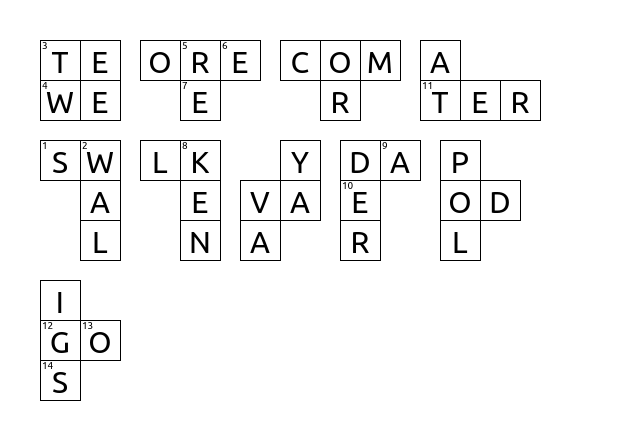
Here's a small starter puzzle to see how they work. You can also print out the PDF. Find more challenging puzzles I've published on Puzzling Stack Exchange.
Greetings (7x7)
Clue numbers are shuffled: 1 Across might not be the top left. 10 pieces.
Across
1. Made a promise
3. Brewed leaves
4. Friendly door mat
7. Caribou cousin
10. Zsa Zsa's sister
11. Latin land
12. The Beatles' "___ ___ Sunshine"
14. McCloskey's "Blueberries for ___"
Down
1. Match a bet
2. Britain's first prime minister
3. Sticks in a nest
5. Shuffle
6. Freddy's "Nightmare" street
8. Nairobi's land
9. Ms. DuVernay, director of "Selma"
13. Meal for a horse or a baker
Solving
To solve a puzzle: print out the PDF, cut out the blocks, and then use the clues to put the blocks together. Here are a few ideas for how to make the blocks:
- Printed on paper - easy to make, but frustrating to work with. Moving a piece or even breathing will probably move some other pieces around.
- Printed on cardstock - a bit heavier and a bit less likely to move.
- Printed on paper, glued to a cereal box - with a bit of thickness and more weight, the blocks move better and won't slide over each other.
- Printed on cardstock, glued to felt - deluxe style. Slides very nicely and the blocks bump gently against each other.
Whatever technique you use, glue sticks are easier to work with than white glue. If you don't want to print it out, you can also download the image and move the pieces around in a paint program.
Constructing Your Own
To construct your own puzzle, you have to construct the crossword puzzle, split it up into blocks of four letters, and then publish it. Read all the details on the Construct Your Own page.
1 maintainer

Metadata
1 maintainer
Release files for four-letter-blocks 1.3.0
For a detailed explanation of source distributions (sdists) and built distributions (wheels), please see the package formats documentation.
Source distribution (sdist)
| File | Size | Uploaded | Provenance | |
|---|---|---|---|---|
| four_letter_blocks-1.3.0.tar.gz | 7.8 MB | Without provenance | Details |
Built distribution (wheel)
| File | Interpreter | ABI | Platform | Reset |
|---|---|---|---|---|
| four_letter_blocks-1.3.0-py3-none-any.whl | Python 3 | none | any | Details |
Total release size: 15.8 MB
Release files / four_letter_blocks-1.3.0.tar.gz
| Download URL | four_letter_blocks-1.3.0.tar.gz |
|---|---|
| Size | 7.8 MB |
| Tags | Source |
|
SHA-256 checksum How to use checksums |
0fe2ee394fb19d986dfa4cc251a7fb985dabf83ae4cc8637808003fdaf4ff848
|
|
BLAKE2b-256 checksum How to use checksums |
2191c069d0cfad5f8c08c300c85c73733e689faea5236a89b51eb5678b4e34a0
|
| Upload date | |
|
Uploaded using Trusted Publishing? What is trusted publishing? |
No |
| Uploaded via |
twine/4.0.2 CPython/3.10.8
|
Release files / four_letter_blocks-1.3.0-py3-none-any.whl
| Download URL | four_letter_blocks-1.3.0-py3-none-any.whl |
|---|---|
| Size | 8.0 MB |
| Tags | Python 3 |
|
SHA-256 checksum How to use checksums |
de65795aaf14ae86864b630318768ce8368de846f041773c2420bb1062798288
|
|
BLAKE2b-256 checksum How to use checksums |
b594cc3d40358654fb9d089c73fb896c873978ab0cbc06a08ebe9fb61e1b7bd4
|
| Upload date | |
|
Uploaded using Trusted Publishing? What is trusted publishing? |
No |
| Uploaded via |
twine/4.0.2 CPython/3.10.8
|
Security for four-letter-blocks 1.3.0
Provenance
Provenance describes where a file came from. On PyPI, provenance is shared via attestations, which provide a verifiable record of the build or publishing details. View details, limitations and caveats.
No provenance found
None of the files in this release were uploaded with provenance metadata.
A note on package security
PyPI is a repository for distributing packages, not a service for auditing them. While third-party security researchers and our staff do their best to detect and remove malicious packages, PyPI cannot guarantee the quality, security or suitability of any given package.














