
FPF Agentic Thinking Map
A small, deterministic Python runtime for agents that may reason freely but must move through a workflow lawfully.
It keeps operational state, evidence freshness, transition legality, authorization boundaries, and waiting conditions outside the model's prose context. The model can inspect the map and choose; the runtime decides whether the move is valid.







pip install fpf-thinking-map
python -m fpf_thinking_map.verify
Important links
- ARCHITECTURE.md
- VERSION_TRACKER.md
- TRIPLE_TAX_CALCULUS.md
- REFLECTIONS.md
- CONTRIBUTING.md
- ADVISORIES.md
dev_mcp/
The dev_mcp development and compliance harness is genuinely tested against
the package and updated whenever runtime behavior, compliance checks, or
integration requirements change.
The problem
An agent can explain a workflow rule and still lose track of it during a long run. Prose instructions compete with task content, earlier decisions, tool output, and context compression.
FPF Agentic Thinking Map moves the parts that should not depend on narration into ordinary code:
- current context and state;
- evidence presence and TTL freshness;
- gates, guards, and lawful transitions;
- cross-context bridges;
- human authorization;
- external dependencies and wake conditions;
- concrete move identity and trace lineage;
- typed claim scope and pathwise assurance;
- tool-call plan closure and hard autonomy budgets.
This is not another reasoning prompt. It is a compact control surface around reasoning.
Why this works across model sizes
The map clips interpretive slack at both ends. Strong models stop free-associating past what a constraint actually says; lighter models receive enough scaffolding that they do not have to infer the workflow's intent from scratch.
Building a good map still requires real judgment, so new controls should be designed and challenged with strong models first. Consuming the finished map does not require the same reasoning capacity. Once a workflow is encoded as explicit constraints and gates instead of tacit prose, following it correctly stops depending on frontier-level inference. A lighter model does not have to understand the workflow deeply; it has to respect the map.
That is what makes the result portable down to smaller models, not merely across flagship ones: the hard reasoning was front-loaded into the encoding, once, by the map author.
The contract
The division of responsibility is deliberate:
| Agent or application | Thinking map runtime |
|---|---|
| Interprets the task | Holds explicit traversal state |
| Generates and compares options | Computes which moves are legal |
| Collects evidence | Checks presence and freshness |
| Proposes a concrete move | Inspects or attempts that move |
| Explains the result | Returns a bounded outcome and trace |
| Requests human input | Enforces the authorization boundary |
| Executes tools and jobs | Never executes, polls, or schedules them |
The map constrains movement, not meaning. It does not replace the model, application logic, retrieval, tools, or a task scheduler.
Structural agentic controls
| Concern | Runtime structure | Enforced effect |
|---|---|---|
| Claim applicability and assurance | ContextSlice, ClaimScope, FormalityLevel, ReliabilityPath |
Numeric G is no longer treated as scope; unknown membership stays unknown; R folds pathwise |
| Tool-call planning | CallPlanPrimitive, BudgetEnvelope, CheckpointReturn |
Incomplete or mismatched declared tool plans return REVISE_PLAN and cannot fire |
| Autonomous enactment | AutonomyBudgetDecl, AutonomyLedgerEntry |
A transition opts in with requires_autonomy_budget_id; failed assignment/gate/envelope returns ESCALATE and successful burn is recorded |
| Performed-work attribution | WorkPrimitive.performed_under, validate_work_attribution() |
Once a map declares RoleAssignments, a dangling or wrong-holder work record cannot satisfy completion |
| Gate decisions | GateDecision, GateCheck.failure_decision, OutcomeCause |
ABSTAIN means the gate lacks enough basis to say yes; an explicit BLOCK means policy says no for the current evaluation. Traversal preserves the distinction as cause=gate_block without breaking the existing outcome enum |
| Map integrity | ThinkingMapTraversal.validate_map() |
Opt-in preflight fails on dangling gate/rule references; explicit unknown transition IDs return typed ABSTAIN |
These are bounded runtime compilations, not a port of the full FPF framework.
Live runtime visual
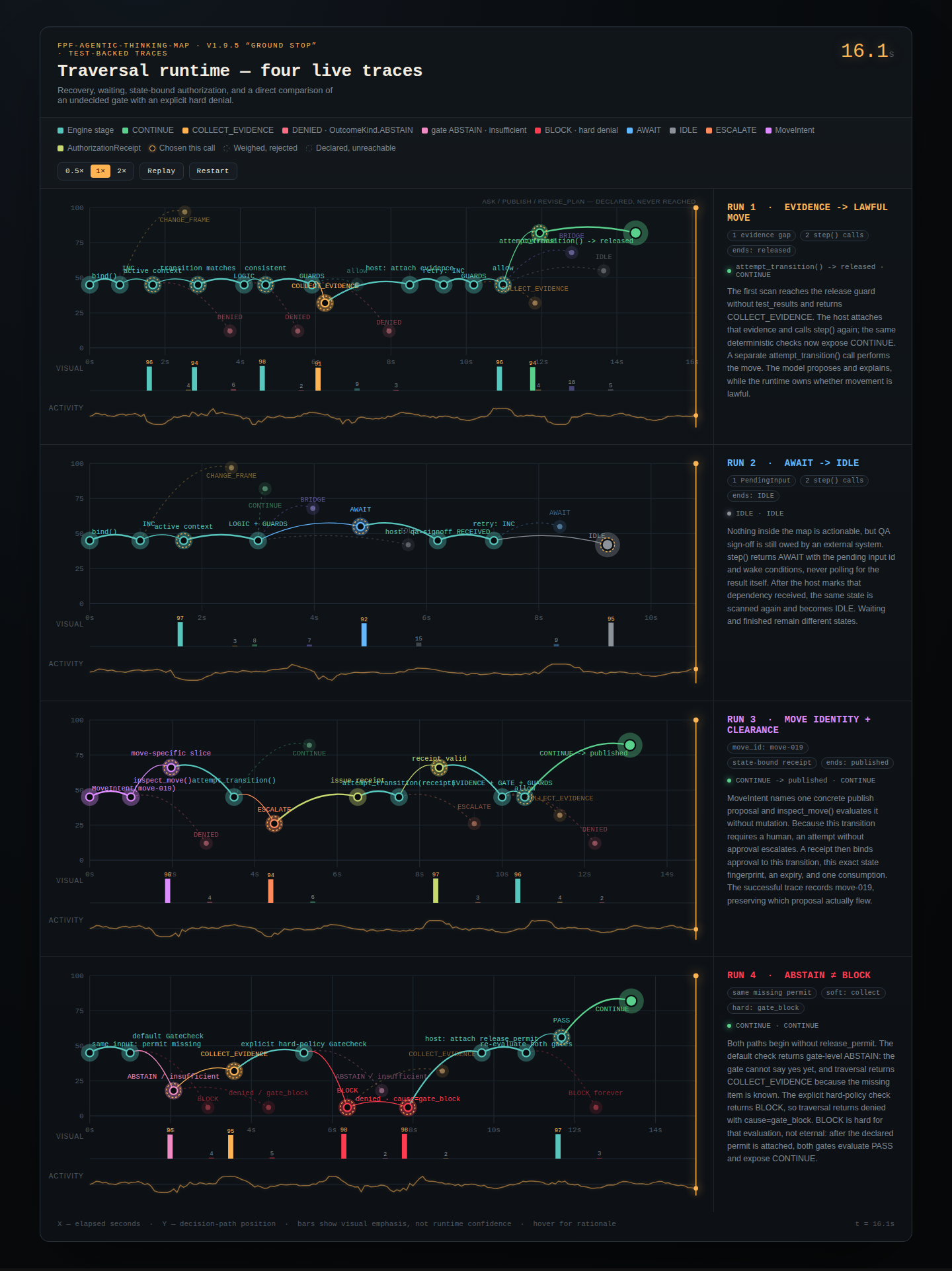
Open the interactive four-run trace
The visual follows evidence recovery, PendingInput/AWAIT, MoveIntent,
state-bound authorization, and the v1.9.5 distinction between an undecided
gate (ABSTAIN) and an explicit hard denial (BLOCK).
Minimal example
from fpf_thinking_map import (
    SemanticMap,
    ContextPrimitive,
    RolePrimitive,
    GatePrimitive,
    GateCheck,
    TransitionPrimitive,
    RuntimeBinding,
    ThinkingMapTraversal,
)

semantic_map = SemanticMap()
semantic_map.register_context(ContextPrimitive("deploy", "Deploy"))
semantic_map.register_role(RolePrimitive("owner", "Owner", "deploy"))
semantic_map.register_gate(
    GatePrimitive(
        "release_gate",
        "Release gate",
        "deploy",
        checks=[
            GateCheck(
                "tests",
                "Tests are green",
                required_evidence=["test_results"],
            )
        ],
    )
)
semantic_map.register_transition(
    TransitionPrimitive(
        "ship",
        "Ship release",
        "deploy",
        "candidate",
        "released",
        required_gate_id="release_gate",
        required_evidence=["test_results"],
    )
)

traversal = ThinkingMapTraversal(semantic_map)
state = traversal.build_active_state(
    RuntimeBinding(
        task="release",
        actor_role_ids=["owner"],
        active_context_id="deploy",
        current_evidence=["test_results"],
    ),
    current_state="candidate",
)

inspection = traversal.step(state)
result = traversal.attempt_transition(state, "ship")

print(inspection.kind)
print(result.kind)
print(state.current_state)
The map is domain-agnostic. Replace the deployment vocabulary with your own contexts, roles, evidence, gates, and transitions.
Run the packaged scenarios:
python -m fpf_thinking_map.examples
What is enforced
Explicit state
The active position is a first-class object, not a conclusion the model must repeatedly reconstruct from chat history.
Evidence with age
Transitions can require evidence. Evidence can decay by semantic floor and TTL, allowing the runtime to distinguish present evidence from usable evidence.
Gates, guards, and logic
Gates test declared conditions. Guards enforce hard constraints. A small propositional layer composes facts without asking the model to reinterpret the rules on every step.
When a gate cannot return PASS, v1.9.5 keeps two different situations apart:
| Gate result | Plain-language meaning | Typical traversal response |
|---|---|---|
ABSTAIN ("insufficient") |
The gate does not have enough basis to say yes | COLLECT_EVIDENCE when the missing evidence is declared; otherwise a denied outcome |
BLOCK |
A check explicitly says no under the current declared policy and state | denied with cause=OutcomeCause.GATE_BLOCK |
BLOCK is hard for that evaluation, not necessarily permanent. It must not be
downgraded by another check or treated as an invitation to guess, but the gate
may evaluate differently after its declared evidence, state, or policy changes.
Existing checks do not become hard blocks automatically; a check opts in with
failure_decision=GateDecision.BLOCK.
Validated bridges
Cross-context movement is explicit. High-risk substitution without a sufficient bridge contract is refused or escalated rather than silently treated as equivalent.
Human authorization
requires_human_authorization separates "structurally legal" from "authorized
to execute."
For stronger integrations, AuthorizationReceipt binds approval to:
- one transition;
- the exact inspected state fingerprint;
- an expiry boundary;
- single consumption.
A denied move may expose declared safe_alternatives, so escalation does not
have to become a dead end.
External waiting
PendingInput and AWAIT distinguish "the workflow is finished" from "the
workflow is alive but waiting for something outside the map." The host owns
polling and resolution.
Concrete move identity
MoveIntent distinguishes a reusable transition type from one particular
proposed move. inspect_move() evaluates it without mutation; a successful
transition can stamp move lineage into the trace.
Why the versions matter
The project has grown by closing specific ambiguities in traversal state, not by expanding into a general agent framework.
| Release line | Capability added |
|---|---|
| v1.0 | Runnable semantic primitives, deterministic guards, lawful traversal |
| v1.2 | Evidence TTL, response contracts, IDLE and BRIDGE |
| v1.3 | Enforced bridge crossing and lean state slices |
| v1.4 | Stagnation detection, integrator advisories, verified documentation |
| v1.5 | Stable public package boundary |
| v1.6 | Human authorization and safe denial routes |
| v1.7 | State-bound, expiring authorization receipts |
| v1.8 | External dependency tracking and AWAIT |
| v1.9 | Concrete move identity, inspection, lineage, authorization-clock fix |
| v1.9.5 "Ground Stop" | Correct A.21 gate join; explicit BLOCK versus insufficient ABSTAIN; typed denial causes; opt-in structural controls |
| v1.9.6 "Missed Approach" | Failed-run revert terminal; upstream FPF scope gate |
| v2.0 "Adjacency Clearance" | Confirmed-absent percepts clear adjacent states under a declared AdjacencyClearanceRule |
The complete reader-facing history is in docs/VERSION_TRACKER.md. Technical changes are in CHANGELOG.md, and full release bodies remain in GitHub Releases.
This separation is intentional: the README describes the stable product; the tracker records how that product became stronger.
Evidence, verification, and limits
The repository includes three different kinds of support. They should not be confused:
- Deterministic verification checks runtime invariants directly.
- Scenario and adversarial tests exercise integration behavior and known failure shapes.
- Model experiments show behavior under stated conditions; they are evidence, not universal guarantees.
python -m fpf_thinking_map.verify
python -m fpf_thinking_map.examples
The 1.9.5 gate distinction was also replayed through dev_mcp with the same
missing release_permit under two policies:
default check       -> gate: insufficient -> outcome: collect_evidence
explicit BLOCK      -> gate: block        -> outcome: denied (cause: gate_block)
permit present      -> gate: pass         -> outcome: continue
That is the release contract in one view: uncertainty requests a resolution path; a declared hard denial stops the move and remains identifiable to the caller.
The compiled state slice was also measured against injecting the corresponding raw FPF sections at five shipped decision points. The measured slice was much smaller, but this is a traversal-context result, not a claim about general intelligence or total application cost. Method and limitations: TRIPLE_TAX_CALCULUS.md.
For the authorization experiments, threat boundaries, failures found, and claims deliberately not made, see IGNITION_LOCK_WIND_TUNNEL.md.
Reference hardware
The FPF thinking map was processed, indexed, and verified on a dual-socket Intel Westmere server (Xeon X5675, 32 nm), powered by a Chieftec Vita 80 PLUS Bronze PSU. The runtime has zero dependencies and needs nothing newer.
Scope
Use this library when you need:
- bounded multi-step traversal;
- explicit next-move legality;
- evidence-aware workflow state;
- inspectable reasons for blocking or escalation;
- human authorization for selected transitions;
- a clean distinction between waiting, resting, and acting;
- compact state projections for an LLM or agent host.
Do not use it as:
- a universal reasoning engine;
- a semantic ingestion system for all of FPF;
- an embeddings or vector database;
- a tool runner, queue, scheduler, or worker supervisor;
- a substitute for application-specific policy;
- a certification that an entire agent system is safe.
Correct map authoring and correct host integration remain part of the trust boundary. Known sharp edges and deliberate non-goals are recorded in ADVISORIES.md.
Repository guide
| Path | Purpose |
|---|---|
fpf_thinking_map/ |
Zero-dependency runtime published to PyPI |
dev_mcp/ |
Separate development and compliance-testing harness |
| ARCHITECTURE.md | Verified control flow and module architecture |
| docs/VERSION_TRACKER.md | Every release, with three practical consequences |
| docs/DECISIONS_REJECTIONS_ADOPTIONS.md | Design provenance and rejected scope |
| docs/deep/ADVISORIES.md | Integration boundaries and known sharp edges |
| SHA256SUMS | Repository-wide source fingerprints |
Design rules
- Keep the model free to generate and compare.
- Keep movement legality explicit and deterministic.
- Add structure only when it changes observable behavior.
- Keep each decision payload small.
- Keep host responsibilities outside the core.
- Record rejected ideas as carefully as adopted ones.
- Prefer a narrow mechanism with inspectable limits over a broad claim.
Relationship to FPF
This project is inspired by ailev/FPF by Anatoly Levenchuk. It is an independent, MIT-licensed implementation with its own runtime scope.
FPF provides the broad conceptual frame. This package compiles a selected part of that frame into a practical traversal runtime. It may omit or reject patterns that do not improve this package's observable agent behavior.
See NOTICE and SOURCES.md for attribution and scope boundaries.
License and contact
MIT License. See LICENSE.
@igareosh · igareosh@igareosh.com
Agent freedom. Explicit movement rules.
1 maintainer

Metadata
1 maintainer
Release files for fpf-thinking-map 2.0.1
For a detailed explanation of source distributions (sdists) and built distributions (wheels), please see the package formats documentation.
Source distribution (sdist)
| File | Size | Uploaded | Provenance | |
|---|---|---|---|---|
| fpf_thinking_map-2.0.1.tar.gz | 95.3 kB | Without provenance | Details |
Built distribution (wheel)
| File | Interpreter | ABI | Platform | Reset |
|---|---|---|---|---|
| fpf_thinking_map-2.0.1-py3-none-any.whl | Python 3 | none | any | Details |
Total release size: 191.8 kB
Release files / fpf_thinking_map-2.0.1.tar.gz
| Download URL | fpf_thinking_map-2.0.1.tar.gz |
|---|---|
| Size | 95.3 kB |
| Tags | Source |
|
SHA-256 checksum How to use checksums |
b6a48015068e9c4fabef092a236abe4f3cedfba5ac7eb88ba17962b9024f2bee
|
|
BLAKE2b-256 checksum How to use checksums |
1ec25016827fd4160454920a5a221d422b8e1532d8273a2c1bb828891b59e368
|
| Upload date | |
|
Uploaded using Trusted Publishing? What is trusted publishing? |
No |
| Uploaded via |
twine/6.2.0 CPython/3.12.8
|
Release files / fpf_thinking_map-2.0.1-py3-none-any.whl
| Download URL | fpf_thinking_map-2.0.1-py3-none-any.whl |
|---|---|
| Size | 96.5 kB |
| Tags | Python 3 |
|
SHA-256 checksum How to use checksums |
32e76cc039d4591d3e3136c1497ad3b82b2f903b0ca8c85d2ed1fc6119d15fc1
|
|
BLAKE2b-256 checksum How to use checksums |
da0e18de2d310a4eda2391743270c4b74de2fc4e7cdf017c2865275dabe478ac
|
| Upload date | |
|
Uploaded using Trusted Publishing? What is trusted publishing? |
No |
| Uploaded via |
twine/6.2.0 CPython/3.12.8
|
Security for fpf-thinking-map 2.0.1
Provenance
Provenance describes where a file came from. On PyPI, provenance is shared via attestations, which provide a verifiable record of the build or publishing details. View details, limitations and caveats.
No provenance found
None of the files in this release were uploaded with provenance metadata.
A note on package security
PyPI is a repository for distributing packages, not a service for auditing them. While third-party security researchers and our staff do their best to detect and remove malicious packages, PyPI cannot guarantee the quality, security or suitability of any given package.














