
FrameRudiments
FrameRudiments renders Shorts, Canvas-style clips and full lyric visualisers from one traceable timeline. It is the offline Python renderer in the DanceFlow ecosystem.
0.2.0 accepts source-bound StemLab BPM/first-beat readings through
clock.beat_alignment. Procedural motion follows the fractional beat phase
after excerpt/repeat mapping. Audio, lyric/cue timestamps and captured
recordings retain their original source clock. See beat alignment.

Play the four-second demonstration: original 120 BPM clicks start at 0.125 seconds; the right movement uses the -16 pip reading. Text and recorded bands keep source time. This synthetic example demonstrates clock composition; it does not establish song-analysis accuracy. Encoded-frame verification and hashes.
It consolidates the shared Python/Pillow/FFmpeg mechanisms developed across the existing Gilt Trip, Blame Putin, Clay, Paper Dreams, Free Danny Tommo, Silly Sausage Britain and Moderate or Good renderers. Release-specific artwork, scene layouts and creative decisions belong in project files or Python scene hooks. Historical render scripts and approved outputs remain preserved.
Install and run
Python 3.11+ and FFmpeg with libx264/AAC are required. Install the package into
its own virtual environment. Published packages use python -m pip install framerudiments;
from a source checkout use python -m pip install .:
python -m pip install .
framerudiments --version
framerudiments demo demo --font /path/to/a/font.ttf
framerudiments plan demo/project.json --output demo-plan.json
framerudiments preflight demo/project.json --output preflight --ffmpeg /path/to/ffmpeg
framerudiments render demo/project.json --output render --ffmpeg /path/to/ffmpeg
Use a new output directory each time. --ffprobe overrides FFmpeg's sibling
ffprobe. Environment alternatives are FRAMERUDIMENTS_FFMPEG and
FRAMERUDIMENTS_FFPROBE. Fonts are explicit hashed inputs; no platform-specific
font or FFmpeg location is hardcoded into the engine. The synthetic demo creates
its own tone, sprite, LRC, CUE and four-dimensional recording.
Capabilities
- Portrait, landscape and square frame-addressed Pillow composition, at native constant 60 fps by default. Other frame rates require a recorded reason.
- Sample-addressed source excerpts and exact repetitions; no time-stretch,
resampling, normalization or remix. The master is never changed. Short
derivatives default to 120 ms quarter-sine endpoint fades; set
audio.fade_seconds: 0to preserve an approved raw seam. Visualisers and Canvas-style projects default to no fades. AAC encoding is lossy. - One caption/cue ledger for actual raster transitions, JSON, SRT and ASS. Retains signed frame error, same-frame ordering, explicit clears, carry-in lyrics and repeat boundaries. Accepts UTF-8 LRC with offsets/multiple stamps and CD CUE INDEX 01 at 75 subframes/s. Section labels never become lyrics.
- Canonical lyric text comparison, exact input hashes, inert text, bounded text wrapping and fit-or-fail behavior. Optional previous/current/next captions and exact-text-associated lyric artwork (planes, tablets, signs, etc.).
- Native DanceRudiments catalogue sampling at integer pips; optional explicit interpolation of adjacent native samples for legacy compositor parity. Preserves the distinction between 64 pips/beat and 16 DanceMoves ticks/beat.
- Saved StemLab beat grids, accepted
stemlab.loops.v1selections, explicitly selectedstemlab.dancerudiments.candidates.v1matches, and nativedancerudiments.recordingfiles. No model execution or copied DSP. Match-window extrapolation needs an explicit choice. N-dimensional recordings retain their own source clock and never wrap outside capture. - Transparent sprites, atlas cycles in musical ticks, cue/time-gated layers, position/rotation/scale mappings with selectable axes, same-pose directional trails, masks, background contain/cover and N-dimensional signed bars. Independent composite motion channels preserve separate bounce/sway/tilt. All transformed sprite alpha extents are checked against declared bounds on every frame. Custom scene drawing has its own review obligations.
- Modular rudiment views: seeded moving particles and trails, signed bar graphs,
scrolling multi-dimensional waveform traces, XY paths and calibrated Fourier
spectrum views with local peak analysis and peak holds. Any view can use
the existing native motion sources; a trusted Python registry supports more
renderers without another frame loop or clock. See
docs/rudiment-renderers.md and run
framerudiments demo demo --rudiments --font /path/to/font.ttf. - The existing seeded paper-glider flight model and connected-alpha sprite cleaner, plus a general frame-addressed lyric-art entrance/hold/exit helper. The flight model is stylized animation; it does not simulate real aerodynamics or establish musical synchronization by itself.
- H.264/yuv420p + AAC MP4 with fast start, full decoding, exact decoded frame count and every decoded timestamp checked for CFR. Audio length, sample rate and channel count are checked against the source. Includes encoded QA stills, a poster, phone preview, input/output hashes, commands and logs.
The spectrum guide covers saved StemLab Fourier calibration,
frequency labels, peak controls and per-frame JSONL effect signals. Run
framerudiments renderers for the current built-in names. The optional
demo --spectrum generator uses StemLab 1.6+; rendering its saved recording
keeps the core package lightweight.
Project format
Start from framerudiments demo and replace its synthetic assets. Every file
reference has path and sha256; paths are relative to the project JSON unless
absolute. See docs/project-format.md for all fields and
docs/extraction.md for source mechanisms and boundaries.
from framerudiments import Project, render

project = Project.load("release/project.json")

def scene(image, context):
    # Existing custom drawing consumes frame, source_seconds, output_seconds,
    # beat, lyric and cue. Return a frame-sized RGBA image.
    return image

render(project, "release/new-render", scene=scene, ffmpeg="/path/to/ffmpeg")
Pin any assets used by a custom scene with project.ref({"path": ..., "sha256": ...})
before rendering. The hook is supplied by trusted Python code, never imported
or executed from a project JSON. Do not reproduce clock, sampling, caption,
encode or verification loops in release adapters.
Evidence and limits
plan is preparation, preflight checks all composed frames without encoding,
and render produces technical-QA passed; creative and attended listening
review pending. No command uploads, schedules or publishes anything.
Automatic checks cannot establish sung-word accuracy, pleasant motion, a
musical loop seam, platform preview acceptance, rights or public eligibility.
Caption boxes are composition constraints, not current official platform
safe-zone verification. Review the exact encoded file and destination preview.
Constant-BPM and saved variable-grid clocks record their authority/status; an estimate never becomes artist confirmation. Beat grids extrapolate from their first/last interval outside their covered extent; constrain projects to supported intervals where that is unsuitable. A ranked match does not prove whole-song alignment. Recording source/axis provenance is retained; the author must select the correct master/stem association. No live WordPress timing, sensor or plugin configuration is changed by offline rendering.
All text in captions.ass is a portable timing sidecar with neutral styling;
the raster compositor remains the authority for the approved layout.
Development
python -m pip install -e '.[dev]'
ruff check .
pytest
python -m build
Set FRAMERUDIMENTS_TEST_FONT and FRAMERUDIMENTS_FFMPEG to run all integration
tests. Without them, corresponding checks report skipped. Tests cover native
sampling, non-looping recordings, input identity, lyric clears, excerpt/repeat
boundaries, text/alpha overflow and actual encoded portrait/landscape/square
outputs. Use synthetic fixtures; never put songs, personal data or private
analysis outputs into the source distribution.
Source, contribution and releases
Canonical repository · Python package · Issues and improvements
Read CONTRIBUTING.md before changing the engine. Improvements belong in focused pull requests to the canonical repository, with current README, meaningful tests and reproducible synthetic examples.
The GitHub Actions CI runs the complete render suite on Linux and Windows with
Python 3.11 and 3.13. The release workflow validates the immutable v<version> tag,
re-runs tests, builds/checks wheel and source distribution, performs a clean wheel
render and publishes exact checksum-labelled assets. Pushing a new v* tag publishes
to GitHub and PyPI automatically after validation; no human reviewer or manual
publication approval is required. The pypi environment has no reviewer gate.
An existing release is reused only after its source commit and downloaded checksums
match; assets are never overwritten. Manual dispatch can resume a registry upload
from an existing immutable tag, preserving its exact GitHub bytes. The PyPI job
uses a separately configured trusted publisher; no API token is stored in this project.
A GitHub release and a PyPI listing are separately verified outcomes.
Full-frame MilkDrop effects, including lyrics and animated sprites
Use optional ordered effects stages with Butterchurn 2.6.7 and projectM
4.2-dev pinned to 349b7cc2db312d47cef6be24c6856ced6643a385. They process the
complete image after captions, lyric artwork and DanceRudiments-driven sprites/
atlases. Original feedback, kaleidoscope and Julia-distortion presets work in
either engine, and stages can be chained. Offline clocks and soundtrack-derived
PCM stay tied to the encoded programme. See setup, format, provenance, GPU
acceptance and limits.
framerudiments visualisers
framerudiments demo ./effect-demo --font /path/to/font.ttf --effect butterchurn --effect projectm
framerudiments render ./effect-demo/project.json --output ./effect-render
Optional runtime setup is explicit; the base renderer still works without Node, a browser or projectM. Feedback is sequential, and GPU output can vary by driver. Inspect processed/encoded glyphs and safe zones; pre-effect text bounds cannot prove final legibility.
Version 0.1.4 preserves portrait geometry in pinned projectM legacy presets through a recorded square overscan/crop mapping; the upstream engine remains unmodified. Neutral portrait/landscape/square mapping is tested for both backends.
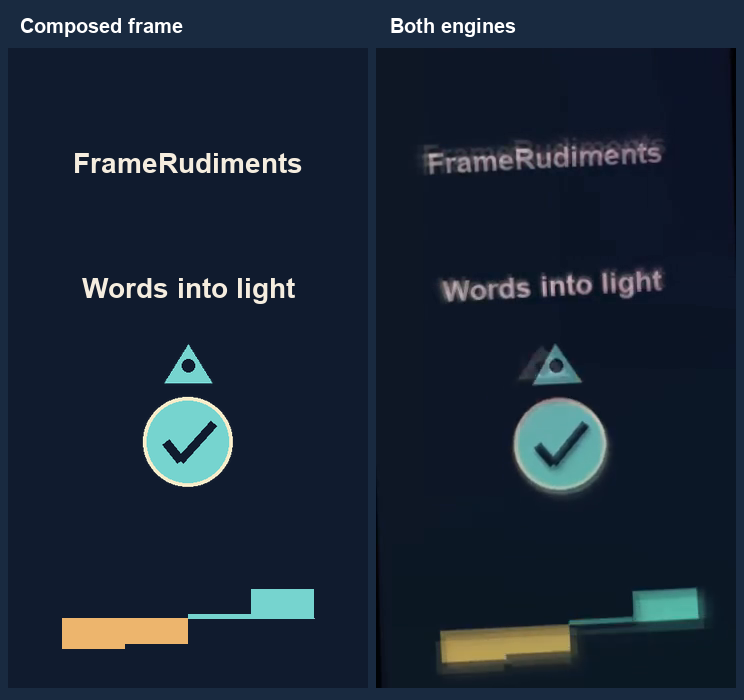
Actual FrameRudiments 0.1.4 candidate output: timed captions and native moving sprites/atlas before composition effects (left) and after both real engines (right). Synthetic oscillator audio and example words; this is a software demo. Play the four-second demonstration and read its transcript. Playback is user-controlled; no automatic media playback is required.
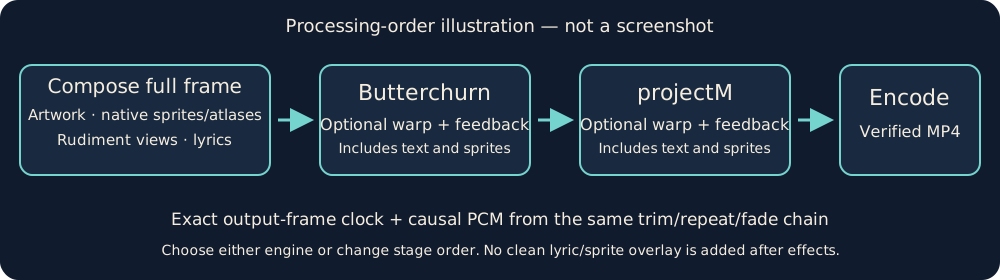
Generated vector illustration of the processing order. The comparison above and linked video are captured renderer output; the diagram is explanatory.
Explore and profile the preset library
Version 0.3.0 adds a separately installed, checksum-pinned library of 14,680 distinct upstream presets (1,738 Butterchurn and 12,942 projectM), with source notices, duplicate aliases and 67 shared textures. Real-engine acceptance is recorded per preset; available catalogue entries are not claimed as tested.
Use framerudiments presets-install, then framerudiments presets-profile or
scripts/profile_visualisers.py to feed ordinary cover/lyric/audio projects and
three static calibration cards through each engine, replay every feedback frame,
capture chosen intervals and invoke released PrismMoves/PixelCue. Reports keep
input/output, temporal, tune/silence and same-card/different-tune comparisons
separate, with measured response ranges and explicit unknowns.
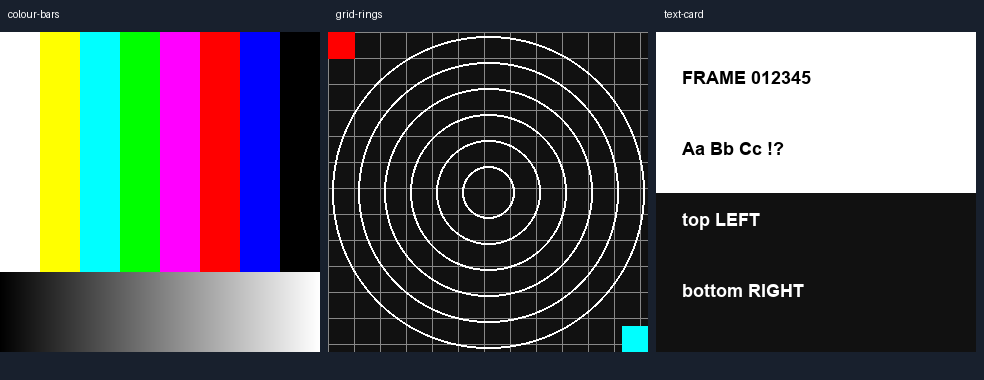
Generated calibration illustrations; not preset-output evidence. The maintained My Songs suite uses Arcadians and The Truth is a Virus with their canonical masters, covers and timed lyrics; those private assets are not bundled. See the complete capture, analysis and synthesis workflow for pinned packs, licences, runtime setup, resume and interpretation limits.
1 maintainer

Metadata
1 maintainer
Release files for framerudiments 0.3.0
For a detailed explanation of source distributions (sdists) and built distributions (wheels), please see the package formats documentation.
Source distribution (sdist)
| File | Size | Uploaded | |
|---|---|---|---|
| framerudiments-0.3.0.tar.gz | 647.1 kB | Details |
Built distribution (wheel)
| File | Interpreter | ABI | Platform | Reset |
|---|---|---|---|---|
| framerudiments-0.3.0-py3-none-any.whl | Python 3 | none | any | Details |
Total release size: 733.6 kB
Release files / framerudiments-0.3.0.tar.gz
| Download URL | framerudiments-0.3.0.tar.gz |
|---|---|
| Size | 647.1 kB |
| Tags | Source |
|
SHA-256 checksum How to use checksums |
fe6588212f773abafd982704738dcca5c2b45e3c45e04b4effba918c580d72b3
|
|
BLAKE2b-256 checksum How to use checksums |
b784de3bd9db5f841b09c1eb6b79b7eaf4bb89c8cc8e10470dda588616e7492c
|
| Upload date | |
|
Uploaded using Trusted Publishing? What is trusted publishing? |
Yes |
| Uploaded via |
twine/7.0.0 CPython/3.13.14
|
Provenance
Provenance describes where a file came from. On PyPI, provenance is shared via attestations, which provide a verifiable record of the build or publishing details. View details, limitations and caveats.


PyPI Publish Attestation
PyPI verified that this artifact, at this checksum, originated from the publisher listed below.
Signed by GitHub Actions, verified by PyPI on Oct 16, 2026.
Transparency logRelease files / framerudiments-0.3.0-py3-none-any.whl
| Download URL | framerudiments-0.3.0-py3-none-any.whl |
|---|---|
| Size | 86.5 kB |
| Tags | Python 3 |
|
SHA-256 checksum How to use checksums |
0719f7da9144a8c3f4fa5b7644aba7ff9f77da8d414e7156ddcdc4bf2eb0c9ac
|
|
BLAKE2b-256 checksum How to use checksums |
992b17b14327391ff1dbdf6d88dcab9fe5b009e8376c0bc336a036f9fcb20429
|
| Upload date | |
|
Uploaded using Trusted Publishing? What is trusted publishing? |
Yes |
| Uploaded via |
twine/7.0.0 CPython/3.13.14
|
Provenance
Provenance describes where a file came from. On PyPI, provenance is shared via attestations, which provide a verifiable record of the build or publishing details. View details, limitations and caveats.
PyPI Publish Attestation
PyPI verified that this artifact, at this checksum, originated from the publisher listed below.
Signed by GitHub Actions, verified by PyPI on Oct 16, 2026.
Transparency log













