
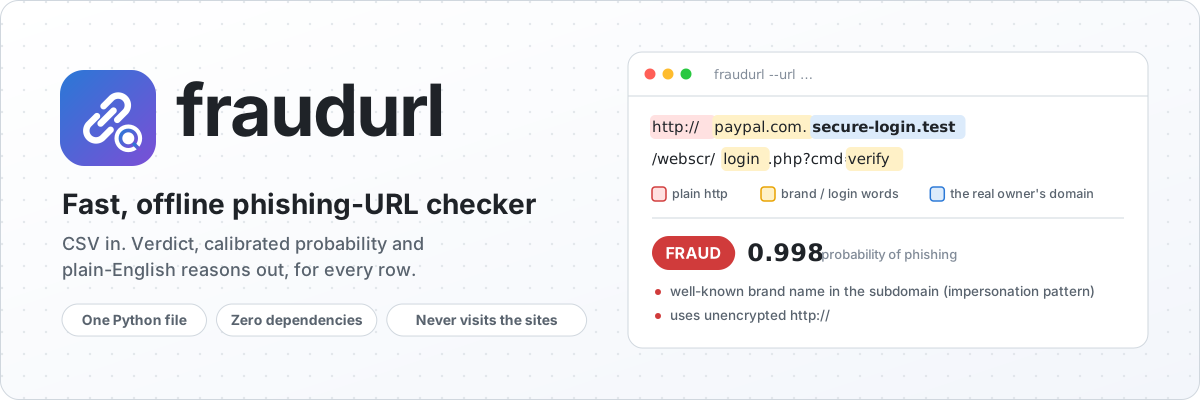
fraudurl: fast, offline phishing URL detector
A phishing URL checker for Python: check any URL, or a whole CSV of links, for phishing, with a calibrated
probability and plain-English reasons. Free, open source, one Python file.
Website: amruth112.github.io/fraudurl-detector






Quick start · How it works · Accuracy · Usage · Limitations · Plain-English guide · Report · Model card

What it does
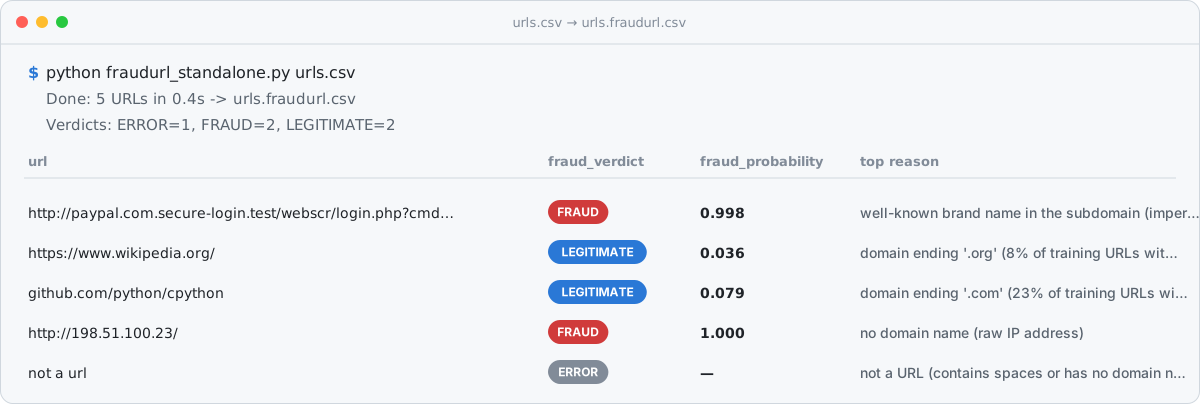
Give fraudurl a CSV of links. It returns the same CSV with three things added to every row:
- a verdict:
FRAUD,LEGITIMATE, orREVIEWwhen the address alone is not conclusive; - a calibrated probability;
- the three plain-English reasons behind the verdict.
It judges the URL itself, using 83 clues such as a brand in the wrong place, login or payment words,
free-hosting addresses, risky domain endings, http:// and random-looking names. It never opens the website.
- One file, no dependencies. The whole tool, models included, is one ~450 KB Python file that runs on the Python 3.9+ standard library.
- Fast. It checks about 1,000 URLs a second on one CPU core and 2,600–3,200 a second on four, with flat memory (about 230 MB on 4 cores).
- Explains itself. The reasons are the model's own per-feature contributions, not a separate heuristic.
- Says when it is unsure. Ambiguous URLs go to
REVIEWfor a person instead of being guessed. - Private by default. Offline mode never touches the network. The optional lookups ask DNS and the domain registry about the domain, never the website.
Quick start
Option 1: the single file.
- Download
fraudurl_standalone.py. Every release also attaches it with a SHA256 checksum. - Run:
python fraudurl_standalone.py my_urls.csv # writes my_urls.fraudurl.csv
Option 2: install the package.
pip install fraudurl
fraudurl my_urls.csv
fraudurl --url "http://paypal.com.secure-login.test/webscr/login.php" --quiet   # one URL -> JSON
Both give identical results. CI checks this on every change, on Linux, macOS and Windows.
How it works
- Read the URL the way a browser does. It splits off tricks such as
paypal.com.in the subdomain and uses the Public Suffix List to find the domain someone actually bought,secure-login.testin the example. - Measure 83 clues. These cover structure, character mix, randomness, redirect tricks, brand and login words, free-hosting platforms, and the phishing history of the domain ending.
- Score. A 400-tree gradient-boosted model, trained with LightGBM and exported to JSON, runs in about 60 lines of plain Python. Its score is calibrated into a probability, and two cut-offs turn that into a verdict.
- Explain. Each tree's contribution is credited to the clue it used, and the three biggest become the reasons.
- Optionally look closer. For unsure URLs, DNS records and the domain's registration age feed a second model that corrects the score.
The step-by-step version, with a worked example, is in HOW_IT_WORKS.md.
How accurate is it?
Every number here is measured on URLs from domains the model never saw in training: held-out test splits of its three training datasets, plus one dataset (Ariyadasa 2021) never used for training at all, 2020 to 2026.
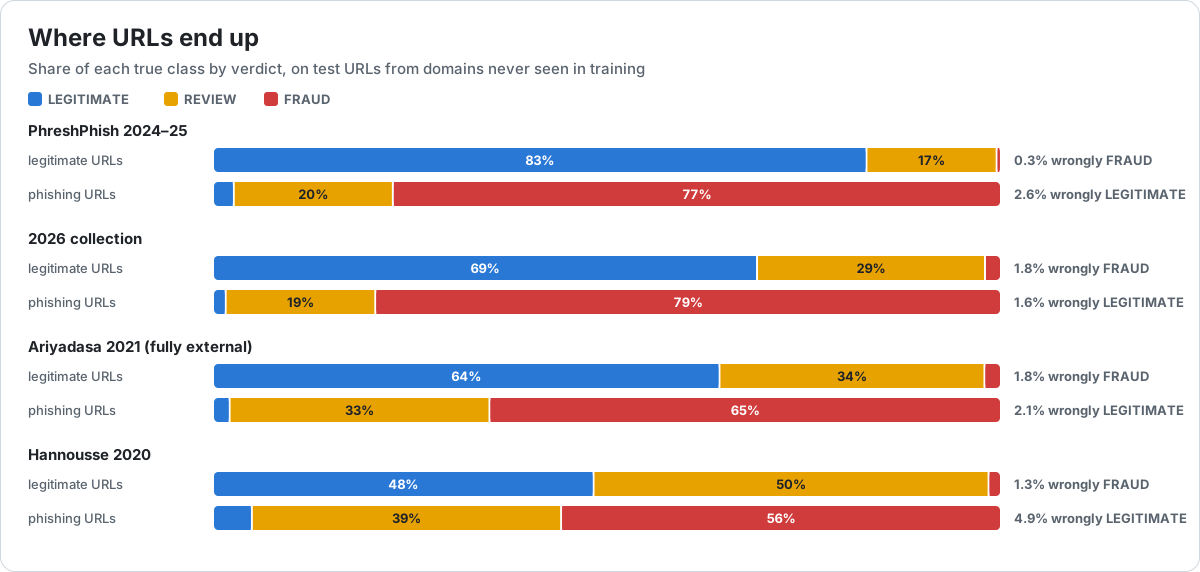
| Test data | ROC-AUC | Caught when 1% of legitimate URLs are flagged | Legitimate called FRAUD | Phishing called LEGITIMATE | Sent to REVIEW |
|---|---|---|---|---|---|
| PhreshPhish 2024–25 | 0.984 | 85% | 0.3% | 2.6% | 18% |
| 2026 collection | 0.975 | 73% | 1.8% | 1.6% | 24% |
| Ariyadasa 2021 (fully external) | 0.958 | 58% | 1.8% | 2.1% | 33% |
| Hannousse 2020 | 0.907 | 51% | 1.3% | 4.9% | 45% |
- Good at: clearing ordinary URLs, catching classic phishing patterns, and handing the ambiguous rest to a person.
- Weaker on unfamiliar data: older or very different data is harder.
- Low-prevalence traffic: when phishing is rare in your traffic, many FRAUD rows will be false alarms, so
use
--base-rate. - Slightly optimistic: the final set-up was chosen partly by looking at these test results.
- More detail: MODEL_CARD.md and the full engineering report, which includes a comparison with the Laya language model, 94–583× slower per URL here.
Usage
fraudurl input.csv                         # offline mode, auto-detects the URL column
fraudurl input.csv -o results.csv
fraudurl input.csv --url-column "Website"  # pick the column explicitly
fraudurl input.csv --enrich-review         # DNS + registration lookups, only for REVIEW rows (recommended)
fraudurl input.csv --enrich                # DNS + registration lookups for every URL (slowest)
fraudurl input.csv --block-list block.txt --allow-list allow.txt   # your own decisions win
fraudurl input.csv --base-rate 0.02        # re-weight probabilities for ~2% expected fraud
fraudurl --url https://example.com/login --enrich-review   # one URL -> one JSON line on screen
fraudurl input.csv --format json           # JSON Lines file (input.fraudurl.jsonl)
fraudurl input.csv -o -                    # write the CSV to the screen (stdout)
fraudurl input.csv --workers 1             # worker processes (default: up to 4)
fraudurl input.csv --enrich-review --cache-dir ./my_cache   # where lookups are cached (default ./.fraudurl_cache)
python fraudurl_standalone.py … accepts exactly the same options.
Input files
- URL column: found from its header (
url,link,website, ...). In a file with no header, the column whose values look most like URLs is used.--url-columnoverrides the choice. - Separators: comma, semicolon, tab or pipe.
- Encodings: UTF-8 (with or without BOM), UTF-16 with BOM, and Windows-1252.
- Large files: streamed in chunks and scored in parallel. In offline mode memory stays flat.
Output columns
All original columns and the original row order are kept. These are added:
| column | meaning |
|---|---|
fraud_verdict |
FRAUD, LEGITIMATE, REVIEW (the URL text alone is not conclusive) or ERROR (not a URL) |
fraud_probability |
calibrated probability that the URL is phishing |
verdict_confidence |
Depends on the verdict: • FRAUD: fraud_probability • LEGITIMATE: 1 - fraud_probability • REVIEW: shows only which way the URL leans, e.g. 0.75 on a row with probability 0.25 means "leans legitimate, not enough to decide" |
top_reasons |
up to three signals that pushed the decision, in plain English |
registrable_domain |
the domain the URL really belongs to (e.g. paypal.com.evil.test → evil.test) |
analysis_mode |
How the row was checked, not a verdict: • offline (URL text only) • with lookups: enriched (URL + DNS + RDAP) or offline (enrichment unavailable for this URL) • with --enrich-review, clear rows: offline (URL text only; clear without lookups) • rows decided by your lists: your block list / your allow list |
lookup_status |
with lookups: what the DNS / registry lookups returned, or why they were skipped |
error |
why a row could not be scored |
Lookups: --enrich-review or --enrich
Every URL first gets the offline check. Then:
--enrich-reviewlooks up only the URLs left inREVIEW(DNS + domain registration). That is where lookups matter most.--enrichlooks up every URL.
On live 2026 phishing domains outside shared hosting platforms, lookups raised the share caught at a 1% false-alarm rate from 43% to 58%.
Lookups are limited to about 2 per second per domain registry:
- on 1,000,000 URLs,
--enrichis estimated at 16–19 hours and--enrich-reviewat about 7; - small files take seconds to minutes;
- only
--enrichsees the rare cases where lookups soften a FRAUD or LEGITIMATE verdict.
Your own allow and block lists
--block-list and --allow-list (both repeatable) take plain text files, one entry per line. # starts a
comment line, and anything after the first space is ignored, so you can add a note.
Entries
example.comcoversexample.comand every subdomain, but notnotexample.com.- An entry with a path (
https://example.com/secure/) covers that path and everything under it:/secure-verifyis not covered;../tricks are resolved;*.example.com/secure/does the same on every subdomain.
- IP addresses match in any spelling (
1.2.3.4,0x01020304,16909060). - Hosts-file lines (
0.0.0.0 evil.test) are understood. - Invalid lines are skipped with a warning.
What a listed URL gets
FRAUD(block) orLEGITIMATE(allow), without lookups.fraud_probabilityandverdict_confidenceare left empty, because this is your decision, not a model probability.top_reasonsstill shows what the model alone said.- The block list always wins.
Do not allow-list shared platforms such as google.com or github.io: that would also allow phishing hosted
on them.
For pipelines: JSON output
--url (repeatable) and --format json write one JSON object per URL (JSON Lines):
{"url": "...", "fraud_verdict": "REVIEW", "fraud_probability": 0.218, "verdict_confidence": 0.782,
 "top_reasons": ["..."], "registrable_domain": "...", "analysis_mode": "enriched (URL + DNS + RDAP)",
 "lookup_status": "dns=ok; rdap=ok", "error": null,
 "stages": {"offline_check": {"verdict": "REVIEW", "probability": 0.299},
            "lookups": {"dns": {"ipv4": ["..."], "nameservers": ["..."], "mail_servers": ["..."], "ttl_seconds": 3321},
                        "registration": {"registered": "1995-04-27T04:00:00Z", "expires": "...",
                                         "registrar": "...", "domain_age_days": 11477}}}}
(Some fields are omitted.)
stagesshows what each step found:- the offline check;
- your list, if it decided;
- the raw DNS and registration facts, if looked up.
- Where output goes: with
--url, results go to stdout unless-ois given. Progress messages go to stderr, and--quietsilences them. - Other details:
- JSON output is ASCII-only.
- File input with
--format jsonalso includes the original row asinput.
What the verdicts and the probability mean
fraud_probability is a calibrated probability (Platt scaling fitted on held-out data), not a raw model
score. On URLs from domains the model never saw:
- Where it is accurate:
- on a fully external 2021 dataset, URLs given ~0.25 were phishing 26% of the time, ~0.85 → 84%, and ≥0.95 → 99% (calibration error 0.012);
- on 2026 data, ~0.24 → 24% and ~0.85 → 82% (error 0.016).
- Where it is off:
- in the middle of the range (0.4–0.8), the 2026 numbers are over-confident by up to ~11 points (0.75 → 65%);
- on 2020-era data, 11% of URLs scored below 0.05 were phishing, and they are called LEGITIMATE.
- It assumes about half your URLs are phishing (47%, the calibration balance).
- If you expect far fewer, say so with
--base-rate. A URL scored 0.97 is only ~27% likely to be phishing when 1% of all URLs are. - With
--base-rate, a FRAUD or LEGITIMATE verdict is downgraded to REVIEW when the re-weighted probability falls on the other side of 0.5.
- If you expect far fewer, say so with
| verdict | rule (offline model) | rule (after lookups) |
|---|---|---|
FRAUD |
probability ≥ 0.873 | ≥ 0.923 |
LEGITIMATE |
probability ≤ 0.101 | ≤ 0.125 |
REVIEW |
in between | in between |
The thresholds were chosen on held-out calibration data to target about 1% of legitimate URLs called FRAUD and 2% of phishing called LEGITIMATE.
Try it on the examples
python fraudurl_standalone.py examples/sample_urls.csv
examples/sample_urls.csv has:
- 15 legitimate held-out test URLs;
- 15 made-up phishing-style URLs: 14 on reserved domains (
.example,.test,example.com, a documentation IP) and 1 Google Forms link with a placeholder ID; - 5 edge cases.
examples/sample_urls.fraudurl.csv and examples/sample_urls.enriched.fraudurl.csv are the outputs.
Limitations
- Distribution shift. Trained on one collection and tested on another, ROC-AUC fell to 0.85–0.96. If your URLs look very different from the training data, expect less.
- Bare homepages of popular sites mostly land in
REVIEW: 76% of 1,000 Tranco top-10k homepages, and 3% were called FRAUD. - Shared platforms cut both ways.
- Phishing on Google Docs, Forms or Sites, or Weebly, can look legitimate. The Google Forms row (id 27) in
examples/sample_urls.fraudurl.csvis called LEGITIMATE. - Honest sites on heavily abused free hosts (
pages.dev,webflow.io) are often called FRAUD.
- Phishing on Google Docs, Forms or Sites, or Weebly, can look legitimate. The Google Forms row (id 27) in
- Other misses. Hacked legitimate sites and carefully disguised URLs are hard to catch from the URL alone.
- Ageing. The model reflects 2020–2026 data and should be retrained periodically.
It is a fast first-line filter for triage, not a replacement for a full phishing-defence stack.
Safety and privacy
- Offline mode (the default) never touches the network. Nothing leaves your computer.
--enrich/--enrich-reviewsend some data out:- host names go to Cloudflare's DNS-over-HTTPS resolver (1.1.1.1);
- registrable domains go to the RDAP server of the domain's registry (at most 2 requests per second per registry);
- IANA's RDAP bootstrap list is downloaded at most once every 30 days;
- the path and query of your URLs are never sent.
- Lookups never touch the site. They never connect to the URL's web server, download pages or submit anything.
- Lookup cache. Results are cached in
./.fraudurl_cache/(DNS for 7 days, registry data for 28 days), and several runs can share one cache folder. - Registry terms. Some registries' terms restrict high-volume automated queries, so check before very
large
--enrichruns. - No keys or paid services. No API keys, accounts or paid services are used.
- Spreadsheet formulas. Only the eight added columns are protected against formula injection. Your original cells are copied unchanged, so open output made from untrusted feeds with formulas disabled.
FAQ
How do I check if a link is phishing?
Run fraudurl --url "https://example.com/login" (installed package) or
python fraudurl_standalone.py --url "https://example.com/login" (single file). It prints the verdict, the
probability of phishing and the reasons, without opening the link.
How do I check a list of links for phishing?
Put the links in a CSV or text file and run fraudurl links.csv (or python fraudurl_standalone.py links.csv).
You get the same file back with a verdict, probability and reasons on every row.
Does it detect malware or other scam links? It is built and tested for phishing URLs: fake login, payment and account pages. It has not been measured on malware downloads or other kinds of malicious or scam URLs, so use a malware scanner or blocklist for those too.
Is it safe to check suspicious links with it? Yes. fraudurl reads the address text only. It never opens, downloads or submits anything at the URLs it checks. In offline mode nothing is sent anywhere; with the optional lookups, the host name goes to Cloudflare's DNS.
How is it different from Google Safe Browsing or VirusTotal? Those are online services that check URLs against threat lists and, for VirusTotal, many vendors' verdicts, backed by far more data than any local model. fraudurl runs entirely on your machine, needs no account, checks a million-URL CSV in minutes and explains each verdict. Because it judges the address itself, it can also give a verdict on a URL that is not on any list yet. It has not been compared with those services; use them together.
Is it free? Yes. It is MIT-licensed, with no API keys, accounts or paid services.
Documentation
| Website | project page: overview, examples and FAQ |
| Guide: check a list of URLs for phishing | step by step, with real output: run it, read the verdicts, --base-rate, lists, Python |
| HOW_IT_WORKS.md | plain-English guide: what you get, what to do with it, every step explained |
| REPORT.md | the engineering report: data, experiments, what worked and what did not, all measurements |
| MODEL_CARD.md | intended use, training data, evaluation, limitations |
| experiments/README.md | how the models were built and how to reproduce them |
| CHANGELOG.md | release notes |
Repository layout
| path | what |
|---|---|
fraudurl_standalone.py |
the whole tool in one file, generated from fraudurl/ (experiments/build_single_file.py) |
fraudurl/ |
the tool as a Python package, plus data/ (the two models and the Public Suffix List) |
tests/ |
python -m pytest -q (offline, a few seconds) |
examples/ |
sample input and outputs |
experiments/ |
the research code: data collection, training, evaluation, the Laya comparison, benchmarks |
results/ |
the measured numbers (JSON) and SUMMARY.md; per-URL outputs are not published |
docs/ |
report template and the README images (generated by experiments/make_readme_assets.py) |
Data, licences and credits
- The code and the trained models are released under the MIT License.
- The bundled Public Suffix List is MPL-2.0 (LICENSES/MPL-2.0.txt).
- The models were trained on the PhreshPhish (CC BY 4.0) and Hannousse (CC BY 4.0) datasets, plus 2026 URLs from PhishTank, the OpenPhish community feed, Hacker News links and Common Crawl.
- No training data is redistributed.
Full credits and citations are in NOTICE.md and CITATION.cff.
Contributing and security
Contributions are welcome; see CONTRIBUTING.md. Report security problems privately, as
described in SECURITY.md. Please never paste live phishing links into issues; defang them
(hxxps://evil[.]example).
1 maintainer

Metadata
1 maintainer
Release files for fraudurl 1.0.1
For a detailed explanation of source distributions (sdists) and built distributions (wheels), please see the package formats documentation.
Source distribution (sdist)
| File | Size | Uploaded | |
|---|---|---|---|
| fraudurl-1.0.1.tar.gz | 323.7 kB | Details |
Built distribution (wheel)
| File | Interpreter | ABI | Platform | Reset |
|---|---|---|---|---|
| fraudurl-1.0.1-py3-none-any.whl | Python 3 | none | any | Details |
Total release size: 639.4 kB
Release files / fraudurl-1.0.1.tar.gz
| Download URL | fraudurl-1.0.1.tar.gz |
|---|---|
| Size | 323.7 kB |
| Tags | Source |
|
SHA-256 checksum How to use checksums |
ad265bed467238efa6fe766adb295835aafc773d949ce85148bd7acc8f6fe926
|
|
BLAKE2b-256 checksum How to use checksums |
bef9fd7f0ed1e9fdd1cdceaae004a249f251e69b040fb3ca30889867281ddd51
|
| Upload date | |
|
Uploaded using Trusted Publishing? What is trusted publishing? |
Yes |
| Uploaded via |
twine/7.0.0 CPython/3.13.14
|
Provenance
Provenance describes where a file came from. On PyPI, provenance is shared via attestations, which provide a verifiable record of the build or publishing details. View details, limitations and caveats.


PyPI Publish Attestation
PyPI verified that this artifact, at this checksum, originated from the publisher listed below.
Signed by GitHub Actions, verified by PyPI on Sep 29, 2026.
Transparency logRelease files / fraudurl-1.0.1-py3-none-any.whl
| Download URL | fraudurl-1.0.1-py3-none-any.whl |
|---|---|
| Size | 315.6 kB |
| Tags | Python 3 |
|
SHA-256 checksum How to use checksums |
2c639d772126b33230daa8df88356cc0675efc05416e004c08f980749ebf111d
|
|
BLAKE2b-256 checksum How to use checksums |
246a1b67ad01b4c34d3c3de660447c4e8afa85b7b0c213bc9cebcf5e9c6ec202
|
| Upload date | |
|
Uploaded using Trusted Publishing? What is trusted publishing? |
Yes |
| Uploaded via |
twine/7.0.0 CPython/3.13.14
|
Provenance
Provenance describes where a file came from. On PyPI, provenance is shared via attestations, which provide a verifiable record of the build or publishing details. View details, limitations and caveats.
PyPI Publish Attestation
PyPI verified that this artifact, at this checksum, originated from the publisher listed below.
Signed by GitHub Actions, verified by PyPI on Sep 29, 2026.
Transparency log












