
Fredo
Fredo is an attempt to copy some of Alfred's features to run on linux (X11).
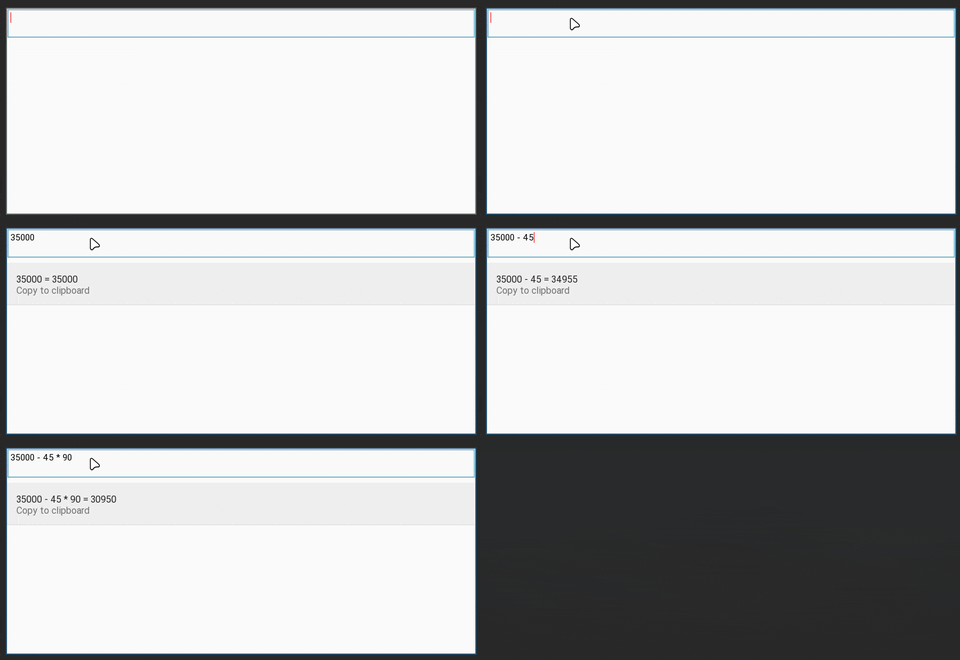
Fredo was a POC project originally made to follow a book, but since It actually became useful to me I'm opening the repo with It's obvious flaws.
How It Works
Fredo implements a simple interface written in kivy that receives input from the user. The input is then parsed at runtime by Fredo that resolves what plugin should be used to get options for the current query. Thus, Fredo works with prefixes. One can have a prefix 'p' for running python scripts for example, or the prefix 'y' to quickly search and open youtube.
Plugins are just python classes that implements two methods: get_options and action. The former takes in the current query and returns a list of options, the latter is a definition of the action to take when the user selects an option, like copying to the clipboard or opening a document.
Writing a Plugin
This will propably change, but to write a plugin you should write a python class that inherit the Plugin class, from fredo.plugins.base. Your class should implement at least two methods:
action(command)
This is the method that will run once the user selects an option. The command argument is a string defined in the option.
get_options(query)
This is the method that gives the options to the user. It receives a query, and It should return a list of options. An option is defined as a dict with a title key, an optional subtitle key (that will be displayed in the gui) and with a command key that will be passed to the action method one the option is selected.
Defining plugins and prefixes
For the moment, Alfredo gets Its configs from the conf.py file in the root of the project. There you can find simple examples on how the plugins and prefixes are set.
Drawbacks
To aviod a frozen screen while expensive functions run to search for results (like searching for files in a disk or querying a slow api), every time the user types a new character a new process is spawned to handle the plugin's search for results, taking place of the previous process that is brutally killed. That means that It's not possible to cache the results, and that a lot of processes are created and killed while using Alfredo. I don't really know how to handle this and would appreciate any help on the matter.
The executable app is built using PyInstaller and at the moment I couldn't find a simpler way to distribute It.
There is no decent dependency management yet (some default actions assume that the user has a certain package installed, like xclip).
1 maintainer

Metadata
1 maintainer
Release files for fredo 0.0.2
For a detailed explanation of source distributions (sdists) and built distributions (wheels), please see the package formats documentation.
Source distribution (sdist)
| File | Size | Uploaded | Provenance | |
|---|---|---|---|---|
| fredo-0.0.2.tar.gz | 9.5 kB | Without provenance | Details |
Built distribution (wheel)
| File | Interpreter | ABI | Platform | Reset |
|---|---|---|---|---|
| fredo-0.0.2-py3-none-any.whl | Python 3 | none | any | Details |
Total release size: 20.2 kB
Release files / fredo-0.0.2.tar.gz
| Download URL | fredo-0.0.2.tar.gz |
|---|---|
| Size | 9.5 kB |
| Tags | Source |
|
SHA-256 checksum How to use checksums |
a7411106a86227d8d525329a0582a2d43ea5720aacc11de81684512e2c411f23
|
|
BLAKE2b-256 checksum How to use checksums |
b37c1f8851893ebf0005b9914ddd5442c8cc643a7a60ed531e454e9946293bb4
|
| Upload date | |
|
Uploaded using Trusted Publishing? What is trusted publishing? |
No |
| Uploaded via |
twine/3.3.0 pkginfo/1.6.1 requests/2.22.0 setuptools/51.1.1 requests-toolbelt/0.9.1 tqdm/4.55.0 CPython/3.8.5
|
Release files / fredo-0.0.2-py3-none-any.whl
| Download URL | fredo-0.0.2-py3-none-any.whl |
|---|---|
| Size | 10.7 kB |
| Tags | Python 3 |
|
SHA-256 checksum How to use checksums |
df41cb001bf50a4bc7a6bbe0fb7c0333aba1c44a4d9ea37505a8a422e773a6b6
|
|
BLAKE2b-256 checksum How to use checksums |
6f1a3dc91f66ff293b2c32927c84a1020e62d4044893ed7d7062c2efd3ca2bc6
|
| Upload date | |
|
Uploaded using Trusted Publishing? What is trusted publishing? |
No |
| Uploaded via |
twine/3.3.0 pkginfo/1.6.1 requests/2.22.0 setuptools/51.1.1 requests-toolbelt/0.9.1 tqdm/4.55.0 CPython/3.8.5
|
Security for fredo 0.0.2
Provenance
Provenance describes where a file came from. On PyPI, provenance is shared via attestations, which provide a verifiable record of the build or publishing details. View details, limitations and caveats.
No provenance found
None of the files in this release were uploaded with provenance metadata.
A note on package security
PyPI is a repository for distributing packages, not a service for auditing them. While third-party security researchers and our staff do their best to detect and remove malicious packages, PyPI cannot guarantee the quality, security or suitability of any given package.
To learn more about protecting yourself from malicious actors, visit our package security documentation.














