
free-search-mcp



A local-first, no-API-key Model Context Protocol server that gives any LLM (Claude, GPT, local Ollama, …) the ability to search the web, fetch and clean up pages, and read documents — without you signing up for a single search API.
It bundles together the best ideas from a handful of open-source MCPs into one Python package, and adds the LLM-ergonomics and reliability work they were each missing.
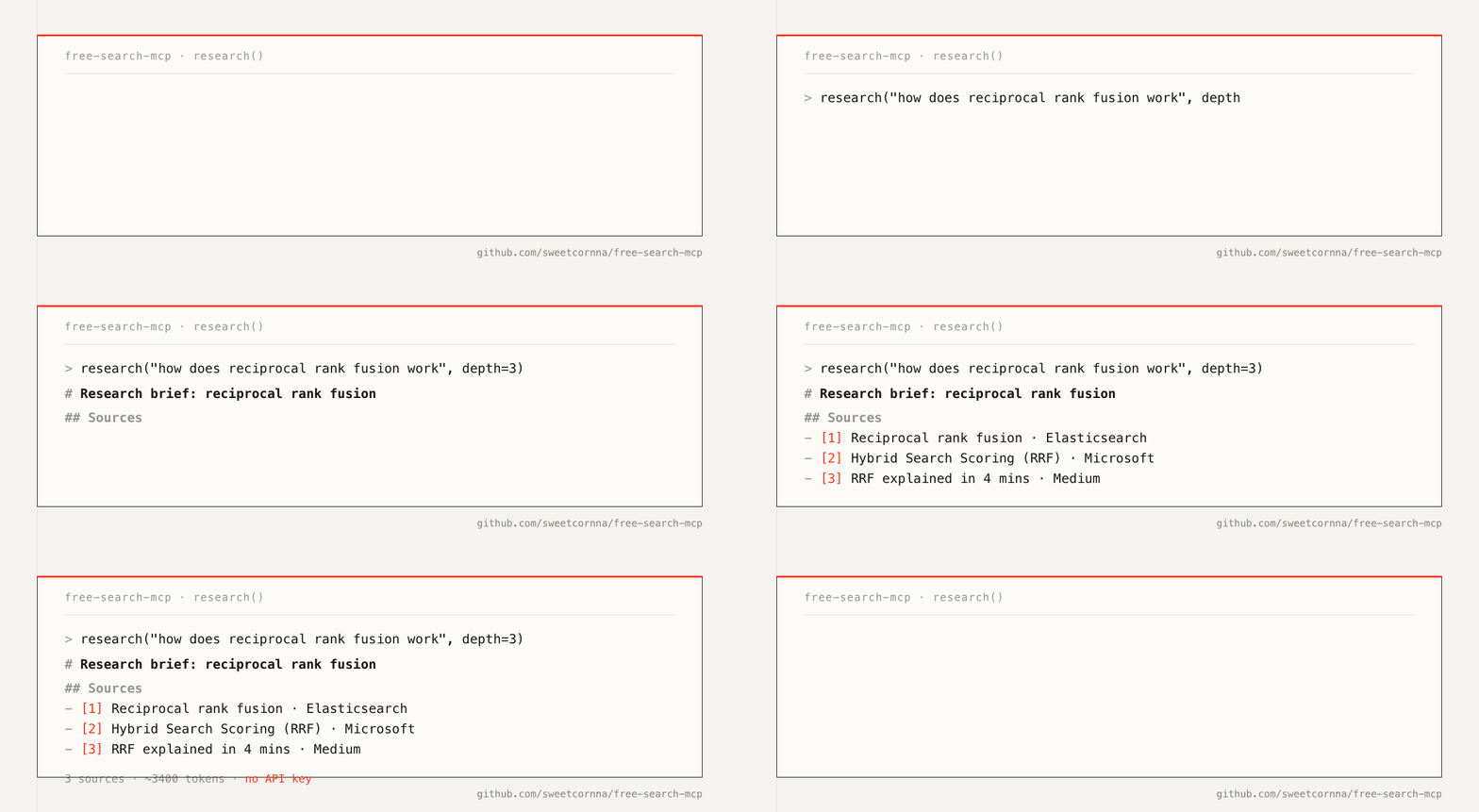
research("how does reciprocal rank fusion work", depth=3)
   ↓
# Research brief: how does reciprocal rank fusion work
_engines: duckduckgo, mojeek, googlenews · sources: 3 · ~3,400 tokens_

## Sources
- [1] Reciprocal rank fusion | Elasticsearch Reference — <https://…>
- [2] Hybrid Search Scoring (RRF) | Microsoft Learn — <https://…>
- [3] RRF explained in 4 mins — Medium — <https://…>

## Documents
…full Markdown bodies of each page, ready for the LLM to read…
One tool call. Three sources. No API key. No OPENAI_API_KEY-but-for-search
shakedown.
🚀 One-click deploy
One command — the keyless engines work immediately, no signup, no key, no checkout (needs uv):
claude mcp add search -- uvx free-search-mcp      # Claude Code
codex mcp add search -- uvx free-search-mcp       # Codex
Any other MCP client: point it at the command uvx free-search-mcp (stdio). The
first run downloads the package from PyPI; every HTTP engine works with no
further setup.
Optional — browser-rendered engines (startpage, zhihu, …) and JS-heavy
page fetches need Chromium once:
uvx --from free-search-mcp playwright install chromium
Without it, HTTP search/fetch keep working, and any call that needs the browser returns that exact install command instead of a cryptic failure.
Configuration (all optional) lives in ~/.config/search-mcp/.env — see
Configuration.
Full install (source checkout + client registration)
curl -LsSf https://raw.githubusercontent.com/sweetcornna/free-search-mcp/main/scripts/install.sh | bash -s -- --client claude-code
It clones or updates the project under ~/.local/share/free-search-mcp,
installs uv, syncs dependencies, installs Chromium for rendered engines
(with OS deps on Linux), smoke-tests the server, and registers the search
MCP server in Claude Code user scope.
Other client targets:
curl -LsSf https://raw.githubusercontent.com/sweetcornna/free-search-mcp/main/scripts/install.sh | bash -s -- --client claude-desktop
curl -LsSf https://raw.githubusercontent.com/sweetcornna/free-search-mcp/main/scripts/install.sh | bash -s -- --client codex
curl -LsSf https://raw.githubusercontent.com/sweetcornna/free-search-mcp/main/scripts/install.sh | bash -s -- --client generic
curl -LsSf https://raw.githubusercontent.com/sweetcornna/free-search-mcp/main/scripts/install.sh | bash -s -- --client add-mcp
curl -LsSf https://raw.githubusercontent.com/sweetcornna/free-search-mcp/main/scripts/install.sh | bash -s -- --client all
Codex, Cursor, Cline, Continue, Zed, and generic agent guidance: docs/AGENT_USAGE.md.
Optional extras, any time (the defaults already work without them):
uv run search-mcp-admin        # bilingual browser UI / 中英双语配置页: http://127.0.0.1:8765
uv run search-mcp-login zhihu  # one-time Zhihu login (persists cookies)
Prefer containers? docker compose run --rm search-mcp. Claude Desktop and
other clients: see Install below.
Why this exists
Existing search MCPs each do one thing well, but you usually want all of it:
| Multi-engine | No API key | Smart fallback | PDF/DOCX | FTS5 cache | Filters | Trafilatura | LLM-tuned | |
|---|---|---|---|---|---|---|---|---|
nickclyde/duckduckgo-mcp-server |
✗ | ✓ | ✗ | ✗ | ✗ | ✗ | ✗ | ~ |
mrkrsl/web-search-mcp |
✓ | ✓ | ✓ | ✗ | ✗ | ✗ | ✗ | ~ |
Aas-ee/open-webSearch |
✓ | ✓ | ~ | ✗ | ✗ | ✗ | ✗ | ~ |
VincentKaufmann/noapi-google-search-mcp |
✗ | ✓ | ✓ | ✓ | ✓ | ✗ | ✗ | ~ |
| free-search-mcp | ✓ | ✓ | ✓ | ✓ | ✓ | ✓ | ✓ | ✓ |
"LLM-tuned" here means: Markdown-first output, token estimates, smart
truncation at paragraph boundaries, "Best for / Not for / Returns / Common
mistakes" docstrings the model uses to pick the right tool, actionable
error hints, MCP prompts and resource templates, and a one-shot
research() that collapses search→fetch→fetch→fetch into a single turn.
"Trafilatura" means we extract main content using
trafilatura — winner of the
Bevendorff 2023 ROUGE benchmark (~0.85 vs ~0.55 for naive boilerplate
stripping). Each fetched page also returns author, published_date, and
sitename for free.
"Filters" means search/research accept freshness, include_domains,
exclude_domains, category, include_text, exclude_text. category also
routes the query to sources that natively index it: a bare group
(news/pdf/github/paper/forum/blog/image/dataset/finance)
widens, and a dotted sub-group (paper.biomed, finance.filings, …) narrows
to just the sources that index it — see
Vertical sources.
Anti-detection & resilience
- HTTP fast path uses
curl_cffiwith a real Chrome 131 JA3/JA4 + HTTP/2 fingerprint, fixing the DDG "anomaly 202" rate-limit response that vanilla httpx triggered. - Playwright fallback uses
launch_persistent_context(cookies survive restarts on disk), prefers a real installed Chrome (channel="chrome"), drops the--no-sandboxfingerprint marker on macOS, and randomizes the viewport per session. - Result dedup is title-fuzzy + host-canonical (rapidfuzz
token_set_ratio >= 92, host normalized forwww./m./amp.and country-TLD collapse), catchingbbc.co.ukvsbbc.comduplicates that URL-only dedup misses. searchincludes an honest extractivelead_snippet— picks the top-3 result whose snippet contains ≥2 query terms and is ≥80 chars; rendered as> **Lead:** According to {host}: …. No LLM call. Returns nothing if no snippet qualifies (no fake answer).
⚠️ We deliberately do not attempt to defeat proof-of-work captchas on Bing or Brave — that crosses the ToS line. When those engines challenge us, we fall back to other engines instead.
Tools (11)
| Tool | Description |
|---|---|
search(query, ...filters) |
Parallel multi-engine search, RRF-merged, title-fuzzy + host-canonical deduped, with optional extractive lead_snippet |
research(question, depth?, ...filters) |
One-shot: search + fetch top N + return Markdown brief |
paper_graph(paper, direction?, limit?) |
Walk one paper's citation graph — references, citing works ranked by influence, and Crossref retraction/correction notices |
compare(question, urls=[2..5]) |
Concurrent fetch of 2-5 URLs, side-by-side excerpts keyed by question |
fetch(url, render?, inline?, ...) |
Fetch any resource: reader-mode Markdown for pages, parsed text for documents, or a description (type/size/dimensions/sha256) for images and binaries. inline=True returns the image itself for vision models |
fetch_batch(urls, ...) |
Concurrent multi-URL fetch (max 20 per call) |
read_doc(source, start?, length?, ...) |
Parse PDF / DOCX / XLSX / PPTX / EPUB / CSV / code / zip-tar / HTML / TXT / MD with pagination |
extract_structured(url, ...) |
Pull JSON-LD / OpenGraph / Twitter cards / microdata via extruct |
cache_search(query, limit?, ...) |
FTS5 search across previously fetched pages |
engines(group?) |
The source tree — group → sub-group → engine, one line each |
download(url, ...) |
Save a file to ${SEARCH_MCP_CACHE_DIR}/downloads by default; files auto-delete after 24h. Set SEARCH_MCP_DOWNLOAD_ENABLED=false to disable it. |
Plus 4 MCP prompts (Research thoroughly, Fact-check claim,
Compare sources, News brief) and 2 resource templates
(cache://page/{url}, cache://search/{query_hash}).
Filters (search / research)
| Param | Values | Effect |
|---|---|---|
freshness |
day / week / month / year |
Only results from the last N |
include_domains |
["python.org", "djangoproject.com"] |
Restrict to these domains |
exclude_domains |
["pinterest.com"] |
Remove these |
category |
a group (paper, finance, news, …) or a sub-group (paper.biomed, finance.filings, …) |
Routes to the sources that natively index that kind of thing; the enum in the tool schema lists every value |
include_text |
"async" |
Substring required in title/snippet |
exclude_text |
"beginner" |
Substring forbidden |
max_age_hours |
24 |
Override the 7-day default cache TTL on this call |
All tools default to format="markdown" — readable, ~40% fewer tokens than
JSON, with provenance and a token-budget header. Pass format="json" for
structured access.
Tool annotations
Every tool ships correct readOnlyHint, idempotentHint, and
openWorldHint annotations so MCP clients can label them and gate
elevated actions.
Engines
Default set (all-HTTP, no browser):
duckduckgo, mojeek, googlenews, bing.
When a search comes back empty (or nearly empty with gated/erroring
engines), the aggregator automatically runs one bounded rescue pass
via searx → bing and reports it as rescued_via — so a CAPTCHA wall
on the defaults degrades to slower results instead of no results.
Opt-in:
-
startpage— browser-rendered (~5-10s/query); good for hard-to-reach results that the HTTP defaults miss. -
brave,baidu— intermittent challenges to headless clients. -
searx— meta-search proxy via public SearXNG instances; included for completeness but most public instances are slow/unreliable in 2026. -
google— keyless Google web SERP scrape (HTTP first, Playwright fallback when Google serves a JS/consent shell).serpsearchis a pure alias ofgoogle(all dedicated "SERP APIs" require a key, so the only keyless SERP is a direct scrape). -
anysearch— AnySearch unified-search REST API, anonymous (keyless) tier; one HTTP call returns fused, re-ranked results. IP rate-limited; 429/5xx degrade to empty. -
bilibili— keyless Bilibili (哔哩哔哩) video search via the publicweb-interface/search/all/v2JSON API (syntheticbuvid3cookie, no login). Returns video results only. -
zhihu— best-effort keyless Zhihu (知乎) search. Zhihu'sapi/v4/search_v3needs login cookies +x-zse-96signing, so the only no-key path is browser-rendering the public search page. Zhihu hard-gates headless clients, so a login wall / empty result is common and honest — treat it likebaidu/brave. -
sogou,so360— Chinese web indexes, HTML scrapes, best-effort likezhihu. Notesogoureturns redirect URLs (sogou.com/link?url=…) rather than target URLs; the blob is only resolvable by following it.fetchhandles that, but host-basedcategoryfiltering will discard them.baiduandso360return direct URLs. -
wikipedia— encyclopedia search; language followsSEARCH_MCP_REGION. -
openlibrary— book search over the Internet Archive catalogue.
Scholarly and financial sources are keyless too, and are normally reached via
category= rather than by name: arxiv, openalex, crossref, pubmed,
europepmc, dblp, doaj, clinicaltrials, zenodo — and sec_edgar,
yahoofinance, cninfo, worldbank, imf. semanticscholar is registered
alongside them but its anonymous pool answers 429 in practice, so it stays out
of automatic routing until a (free) key is configured.
All keyless engines stay opt-in — they're not in the fast default pool, so the ~2x latency win of the all-HTTP defaults is preserved. Enable per call with
engines=["google","bilibili", ...], or globally viaSEARCH_MCP_DEFAULT_ENGINES.
Vertical sources (selected automatically by category)
These index something a general web engine can't. You normally don't name
them — passing category= to search/research routes to them. Sources are
organised as group → sub-group: a bare group widens (one specialist per
sub-group joins the web pool), a dotted sub-group narrows to exactly the
sources that index it.
category |
Engines | Why it matters |
|---|---|---|
paper |
one per sub-group, below | Actually searches the literature instead of filtering web results by hostname |
paper.index |
openalex, crossref, semanticscholar |
Cross-discipline DOI indexes with citation counts |
paper.preprint |
arxiv, europepmc (SRC:"PPR") |
Work that has not been peer reviewed yet, flagged as such |
paper.biomed |
europepmc, pubmed |
MEDLINE and its 40M-record superset, with open-access full text |
paper.cs |
dblp |
Curated CS bibliography: exact venues, authors, DOIs |
paper.openaccess |
doaj, europepmc |
Every hit is free to read in full, so read_doc can open it |
paper.trial |
clinicaltrials |
Registered human trials — evidence the literature has not caught up with |
finance |
one per sub-group, below | No general engine indexes filings, quotes or macro series |
finance.filings |
sec_edgar, cninfo |
Regulatory filings in full text (US, and A-share/HK) |
finance.market |
yahoofinance |
Ticker resolution plus market news for the resolved instrument |
finance.macro |
worldbank, imf |
World Bank research and IMF DataMapper series, WEO forecasts included |
github |
github (repos + issues/PRs), github_code (needs a token) |
Real repository metadata, stars, last push |
forum |
stackexchange, hackernews |
Accepted-answer and score signals |
news / news.world |
googlenews, gdelt |
GDELT covers 100+ languages Google News never surfaces |
image |
openverse |
Openly-licensed images; results are direct file URLs, so fetch(inline=True) works on them |
dataset |
zenodo |
Datasets, software and their DOIs |
image and dataset replace the default pool rather than adding to it —
a web engine can't return an image file or a dataset record, so mixing it in
only crowds out the source that can. The others augment it, capped by
SEARCH_MCP_CATEGORY_ENGINE_LIMIT (default 3). Because that cap is smaller
than most groups, a bare group round-robins across its sub-groups before
truncating: category="paper" spends its three slots on three different
corpora rather than on three overlapping DOI indexes.
Results from an engine that natively indexes the requested category count
double in the rank fusion. Without that, category= barely affected the
order: a specialist is usually the only source returning a given document, so
its hit lost to three general engines agreeing on a blog post about the topic.
engines() prints this tree live from the registry — it is derived from what
each engine declares, so it cannot drift from what actually runs.
Naming engines explicitly (engines=[...]) turns the routing off.
Sources that publish a stricter rate limit than our default declare it themselves, and are skipped rather than queued when their bucket is empty — search is a parallel fan-out, so waiting on one slow source would add that delay to every other engine's results.
API-key engines & the admin backend
Keyless is the default, but you can also plug in keyed providers for higher reliability/quality. These engines stay dormant (and return a clear "not configured" hint) until you add a key:
| Engine | Provider | Free tier |
|---|---|---|
brave_api |
Brave Search API | 2,000 queries/mo |
serper |
Serper (Google) | 2,500 queries |
tavily |
Tavily (AI search) | 1,000 credits/mo |
google_cse |
Google Custom Search | 100 queries/day |
anysearch |
AnySearch (key optional) | keyless works; key lifts limits |
github_code |
GitHub | code search is auth-only; the keyless github engine covers repos + issues |
stackexchange |
Stack Apps (key optional) | 300 req/day keyless; a key lifts the quota |
semanticscholar |
Semantic Scholar (key optional) | the anonymous pool answers 429 in practice; a free key makes it usable |
Simplest setup — the admin UI:
uv run search-mcp-admin # opens a local config page on 127.0.0.1:8765
It serves one bilingual page (English + 中文, bound to localhost only) with,
per provider: a how-to-get-a-key / 如何获取密钥 guide + signup/docs links,
masked key fields, Save / 保存 (applies live — no server restart),
Test / 测试, and Clear / 清除. The same page also includes
Network / Proxy / 网络 / 代理 settings. Keys are written to
~/.config/search-mcp/config.json (0600); they're never echoed back to the
page. Prefer env vars? Set SEARCH_MCP_<PROVIDER>_API_KEY instead (these
override the saved file). Full walkthrough for each provider:
docs/API_KEYS.md.
search("…", engines=["brave_api"])        # once a key is saved
search("…", engines=["tavily", "serper"]) # mix keyed + keyless freely
When an engine is gated (proxy · fallback · login)
Some engines get blocked by the provider — Google/Bing serve a CAPTCHA to datacenter IPs, Zhihu needs a login. We don't defeat CAPTCHAs (ToS); instead:
- Proxy (the real fix for IP gating): set a proxy in the admin UI
"Network / Proxy" card or
SEARCH_MCP_PROXY(http/https/socks5, optionaluser:pass@). It routes the HTTP engines, the browser, andfetchthrough a non-blocked IP. Scope it withSEARCH_MCP_PROXY_ENGINES="google bing zhihu". - SearXNG auto-fallback: when
google/serpsearch/bingare CAPTCHA-gated, they transparently retry via the workingsearxmeta-search — you still get results, honestly attributed tosearx. - Gate diagnostics: the response includes
gated_engines+gated_hinttelling you which engine was gated (captcha/consent/login) and how it was handled. - Zhihu login: run
uv run search-mcp-login zhihu(or the admin "Login" button) once — a browser opens, you log in, cookies persist, andzhihusearch then works. Requires a desktop session.
Full guide: docs/PROXY_AND_GATES.md.
Brave/Bing/Baidu all gate headless browsers after a handful of calls (PoW CAPTCHAs, "something went wrong" pages, redirect wrappers). Pass
engines=["brave"]etc. only when the defaults can't find what you need.
Sparse-result diagnostics
When filters drop results so aggressively that ≤3 are returned, the
response includes filter_diagnostics so the LLM knows which knob to
relax. Example for category="forum" + exclude_text="beginner":
⚠️ **Filter diagnostics** (results were sparse)
Raw results: 20 across 3 engines → 0 after filters.
Top drops: category_forum (20).
Hint: Filters dropped 20 of 20 raw results. Most were excluded by
category=forum. Try widening or removing one filter.
Install
Zero-checkout (uvx, recommended)
claude mcp add search -- uvx free-search-mcp      # Claude Code
codex mcp add search -- uvx free-search-mcp       # Codex
uvx free-search-mcp                               # or run the stdio server directly
Optional extras, any time:
uvx --from free-search-mcp playwright install chromium   # browser-rendered engines
uvx --from free-search-mcp search-mcp-admin               # bilingual config UI (opens browser)
One-click setup (source checkout)
curl -LsSf https://raw.githubusercontent.com/sweetcornna/free-search-mcp/main/scripts/install.sh | bash -s -- --client claude-code
The remote installer clones or updates
~/.local/share/free-search-mcp, installs uv if needed, syncs dependencies,
installs Chromium, smoke-tests the MCP server, then registers it with the
requested client:
--client claude-code      # Claude Code user-scope config
--client claude-desktop   # claude_desktop_config.json
--client codex            # Codex config
--client generic          # print portable MCP JSON for other agents
--client add-mcp          # delegate to npx add-mcp
--client both             # Claude Code + Claude Desktop
--client all              # Claude Code + Claude Desktop + Codex
--client none             # install only, no client config changes
Prefer a local checkout?
git clone https://github.com/sweetcornna/free-search-mcp.git
cd free-search-mcp
./scripts/install.sh --client none
Prefer to do it by hand?
uv sync
uv run playwright install chromium
cp .env.example .env        # optional: customize engines/limits
Run as a stand-alone server (stdio transport):
uv run search-mcp
Or serve it over HTTP. MCP revision 2026-07-28 removed protocol-level
sessions, so the HTTP endpoint is stateless — no sticky routing, any replica
can answer any request:
uv run search-mcp --transport streamable-http --port 8000 # → http://127.0.0.1:8000/mcp
The HTTP endpoint has no authentication and will fetch arbitrary URLs on behalf of whoever reaches it. It binds
127.0.0.1by default; if you change--host, put an authenticating reverse proxy in front. A DNS-rebinding guard rejects unknownOrigin/Hostheaders — add trusted browser origins withSEARCH_MCP_HTTP_ALLOWED_ORIGINS. This is a separate process and port from the admin UI (search-mcp-admin, port 8765), which stays loopback-only because it reads and writes your API keys.
Docker (one-click, containerized)
docker compose build
docker compose run --rm search-mcp     # attaches stdio for MCP
Config & env vars
All settings are env vars prefixed with SEARCH_MCP_. Copy .env.example →
.env and edit — it documents every knob, including how to enable the new
engines via SEARCH_MCP_DEFAULT_ENGINES. See the full table under
Configuration and the usage guide.
Tests
uv run pytest -q                              # offline (default, no network)
SEARCH_MCP_TEST_NETWORK=1 uv run pytest -v    # live tests, hit the real web
Wire into Claude Code
claude mcp add search -s user -- uvx free-search-mcp
From a source checkout instead: this repo ships a project-scoped .mcp.json,
so running claude inside the project auto-detects the search server; or
register the checkout globally:
claude mcp add search -s user -- uv --directory /absolute/path/to/free-search-mcp run search-mcp
Wire into Codex
codex mcp add search -- uvx free-search-mcp
codex mcp list
(Source checkout: swap the command for
uv --directory /absolute/path/to/free-search-mcp run search-mcp.)
Wire into Claude Desktop
Add this to ~/Library/Application Support/Claude/claude_desktop_config.json
(macOS) or the equivalent on your platform:
{
  "mcpServers": {
    "search": {
      "command": "uvx",
      "args": ["search-mcp"]
    }
  }
}
(Source checkout: "command": "uv", "args": ["--directory", "/absolute/path/to/free-search-mcp", "run", "search-mcp"].)
Restart Claude Desktop. The eleven tools above will appear in the tool drawer.
Wire into other clients
The server speaks plain MCP over stdio (or streamable-http, see above). It
implements protocol revision 2026-07-28 and serves every earlier revision
from the same process, so both new and older clients work unchanged:
- Codex (
codex mcp add search -- uvx free-search-mcp) - Claude Code (
claude mcp add search -s user -- uvx free-search-mcp) - Cursor / Continue / Cline (use the JSON snippet above)
- Custom Python / TypeScript clients via the official MCP SDK
For agent-specific operating rules, tool-selection guidance, and a reusable system-prompt snippet, see docs/AGENT_USAGE.md.
Installer choice
uvx free-search-mcp (PyPI) is the fastest path and needs no checkout — HTTP
engines work immediately and Chromium is a single optional follow-up command.
scripts/install.sh remains the full bootstrap for people who want a source
checkout, Chromium with OS deps, a smoke test, and client registration in one
shot. Generic MCP installers still have their place: add-mcp can write
config for many clients at once, Smithery is strongest for registry/remote
MCP connections, and MCPB is the right future format for clickable desktop
bundles.
Configuration
All settings can be overridden by environment variables prefixed with
SEARCH_MCP_. They can live in three places (highest precedence first):
real environment variables → ./.env in the launch directory (source
checkouts) → ~/.config/search-mcp/.env (the stable location for uvx/PyPI
installs; directory overridable via SEARCH_MCP_CONFIG_DIR).
API keys and the proxy are easiest to manage in the admin UI
(search-mcp-admin, opens your browser automatically; set
SEARCH_MCP_ADMIN_NO_BROWSER=1 to suppress).
Available knobs:
| Var | Default | Meaning |
|---|---|---|
SEARCH_MCP_DEFAULT_ENGINES |
["duckduckgo","mojeek","googlenews","bing"] |
JSON list |
SEARCH_MCP_SEARX_INSTANCES |
(empty) | pin known-good SearXNG instance URL(s), comma/space separated; overrides the built-in shortlist |
SEARCH_MCP_RESCUE_ENABLED |
true |
auto-rescue empty searches via rescue engines |
SEARCH_MCP_RESCUE_ENGINES |
["searx","bing"] |
rescue order (JSON list) |
SEARCH_MCP_RESCUE_TIMEOUT |
10.0 |
seconds; cap on the whole rescue pass |
SEARCH_MCP_MAX_RESULTS_PER_ENGINE |
10 |
|
SEARCH_MCP_RATE_LIMIT_PER_MINUTE |
30 |
per engine |
SEARCH_MCP_FETCH_RATE_LIMIT_PER_MINUTE |
20 |
shared fetch bucket |
SEARCH_MCP_CACHE_DIR |
~/.cache/search-mcp |
|
SEARCH_MCP_CACHE_TTL_SECONDS |
604800 |
7 days |
SEARCH_MCP_CACHE_MAX_MB |
512 |
size cap on the cache file; 0 disables |
SEARCH_MCP_FETCH_STRATEGY |
auto |
auto / http / browser |
SEARCH_MCP_BROWSER_HEADLESS |
true |
|
SEARCH_MCP_BROWSER_POOL_SIZE |
2 |
concurrent pages |
SEARCH_MCP_MAX_CONTENT_CHARS |
50000 |
per result truncation |
SEARCH_MCP_USER_AGENT |
desktop Chrome UA | used by the httpx (documents) and Playwright paths; the curl_cffi path derives its UA from browser impersonation |
SEARCH_MCP_DOWNLOAD_ENABLED |
true |
set false to disable local file downloads |
SEARCH_MCP_DOWNLOAD_DIR |
${SEARCH_MCP_CACHE_DIR}/downloads |
optional directory override; unset or blank uses the dynamic default (/data/downloads in Docker) |
SEARCH_MCP_DOWNLOAD_TTL_HOURS |
24 |
downloaded files are deleted after this; 0 keeps them forever |
SEARCH_MCP_DOWNLOAD_MAX_MB |
100 |
second-layer save cap; effective remote cap is the smaller of this and SEARCH_MCP_MAX_RESPONSE_BYTES (25,000,000 bytes by default) |
SEARCH_MCP_CATEGORY_ENGINE_LIMIT |
3 |
how many category-native engines category= may add |
SEARCH_MCP_CONTACT_EMAIL |
(empty) | optional; routes OpenAlex/Crossref/NCBI into their faster identified-caller pools |
SEARCH_MCP_TRANSPORT |
stdio |
stdio / streamable-http |
SEARCH_MCP_HTTP_HOST |
127.0.0.1 |
streamable-http bind address |
SEARCH_MCP_HTTP_PORT |
8000 |
streamable-http port |
SEARCH_MCP_HTTP_PATH |
/mcp |
streamable-http endpoint path |
SEARCH_MCP_HTTP_ALLOWED_ORIGINS |
(empty) | extra Origin values the DNS-rebinding guard accepts, comma/space separated (loopback is always allowed) |
Architecture
   ┌─────────────────────────────────────────────────────┐
   │  MCP server (stdio | streamable-http)               │
   │  tools: search / research / fetch / fetch_batch /   │
   │         read_doc / cache_search / engines           │
   └────────────┬────────────────────────────────────────┘
                │
   ┌────────────▼────────────┐  ┌────────────────────────┐
   │  aggregator             │  │  fetcher               │
   │  - parallel engines     │  │  - httpx fast path     │
   │  - reciprocal rank      │  │  - playwright fallback │
   │    fusion               │  │  - markdownify         │
   │  - search cache (FTS5)  │  │  - page cache (FTS5)   │
   └────┬────────────────────┘  └────────────┬───────────┘
        │                                    │
   ┌────▼─────────────────┐  ┌──────────────▼─────────────┐
   │  engines/            │  │  browser pool              │
   │   duckduckgo.py      │  │   - persistent context     │
   │   mojeek.py          │  │   - stealth init script    │
   │   searx.py           │  │   - shared cookies         │
   │   startpage.py (opt) │  │   - semaphore-bounded pages│
   │   brave.py     (opt) │  └────────────────────────────┘
   │   bing.py      (opt) │
   │   baidu.py     (opt) │
   │   google.py    (opt) │
   │   serpsearch.py(opt) │
   │   anysearch.py (opt) │
   │   bilibili.py  (opt) │
   │   zhihu.py     (opt) │
   │   sogou.py     (opt) │
   │   so360.py     (opt) │
   │   arxiv/openalex/    │
   │   crossref/pubmed    │
   │   github/stackexch.  │
   │   hackernews/gdelt   │
   │   wikipedia/openlib. │
   │   openverse/zenodo   │
   └──────────────────────┘

   ┌────────────────────────────┐    ┌──────────────────┐
   │  documents/                │    │  ratelimit       │
   │   pypdf, python-docx,      │    │   token bucket   │
   │   markdownify              │    │   per engine     │
   └────────────────────────────┘    └──────────────────┘

   ┌────────────────────────────┐    ┌──────────────────┐
   │  formatting                │    │  research        │
   │   token estimate           │    │   composed       │
   │   smart truncation         │    │   workflow       │
   │   markdown renderers       │    │                  │
   └────────────────────────────┘    └──────────────────┘
Engine adapter pattern
Each engine in src/search_mcp/engines/ implements:
class Engine:
    name: str
    needs_browser: bool          # Force Playwright?
    wait_selector: str | None    # CSS to wait for in browser mode

    def build_url(self, query: str, max_results: int) -> str: ...
    def parse(self, html: str) -> list[SearchResult]: ...
The base class handles transport (httpx → Playwright fallback), rate limiting, and the case where HTTP returns a captcha shell instead of results (auto-retries via the browser).
Credits
This project stands on the shoulders of:
mrkrsl/web-search-mcp— smart httpx-then-Playwright fetch strategy, multi-engine fallback chainAas-ee/open-webSearch— multi-engine breadth (Bing/DDG/Baidu/Brave/Startpage)VincentKaufmann/noapi-google-search-mcp— anti-detection patterns (navigator.webdriver, UA, cookies), SQLite FTS5 cache idea, multi-formatread_documentnickclyde/duckduckgo-mcp-server— per-engine rate limiting, LLM-friendly content cleanup- Mojeek — independent search index that doesn't gate on User-Agent
- Model Context Protocol and the official Python SDK
License
MIT — see LICENSE.
1 maintainer

Download files
Download the file for your platform. If you're not sure which to choose, learn more about installing packages.
Source Distribution
Built Distribution
Filter files by name, interpreter, ABI, and platform.
If you're not sure about the file name format, learn more about wheel file names.
Copy a direct link to the current filters
File details
Details for the file free_search_mcp-0.10.0.tar.gz.
File metadata
- Download URL: free_search_mcp-0.10.0.tar.gz
- Upload date:
- Size: 515.1 kB
- Tags: Source
- Uploaded using Trusted Publishing? No
- Uploaded via:
twine/7.0.0 CPython/3.13.14
File hashes
| Algorithm | Hash digest | |
|---|---|---|
| SHA256 |
1b370859c181b9fe69280268d51cd9afde95aa2b93f69019f6b0e6f79a8614be
|
|
| MD5 |
1e4f581bbbbd04bb6a9ee1c4b504d72d
|
|
| BLAKE2b-256 |
14dc01949112194930162ba7c329d45f6d6c7bddffaaba451c03db32f2989a63
|
File details
Details for the file free_search_mcp-0.10.0-py3-none-any.whl.
File metadata
- Download URL: free_search_mcp-0.10.0-py3-none-any.whl
- Upload date:
- Size: 263.5 kB
- Tags: Python 3
- Uploaded using Trusted Publishing? No
- Uploaded via:
twine/7.0.0 CPython/3.13.14
File hashes
| Algorithm | Hash digest | |
|---|---|---|
| SHA256 |
03d927d773a692e6f7fcf3b405da789d7d3eb0acabcd41195295b5dd7aa717f2
|
|
| MD5 |
cdd9ad5cb582e6e39ebbd215af0c57dc
|
|
| BLAKE2b-256 |
9c094b8880263eaef8f9c4267536ee719b57b5810da7039fa706b075d1dc1332
|














