
full-circle-optimization
One pass that runs several independent code-health finders as a team and trusts a defect only when two of them agree — so it holds up on a codebase it has never seen.




See it work
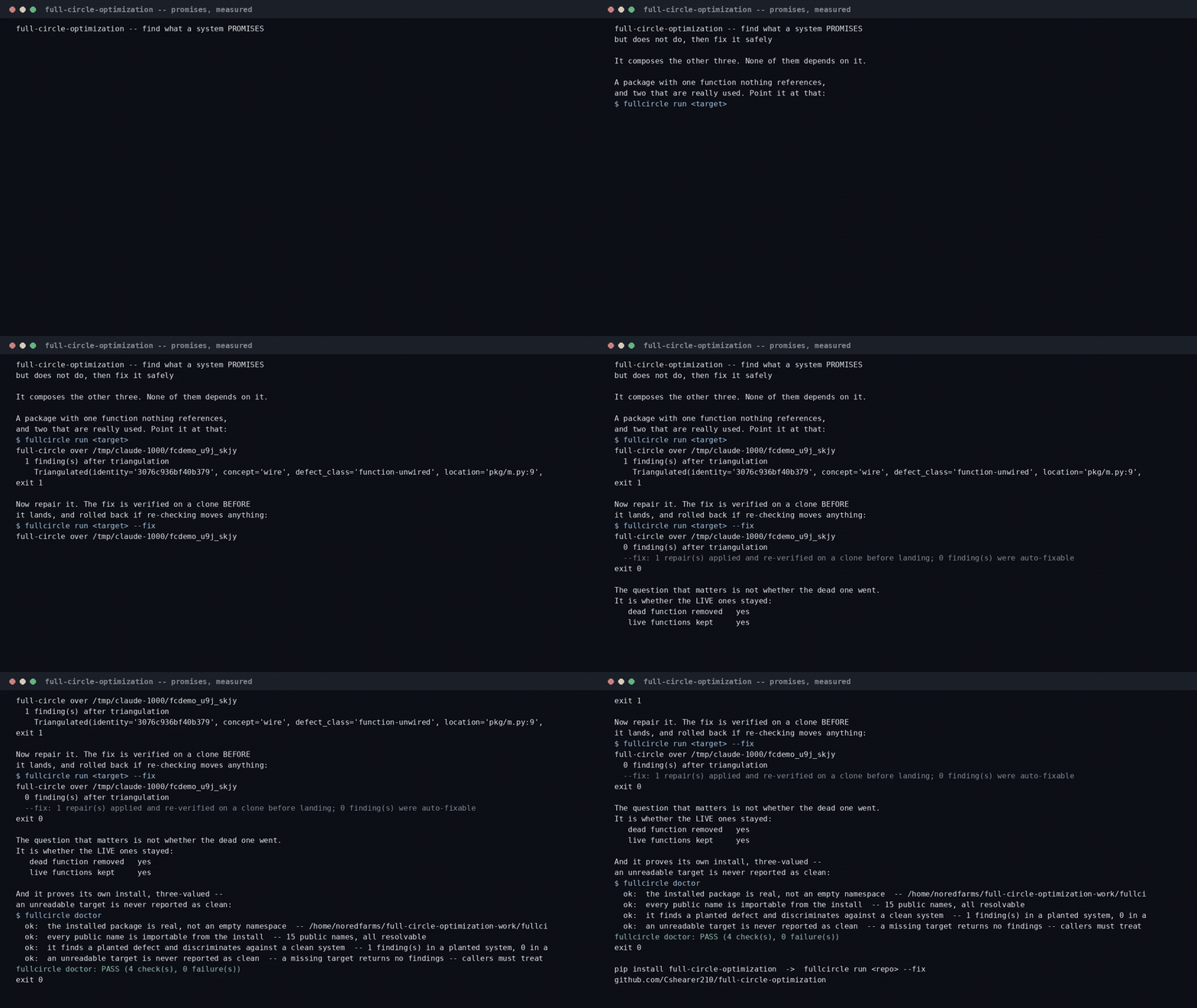
22 seconds, and the target is built on camera rather than being a fixture you have to trust: a package with one function referenced by nothing and two that really are used. It finds the dead one, repairs it, and then shows the beat that actually matters — the dead function is gone AND the live ones are still there. A repair tool that deletes working code passes every "did it change anything" check, so that is the only question worth filming.
Every line on screen is the real output of a command that really ran, with its real exit code. Full quality MP4.
239 tests pass — measured 2026-10-04, and reproducible by anyone in about three seconds:
python3 -m pytest -q        # 239 passed
fullcircle doctor           # 5 checks, and it exits non-zero if any of them is untrue
The tests that earn their place here are the ones that plant a defect and then assert the repair removed the dead code and left the live code alone — not that it ran, and not that the file changed. A fixer is only as trustworthy as the test that proves it does not over-reach.
That count is checked against the real suite rather than trusted: if the number here and the number the suite reports ever disagree, the pre-ship gate refuses the push.
Why it exists
The dangerous defects in generated code are the quiet ones: a test that runs but asserts nothing,
a gate that always returns True, the same function copied to two paths so a fix to one silently
misses the other, a constant with two different values in two files. Each survives review because a
single checker has a single blind spot — and a single checker gives you no way to tell a real
finding from a false alarm.
The whole idea here is corroboration. Every defect is looked for by several independent methods. A defect that two methods agree on is trustworthy precisely because no one blind spot could have produced both — so it is safe to act on. A defect only one method saw is a lead, and it is routed to a human instead of auto-fixed. Nothing keys on a name: the finders look at what the code does (its AST and call graph), so renaming everything in the target changes none of the results.
Limits, up front
- Python source only. Detection is AST- and call-graph-based; it does not analyse other languages.
- Proven on generated systems, not yet on real third-party repos. The proof below plants known defects into synthetic projects and scores against ground truth. Running against arbitrary public repositories is on the roadmap, not a claim.
- Auto-fix is deliberately narrow. Only corroborated, mechanical defects are eligible; the one auto-fix implemented today is removal of corroborated dead/unwired code, and every fix is verified on a throwaway clone and rolled back if anything moves. Everything else — conflicts, single-method leads — goes to a human review queue.
- Mostly static. It reasons about code shape, not runtime behaviour. The one exception is the mutation-testing module, which actually runs a target's test suite against mutated copies.
- The silent-defect classes need an optional companion. Six of the sixteen defect classes are
found by a separate tool,
claimproof(its own repository). It is optional: without it, this repo still proves the ten structural classes on its own (see the status table). With it installed, the same pipeline additionally proves the six silent classes.
Install
Zero friction — it is pure Python standard library. No dependencies, no build step, no account, and it makes no network calls.
pip install git+https://github.com/Cshearer210/full-circle-optimization

fullcircle doctor              # verify THIS install actually works, before trusting it
fullcircle run <path>          # then point it at any Python project
fullcircle doctor exists because a green CI badge tells you the source is fine and says nothing
about the copy on your machine — and because a tool that audits other people's systems has no
business asking to be trusted on its word. It checks the installed package is real rather than an
empty namespace, that every name it publishes resolves, that an unreadable target is never reported
as clean, and — in both directions — that it finds a planted defect in a synthetic project and
produces fewer findings on a clean one. It exits non-zero if any of that is untrue.
Working on the tool itself. Both older invocations still work unchanged:
git clone https://github.com/Cshearer210/full-circle-optimization
cd full-circle-optimization
python3 run_all_tests.py                      # every module's selftest, both directions
python3 -m fullcircle run <path>              # the module form
python3 fullcircle/orchestrator.py <path>     # the per-module script form
Requires Python 3.11+.
Minimal example
Run the pipeline over any Python project directory:
python3 fullcircle/orchestrator.py <path-to-a-project>                 # 2-round pipeline
python3 fullcircle/orchestrator.py <path> --sarif findings.sarif      # + SARIF for code scanning
python3 fullcircle/structural.py  <path>                              # just the structural finder
Or from Python:
from fullcircle import orchestrator

finders = orchestrator._wire_real_finders()          # structural finder (+ companion if installed)
report  = orchestrator.run("path/to/project", finders)

for t in report["auto_fixable"]:       # corroborated by >=2 methods -> safe to auto-fix
    print(t.defect_class, t.location, t.methods)
for t in report["human_review_queue"]: # single-method leads / judgment calls -> a human decides
    print(t.defect_class, t.location, t.methods)
Demo
examples/demo.py builds a throwaway project with four planted defects plus one clean control,
runs the real pipeline over it, and prints what it found. This is the actual, unedited output
of a fresh clone (companion not installed):
$ python3 examples/demo.py
full-circle-optimization demo
target: a generated project with 4 planted defects + 1 clean control
finders wired: 1 (structural only)

round 1: 4 findings  3 corroborated  2 auto-fixable  2 need a human
round 2: 4 findings  3 corroborated  2 auto-fixable  2 need a human

CORROBORATED (>=2 independent methods -> safe to auto-fix):
  [corroborated] function-unwired         core/orphan.py:1  via no-call-edge,no-reference
  [corroborated] stub-implementation      core/pay.py:1  via body-is-stub,has-callers

HUMAN-REVIEW QUEUE (single-method leads or judgment calls):
  [corroborated] conflicting-definition   RETRY_LIMIT='five' in {conf/b.py}; RETRY_LIMIT  via constant-conflict,value-type-mismatch
  [single-method] second-door-duplicate    core/handler_a.py | legacy/handler_b.py  via same-content

SARIF 2.1.0 written with 4 result(s) (drop-in for GitHub code scanning).
Ran 2 round(s), capped at 2; re-run later once the code has changed. 2 item(s) need a human decision.
Note two design decisions visible in that output: the conflicting-definition is corroborated but
still sent to a human (choosing which value is correct is a judgment call, never a bot's), and the
second-door-duplicate is a single-method lead, so it too waits for a human rather than being
auto-fixed.
Proof
The test bed generates fake systems with known planted defects plus clean controls, runs every finder, and scores catch rate against ground truth — then repeats with every symbol and file renamed, which is the label-independence proof: the catch rate must not move when the names do.
Fixed bed, three complexity levels, fresh clone (structural classes; companion not installed):
$ python3 fullcircle/testbed.py
TEST BED -- intended-job catch rate across levels (must be 100%, 0 FP)
companion silent-defect finder: not installed -- structural classes only;
silent classes reported as SKIPPED (install claimproof to exercise them)
  basic              4/4 caught  0 false-pos   OK  (3 silent skipped)
  basic+renamed      4/4 caught  0 false-pos   OK  (3 silent skipped)
  medium             4/4 caught  0 false-pos   OK  (3 silent skipped)
  medium+renamed     4/4 caught  0 false-pos   OK  (3 silent skipped)
  complex            4/4 caught  0 false-pos   OK  (3 silent skipped)
  complex+renamed    4/4 caught  0 false-pos   OK  (3 silent skipped)
VERDICT: 100% on intended jobs, 0 false positives (structural classes; silent classes not exercised)
Randomised scale test — hundreds of systems, each with a random subset of classes under random names (a continuous label-independence proof). Fresh clone:
$ python3 fullcircle/testbed_scale.py
SCALE TEST -- 300 randomised systems, 1644 planted defects
  bare-except                       ...   100.0%
  conflicting-definition            ...   100.0%
  dead-code                         ...   100.0%
  function-unwired                  ...   100.0%
  mutable-default-arg               ...   100.0%
  resource-leak                     ...   100.0%
  second-door-duplicate             ...   100.0%
  shadowed-builtin                  ...   100.0%
  stub-implementation               ...   100.0%
  unused-import                     ...   100.0%
  false positives on controls: 0
  clean configs: 300/300
  SKIPPED (companion silent-defect finder not installed): assert-constant-in-production, labeled-gate-that-cannot-fail, predicate-returns-none, swallowed-exception, test-cannot-fail, unreachable-except
VERDICT: 100% catch, 0 false positives across all configs (structural classes; silent classes not exercised)
Measured on a fresh clone: 10 structural defect classes, 1,644 planted defects across 300
randomised systems, 100% caught, 0 false positives. Every module also ships a --selftest that
proves it fires on a known-bad case and stays quiet on a known-good one — a detector proven in
only one direction is not proven.
On top of the selftests there is a pytest suite of 239 tests (tests/) that exercises every
module directly — happy paths, edge and boundary cases, error/exception paths, the corroboration
logic, and the SARIF output shape — plus a handful of property-based tests. Both run in CI:
python3 run_all_tests.py          # the module selftests (standard library only)
python3 -m pytest -q tests        # the pytest suite: 239 passing
Line+branch coverage of the fullcircle package is 81% (measured with coverage over the
pytest suite; the uncovered remainder is mostly the __main__ CLI blocks and the selftests'
failure-branch messages, which only execute when a check actually fails).
Status
| Component | State |
|---|---|
| Structural finder — 10 defect classes (see below) | Works today. 100% catch, 0 false positives, 300 randomised + 3-level fixed bed, label-independent |
| Triangulation + shared finding contract + SARIF 2.1.0 export | Works today |
| Orchestrator — 2-round loop, corroborated-vs-lead split, human-review queue | Works today |
| Safe fixer — isolated clone, verify-both-directions, rollback, single-writer merge | Works today (exercised by selftests; auto-fix limited to the corroborated dead/unwired class) |
| Mutation testing — proves a target's own suite can actually fail | Works today (self-quality module) |
| Concept/label portability core — classify by behaviour, learn the target's own names | Works today |
| Silent-defect classes (6) — test-cannot-fail, gate-ignores-input, swallowed-exception, predicate-returns-none, unreachable-except, assert-cannot-fail | Optional companion (claimproof, separate repo); integration wired, skipped cleanly when absent |
| Live runs against real third-party repositories | Roadmap — proven on generated systems only so far |
| More mechanical auto-fix providers | Roadmap |
The 10 structural classes proven self-contained
second-door-duplicate · conflicting-definition · function-unwired · stub-implementation ·
dead-code · unused-import · mutable-default-arg · bare-except · resource-leak ·
shadowed-builtin. Each is found by two independent methods where possible; where they agree the
finding is marked corroborated, otherwise it is a lead for human review.
How it works
finders  ->  triangulate  ->  partition            ->  loop (<=2 rounds)  ->  one SARIF + report
(each a    (collapse to    (corroborated+mechanical
 callable   one finding     -> auto-fixable;
 root ->    per defect,     everything else
 findings)  count methods)  -> human review)
finding.py— the one shared finding contract (a defect is identified by what is wrong where, independent of which method found it) and the triangulation engine, plus SARIF export.structural.py— the structural finder: duplicates, conflicting definitions, unwired functions, called stubs and more, each keyed on a behavioural/structural signal, never a label.orchestrator.py— the thin linker: collects findings from every wired finder, triangulates, runs at most two rounds, and splits results into auto-fixable vs human-review.fixer.py/patches.py— the safe fix engine: every fix is tried on an isolated clone, verified in both directions (the target finding must disappear and nothing new may break), and rolled back otherwise; verified fixes are merged by a single writer so parallel work cannot collide.concepts.py— the portability core: classify code by behaviour into shared concepts and learn the target's own names for them, so detection survives renaming.mutation.py— mutation testing: change the code and the tests must go red; a surviving mutation proves a green suite is protecting nothing.testbed.py/testbed_scale.py— the proof harness described above.
The silent-defect finder (claimproof) lives in its own repository and is loaded only if
importable, or if CLAIMPROOF_SRC points at a local checkout. This repo therefore stands entirely
on its own; the companion only adds the six silent classes.
License
MIT — see LICENSE.
1 maintainer

Metadata
1 maintainer
Release files for full-circle-optimization 0.1.0
For a detailed explanation of source distributions (sdists) and built distributions (wheels), please see the package formats documentation.
Source distribution (sdist)
| File | Size | Uploaded | |
|---|---|---|---|
| full_circle_optimization-0.1.0.tar.gz | 83.2 kB | Details |
Built distribution (wheel)
| File | Interpreter | ABI | Platform | Reset |
|---|---|---|---|---|
| full_circle_optimization-0.1.0-py3-none-any.whl | Python 3 | none | any | Details |
Total release size: 155.6 kB
Release files / full_circle_optimization-0.1.0.tar.gz
| Download URL | full_circle_optimization-0.1.0.tar.gz |
|---|---|
| Size | 83.2 kB |
| Tags | Source |
|
SHA-256 checksum How to use checksums |
5d4e5c3ad242f191277b7900c31cbfc8add02c359b8ac532e83c9d4eccbd2092
|
|
BLAKE2b-256 checksum How to use checksums |
9a5c1a96ae08d5c88b81d5e492f1479ca4c994519ad5c665ce04de9d934a7a62
|
| Upload date | |
|
Uploaded using Trusted Publishing? What is trusted publishing? |
Yes |
| Uploaded via |
twine/7.0.0 CPython/3.13.14
|
Provenance
Provenance describes where a file came from. On PyPI, provenance is shared via attestations, which provide a verifiable record of the build or publishing details. View details, limitations and caveats.


PyPI Publish Attestation
PyPI verified that this artifact, at this checksum, originated from the publisher listed below.
Signed by GitHub Actions, verified by PyPI on Oct 4, 2026.
Transparency logRelease files / full_circle_optimization-0.1.0-py3-none-any.whl
| Download URL | full_circle_optimization-0.1.0-py3-none-any.whl |
|---|---|
| Size | 72.3 kB |
| Tags | Python 3 |
|
SHA-256 checksum How to use checksums |
b905d059b4629cb8c246fed9877d108f5029860dca51a2a6b4ecae82cc22bfe7
|
|
BLAKE2b-256 checksum How to use checksums |
7cef870d37165e95db92e61f8220bdff50fa2e97d19cf0ded066cf3a54114ac8
|
| Upload date | |
|
Uploaded using Trusted Publishing? What is trusted publishing? |
Yes |
| Uploaded via |
twine/7.0.0 CPython/3.13.14
|
Provenance
Provenance describes where a file came from. On PyPI, provenance is shared via attestations, which provide a verifiable record of the build or publishing details. View details, limitations and caveats.
PyPI Publish Attestation
PyPI verified that this artifact, at this checksum, originated from the publisher listed below.
Signed by GitHub Actions, verified by PyPI on Oct 4, 2026.
Transparency log












