
fusedtok


Fused CUDA kernels for LLM inference — RMSNorm / RoPE / SwiGLU and friends, with zero-copy torch tensor support: up to 6.2x faster than PyTorch eager (RoPE, RTX 3060, see Benchmarks).
中文文档请看 README_zh.md | English below.
Why
LLM inference frameworks launch many small, memory-bound operators per token. Each launch
round-trips through global memory. fusedtok fuses them into single kernels to cut memory
traffic and launch overhead.
Operators
| Status | Kernel | Notes |
|---|---|---|
| ✅ | RMSNorm (+residual) | LLaMA/Qwen style, fused residual add |
| ✅ | LayerNorm | with affine |
| ✅ | RoPE | interleaved and NeoX layouts, kv-cache pos_offset |
| ✅ | SwiGLU | fused MLP activation |
| ✅ | Softmax (row-wise) | numerically stable |
| ✅ | SiLU / GeLU / GeLU-tanh / ReLU / Tanh / Sigmoid | elementwise |
| ✅ | add / mul | elementwise binary (fused add+residual pattern) |
| ✅ | top-k / top-p (nucleus) | arrival-ticket radix + early-exit compaction, replayed from a cached CUDA graph; deterministic ties (1.5x vs torch/CUB @131k on a 36-SM RTX 5060 Ti) |
| ✅ | argmax / temperature | greedy decoding helpers |
| ✅ | sample_topp | fused nucleus sampling: softmax -> top-p -> seeded draw, global-mass threshold |
| ✅ | repetition penalty | CTRL-style, applied to sampled token ids |
| ✅ | decode_step | the whole decode step fused: penalty -> temperature -> nucleus sample, one call, one readback |
| ✅ | quantize_int8 / dequantize_int8 / qadd_int8 | symmetric per-tensor INT8, fused dequant-add-requant |
| ✅ | qgemm | INT8 matmul, int32-exact: tensor-core IMMA GEMM + warp-per-row GEMV (M=1 decode; 2x vs fp16 projection) |
Install
pip install fusedtok
Prebuilt Linux x86_64 wheels (manylinux, built with CUDA 12.4) are on PyPI. On Windows (or any platform without a matching wheel) pip builds from source automatically:
git clone https://github.com/Hai-Wenxiang/fusedtok.git
cd fusedtok
pip install .
Requirements:
- NVIDIA GPU of RTX 30 series (Ampere) or newer — e.g. RTX 3060/3090, RTX 4080, RTX 5090, A100, H100
- CUDA Toolkit >= 12.0
- A C++17 compiler (MSVC on Windows, GCC/Clang on Linux); Python 3.10+
What is "compute capability"? (click to expand)
Compute capability is NVIDIA's version number for a GPU architecture generation — not a performance score. CUDA code must be compiled for a specific architecture to run on it. The wheel builds native cubins for compute capability 8.0 (A100) and 8.6 (RTX 30) plus a compute_86 PTX fallback, so Ampere runs natively and newer architectures (RTX 40/50, ...) JIT the PTX with their driver.
| Compute capability | Architecture | Example GPUs |
|---|---|---|
| 7.5 | Turing | GTX 16xx, RTX 20xx (not supported) |
| 8.0 / 8.6 | Ampere | A100, RTX 30xx |
| 8.9 | Ada | RTX 40xx (via PTX) |
| 9.0 | Hopper | H100 (via PTX) |
| 12.0 | Blackwell | RTX 50xx (via PTX) |
Check yours: run nvidia-smi to see your GPU model, then look it up at
https://developer.nvidia.com/cuda-gpus
Usage
numpy in / numpy out, or torch in / torch out — including zero-copy CUDA:
kernels read and write torch device buffers directly via data_ptr(), with
no staging copies and no host synchronization.
import numpy as np
import torch
import fusedtok

x = np.random.randn(4, 1024).astype(np.float32)
w = np.random.rand(1024).astype(np.float32)

# CPU reference implementation (ground truth, runs anywhere)
y = fusedtok.rmsnorm(x, w, eps=1e-6)

# staged CUDA: copies to GPU, runs kernel, copies back
y = fusedtok.rmsnorm(x, w, cuda=True)

# zero-copy CUDA with torch tensors: kernels run in torch's own buffers,
# stream-ordered with other torch operations
xt, wt = torch.from_numpy(x).cuda(), torch.from_numpy(w).cuda()
yt = fusedtok.rmsnorm(xt, wt)          # -> CUDA torch tensor

# RoPE with kv-cache position offset, NeoX (LLaMA-HF) layout
q = torch.randn(1, 4096, device="cuda")          # new token only
q_rot, k_rot = fusedtok.rope(q, k=None, pos_offset=1023, neox=True)

# sampling side: the whole decode step in one fused call
token = fusedtok.decode_step(logits, sampled_ids, penalty=1.1,
                             p=0.9, temperature=0.8, seed=step)
# or step by step:
logits = fusedtok.repetition_penalty(logits, sampled_ids, penalty=1.1)
token = fusedtok.sample_topp(logits, p=0.9, temperature=0.8, seed=step)
A minimal per-token sampling loop:
import torch, fusedtok as ft

h = torch.zeros(1, 4096, device="cuda")            # decoder state
w = torch.load("rms_weight.pt").cuda()             # float32 weights
wq, wscale = ft.quantize_int8(weight_f32.ravel())  # int8 weights
generated = []
for step in range(256):
    h = ft.rmsnorm(h, w, residual=h)               # fused add + norm
    q = ft.rope(q, k=None, pos_offset=step, neox=True)
    logits = model_output(h)                       # your model
    tok = ft.decode_step(logits, generated, penalty=1.1,
                         p=0.9, temperature=0.8, seed=step)
    generated.append(int(tok))
Every function accepts float32 numpy arrays or torch tensors (other dtypes are converted with a copy) and returns float32 outputs of the same family. CUDA torch tensors may also be bfloat16 - the kernels compute in float32 and convert at the load/store boundary (norm weights are upcast to float32 automatically; sampling/selection ops stay float32). CUDA torch tensors select the zero-copy path automatically.
See examples/demo.py for a runnable tour of every operator.
Correctness
Every kernel ships with a CPU reference implementation and element-wise parity tests (pytest). Tests run on machines without a GPU (CUDA cases skip automatically).
Benchmarks
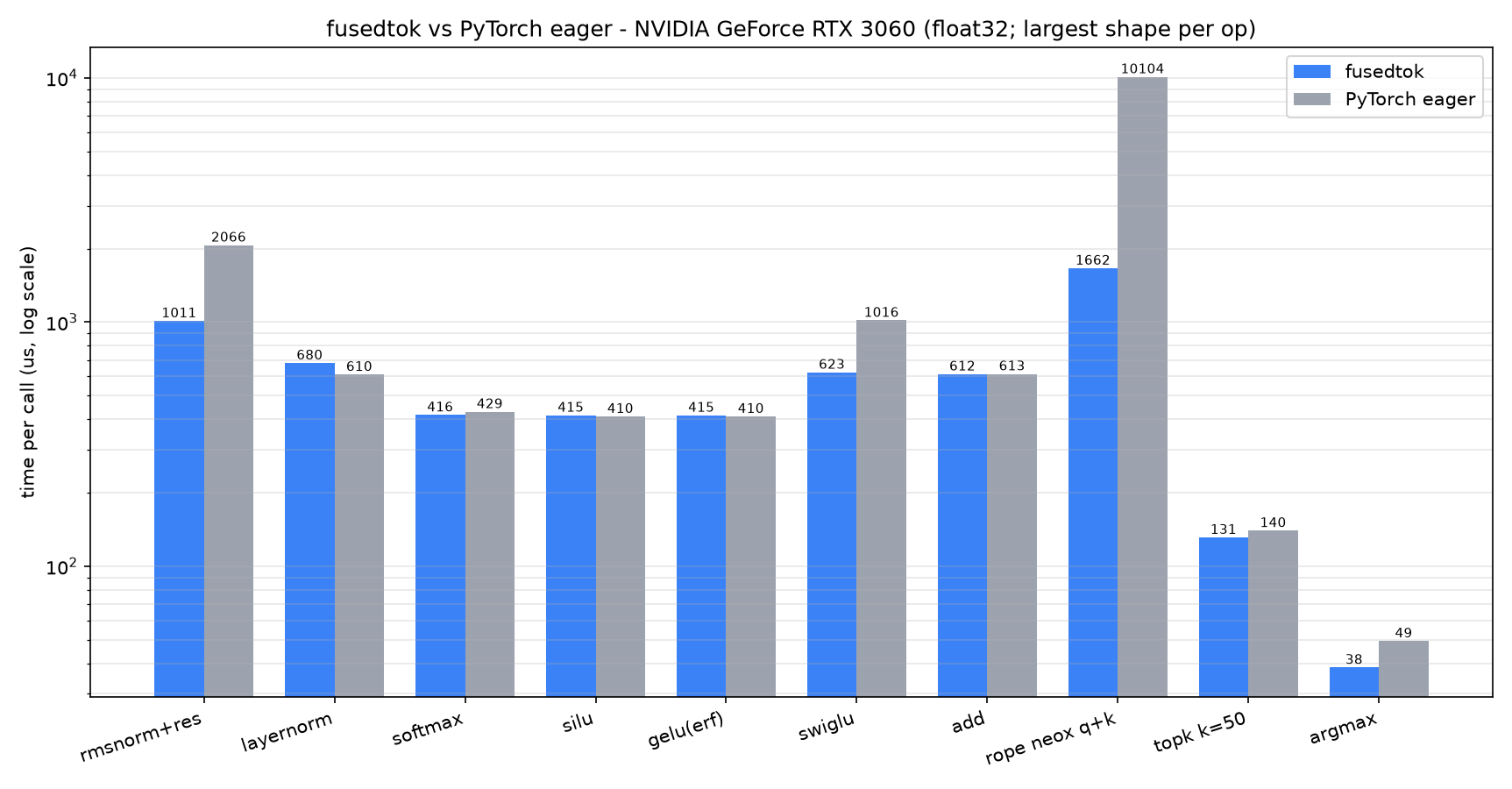
RTX 3060 (sm_86), float32, zero-copy torch tensors, CUDA-event timing, vs the
equivalent PyTorch eager expressions (full data: docs/benchmark_rt3060.json,
reproduce with python benchmarks/bench.py):
| Op | Shape | fusedtok | PyTorch eager | Speedup |
|---|---|---|---|---|
| RoPE NeoX (q+k) | [2048×4096] | 418 µs | 2571 µs | 6.2x |
| RMSNorm (+residual) | [1024×4096] | 156 µs | 538 µs | 3.4x |
| LayerNorm | [1024×4096] | 115 µs | 161 µs | 1.4x |
| SwiGLU | [1024×4096] | 158 µs | 263 µs | 1.7x |
| top-k (k=50) | [131072] | 74 µs | 131 µs | 1.8x |
| decode_step (penalty+sample) | [131072] | 309 µs | 354 µs (3 calls) | 1.15x |
| Softmax | [1024×4096] | 103 µs | 118 µs | 1.1x |
| SiLU | [1024×4096] | 104 µs | 108 µs | ~1.0x |
| argmax | [131072] | 67 µs | 40 µs | 0.6x (incl. host readback) |
| INT8 decode GEMV | [1×4096] @ [131072×4096] | 1595 µs | 3186 µs (fp16) | 2.0x |
Row-wise kernels (norms, softmax) autotune their thread-block size per shape at first call (v0.4.1); the table reflects the tuned choices.
RTX 5060 Ti (Blackwell, sm_120) — same suite, torch 2.11/cu128, highlights:
| Op | Shape | fusedtok | PyTorch eager | Speedup |
|---|---|---|---|---|
| RoPE NeoX (q+k) | [512×4096] | 29 µs | 239 µs | 8.3x |
| RMSNorm (+residual) | [4096×4096] | 512 µs | 1662 µs | 3.3x |
| Softmax | [1024×4096] | 20 µs | 51 µs | 2.6x |
| top-k (k=50) | [131072] | 27 µs | 41 µs (CUB) | 1.5x |
| SwiGLU | [4096×4096] | 504 µs | 859 µs | 1.7x |
| argmax | [32000] | 15 µs | 22 µs | 1.5x |
| LayerNorm | [1024×4096] | 27 µs | 28 µs | ~1.0x |
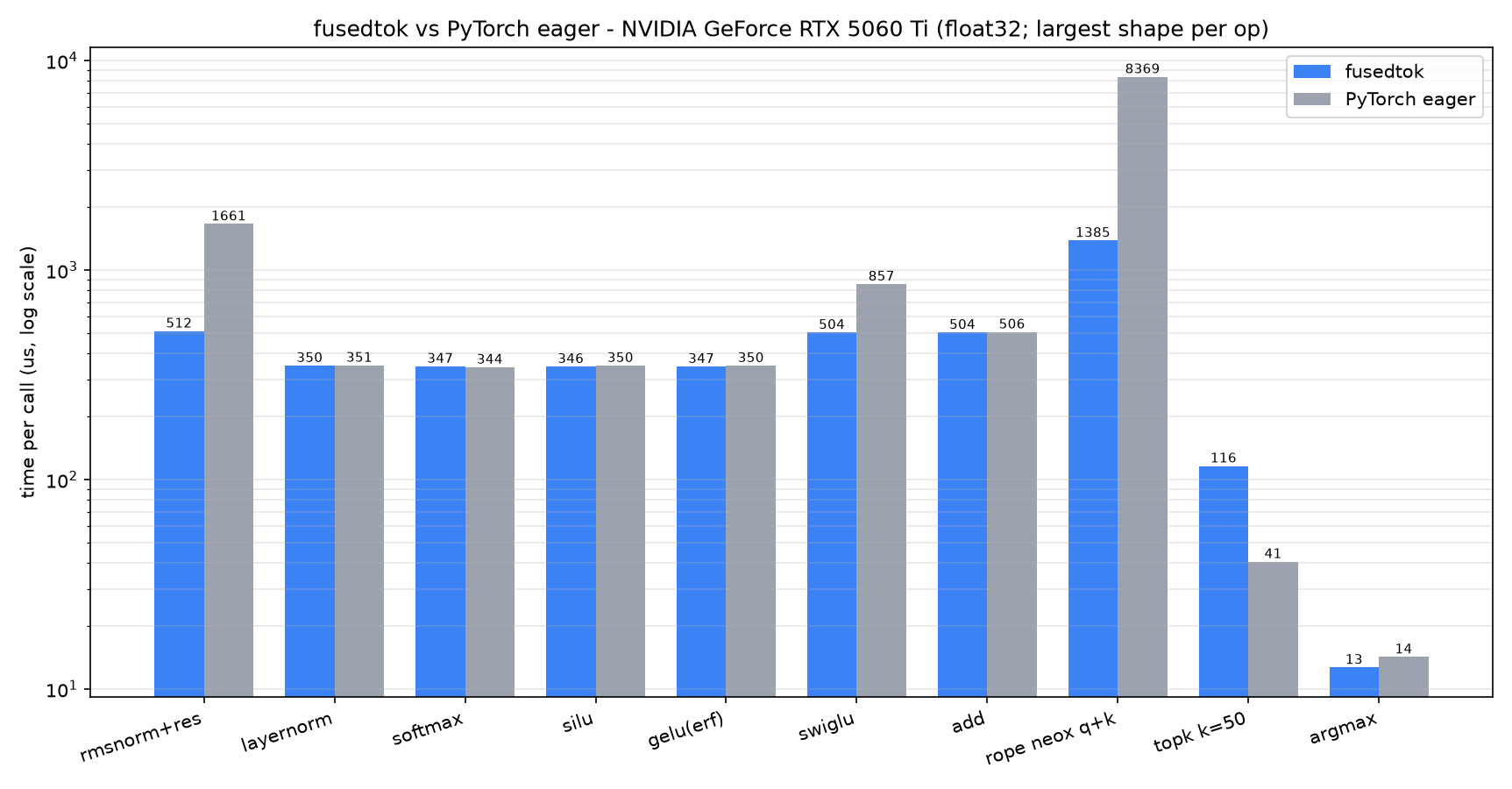
The PyPI wheel ships sm_80/sm_86 cubins plus a compute_86 PTX fallback — verified to JIT and run correctly on Blackwell (sm_120) drivers.
Fusions win big (RoPE / RMSNorm / SwiGLU) because eager mode round-trips
intermediate tensors through global memory. The v0.4 selection pipeline
(arrival-ticket radix rounds + early-exit compaction, replayed from a
cached CUDA graph) beats torch's CUB radix select at small k on both
GPUs; mid-range k (2048..n) stays at or below parity — honest numbers,
a pipelined tensor-core sort stays future work. The INT8 decode GEMV
moves half the bytes of an fp16 projection and runs at full memory
bandwidth (2x); the IMMA GEMM path (~17 TOPS) is correctness-first —
cuBLASLt (torch._int_mm) remains faster for large prefill matmuls.
Development
See CONTRIBUTING.md for the full guide (test rules, error contract, determinism invariants). Quick start:
# Windows: run inside a VS developer prompt (vcvars64)
cmake -S . -B build -G Ninja -DCMAKE_BUILD_TYPE=Release
cmake --build build
# from repo root: PYTHONPATH picks up the built module, conftest.py adds python/
$env:PYTHONPATH = "$PWD/build"        # Windows
PYTHONPATH=$PWD/build                 # Linux
python -m pytest tests -q
python benchmarks/bench.py            # GPU benchmark + chart
Windows / Linux. Windows uses MSVC via nvcc; CI builds and runs the CPU test suite on every push.
Roadmap
- v0.2 (done): bf16 zero-copy, radix-select top-k/top-p, fused nucleus sampling, single-read softmax, CUDA-graph verified
- v0.3 (done): chunk-merge selection sort + parallel nucleus count, bf16x4/x8 vectorized elementwise, INT8 quantize/dequantize utilities
- v0.4 (done): arrival-ticket selection pipeline (no cooperative launch, early-exit compaction, cached CUDA graphs), stream-aware launchers everywhere (real CUDA-graph capture), INT8 compute path (IMMA qgemm + decode GEMV), fused decode_step sampling
- v0.4.1 (done): runtime block-size autotuning for the row-wise kernels (norms/softmax pick 128..1024 threads per shape at first call)
- v0.4+: lightweight fused attention; prebuilt wheels on PyPI; pipelined tensor-core INT8 GEMM
Community
- Contributing guide — setup, rules of the road, PR process
- Code of conduct
- Security policy
- Changelog
License
MIT — see LICENSE. Third-party notices: NOTICES.md.
1 maintainer

Download files
Download the file for your platform. If you're not sure which to choose, learn more about installing packages.
Source Distribution
Built Distribution
Filter files by name, interpreter, ABI, and platform.
If you're not sure about the file name format, learn more about wheel file names.
Copy a direct link to the current filters
File details
Details for the file fusedtok-0.4.1.tar.gz.
File metadata
- Download URL: fusedtok-0.4.1.tar.gz
- Upload date:
- Size: 299.8 kB
- Tags: Source
- Uploaded using Trusted Publishing? Yes
- Uploaded via:
twine/7.0.0 CPython/3.13.14
File hashes
| Algorithm | Hash digest | |
|---|---|---|
| SHA256 |
c3f63c0c82741fcae189c6da14bc011b76aec4234f26e25afa0783d1c00ff5cb
|
|
| MD5 |
479c1654aeed18c2e55ff7fb8c365f52
|
|
| BLAKE2b-256 |
b5fd30842a9c284e485fbba3dff7b1adc50c5bf3977db2c89226b24e18aad8b5
|
Provenance
The following attestation bundles were made for fusedtok-0.4.1.tar.gz:
Publisher:
publish.yml on Hai-Wenxiang/fusedtok
-
Statement:
-
Statement type:
https://in-toto.io/Statement/v1 -
Predicate type:
https://docs.pypi.org/attestations/publish/v1 -
Subject name:
fusedtok-0.4.1.tar.gz -
Subject digest:
c3f63c0c82741fcae189c6da14bc011b76aec4234f26e25afa0783d1c00ff5cb - Sigstore transparency entry: 2628327217
- Sigstore integration time:
-
Permalink:
Hai-Wenxiang/fusedtok@e92f86f0e8b763d0046aaa9b59dd5897cb8dd0ac -
Branch / Tag:
refs/tags/v0.4.1 - Owner: https://github.com/Hai-Wenxiang
-
Access:
public
-
Token Issuer:
https://token.actions.githubusercontent.com -
Runner Environment:
github-hosted -
Publication workflow:
publish.yml@e92f86f0e8b763d0046aaa9b59dd5897cb8dd0ac -
Trigger Event:
release
-
Statement type:
File details
Details for the file fusedtok-0.4.1-cp310-cp310-manylinux_2_34_x86_64.whl.
File metadata
- Download URL: fusedtok-0.4.1-cp310-cp310-manylinux_2_34_x86_64.whl
- Upload date:
- Size: 776.0 kB
- Tags: CPython 3.10, manylinux: glibc 2.34+ x86-64
- Uploaded using Trusted Publishing? Yes
- Uploaded via:
twine/7.0.0 CPython/3.13.14
File hashes
| Algorithm | Hash digest | |
|---|---|---|
| SHA256 |
a8ffb8f5fc2c62f8efbf72bab49d223d3e89a42a5672e02d2a7b1c3b8e9df072
|
|
| MD5 |
91a5ce08290d5669d73262a4aa41b339
|
|
| BLAKE2b-256 |
9c20a969c203c4b9cfe8d7edcd8650a713b8ec1ff0dedddac69157b1a16245f9
|
Provenance
The following attestation bundles were made for fusedtok-0.4.1-cp310-cp310-manylinux_2_34_x86_64.whl:
Publisher:
publish.yml on Hai-Wenxiang/fusedtok
-
Statement:
-
Statement type:
https://in-toto.io/Statement/v1 -
Predicate type:
https://docs.pypi.org/attestations/publish/v1 -
Subject name:
fusedtok-0.4.1-cp310-cp310-manylinux_2_34_x86_64.whl -
Subject digest:
a8ffb8f5fc2c62f8efbf72bab49d223d3e89a42a5672e02d2a7b1c3b8e9df072 - Sigstore transparency entry: 2628327229
- Sigstore integration time:
-
Permalink:
Hai-Wenxiang/fusedtok@e92f86f0e8b763d0046aaa9b59dd5897cb8dd0ac -
Branch / Tag:
refs/tags/v0.4.1 - Owner: https://github.com/Hai-Wenxiang
-
Access:
public
-
Token Issuer:
https://token.actions.githubusercontent.com -
Runner Environment:
github-hosted -
Publication workflow:
publish.yml@e92f86f0e8b763d0046aaa9b59dd5897cb8dd0ac -
Trigger Event:
release
-
Statement type:














