
FuseMap
Integrate spatial transcriptomics with universal gene, cell, and tissue embeddings.
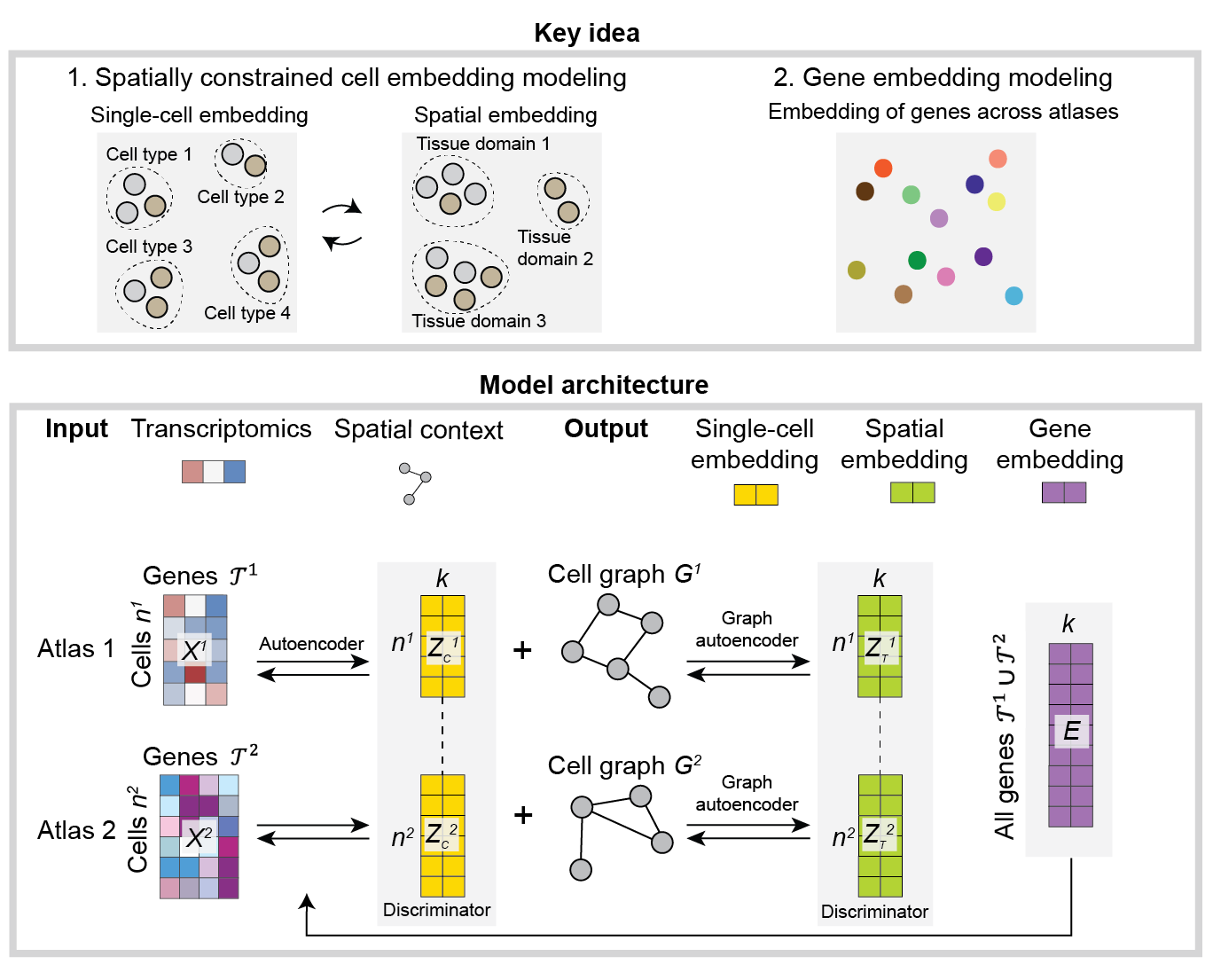
Current manuscript: An agentic AI spatial molecular foundation model of the brain. See release notes for the distinction between the manuscript workflows and the current software, including anchor alignment and Agent v2.
Manuscript code and data
Reproducibity
For manuscript analysis code, see paper_code. The current manuscript describes a frozen code and analysis archive at Zenodo. Use that archive and its run configurations for paper reproduction.
Exploratory analysis
We provide an interactive online database of the molCCF.
System Requirements
Hardware requirements
FuseMap package requires a standard computer with optional GPU to support the in-memory operations.
Software requirements
OS Requirements
This package is supported for Linux. The package has been tested on the following system:
- Linux: Ubuntu 20.04
Python Dependencies
FuseMap mainly depends on the Python scientific stack.
dgl
numpy
scipy
scikit-learn
pandas
pytorch
scanpy
seaborn
Installation and Tutorial
Use Python 3.9–3.11 (3.10 recommended). Install this checkout with:
python -m pip install .
For notebook dependencies, use python -m pip install ".[tutorials]".
The PyPI package is installed with python -m pip install fusemap; see the
release notes for this checkout's version.
import fusemap
fusemap.integrate("./data", "./output")
The classic Agent uses python -m pip install ".[agent]" from this repository.
Agent v2 uses a separate environment and a registered scientific kernel; follow
the Agent setup instructions.
Citation
The current manuscript is titled An agentic AI spatial molecular foundation model of the brain. The earlier public preprint can be cited as:
Yichun He, Hao Sheng, Hailing Shi, Wendy Xueyi Wang, Zefang Tang, Jia Liu, Xiao Wang. Towards a universal spatial molecular atlas of the mouse brain. Preprint at bioRxiv https://www.biorxiv.org/content/10.1101/2024.05.27.594872v1 (2024).
1 maintainer

Metadata
1 maintainer
Release files for fusemap 1.1.3
For a detailed explanation of source distributions (sdists) and built distributions (wheels), please see the package formats documentation.
Source distribution (sdist)
| File | Size | Uploaded | Provenance | |
|---|---|---|---|---|
| fusemap-1.1.3.tar.gz | 84.8 kB | Without provenance | Details |
Built distribution (wheel)
| File | Interpreter | ABI | Platform | Reset |
|---|---|---|---|---|
| fusemap-1.1.3-py3-none-any.whl | Python 3 | none | any | Details |
Total release size: 174.1 kB
Release files / fusemap-1.1.3.tar.gz
| Download URL | fusemap-1.1.3.tar.gz |
|---|---|
| Size | 84.8 kB |
| Tags | Source |
|
SHA-256 checksum How to use checksums |
da34a195c6e3a887d5ab7eda65fafd55f422f647346cdb44a3b315c5a50b13ce
|
|
BLAKE2b-256 checksum How to use checksums |
80aafcfbab5f8d0f87eff10e0f55c4230975eebfdcf79ed76ae7d391744350c8
|
| Upload date | |
|
Uploaded using Trusted Publishing? What is trusted publishing? |
No |
| Uploaded via |
twine/6.1.0 CPython/3.10.18
|
Release files / fusemap-1.1.3-py3-none-any.whl
| Download URL | fusemap-1.1.3-py3-none-any.whl |
|---|---|
| Size | 89.2 kB |
| Tags | Python 3 |
|
SHA-256 checksum How to use checksums |
8b0fc7cde9f1499949d88efb3a72c77862f265146ee226b2091f272ad6b3200c
|
|
BLAKE2b-256 checksum How to use checksums |
d0f293f78f368e646244a62b790f8a62ed2fc54ab2777e467eaca401c1e796ef
|
| Upload date | |
|
Uploaded using Trusted Publishing? What is trusted publishing? |
No |
| Uploaded via |
twine/6.1.0 CPython/3.10.18
|
Security for fusemap 1.1.3
Provenance
Provenance describes where a file came from. On PyPI, provenance is shared via attestations, which provide a verifiable record of the build or publishing details. View details, limitations and caveats.
No provenance found
None of the files in this release were uploaded with provenance metadata.
A note on package security
PyPI is a repository for distributing packages, not a service for auditing them. While third-party security researchers and our staff do their best to detect and remove malicious packages, PyPI cannot guarantee the quality, security or suitability of any given package.
To learn more about protecting yourself from malicious actors, visit our package security documentation.














