
fux
Your team's docs, as a search index your AI agent can trust.
Ranked. Cited. Checked against the source. Committed to git.
No server · no vector database · no API key · no model · zero dependencies





fux is pronounced "fox".
Your agent can read every line of your code. It still doesn't know why the code is the way it is — that lives in ADRs, runbooks, specs, wiki pages and the PDF someone attached to a ticket in 2023.
So it greps, guesses, or asks a vector database for "the nearest chunk" — and gets an answer that sounds right, from a doc that went stale six months ago.
fux fixes that with boring, auditable arithmetic:
$ fux answer "how do I roll back a release"
To roll back a bad release, run `make rollback` from the release branch.
The previous image tag is kept for 7 days.

  -- docs/deploy.md:L1-L6 (sha 18ac8c4e4d33, current)

$ fux ask --band "kubernetes autoscaling limits"
No confident matches.
confidence: none - nothing in the index scored for this query.
The first answer quotes exact lines and proves they still say that today. The second one refuses — because your docs don't cover it, and a confident wrong answer is worse than none.
Why people use fux
grep / rg |
Vector-DB RAG | fux | |
|---|---|---|---|
| Ranks by relevance | ❌ | ✅ | ✅ BM25F, field-weighted |
| Runs with nothing hosted | ✅ | ❌ server, embeddings, key | ✅ |
| Same query → same result, every machine | ✅ | ⚠️ depends on model + chunker | ✅ byte-identical |
| Cites exact line ranges | lines, unranked | chunks | ✅ plus a current / stale verdict |
| Says "I don't know" | — | returns the nearest neighbour | ✅ confidence band |
| Index reviewable in a PR | — | ❌ opaque vectors | ✅ plain JSONL, diffs like code |
| Reads PDF, Word, Excel, slides, wikis | ❌ | depends | ✅ editable decoders |
- 🗂 Clone and ask. The index lives in
.fux/index/. Every clone — yours, a teammate's, CI's, your agent's — searches the same thing. Nothing to deploy. - 🔍 Answers you can audit.
answerre-reads the cited lines from the source and tells you whether they still match.--receipt+fux verifylets anyone reproduce it later. - 🤖 Built for agents first.
fux setupdrops ready-made skills and instructions for Claude Code, Codex, GitHub Copilot and Kiro, andfux mcpserves the index over MCP. - 🔒 Offline unless you ask. No telemetry, no network on any default path, PII redaction before anything is committed.
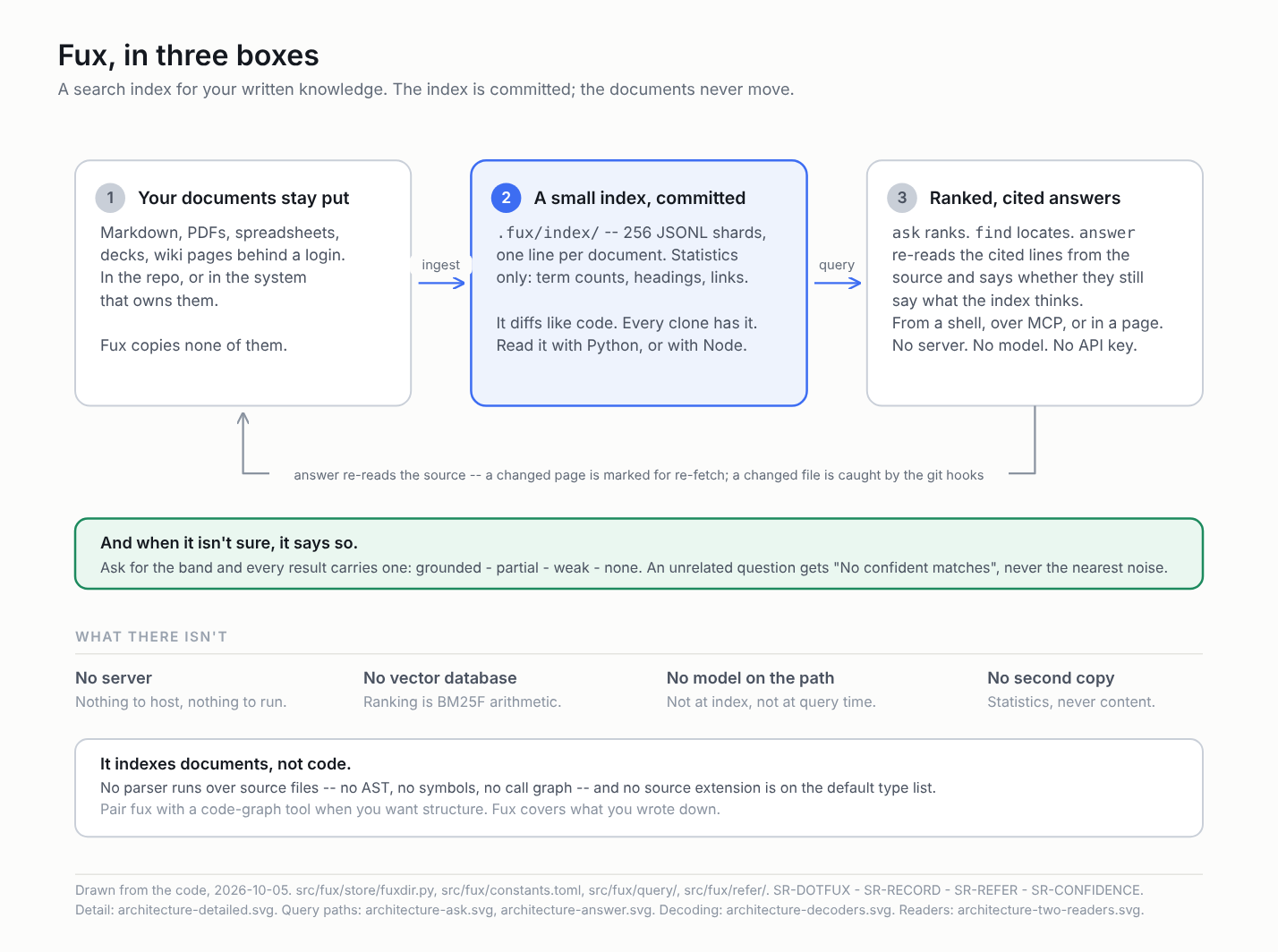
- 🧾 Your docs never move. fux stores statistics, not content. Sources stay in the repo or in the system that owns them.
60-second quickstart
pip install --pre fux-engine     # Python ≥ 3.12 · Linux, macOS, Windows · zero deps
cd your-repo
fux setup                        # writes .fux/ and agent instructions (only missing files)
fux ingest                       # indexes README.md and docs/ by default
fux ask "how do we roll back a release"
git add .fux fux.toml && git commit -m "Add fux index"
That's it. Your teammates — and their agents — now get the same answers from a
plain git clone.
No Python on the machine?
fux setupvendors a single-file, zero-dependency Node reader into.fux/node/, so.fux/fux find rollbackworks with nothing installed. Or:npx fux-engine find rollback.
Prefer a library?
from fux import open as fux_open
fux_open(".").ask("how do we roll back a release")
Plug it into your coding agent
fux setup        # skills + instructions for Claude Code, Codex, Copilot, Kiro, plus AGENTS.md
fux mcp          # MCP over stdio: fux_search, fux_passage, fux_related
The instructions teach the agent to search the index before grepping, read
the JSON (not the prose), and treat an archived document as history rather than
as the current design. There's deliberately no answer tool over MCP — the
agent is the answerer; fux is the evidence.
(SR-AGENT-POLICY · SR-MCP)
What it can read
- Text: Markdown, reStructuredText, AsciiDoc, Org, plain text
- Office & data: PDF, Word, PowerPoint, Excel, CSV/TSV, JSON, YAML, TOML, INI, XML
- Everything else: HTML, email, draw.io, SVG, images (via your agent,
fux enrich) - Web pages and wikis:
fux add <url>— plain HTTP, or through the session your signed-in Chrome already holds, so internal wikis work too
Every decoder and fetcher is copied into .fux/ as your code — read it,
edit it, replace it (SR-DECODE, SR-FETCHER).
Everyday commands
| I want to… | Run |
|---|---|
| Rank documents for a question | fux ask "…" |
| One answer, quoted from the source | fux answer "…" |
| Just file paths, for piping | fux find "…" |
| Know why something ranked, or how sure fux is | fux ask --why "…" · fux ask --band "…" |
| Machine-readable output | add --json |
| Index another folder, file or URL | fux add <path-or-url> |
| Re-index after changes | fux ingest (or fux hooks to do it on every commit) |
| Fix a wrong answer, durably | fux correct "<question>" <doc-that-answers-it> |
| Follow links between docs | fux explain <doc> · fux graph "…" · fux path <a> <b> |
| Find duplicate, unreachable or boilerplate docs | fux inspect |
Keep IDs whole (RF 118 = RF-118) |
fux identifiers |
| List what is in the index, one line per document | fux register (--json for scripts) |
| See it all in a browser | fux serve — Ask, Answer, Documents, Words, Index, Identifiers |
| Check the setup | fux doctor (read-only, offline) |
Full surface: fux --help and SR-CLI.
Measured, not assumed
Every claim ships with a pre-registered bar and a published run — including the ones that failed.
- ⚡ 27.2 ms worst-case p95 for warm
ask --fastover 8,870 RFCs, against a 150 ms bar (run). The fast path must return byte-identical results to the full scan. - 🕸 24/24 on a graded 66-document graph corpus, with the derived graph hashing identically on x86-64 Linux and arm64 macOS (run).
- 🪦 Failures kept on file. Index pruning failed its gate (verdict). A dense embedding lane fixed 0 queries and broke 2 — so it was deleted.
What fux is not
Honesty up front, so you don't find out the hard way:
- Not code search. No AST, no symbols, no call graph. Pair it with a code-graph tool; fux covers what you wrote down.
- Not semantic magic. Ranking is lexical. If your docs say "revert" and you
ask "undo", use
--expand, or teach it once withfux correct. - Not a chatbot. fux finds and verifies evidence. Your agent (or you) writes the answer.
Status
3.0.0 is in alpha (pip install --pre fux-engine); 2.0.x is the latest
stable line. The index format is versioned and fux tells you when to run
fux ingest --full. Every change is in CHANGELOG.md.
⭐ Star the repo if fux saved your agent from one confident wrong answer — it's how other people find it. 👀 Watch → Custom → Releases to hear when 3.0 goes stable.
Under the hood
Architecture diagrams
- The whole idea in one picture
- How
askworks · howanswerworks · decoders - Python and Node, component for component
- Every plane, what is committed and what isn't
- The paper — the architecture of record, with twenty diagrams
The fourteen laws fux is built under
Every decision of record lives in the SR register
(SR-LAWS):
L0 SRs are the source of truth ·
L1 a retired SR is archived ·
L2 $0, FOSS-only ·
L3 content never durable ·
L4 deterministic ·
L5 offline by default ·
L6 say "index" ·
L7 Python ≥ 3.12 ·
L8 Node ≥ 22 ·
L9 use record never committed ·
L10 build output, never source ·
L11 the sealed answer key is closed to Claude ·
L12 every value lives in a config file ·
L13 a ranking change ships only through the standing bar.
The laws were renumbered on 2026-09-28; an older document is read through
SR-LAWS decision 2a.
Security and sensitive text
.fux/pii.tomlredacts matches before anything reaches the committed index; fux will not run without it (SR-PII)..fux/refusals.tomlstops a sign-in wall being indexed as the page behind it (SR-REFUSAL).- Only explicit, opt-in commands touch the network, and they say so on stderr (L5).
Reading order for contributors
docs/index.md— the map of every doc in the repo- The SR register — every decision of record
- The paper — what ships, what was measured, what was designed and not built
- Sibling environments — the sandbox, measurement lab and benchmark harness
CLAUDE.md— how work is done here, for people and agents
Contributing
pip install -e ".[dev]" && pytest
Issues and PRs welcome — bug reports with a failing query are gold. Every change
to an SR-owned component updates its owning record in the same commit; CI checks
it. Start with CLAUDE.md.
License
1 maintainer

Metadata
1 maintainer
Release files for fux-engine 3.0.1
For a detailed explanation of source distributions (sdists) and built distributions (wheels), please see the package formats documentation.
Source distribution (sdist)
| File | Size | Uploaded | |
|---|---|---|---|
| fux_engine-3.0.1.tar.gz | 83.8 MB | Details |
Built distribution (wheel)
| File | Interpreter | ABI | Platform | Reset |
|---|---|---|---|---|
| fux_engine-3.0.1-py3-none-any.whl | Python 3 | none | any | Details |
Total release size: 85.1 MB
Release files / fux_engine-3.0.1.tar.gz
| Download URL | fux_engine-3.0.1.tar.gz |
|---|---|
| Size | 83.8 MB |
| Tags | Source |
|
SHA-256 checksum How to use checksums |
e61efc2baffcb17c98fa0f885dcc1764e8919b15456af1c11fd3485312f45b48
|
|
BLAKE2b-256 checksum How to use checksums |
de59369a333c710fa824321a53bad954a9e4152a99579adc51664677ece19857
|
| Upload date | |
|
Uploaded using Trusted Publishing? What is trusted publishing? |
Yes |
| Uploaded via |
twine/7.0.0 CPython/3.13.14
|
Provenance
Provenance describes where a file came from. On PyPI, provenance is shared via attestations, which provide a verifiable record of the build or publishing details. View details, limitations and caveats.


PyPI Publish Attestation
PyPI verified that this artifact, at this checksum, originated from the publisher listed below.
Signed by GitHub Actions, verified by PyPI on Oct 13, 2026.
Transparency logRelease files / fux_engine-3.0.1-py3-none-any.whl
| Download URL | fux_engine-3.0.1-py3-none-any.whl |
|---|---|
| Size | 1.3 MB |
| Tags | Python 3 |
|
SHA-256 checksum How to use checksums |
ccdb3c71ee60322a7ff403385860682ee49715c3042116a2e12bf23bb6c01f2f
|
|
BLAKE2b-256 checksum How to use checksums |
0f4fcfb172a928249cb2adad770dfbe4e62cb24fa98ffb91855eb2062a0092ac
|
| Upload date | |
|
Uploaded using Trusted Publishing? What is trusted publishing? |
Yes |
| Uploaded via |
twine/7.0.0 CPython/3.13.14
|
Provenance
Provenance describes where a file came from. On PyPI, provenance is shared via attestations, which provide a verifiable record of the build or publishing details. View details, limitations and caveats.
PyPI Publish Attestation
PyPI verified that this artifact, at this checksum, originated from the publisher listed below.
Signed by GitHub Actions, verified by PyPI on Oct 13, 2026.
Transparency log
















