
fuzzy-graph-coloring
fuzzy-graph-coloring is a Python package for calculating
the fuzzy chromatic number and coloring of a graph with fuzzy edges.
It will create a coloring with a minimal amount of incompatible edges
using a genetic algorithm (genetic_fuzzy_color) or a greedy-k-coloring (greedy_k_color)
combined with a binary search (alpha_fuzzy_color).
If you don’t know which one to use, we recommend alpha_fuzzy_color.
If you are looking for a networkX coloring but with a given k, use greedy_k_color.
See repository https://github.com/ferdinand-dhbw/fuzzy-graph-coloring See the paper that accompanied the project https://github.com/ferdinand-dhbw/fuzzy-graph-coloring/blob/main/docs/KoenigRheinerFGCStudentResearchProject2022.pdf
Quick-Start
Install package: pip install fuzzy-graph-coloring
Consider the following graph:
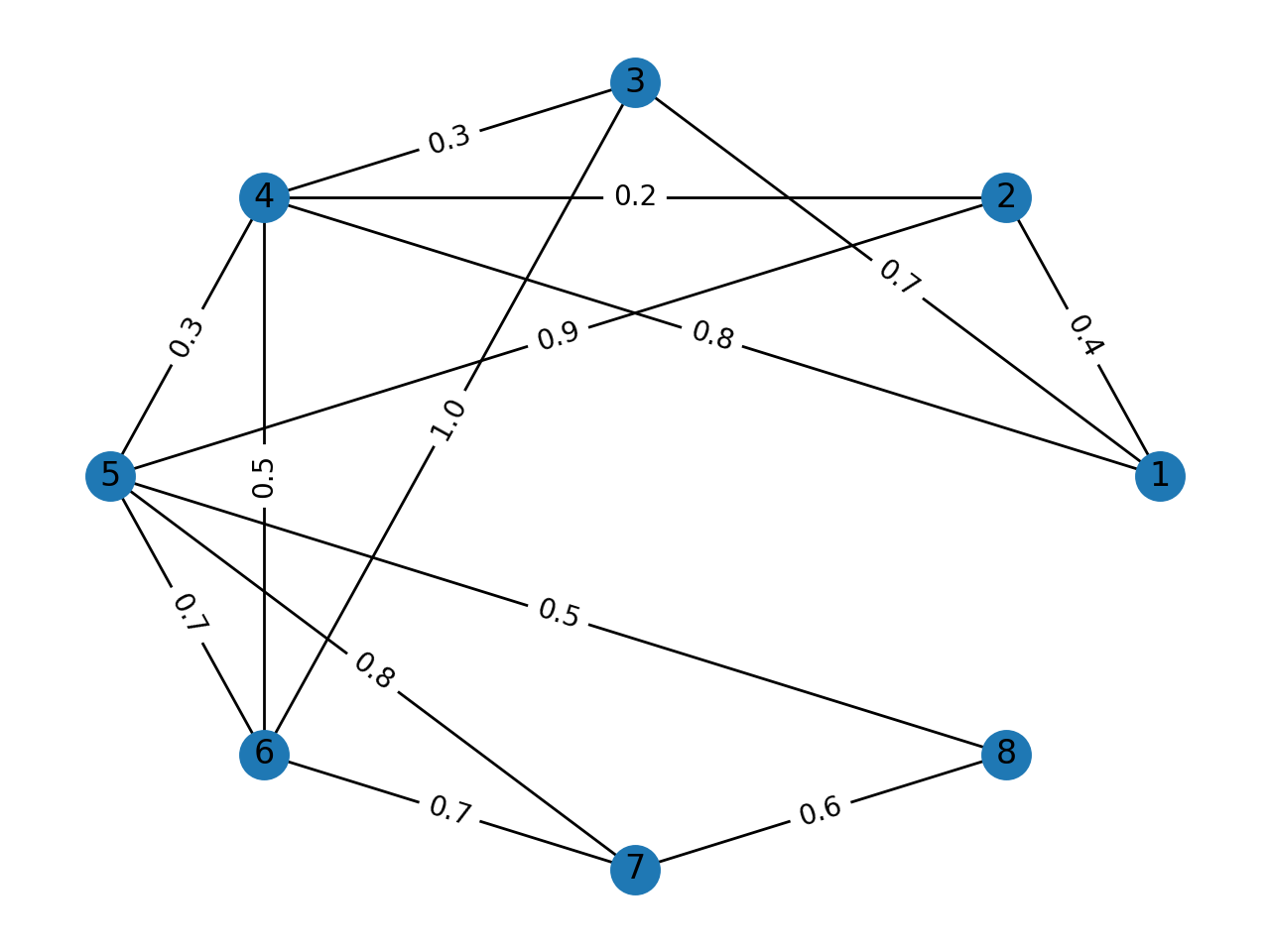
Try simple code:
import fuzzy-graph-coloring as fgc

TG2 = nx.Graph()
TG2.add_edge(1, 2, weight=0.4)
TG2.add_edge(1, 3, weight=0.7)
TG2.add_edge(1, 4, weight=0.8)
TG2.add_edge(2, 4, weight=0.2)
TG2.add_edge(2, 5, weight=0.9)
TG2.add_edge(3, 4, weight=0.3)
TG2.add_edge(3, 6, weight=1.0)
TG2.add_edge(4, 5, weight=0.3)
TG2.add_edge(4, 6, weight=0.5)
TG2.add_edge(5, 6, weight=0.7)
TG2.add_edge(5, 7, weight=0.8)
TG2.add_edge(5, 8, weight=0.5)
TG2.add_edge(6, 7, weight=0.7)
TG2.add_edge(7, 8, weight=0.6)

print(fgc.alpha_fuzzy_color(TG2, 3, return_alpha=True, fair=True))
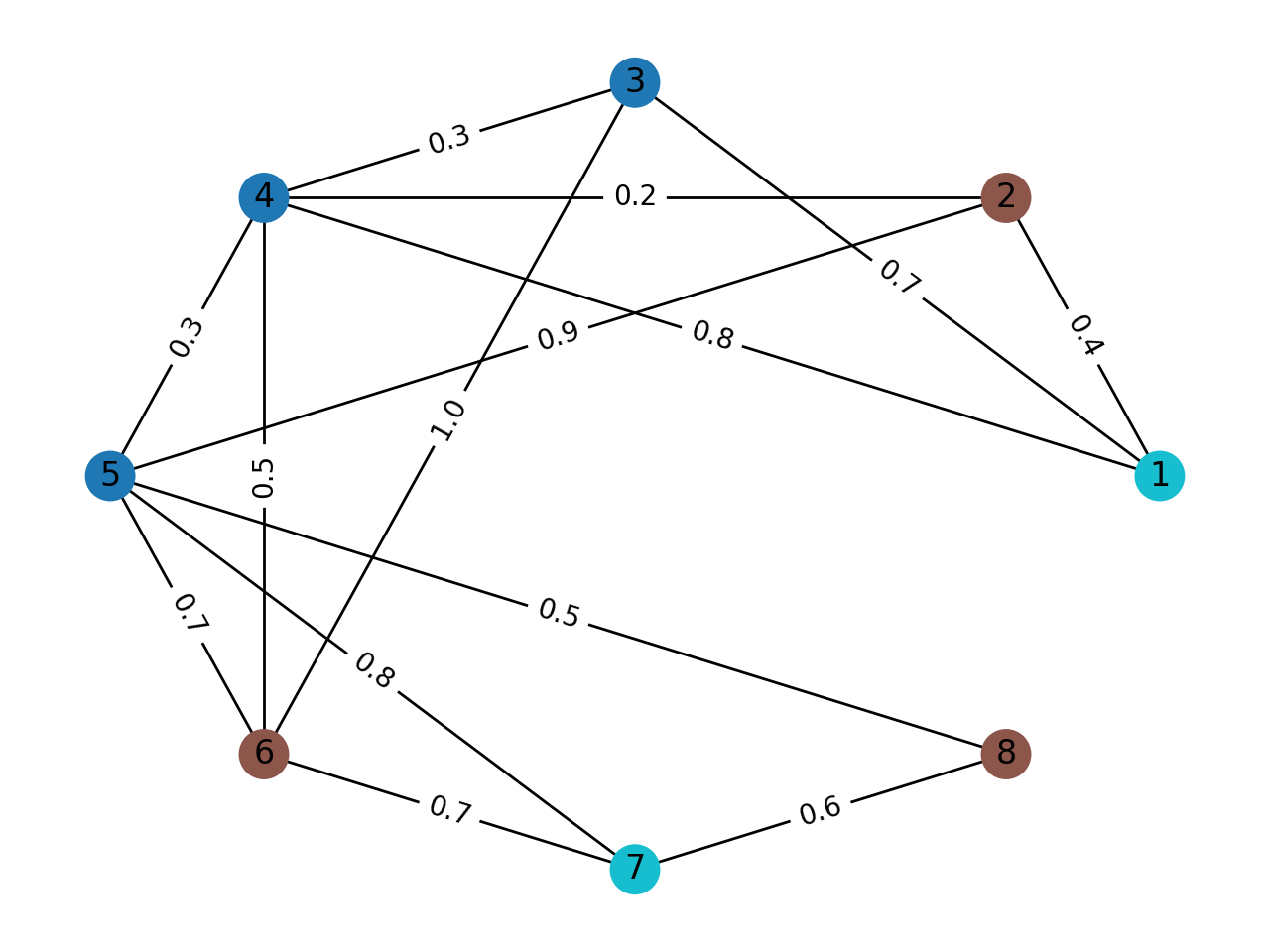
Result: {5: 0, 6: 1, 1: 2, 7: 2, 2: 1, 3: 0, 4: 0, 8: 1} 0.9285714285714286 0.4
(Tuple of coloring, score [(1-DTI)], and alpha [of alpha-cut])
Bibliography
The project uses a lot of the by Keshavarz created basics: E. Keshavarz, “Vertex-coloring of fuzzy graphs: A new approach,” Journal of Intelligent & Fuzzy Systems, vol. 30, pp. 883-893, 2016, issn: 1875-8967. https://doi.org/10.3233/IFS-151810
License
This project is licensed under GNU General Public License v3.0 (GNU GPLv3). See LICENSE in the code repository.
Setup development environment
Get poetry https://python-poetry.org/docs/
Make sure, Python 3.8 is being used
poetry installin your system shellpoetry run pre-commit install
Run pre-commit
poetry run pre-commit run --all-files
Run pytest
poetry run pytest .\tests
Create documentation
.\docs\make html


Release files for fuzzy-graph-coloring 0.1.3
For a detailed explanation of source distributions (sdists) and built distributions (wheels), please see the package formats documentation.
Source distribution (sdist)
| File | Size | Uploaded | Provenance | |
|---|---|---|---|---|
| fuzzy-graph-coloring-0.1.3.tar.gz | 22.7 kB | Without provenance | Details |
Built distribution (wheel)
| File | Interpreter | ABI | Platform | Reset |
|---|---|---|---|---|
| fuzzy_graph_coloring-0.1.3-py3-none-any.whl | Python 3 | none | any | Details |
Total release size: 45.0 kB
Release files / fuzzy-graph-coloring-0.1.3.tar.gz
| Download URL | fuzzy-graph-coloring-0.1.3.tar.gz |
|---|---|
| Size | 22.7 kB |
| Tags | Source |
|
SHA-256 checksum How to use checksums |
66a004826035a57c9fd7e74a054f24296ad845da12e318631d9851bb4ea5ab02
|
|
BLAKE2b-256 checksum How to use checksums |
8c9ceb5fd2eed07004438be7ef237d727caa300e4e7491c6b9b724ff4c9252d2
|
| Upload date | |
|
Uploaded using Trusted Publishing? What is trusted publishing? |
No |
| Uploaded via |
poetry/1.1.12 CPython/3.8.8 Windows/10
|
Release files / fuzzy_graph_coloring-0.1.3-py3-none-any.whl
| Download URL | fuzzy_graph_coloring-0.1.3-py3-none-any.whl |
|---|---|
| Size | 22.3 kB |
| Tags | Python 3 |
|
SHA-256 checksum How to use checksums |
16dec94fa66282427204f2d131b4bbf5c6c0ee5d23d0dcd36dde41e9a26fa246
|
|
BLAKE2b-256 checksum How to use checksums |
e940e7ea8327ea9accd60ff5e7493ae14dc4c1b13eb90764e78ab66ced7d72de
|
| Upload date | |
|
Uploaded using Trusted Publishing? What is trusted publishing? |
No |
| Uploaded via |
poetry/1.1.12 CPython/3.8.8 Windows/10
|
Security for fuzzy-graph-coloring 0.1.3
Provenance
Provenance describes where a file came from. On PyPI, provenance is shared via attestations, which provide a verifiable record of the build or publishing details. View details, limitations and caveats.
No provenance found
None of the files in this release were uploaded with provenance metadata.
A note on package security
PyPI is a repository for distributing packages, not a service for auditing them. While third-party security researchers and our staff do their best to detect and remove malicious packages, PyPI cannot guarantee the quality, security or suitability of any given package.














