
Fuzzy path
pip3 install fuzzy-path
environments:
FZPATH_FILES: also list files (default list only directories)ROOT: the root directory to list
Install for shells
Install fzf by following its installation instruction.
Zsh
curl -sS https://raw.githubusercontent.com/weaming/fuzzy-path/master/plugins/setup-zsh.sh | ZSH_CUSTOM=$ZSH_CUSTOM bash
Usage
Press Ctrl+i for completion, it'll launch fzf automatically. It will only complete the last part of your input command.
Check fzf’s readme for more search syntax usage.
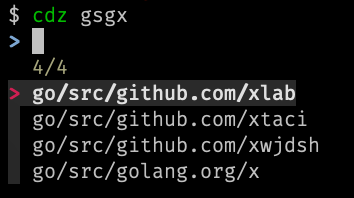
Support comamnds:
- cdz (the original purpose of the project)
- rmdir
- mkdir
- open
- rm
- mv
- cd
- vi
- ls
Fish
curl -sS https://raw.githubusercontent.com/weaming/fuzzy-path/master/plugins/setup-fish.fish | fish
1 maintainer

Metadata
1 maintainer
Release files for fuzzy-path 0.1
For a detailed explanation of source distributions (sdists) and built distributions (wheels), please see the package formats documentation.
Built distribution (wheel)
| File | Interpreter | ABI | Platform | Reset |
|---|---|---|---|---|
| fuzzy_path-0.1-py3-none-any.whl | Python 3 | none | any | Details |
Release files / fuzzy_path-0.1-py3-none-any.whl
| Download URL | fuzzy_path-0.1-py3-none-any.whl |
|---|---|
| Size | 2.8 kB |
| Tags | Python 3 |
|
SHA-256 checksum How to use checksums |
21c20f035500c880768d7512efe91ec674a7a02ab8453f2ab84a049a67f0f5cb
|
|
BLAKE2b-256 checksum How to use checksums |
1ad073b43d73bf95057132a711cdf8d40b608d711285ef5f99a4212f13e3fb9d
|
| Upload date | |
|
Uploaded using Trusted Publishing? What is trusted publishing? |
No |
| Uploaded via |
twine/1.13.0 pkginfo/1.5.0.1 requests/2.22.0 setuptools/39.0.1 requests-toolbelt/0.9.1 tqdm/4.34.0 CPython/3.6.7
|
Security for fuzzy-path 0.1
Provenance
Provenance describes where a file came from. On PyPI, provenance is shared via attestations, which provide a verifiable record of the build or publishing details. View details, limitations and caveats.
No provenance found
None of the files in this release were uploaded with provenance metadata.
A note on package security
PyPI is a repository for distributing packages, not a service for auditing them. While third-party security researchers and our staff do their best to detect and remove malicious packages, PyPI cannot guarantee the quality, security or suitability of any given package.













