
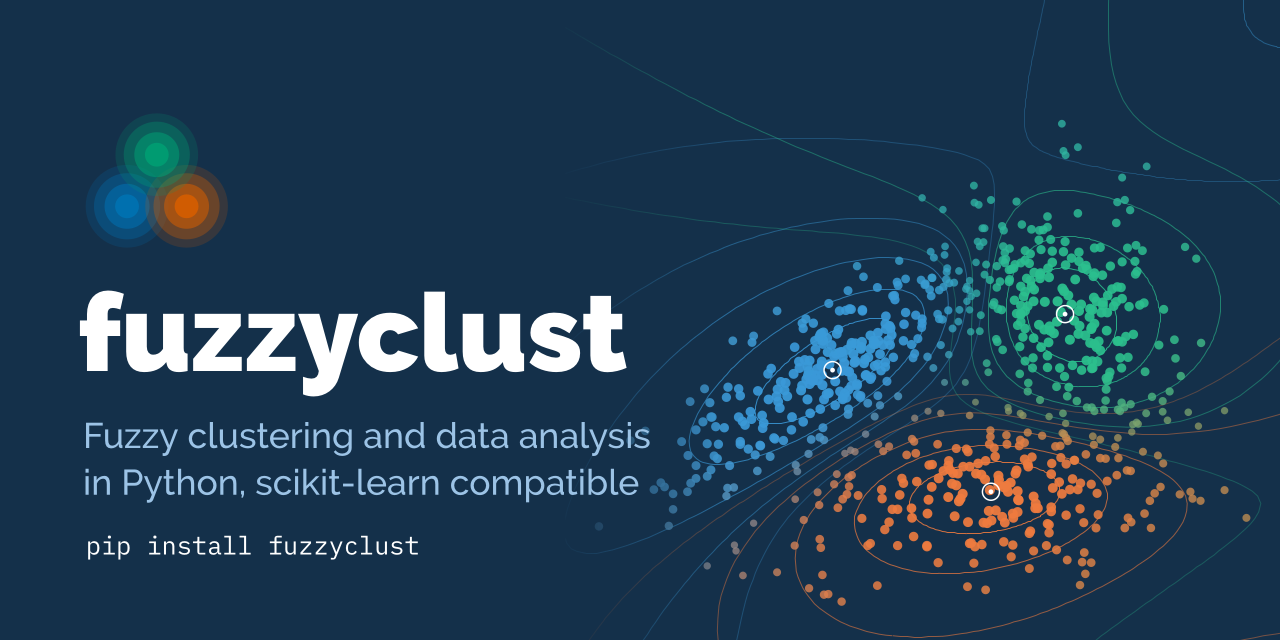
fuzzyclust: fuzzy clustering and data analysis in Python




fuzzyclust is a scikit-learn compatible toolbox for fuzzy clustering and the data-analysis methods built on it. It succeeds the Fuzzy Clustering and Data Analysis Toolbox for MATLAB (Balaskó, Abonyi, Feil) and collects the clustering-based methods of the Abonyi group (model identification, time-series segmentation, visualization of fuzzy clusters, graph-based clustering) together with the possibilistic, noise, kernel and shape-prototype variants of fuzzy c-means and methods for relational, incomplete, very large and image data.
| Sub-package | Contents |
|---|---|
fuzzyclust.cluster |
k-means, k-medoids, fuzzy c-means, Gustafson–Kessel, Gath–Geva; regularized and polynomial fuzzifiers, deterministic annealing; subtractive and mountain clustering; compatible cluster merging |
fuzzyclust.validity |
PC, CE, MPC, SC, S, XB, FS, Dunn, alternative Dunn, silhouette, FHV, PD, APD, PBMF, Kwon, PCAES; fuzzy Rand/ARI; scans and stability-based selection of the number of clusters |
fuzzyclust.extensions |
possibilistic c-means, PFCM, noise clustering, kernel FCM, fuzzy c-varieties, fuzzy c-shells, volume prototypes, SCAD and weighted FCM |
fuzzyclust.graph |
minimal-spanning-tree hybrid clustering, geodesic-distance fuzzy c-medoids, Isomap-FCM |
fuzzyclust.viz |
PCA, Sammon mapping, fuzzy Sammon mapping (FUZZSAM), projection quality, fuzzy self-organizing map |
fuzzyclust.models |
Takagi–Sugeno identification by modified Gath–Geva clustering (SISO/MIMO), fuzzy c-regression, supervised fuzzy classifiers, fuzzy partitions for decision trees, hinging-hyperplane regression trees |
fuzzyclust.timeseries |
fuzzy segmentation of multivariate series, model-order selection, state-space reconstruction and prediction of chaotic series, structure selection with mixed inputs |
fuzzyclust.relational |
relational FCM, NERF c-means, fuzzy c-medoids, fuzzy k-modes / k-prototypes; DTW, autocorrelation and Gower dissimilarities |
fuzzyclust.incomplete, large, image |
FCM with missing values; weighted, sampling, single-pass and online FCM for very large data and streams; spatial FCM variants for image segmentation |
fuzzyclust.semisupervised, coclustering, collaborative, ensemble |
partial supervision and pairwise constraints, fuzzy co-clustering, collaborative FCM across sites, fuzzy cluster ensembles |
fuzzyclust.datasets, preprocessing, plotting |
synthetic generators, scaling and regressor construction, plotting helpers |
Installation
pip install fuzzyclust
Python ≥ 3.10; depends on numpy, scipy, scikit-learn ≥ 1.6, pandas and matplotlib.
Quick start
from fuzzyclust.cluster import GK
from fuzzyclust.datasets import make_fuzzy_blobs
from fuzzyclust.validity import scan_n_clusters, suggest_n_clusters
from fuzzyclust.plotting import plot_clusters, plot_membership_contours

X, _ = make_fuzzy_blobs(n_clusters=3, random_state=0)

gk = GK(n_clusters=3, m=2.0, random_state=0).fit(X)
gk.membership_          # fuzzy partition U, shape (n_samples, n_clusters)
gk.cluster_centers_     # prototypes v_i
gk.covariances_         # fuzzy covariance matrices F_i
gk.predict_proba(X)     # memberships of (new) samples

table = scan_n_clusters(GK(random_state=0), X, range(2, 8))   # validity indices vs. c
print(suggest_n_clusters(table))

ax = plot_clusters(X, gk.labels_, gk.cluster_centers_)
plot_membership_contours(gk, X, ax=ax)
Every estimator follows the scikit-learn conventions (fit, predict,
predict_proba, transform, fitted attributes with a trailing underscore),
accepts NumPy arrays or pandas DataFrames and works inside a Pipeline.
Documentation, examples, book
- Documentation and example gallery: https://complexsystemsintelligence.github.io/fuzzyclust. One runnable example per algorithm; each generates its own data, explains the method and ends with a study of its parameters. Every example is also a Jupyter notebook (download button in the gallery).
- Book: Fuzzy Clustering and Data Analysis in Python: The fuzzyclust
toolbox, PDF
(384 pages, CC BY 4.0; LaTeX source in
book/, the PDF is also attached to every release). Theory in one notation, algorithm boxes, and the gallery examples as case studies. - Migration from the MATLAB toolbox: Appendix B of the book and
docs/migration.rst.
Development
git clone https://github.com/ComplexSystemsIntelligence/fuzzyclust.git && cd fuzzyclust
pip install -e ".[dev]"
pytest                                   # > 3700 tests
ruff check src tests examples book
sphinx-build -b html docs docs/_build/html
book/build.sh                            # cover, figures, appendices, PDF
DESIGN.md sets the conventions for the code, the docstrings, the examples
and the book (notation, API contract, layout, templates).
Citing
See CITATION.cff. Please also cite the original publications of the methods
you use; they are listed in every docstring and chapter.
About
fuzzyclust is developed by the HUN-REN–PE Complex Systems Monitoring Research Group (AbonyiLab) at the University of Pannonia, Veszprém, Hungary. The group's open textbooks and software are collected at complexsystemsintelligence.github.io. The work was supported by the National Research, Development and Innovation Office of Hungary (NKFIH) through the OTKA 143482 project.
License
Code: MIT. Book: CC BY 4.0. The MATLAB toolbox this project succeeds was written by Balázs Balaskó, János Abonyi and Balázs Feil at the University of Veszprém (today University of Pannonia).
1 maintainer

Metadata
1 maintainer
Release files for fuzzyclust 1.0
For a detailed explanation of source distributions (sdists) and built distributions (wheels), please see the package formats documentation.
Source distribution (sdist)
| File | Size | Uploaded | Provenance | Actions |
|---|---|---|---|---|
| fuzzyclust-1.0.tar.gz | 504.4 kB | With provenance | Details for fuzzyclust-1.0.tar.gz |
Built distribution (wheel)
| File | Interpreter | ABI | Platform | Actions Reset |
|---|---|---|---|---|
| fuzzyclust-1.0-py3-none-any.whl | Python 3 | none | any | Details for fuzzyclust-1.0-py3-none-any.whl |
Total release size: 863.2 kB
Release files / fuzzyclust-1.0.tar.gz
| Download URL | fuzzyclust-1.0.tar.gz |
|---|---|
| Size | 504.4 kB |
| Tags | Source |
|
SHA-256 checksum How to use checksums |
d6206384f39a881e92c5e5e84a3e327bd18ab23598f2655f217fed5a7a65b316
|
|
BLAKE2b-256 checksum How to use checksums |
4aaaf673bcdb0eadb4c91f9ddcc78b574280fb2fe8a2398cdff4f3e1dfdc2097
|
| Upload date | |
|
Uploaded using Trusted Publishing? What is trusted publishing? |
Yes |
| Uploaded via |
twine/7.0.0 CPython/3.13.16
|
Provenance
Provenance describes where a file came from. On PyPI, provenance is shared via attestations, which provide a verifiable record of the build or publishing details. View details, limitations and caveats.


PyPI Publish Attestation
PyPI verified that this artifact, at this checksum, originated from the publisher listed below.
Signed by GitHub Actions, verified by PyPI on Nov 25, 2026.
Transparency logRelease files / fuzzyclust-1.0-py3-none-any.whl
| Download URL | fuzzyclust-1.0-py3-none-any.whl |
|---|---|
| Size | 358.8 kB |
| Tags | Python 3 |
|
SHA-256 checksum How to use checksums |
4473cec864663e6736a52a6659fa175b4843d00e6327b078a706a670dfa649a8
|
|
BLAKE2b-256 checksum How to use checksums |
cb1b1eea99706f75235534635d4f61da6d7133322e2969f986ae6a499d92e805
|
| Upload date | |
|
Uploaded using Trusted Publishing? What is trusted publishing? |
Yes |
| Uploaded via |
twine/7.0.0 CPython/3.13.16
|
Provenance
Provenance describes where a file came from. On PyPI, provenance is shared via attestations, which provide a verifiable record of the build or publishing details. View details, limitations and caveats.
PyPI Publish Attestation
PyPI verified that this artifact, at this checksum, originated from the publisher listed below.
Signed by GitHub Actions, verified by PyPI on Nov 25, 2026.
Transparency logSecurity for fuzzyclust 1.0
Provenance
Provenance describes where a file came from. On PyPI, provenance is shared via attestations, which provide a verifiable record of the build or publishing details. View details, limitations and caveats.
Full provenance
Both files in this release have been uploaded with provenance metadata.
Attestation for fuzzyclust-1.0.tar.gz
PyPI Publish Attestation
PyPI verified that this artifact, at this checksum, originated from the publisher listed below.
Signed by GitHub Actions, verified by PyPI on Nov 25, 2026.
Transparency logA note on package security
PyPI is a repository for distributing packages, not a service for auditing them. While third-party security researchers and our staff do their best to detect and remove malicious packages, PyPI cannot guarantee the quality, security or suitability of any given package.
To learn more about protecting yourself from malicious actors, visit our package security documentation.













