

FuzzyRoutines
Turn measurements into interpretable linguistic grades with explicit fuzzy mathematics.
Classify measurements, combine fuzzy criteria, inspect sets and explain results. CPython 3.13–3.14 · no mandatory runtime dependencies · Apache-2.0
Documentation · Русский · 简体中文
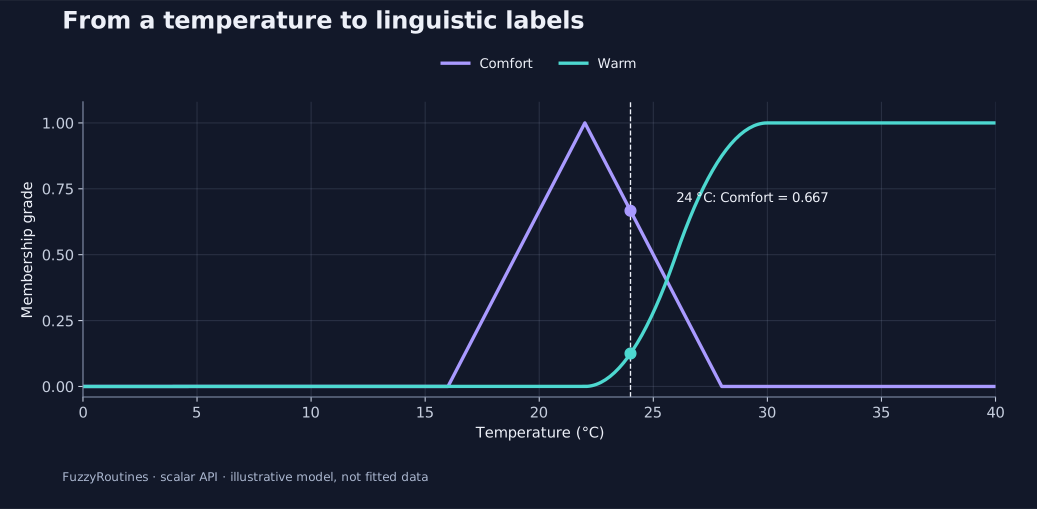
Try it: is 24 °C comfortable or warm?
This source describes FuzzyRoutines 2.1.0. Install that exact version:
python -m pip install fuzzyroutines==2.1.0
If 2.1.0 is not yet available on PyPI, install the reviewed CI wheel using the version-aware agent guide. The published 2.0.0 baseline remains available for reproducing earlier results.
from fuzzyroutines import (
    ContinuousUniverse, LinguisticScale, LinguisticTerm,
    ScalarFuzzySet, SShoulder, Triangle,
)

universe = ContinuousUniverse(0, 40, leftClosed=True, rightClosed=True)
scale = LinguisticScale((
    LinguisticTerm("Comfort", ScalarFuzzySet(universe, Triangle(16, 22, 28))),
    LinguisticTerm("Warm", ScalarFuzzySet(universe, SShoulder(22, 30))),
))
result = scale.Fuzzify(24)
print({item.term.name: round(item.grade, 3) for item in result.memberships})
print(result.selectedTerms[0].name)
{'Comfort': 0.667, 'Warm': 0.125}
Comfort
These illustrative thresholds define the model. Membership grades describe how well the measurement fits each concept; they are not probabilities and need not sum to one. The two terms do not cover every temperature.
Use with your AI assistant
Copy this request:
Use FuzzyRoutines 2.1.0 and its modern Python API to classify a 24 °C measurement. Read the version-aware quick start below, use the reviewed CI wheel if 2.1.0 is unavailable on PyPI, and verify Python and the installed package version, run the example and check Comfort = 2/3, Warm = 0.125, selected label = Comfort. Return the code and observed values. Explain the chosen thresholds and distinguish membership grades from probabilities. If Python execution is unavailable, label the output as expected.
2.1 quick start · Agent guide and capability map
Explore a useful scenario
These tagged 2.0 baseline guides describe scalar operations preserved in 2.1.
| Goal | Start here |
|---|---|
| Classify a measurement | Temperature example |
| Choose membership curves | Membership gallery |
| Combine criteria, inspect results | Worked examples |
| Maintain existing 1.x software | Compatibility and migration |
Explore 2.1 features
FuzzyRoutines 2.1 adds the historical Universal Fuzzy Scale factory, linguistic encodings, traced Mamdani and Sugeno inference, explicit NumPy batches and optional CPU neural examples. The scalar core keeps zero mandatory runtime dependencies.
For installation checks and the new APIs, use the version-aware agent guide and a 2.1.0 package matching the reviewed source revision. Release review #348 records the reviewed release evidence.
Learn more and contribute
- API reference
- Mathematical contracts
- Benchmarks and their limits
- Development and evidence rules
- Changes
The published /latest/ reference moves with approved releases. Use matching
tagged sources when reproducing an older version.
License
Apache-2.0. Preserve the license and NOTICE.
1 maintainer

Metadata
1 maintainer
Release files for fuzzyroutines 2.1.0
For a detailed explanation of source distributions (sdists) and built distributions (wheels), please see the package formats documentation.
Source distribution (sdist)
| File | Size | Uploaded | Provenance | |
|---|---|---|---|---|
| fuzzyroutines-2.1.0.tar.gz | 249.2 kB | With provenance | Details |
Built distribution (wheel)
| File | Interpreter | ABI | Platform | Reset |
|---|---|---|---|---|
| fuzzyroutines-2.1.0-py3-none-any.whl | Python 3 | none | any | Details |
Total release size: 334.5 kB
Release files / fuzzyroutines-2.1.0.tar.gz
| Download URL | fuzzyroutines-2.1.0.tar.gz |
|---|---|
| Size | 249.2 kB |
| Tags | Source |
|
SHA-256 checksum How to use checksums |
fe38abd9b1f0274780527badd1d3882fe9a35866383c0f6461315d0cebef61ec
|
|
BLAKE2b-256 checksum How to use checksums |
3de2e71b3724e7b9cb694835daf5a59bde676f9a2124b873c9fa746ac6db0f7e
|
| Upload date | |
|
Uploaded using Trusted Publishing? What is trusted publishing? |
Yes |
| Uploaded via |
twine/7.0.0 CPython/3.13.14
|
Provenance
Provenance describes where a file came from. On PyPI, provenance is shared via attestations, which provide a verifiable record of the build or publishing details. View details, limitations and caveats.


PyPI Publish Attestation
PyPI verified that this artifact, at this checksum, originated from the publisher listed below.
Signed by GitHub Actions, verified by PyPI on Oct 19, 2026.
Transparency logRelease files / fuzzyroutines-2.1.0-py3-none-any.whl
| Download URL | fuzzyroutines-2.1.0-py3-none-any.whl |
|---|---|
| Size | 85.3 kB |
| Tags | Python 3 |
|
SHA-256 checksum How to use checksums |
5bc23a6c873cb74ee97217cc62ed1f8d55d3d1fe0160de1510ae6a9d3cacc72f
|
|
BLAKE2b-256 checksum How to use checksums |
4f1bc944fa82bf7f250225c06775a9cb5eb57f3250ce112aeba5071113f6a5ce
|
| Upload date | |
|
Uploaded using Trusted Publishing? What is trusted publishing? |
Yes |
| Uploaded via |
twine/7.0.0 CPython/3.13.14
|
Provenance
Provenance describes where a file came from. On PyPI, provenance is shared via attestations, which provide a verifiable record of the build or publishing details. View details, limitations and caveats.
PyPI Publish Attestation
PyPI verified that this artifact, at this checksum, originated from the publisher listed below.
Signed by GitHub Actions, verified by PyPI on Oct 19, 2026.
Transparency logSecurity for fuzzyroutines 2.1.0
Provenance
Provenance describes where a file came from. On PyPI, provenance is shared via attestations, which provide a verifiable record of the build or publishing details. View details, limitations and caveats.
Full provenance
All 2 files in this release have been uploaded with provenance metadata.
Attestation for fuzzyroutines-2.1.0.tar.gz
PyPI Publish Attestation
PyPI verified that this artifact, at this checksum, originated from the publisher listed below.
Signed by GitHub Actions, verified by PyPI on Oct 19, 2026.
Transparency logA note on package security
PyPI is a repository for distributing packages, not a service for auditing them. While third-party security researchers and our staff do their best to detect and remove malicious packages, PyPI cannot guarantee the quality, security or suitability of any given package.
To learn more about protecting yourself from malicious actors, visit our package security documentation.














