
Point it at your app, it tries to break it. A dynamic security scanner for localhost servers and Android APKs.
Verified details
These details have been verified by PyPIProject links
GitHub Statistics
Maintainers

Project description
 F*ck Your App
Point it at your app. It tries to break it.
A dynamic, target-adaptive security scanner for localhost servers and Android APKs.


[!WARNING] Authorized testing only. Only scan systems you own or are explicitly authorized in writing to test. Scanning a target that is not local requires the
--i-am-authorizedflag. Unauthorized scanning may be illegal. You are responsible for how you use this tool. See SECURITY.md.
Table of Contents
- What it is
- Highlights
- Install
- Quickstart
- Scan profiles
- What it checks
- How it adapts per target
- External tools
- Reports
- Architecture
- Contributing
- Acknowledgements
- License
What it is
fya is an open-source, dynamic security scanner. Give it a running server
(localhost or a URL), an Android .apk, or a source directory, and it detects
what the target is, fingerprints it, tunes its own scan parameters to fit, and
runs a battery of security checks mapped to the OWASP Top 10 and OWASP MASVS. It
ships its own fast, pure-Python checks and, when they are installed, orchestrates
the best-in-class tools (Nuclei, Nikto, sqlmap, nmap, testssl, jadx, apkleaks)
instead of reinventing them.
Highlights
- One tool, three targets. Scan a running web server, an Android
.apk, or a source directory with the same command. - Black, gray, and white box. Fuzz inputs from outside, probe access control (IDOR, auth bypass) with partial knowledge, or run static analysis over the source itself.
- Adaptive. Detects the stack, tunes payloads and request pacing, and runs only the checks that apply.
- You pick the mode. Choose
recon,web,api,mobile,blackbox,graybox,whitebox, orfull(or an interactive menu), and watch a live per-category progress animation as it runs. - Fits real apps and CI. Authenticated scans (
--header/--cookie/--bearer), scope and request-budget controls, an optional headless-browser crawler for single-page apps, and a baseline file to suppress known findings. - 42 checks, OWASP-mapped. Web, API, TLS, black/gray-box, source static analysis, and APK, each tagged to OWASP Top 10 / MASVS and CWE, and grouped by test strategy in the report.
- Orchestrates, does not reinvent. Uses Nuclei, Nikto, sqlmap, nmap, and testssl when present; falls back to built-in checks when not.
- Safe by default. Non-destructive, no flooding, request pacing that backs off on errors, localhost allowed, remote requires explicit authorization.
- CI-ready reports. Console, JSON, SARIF, Markdown, and self-contained HTML, with
--fail-onexit codes. - Tiny core.
requestsandrichonly. APK analysis, a browser, and external tools are optional.
Install
pip install fya                 # from PyPI
pip install "fya[apk]"          # add Android APK manifest analysis (androguard)
pip install "fya[browser]"      # add the headless-browser crawler for SPAs (playwright)
From a clone, with test tooling:
git clone https://github.com/ayam04/fya
cd fya
pip install -e ".[dev]"
Python 3.9 or newer. The core install pulls only requests and rich; APK, browser, and dev tooling are optional extras.
Or run it in Docker (the image bundles nmap):
docker build -t fya .
docker run --rm --network host fya scan http://127.0.0.1:8000
Quickstart
# scan a local dev server (no authorization flag needed for localhost)
fya scan http://127.0.0.1:8000

# read-only, then progressively heavier
fya scan http://127.0.0.1:8000 --profile passive
fya scan http://127.0.0.1:8000 --profile safe          # default
fya scan http://127.0.0.1:8000 --profile aggressive

# pick what to run, or choose from a menu
fya scan http://127.0.0.1:8000 --mode web              # web + tls + api
fya scan http://127.0.0.1:8000 --mode blackbox         # input fuzzing + outside-in
fya scan http://127.0.0.1:8000 --mode graybox          # IDOR, auth bypass, API
fya scan http://127.0.0.1:8000 --mode full             # everything, aggressive
fya scan http://127.0.0.1:8000 --interactive           # menu to pick mode + profile
fya modes                                               # list the modes

# authenticated and scoped, with a request budget
fya scan http://127.0.0.1:8000 -H "Authorization: Bearer $TOKEN" --exclude '/logout' --max-requests 500
fya scan http://127.0.0.1:8000 --cookie "session=abc123"
fya scan http://127.0.0.1:8000 --spa                    # render JS/SPA pages (needs the [browser] extra)

# baseline for CI: record once, then fail only on new findings
fya scan http://127.0.0.1:8000 --write-baseline .fya-baseline.json
fya scan http://127.0.0.1:8000 --baseline .fya-baseline.json --fail-on high

# analyze an Android app
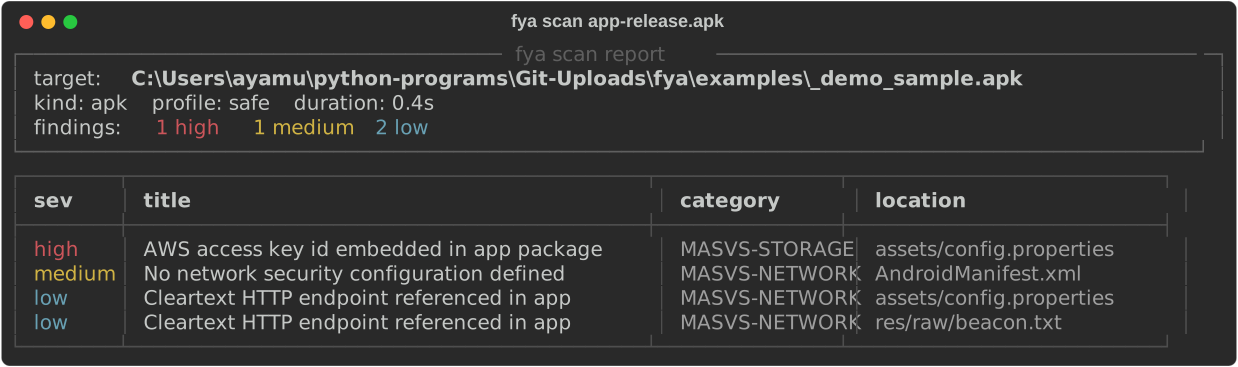
fya scan ./app-release.apk

# white-box static analysis of a source directory
fya scan ./my-service --mode whitebox

# write a shareable report (format inferred from the extension)
fya scan http://127.0.0.1:8000 -o report.html
fya scan http://127.0.0.1:8000 -o findings.sarif       # for CI code scanning

# fail a CI job if anything high or worse is found
fya scan http://127.0.0.1:8000 --fail-on high

# a non-local target requires explicit authorization
fya scan https://staging.example.com --i-am-authorized

# see which external tools fya can hand off to
fya tools
Try it right now against the bundled deliberately-vulnerable app:
python examples/vulnerable_app.py       # starts on http://127.0.0.1:5001
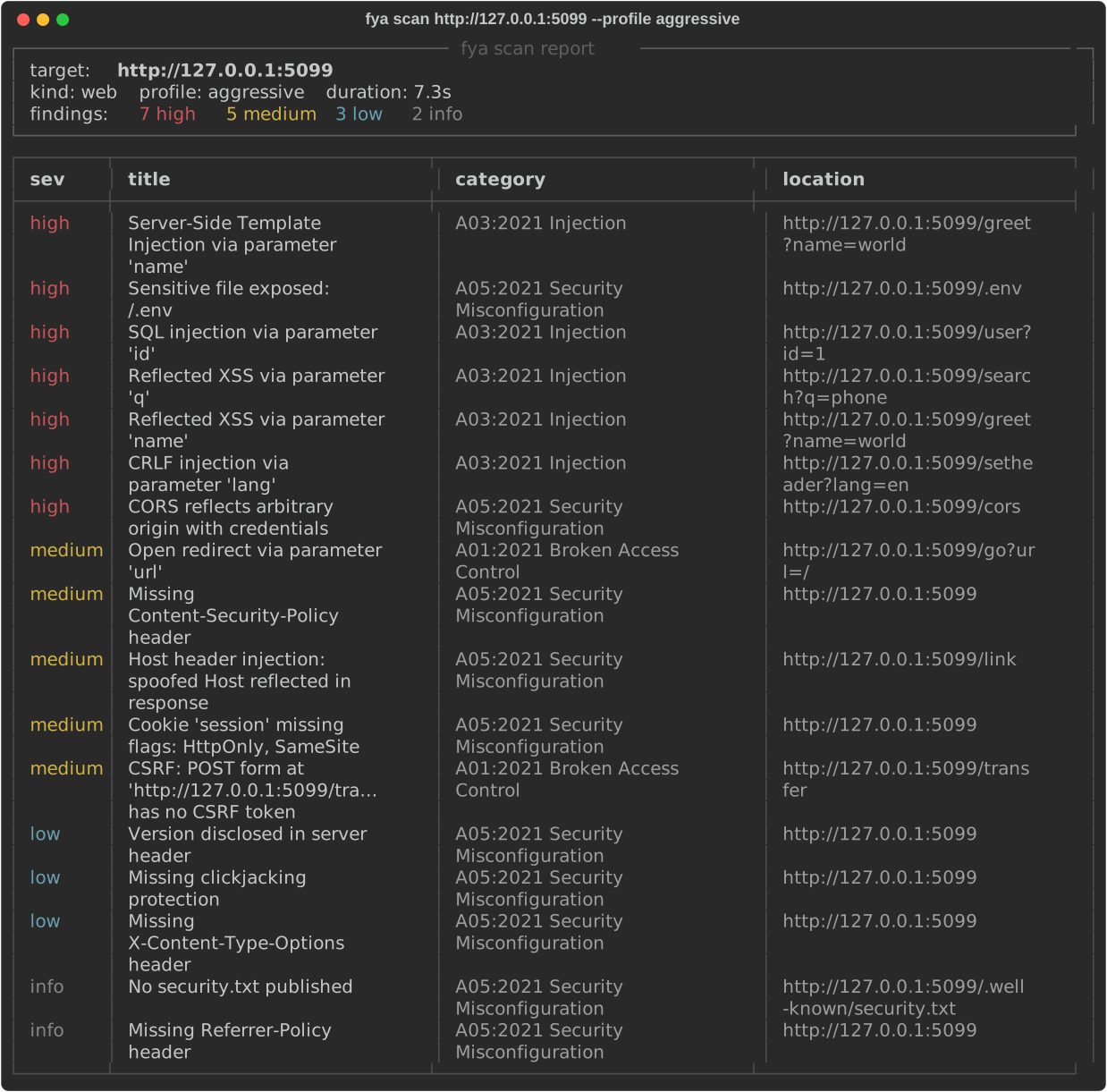
fya scan http://127.0.0.1:5001 --profile aggressive -o report.html
Scan profiles
| Profile | What it does |
|---|---|
passive |
Read-only. Headers, TLS, cookies, disclosure, fingerprinting. |
safe |
Non-destructive active probes. Reflection, error signatures, CORS. |
aggressive |
Heavier probing and external-tool handoff. Still non-destructive. |
fya never floods a target or runs denial-of-service payloads. Request pacing
adapts automatically, slowing down on errors, timeouts, and slow responses.
What it checks
42 checks across the areas below, each mapped to OWASP Top 10 / MASVS and a CWE, and grouped by test strategy in the report. Full catalog in docs/checks.md.
| Area | Checks |
|---|---|
| Web (passive) | Security headers, server/version disclosure, insecure cookie flags |
| Web (active) | Reflected XSS, error-based SQLi, open redirect, path traversal, CORS misconfiguration, dangerous HTTP methods, sensitive file exposure |
| Web (advanced) | Server-side template injection (SSTI), missing CSRF token, Host header injection, CRLF/header injection |
| Web (hardening) | CSP policy weaknesses, JWT (alg / expiry / sensitive claims), outdated JS libraries, security.txt and robots.txt |
| Black box | Input fuzzing and robustness: malformed, oversized, wrong-type, unicode, null-byte, and format-string payloads that surface 5xx crashes and leaked stack traces |
| Gray box | Insecure direct object references (IDOR), protected routes reachable without authentication |
| White box (source) | Hardcoded secrets, risky sinks (eval, exec, shell=True, pickle, verify=False), semgrep/bandit folded in when installed |
| TLS | Certificate validity and trust, weak protocol versions, missing HTTP to HTTPS upgrade |
| API | OpenAPI/Swagger exposure, GraphQL introspection, verbose error disclosure, unauthenticated admin/debug endpoints |
| APK (static) | Hardcoded secrets, cleartext HTTP endpoints, manifest issues (debuggable, backup, exported components, cleartext, minSdk, permissions) |
| Integrations | Nuclei, Nikto, nmap, sqlmap, testssl/sslyze handoff, normalized into the same report |
Load, stress, and network-chaos testing are deliberately out of scope: they are denial-of-service shaped and break the non-destructive guarantee. Use k6, Locust, or Toxiproxy for those, on infrastructure you own.
How it adapts per target
- Detect whether the target is a web server, an
.apk, or a source directory. - Fingerprint the tech stack (server, framework, cookies, whether it is a JSON API) from the first responses.
- Select only the checks that apply to that target kind and profile.
- Tune payloads, pacing, and concurrency to what the target tolerates.
- Normalize every finding to OWASP / CWE and de-duplicate.
- Report to console, JSON, SARIF, Markdown, or a self-contained HTML page.
External tools
If any of these are on your PATH, fya uses them and folds their results
into one normalized report. If not, it silently falls back to built-in checks.
nuclei · nikto · sqlmap · nmap · testssl.sh · sslyze · jadx · apkleaks
Check what is detected with fya tools.
Reports
| Format | Use it for |
|---|---|
console |
The default. A colored summary table in your terminal. |
json |
Machine-readable output for pipelines and dashboards. |
sarif |
Upload to GitHub code scanning and other SARIF consumers. |
markdown |
Drop into issues, wikis, or pull requests. |
html |
A self-contained, shareable page. See docs/sample-report.html. |
Format is inferred from the -o file extension, or set it explicitly with
--format. Use --fail-on {low,medium,high,critical} to return a non-zero
exit code in CI.
Architecture
fya/
  models.py        finding, target, profile, scan-result data models
  detect.py        target-kind detection (web vs apk)
  fingerprint.py   web tech fingerprinting used to tune checks
  http.py          adaptive, self-throttling HTTP client
  registry.py      the Check base class and auto-discovery
  engine.py        orchestrator: fingerprint, plan, run in parallel, collect
  authorization.py the scope and consent gate
  tools.py         detection and safe subprocess handoff to external tools
  report.py        console / json / sarif / markdown / html reporters
  checks/          one file per area, auto-registered on import
Details in docs/architecture.md.
Contributing
Issues and PRs welcome. Adding a check is a single file dropped in
fya/checks/, auto-discovered on import. Run pytest and ruff check .
before submitting. See CONTRIBUTING.md for the walkthrough.
Acknowledgements
Built on the shoulders of OWASP (Top 10 and MASVS/MASTG), the tools it orchestrates (Nuclei, Nikto, sqlmap, Nmap, testssl.sh, androguard), and requests + rich.
License
MIT.
Project details
Verified details
These details have been verified by PyPIProject links
GitHub Statistics
Maintainers


Download files
Download the file for your platform. If you're not sure which to choose, learn more about installing packages.
Source Distribution
Built Distribution
Filter files by name, interpreter, ABI, and platform.
If you're not sure about the file name format, learn more about wheel file names.
Copy a direct link to the current filters
File details
Details for the file fya-0.4.0.tar.gz.
File metadata
- Download URL: fya-0.4.0.tar.gz
- Upload date:
- Size: 745.5 kB
- Tags: Source
- Uploaded using Trusted Publishing? Yes
- Uploaded via: twine/6.1.0 CPython/3.13.12
File hashes
| Algorithm | Hash digest | |
|---|---|---|
| SHA256 |
7ce81cb1ab54f372f32a154ad2dbd43b371345d999731fa7fb908a5f66a0bb80
|
|
| MD5 |
f423f7a697acce09ccad79c4446c42aa
|
|
| BLAKE2b-256 |
36c334c9083ef2486b77ae03fa3359c392f1756e276a47538d4019a8b977192f
|
Provenance
The following attestation bundles were made for fya-0.4.0.tar.gz:
Publisher:
publish.yml on ayam04/fya
-
Statement:
-
Statement type:
https://in-toto.io/Statement/v1 -
Predicate type:
https://docs.pypi.org/attestations/publish/v1 -
Subject name:
fya-0.4.0.tar.gz -
Subject digest:
7ce81cb1ab54f372f32a154ad2dbd43b371345d999731fa7fb908a5f66a0bb80 - Sigstore transparency entry: 2047490418
- Sigstore integration time:
-
Permalink:
ayam04/fya@9aa16908aade3cbba701c84858c840d958184910 -
Branch / Tag:
refs/tags/v0.4.0 - Owner: https://github.com/ayam04
-
Access:
public
-
Token Issuer:
https://token.actions.githubusercontent.com -
Runner Environment:
github-hosted -
Publication workflow:
publish.yml@9aa16908aade3cbba701c84858c840d958184910 -
Trigger Event:
release
-
Statement type:
File details
Details for the file fya-0.4.0-py3-none-any.whl.
File metadata
- Download URL: fya-0.4.0-py3-none-any.whl
- Upload date:
- Size: 70.9 kB
- Tags: Python 3
- Uploaded using Trusted Publishing? Yes
- Uploaded via: twine/6.1.0 CPython/3.13.12
File hashes
| Algorithm | Hash digest | |
|---|---|---|
| SHA256 |
766b66206c6cca16a69c551ba8d29ee6a12659497f88a947922d0e6e0939a30c
|
|
| MD5 |
c1a031430ae9435da711a8aff04e2a89
|
|
| BLAKE2b-256 |
f2f5688d1d7768d7b39529e0ff80b37475e42d5689a5f2271c927bb2bc44c4c3
|
Provenance
The following attestation bundles were made for fya-0.4.0-py3-none-any.whl:
Publisher:
publish.yml on ayam04/fya
-
Statement:
-
Statement type:
https://in-toto.io/Statement/v1 -
Predicate type:
https://docs.pypi.org/attestations/publish/v1 -
Subject name:
fya-0.4.0-py3-none-any.whl -
Subject digest:
766b66206c6cca16a69c551ba8d29ee6a12659497f88a947922d0e6e0939a30c - Sigstore transparency entry: 2047490428
- Sigstore integration time:
-
Permalink:
ayam04/fya@9aa16908aade3cbba701c84858c840d958184910 -
Branch / Tag:
refs/tags/v0.4.0 - Owner: https://github.com/ayam04
-
Access:
public
-
Token Issuer:
https://token.actions.githubusercontent.com -
Runner Environment:
github-hosted -
Publication workflow:
publish.yml@9aa16908aade3cbba701c84858c840d958184910 -
Trigger Event:
release
-
Statement type:






