





A humanoid locomotion policy that walks in the simulator it was trained in often fails in a second one, or scores nothing in someone else's harness. Three different things can be wrong, and they need different fixes:
- the contract: the harness does not build the observation or apply the action the way training did (layout, scale, gains, joint order),
- the physics: the two simulators disagree on the robot (mass, friction, armature, how the drive is integrated),
- the policy under the task: it was never able to do what it is being asked.
gaitkeeper tells them apart, and says how much evidence backs the answer.
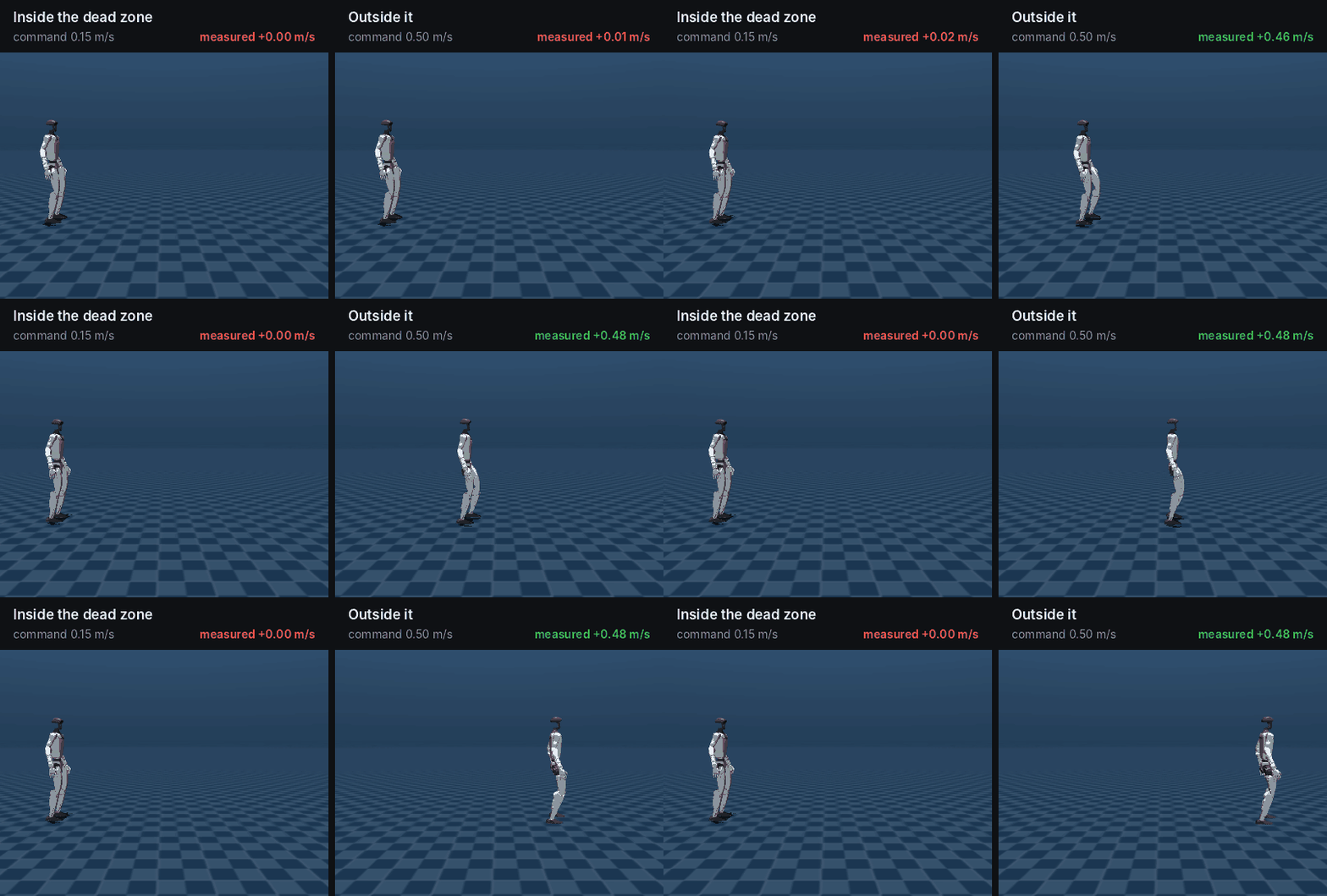
The official unitree_rl_lab G1 policy in unitree_mujoco, rendered from gaitkeeper's runner
(tools/render_readme_media.py). Below about 0.2 m/s it stands still. A waypoint tour is
mostly small commands, which is one reason it can score 0% with a harness that follows the contract.
How it decides

It reads the policy's contract from the exported files, with the source of
every field (live, file, file+table, default, preset, inferred,
user, unknown or conflicting). Against a golden trace recorded in the
training simulator it checks one boundary at a time and stops at the first that
disagrees:
| Boundary | Question | A mismatch means | |
|---|---|---|---|
| B | observation → action | Does the policy file give the recorded actions on the recorded inputs? | CONTRACT (wrong file, normalizer, state) |
| A | signals → observation | Is each observation term rebuilt from raw state the way training built it? | CONTRACT, with the term and the pattern (scale, permutation, frame, layout, time shift) |
| C | action → effort | Same scale, offset, clip, delay, gains by name? | CONTRACT; effort limits are reported, never a mismatch |
| D | effort → next state | Does the target model's inverse dynamics explain the recorded motion? | evidence for PHYSICS, never a cause by itself |
PHYSICS needs a golden trace this tool did not write, A to C passing, the
nominal closed loop failing, a residual above a floor calibrated for that
source engine, and a counterfactual: copying one parameter group from the
source model into the target changes the outcome. Without a golden trace,
gaitkeeper still runs the policy in a target MJCF and reports what the robot
does, labeled as a behavioral finding under stated assumptions, not a cause.
Quick start
python -m venv .venv && . .venv/bin/activate
pip install "gaitkeeper[sim]"
gaitkeeper demo
demo runs the unitree_rl_lab issue 145
setup end to end on the CPU: unitree_rl_lab's G1 velocity policy, as shipped, on
unitree_mujoco's G1 scene, driven through a tour of small commands and in-place
turns with the arms held, then 600 N punches. On first use it downloads the
policy and the scene (about 20 MB, pinned commits, sha256 checked) into
~/.cache/gaitkeeper. It takes under a minute and prints the contract it read,
the command response map with its dead zones, the task segment by segment, and
the finding:
DEAD ZONE  vx ignored for |cmd| <= 0.20 on the + side (first tracked +0.22); ...
Task 'issue 145 tour' (3 seeds) on .../scene_29dof.xml: misses the bar on 3/3 seeds
    2.0 to   6.0 s (+0.15, +0.00, +0.00)  achieved (+0.00, -0.00, +0.00)  misses the bar on 3/3 seeds: dead zone
    ...
Finding  TASK_FAILURE_OBSERVED / BEHAVIORAL_LIMITATION  (evidence L1, exit 5)
  caveat: a silent contract error is not excluded
  caveat: no attribution: neither PHYSICS nor CONTRACT can be concluded without a reference
That is a finding about the policy in this runner, not a verdict on anyone's harness. See Evidence levels.
Evidence levels
| Level | Name | Backed by |
|---|---|---|
| L0 | parsed | A file or preset. Static checks only. |
| L1 | behaves | This runner only: behavioral findings under stated controller assumptions. |
| L2 | conformant | Boundaries A to C match an independently recorded source trace on the covered states and channels. |
| L3 | matched | L2, and the dynamics residual is at the calibrated floor on the measured channels. |
"Verified" appears only at L2 or above. A trace written by gaitkeeper's own runner never raises the level.
Exit codes (verify, task): 0 PASS (or L1 findings with nothing
failing) · 1 CONTRACT · 2 INVALID_INPUT · 3 PHYSICS · 4
POLICY_UNDER_TASK · 5 UNDETERMINED or an L1 finding such as
TASK_FAILURE_OBSERVED · 6 UNSUPPORTED. Every command exits 2 with a one line
message when an input is missing or unreadable (GAITKEEPER_DEBUG=1 shows the
traceback), and warns when the MJCF has no floor. demo exits 0 when it ran.
Commands
| Command | What it does | Level it can reach |
|---|---|---|
demo |
The issue 145 setup, end to end | L1 |
fetch |
Pinned policies and MJCF scenes, sha256 checked | |
inspect |
Contract from an mjlab ONNX export or a Unitree deploy.yaml (G1 29 dof, H1) |
a reading |
verify <trace> |
Boundaries B, A, C | L2 on a golden trace, L1 on a harness log or a self trace |
verify <trace> --mjcf |
Plus D, the nominal closed loop and the model counterfactual | L2 for PHYSICS and POLICY_UNDER_TASK, L3 for PASS |
residual |
D alone, plus parameter fits that stay out of the verdict | detection only |
task |
A command schedule, held joints and punches, with no reference | L1 |
run, check, envelope |
Closed loop, static and linearized checks, the command response map | L1 |
infer |
Observation layout from a trace, abstaining when ambiguous | |
deviation |
Deploy values against training values, per joint |
Usage examples, runner backends and controller assumptions
# golden trace in the training env (runs in the mjlab environment)
python tools/record_mjlab.py --task-path <unitree_rl_mjlab> --onnx <policy.onnx> --out runs/g1_golden

# contract from the exported files
gaitkeeper inspect --onnx <policy.onnx> --yaml <deploy.yaml> --out contract.yaml

# verify a golden trace or a harness log against a contract
gaitkeeper verify runs/g1_golden --onnx <policy.onnx> --yaml <deploy.yaml>
gaitkeeper verify harness_log.npz --contract contract.yaml --policy <policy.onnx>

# with a target: boundary D, the nominal closed loop and the model counterfactual
gaitkeeper verify runs/g1_golden --contract runs/g1_golden/contract.live.yaml \
    --onnx <policy.onnx> --mjcf <scene.xml> --seeds 12
gaitkeeper residual runs/g1_golden --contract runs/g1_golden/contract.live.yaml --mjcf <scene.xml>

# a task without a reference (L1 at most): schedule, held joints, punches
gaitkeeper task --deploy <deploy.yaml> --onnx <policy.onnx> --mjcf <scene.xml> \
    --schedule tour.yaml --hold left_elbow_joint,right_elbow_joint \
    --push-every 3 --push-first 20 --push-force 600

# Unitree deploy.yaml, read as what the robot runs (SDK tables: G1 29-DoF, H1)
gaitkeeper inspect --deploy <deploy.yaml> --onnx <policy.onnx>

# closed loop in a target MJCF; every result prints the controller assumptions
gaitkeeper run --deploy <deploy.yaml> --onnx <policy.onnx> --mjcf <scene.xml> \
    --command 0.5,0,0 --kick 3,0.5,0 --push 6,0,150,0,torso_link,0.1

# checks S16, S17a, S17b, S18, S19, S21 and the command response map
gaitkeeper check --deploy <deploy.yaml> --onnx <policy.onnx> --mjcf <scene.xml> --scenario 0,0,0.2
gaitkeeper envelope --deploy <deploy.yaml> --onnx <policy.onnx> --mjcf <scene.xml>

# behavior probes: standstill in the dead zone (two backends), after a kick,
# yaw while walking, trained kicks and force punches over seeds, fragility sweep
gaitkeeper envelope --deploy <deploy.yaml> --onnx <policy.onnx> --mjcf <scene.xml> \
    --push-seeds 10 --physics --json envelope.json

# observation layout from a trace (exit 0 inferred, 3 partial or abstained)
gaitkeeper infer runs/g1_golden --json layout.json
gaitkeeper infer harness_log.npz --no-raw          # (obs, action) only

# deploy values against training values, per joint
gaitkeeper deviation --deploy <deploy.yaml> --reference runs/g1_golden/contract.live.yaml --trace runs/g1_golden
Runner backends: native_implicit (default; PD inside MuJoCo every step),
explicit_zoh (torque held over the training sim_dt; the MuJoCo step is
changed to divide it and the change is printed), python_pd (debugging),
standin_implicit (a position-implicit drive in damping and Euler, the way
some engines integrate PD; used to test that boundary D does not turn a drive
difference into a cause).
Torque limits come from the MJCF unless --limits contract. A field the
contract takes from no source prints CONTROLLER_ASSUMED. --preset fills
named training facts (for example
unitree_rl_lab_g1_29dof_velocity@4960b84) with provenance preset. A
controller field from a preset still prints CONTROLLER_ASSUMED: the preset
reads the training config at a commit, not the run that produced the policy.
Install
pip install "gaitkeeper[sim]"            # runner, check, envelope, task, demo (MuJoCo)
pip install gaitkeeper                   # contracts and trace comparison only

git clone https://github.com/dundysm/gaitkeeper && cd gaitkeeper
pip install -e ".[sim,dev]"              # from source, with tests and lint
pip install -e ".[record-mjlab]"         # recorder (mjlab 1.2.0, MuJoCo 3.5.0, CPU is enough)
Python 3.10 or newer. Reading contracts and comparing traces needs only the base install (numpy, pyyaml, onnxruntime).
Third-party files
Nothing third party is vendored. gaitkeeper fetch downloads pinned files from
their upstream repositories at fixed commits and checks each sha256
(src/gaitkeeper/data/fixtures.json):
| Set | Source | What |
|---|---|---|
g1_rl_lab |
unitree_rl_lab @ 4960b84 | G1 29 dof velocity policy: deploy.yaml, policy.onnx |
g1_rl_mjlab |
unitree_rl_mjlab @ 1425b15 | G1 velocity policy: deploy.yaml, policy.onnx |
g1_unitree_mujoco |
unitree_mujoco @ 1eb6642 | G1 29 dof scene and meshes (BSD-3-Clause) |
g1_menagerie |
mujoco_menagerie @ 0059d43 | Unitree G1 scene and meshes (BSD-3-Clause) |
gaitkeeper fetch          # list the sets and whether they are present
gaitkeeper fetch all      # download every set
The two policy repositories have no LICENSE file at those commits
(unitree_rl_lab's README shows an Apache-2.0 badge; unitree_rl_mjlab states
no license); the files are fetched for local use, not redistributed. The directory is
$GAITKEEPER_DATA when set, else ~/.cache/gaitkeeper.
What has been measured
The source engine for every attribution so far is mjlab 1.2.0 on mujoco_warp 3.5.0. Nothing has been recorded in Isaac Lab or PhysX yet, so no Isaac source is calibrated and nothing about issue 145 goes past L1. See STATUS.md for what works, what was measured and what is left.
What the tests and the measurements show
pytest runs the unit suite on synthetic traces with a stand-in linear
policy anywhere. Integration tests run on the fixtures (gaitkeeper fetch all)
and on golden traces recorded with the mjlab recorder under runs/
($GAITKEEPER_RUNS); each skips, naming what is missing, when its files are
absent. They show:
-
A harness log built correctly from the contract passes B, A and C, where contract numbers printed to 3 decimals are admitted only through the
export_roundingtolerance class; with that class removed, C fails. -
A wrong policy file fails B.
-
For each injected defect (history layout, order and reset fill; both quaternion misreads, (w, x, y, z) read as (x, y, z, w) and the reverse; gyro in the world frame; joint remap skipped on input or on output; joint velocity scale; a term never filled; action scale taken from the rounded yaml; one action scale factor on every joint; action offset dropped; one and two step action delays, with a repeated or an empty (zero) delay line; raw action clipped; kp scaled, kd scaled, both scaled; gains bound by index in the wrong joint order; three defects at once; simulator state read one step late), the comparator names the boundary, the term and the defect, and nothing else, without using falls.
-
Effort limits are reported, never compared. A harness that clips effort below the contract's limit passes C with a
LIMIT_DIFFERENCE_ACTIVEfinding; the clip level is inferred from the effort plateau only when the joint follows the PD law on every other row, so a gain error is not explained away as a clip. -
On segments that cannot tell the contract from a known alternative (standing at zero command; one constant walking command), it returns UNDETERMINED rather than PASS, including when such an invisible defect is present.
-
When two equally simple explanations fit, it names neither.
-
A trace written by gaitkeeper's own runner is labeled SELF_CONSISTENT and capped at evidence L1.
-
The reader finds the rounded wrist action scale in the shipped deploy.yaml, and the recorded mjlab G1 golden trace passes against the contract read from the exported files (integration tests).
-
The Unitree deploy reader binds gains by SDK index and pose, scale and history by policy index, skips H1's empty SDK slot, and reads the mjlab G1 wrist action scale 0.07 as exact; against the ONNX metadata that is 6.7% low and the wrist kd 3.0% high, reported as deviations of the deployment.
-
The streaming observation builder used by the runner gives the same vectors as the batch builder the comparator uses. Recurrent state is carried and zeroed at reset.
-
S17a's bound of 4 matches a simulated one-joint PD (3.9 decays, 4.1 diverges). S17b separates a slow tipping mode from negative, complex and fast modes. S16 finds 0 mismatched pairs in the shipped unitree_rl_lab G1 yaml, 9 when the default pose is read in SDK order, and 3 kp and 3 kd when the gains are read in policy order.
-
On the unitree_mujoco G1 scene (integration tests, Appendix A bounds): the unitree_rl_lab policy walks 4.69 m in 10 s at 0.5 m/s under python_pd; ignores vx 0.20 and walks at 0.22, ignores vy 0.25 and walks at 0.28, under both python_pd and native_implicit; does not turn in place at wz 0.2; falls in 1 to 2 s under zero action; falls under 1 s with armature 0 under python_pd and walks under native_implicit. The wrist roll margin is 3.88 at 2 ms; native_implicit has only the tipping mode outside the unit circle and python_pd with armature 0 has 11, the most negative near -49. The mjlab policy walks 4.82 m.
-
Behavior probes (unit tests on hand-built inputs; integration tests on the unitree_mujoco G1 scene with the unitree_rl_lab policy): stillness needs all three measures (action std, joint speed, no contact change); the fall time comparison is suppressed when S17a warns or a joint sits at its torque limit; a fragility row names numerical instability only when S17a or S17b fires beyond the nominal model. The dead zone is a true standstill under both backends; after a (0.5, 0.5) m/s kick the robot returns to standstill at the vx and wz edges but starts walking sideways at the vy edge (+-0.25) and does not stop; over 3 seeds it survives the trained kicks and falls to 300 to 600 N punches; with armature 0 under python_pd it falls in under 1 s (no-policy baseline 0.62 s on the same model and backend), S17a warns, S17b fails with a tipping time constant between 0.2 and 0.6 s, and the fall time comparison is suppressed; under native_implicit it walks.
-
Boundary D on the three mjlab golden traces against their own recorded model: at the calibrated floor (legs 1e-6 to 4e-5 N m clean RMS, arms 8e-5 to 5e-4, waist up to 1.8e-3, root 0.51 N and 0.11 N m; float32 source, float64 analysis). Legs are judged on swing steps only. An injected ankle armature change (+0.01, -0.002) is named on both legs, and the research fit recovers it with the right sign and size; armature, damping and effort limit changed together on one leg are named as that chain, never as one parameter (AT11); with joint friction on both sides an armature search recovers a wrist change; the stand-in drive shows armature -h^2 kp and damping -h kp exactly (Appendix B).
-
The counterfactual on the mjlab golden trace with the target changed: floor friction 0.1 gives
PHYSICSwith contact parameters as the group whose swap restores the outcome; torso +15 kg gives mass and inertia, then body masses. The source's own model with a dead-zone task givesPOLICY_UNDER_TASK(AT9). Armature 0 and floor friction 2.0 never giveCONTRACT(AT1). A source with the stand-in drive is far above floor on every chain, its behavior unchanged, and a dead-zone task failure givesPOLICY_UNDER_TASK, neverPHYSICS(AT15). -
Every row of the plan's decision table is a test, with the invariants (no
PHYSICSwithout a nominal failure, D above a calibrated floor and a counterfactual change; noPHYSICSorCONTRACTwithout a reference). -
The issue 145 setup (unitree_rl_lab policy on unitree_mujoco's G1, arms held, small commands, in-place turns, 600 N punches) gives
TASK_FAILURE_OBSERVED / BEHAVIORAL_LIMITATIONat L1, exit 5, with the caveats that a silent contract error is not excluded and nothing is attributed. -
inferrecovers history length, layout, order and init on all four layouts from(obs, action)alone; labels every term with its scale and joint order from raw state (including a world-frame gyro); abstains with no boundaries when a column is constant or copies more than one column (a constant command, AT4), and claims no history length when noise removes the exact copies. On a 30 s closed-loop rl_lab trace with a command schedule it returns history 5, term major, oldest first, repeat-first init, gyro scale 0.2, joint velocity scale 0.05 and the Isaac joint order.
Measured outside the test suite (scripts and outputs under runs/, not
committed):
- The 29 development harness logs (G1, unitree_rl_lab policy, unitree_mujoco
scene, regenerated with
qposandqvel):verifynames 29 of 29 as labeled (16 observation, 12 gain or action, 1 clean that returns UNDETERMINED because its command never changes). E0's baseline named 11 of 16 and 0 of 12. This is a development set: the comparator was fixed on it (effort clip levels, kp and kd named apart, empty delay lines, the second quaternion misread, zero scale as an unfilled term), so it is not evidence of accuracy on unseen harnesses. On the falling logs the harness clips at the MJCF limits (hip roll 88, waist roll and pitch 50) where training uses 139 and 25, reported asLIMIT_DIFFERENCE_ACTIVE. inferabstains on all 29 development logs (constant command), returns the full layout on the three recorded mjlab golden traces (no history, the phase pair labeled from observations, SDK joint order), keeps the structure but loses most labels under per-frame noise stored in history, and abstains under independent per-entry noise.- Envelope, unitree_rl_lab G1 policy on unitree_mujoco (
runs/step3): dead zone vx 0.20 (+) and 0.15 (-), vy 0.25, no in-place turning; yaw while walking tracks 67% to 73% inside the limit range; the vy kick hysteresis above; trained kicks survived on 10 of 10 seeds, punches on 0 of 10. The lateral and in-place yaw scenarios are NONE: no tracked command sits 1.25 times past the dead zone edge inside the limit range (vy edge 0.25, limit 0.30). Fragility: friction 2.0 (stand drift, fwd + yaw), softer contacts (stand drift) and kp x0.8 (fwd + yaw) miss the bar; armature 0 and a 5 ms step under python_pd are numerical (S17a and S17b fire); S17b passes at 5 ms under native_implicit. The mjlab G1 policy has only its by-design 0.05 dead zone, tracks yaw while walking at 74% to 99% and survives 2 of 10 punch runs; its rerun under the new rules is unchanged. - S17b at a 5 ms step (unitree_rl_lab policy, unitree_mujoco G1): the complex pair at modulus 1.0001 is a real slow mode of the linearized standing system, not numerical. It is the same for finite difference steps 1e-4 to 1e-9, centered or forward; it is present at 2 ms with the same rate per second (0.025/s against 0.023/s, turning 0.025 rad/s), where the per-step tolerance hides it; it lives in base y, yaw and ankle roll, next to the exact translation and yaw symmetries, and comes and goes with the settle time. With the policy in the loop a yaw offset stays at 0.0100 rad for 45 s (the mode would predict 0.028). S17b now reports such a pair as drift, as it already did slow real modes; the per-step tolerance is unchanged.
results.json(tools/results.py): 62 cases with a known cause (the injection corpus, the 29 development logs, the physics and task cases above), 55 confident outputs, 0 false confident attributions, abstention 6.5%; A detected 27 of 27, C 25 of 25, D 3 of 3. The development logs were used to fix the comparator, so this is not a measure on unseen harnesses.
They do not show that any of this holds for other frameworks, other robots, real harness logs, or the robot itself. Runner results are labeled with the controller assumptions they rest on and are evidence L1 at most.
Help test it
Every number above comes from cases built alongside the comparator. If you have a harness
of your own, a few of its logs, with labels you seal before sending, are the most useful
contribution: docs/BLIND_TEST.md describes the format and the
protocol, and tools/blind.py scores only against the committed hashes. Start with a
blind test issue.
Results are published whatever they are.
Formerly sim2sim
The project was called sim2sim. Contracts and traces written under the old
schema ids, SIM2SIM_* environment variables and a cache in
~/.cache/sim2sim are still read.
License
Apache-2.0
1 maintainer

Metadata
1 maintainer
Release files for gaitkeeper 0.1.0
For a detailed explanation of source distributions (sdists) and built distributions (wheels), please see the package formats documentation.
Source distribution (sdist)
| File | Size | Uploaded | |
|---|---|---|---|
| gaitkeeper-0.1.0.tar.gz | 184.8 kB | Details |
Built distribution (wheel)
| File | Interpreter | ABI | Platform | Reset |
|---|---|---|---|---|
| gaitkeeper-0.1.0-py3-none-any.whl | Python 3 | none | any | Details |
Total release size: 346.5 kB
Release files / gaitkeeper-0.1.0.tar.gz
| Download URL | gaitkeeper-0.1.0.tar.gz |
|---|---|
| Size | 184.8 kB |
| Tags | Source |
|
SHA-256 checksum How to use checksums |
713237c23190cb9ea353a5276ef02339f5a89107fd4f06704a039eba857b2c3c
|
|
BLAKE2b-256 checksum How to use checksums |
71692acf5f4c8640f7b23eb8517c873e26cd11548f36938dd712eb9809a5d394
|
| Upload date | |
|
Uploaded using Trusted Publishing? What is trusted publishing? |
Yes |
| Uploaded via |
twine/7.0.0 CPython/3.13.14
|
Provenance
Provenance describes where a file came from. On PyPI, provenance is shared via attestations, which provide a verifiable record of the build or publishing details. View details, limitations and caveats.


PyPI Publish Attestation
PyPI verified that this artifact, at this checksum, originated from the publisher listed below.
Signed by GitHub Actions, verified by PyPI on Oct 9, 2026.
Transparency logRelease files / gaitkeeper-0.1.0-py3-none-any.whl
| Download URL | gaitkeeper-0.1.0-py3-none-any.whl |
|---|---|
| Size | 161.7 kB |
| Tags | Python 3 |
|
SHA-256 checksum How to use checksums |
30ba7a54ee581d5276adb7509330506817adbf514eb2ce0672c515e26d329ca1
|
|
BLAKE2b-256 checksum How to use checksums |
04f7634f47986e7f15d34ce99ad7a39b139a4223fe288043576f8996dd365a8f
|
| Upload date | |
|
Uploaded using Trusted Publishing? What is trusted publishing? |
Yes |
| Uploaded via |
twine/7.0.0 CPython/3.13.14
|
Provenance
Provenance describes where a file came from. On PyPI, provenance is shared via attestations, which provide a verifiable record of the build or publishing details. View details, limitations and caveats.
PyPI Publish Attestation
PyPI verified that this artifact, at this checksum, originated from the publisher listed below.
Signed by GitHub Actions, verified by PyPI on Oct 9, 2026.
Transparency log













