
🧩 gated-sae-tf
sparse gated autoencoders for TensorFlow & Keras, batteries included
Almost every open-source sparse-autoencoder (SAE) toolkit speaks PyTorch. If you
live in TensorFlow/Keras, you've mostly been left to port things yourself.
gated-sae-tf closes that gap: a clean, tested, pip-installable gated SAE
for dictionary learning and mechanistic interpretability, with the whole
training recipe and the interpretability tooling already wired up.
🧠 gated SAE · 📉 warmup→cosine LR · 🔬 sparsity + sharpness reports · 🖼️ feature galleries · ✅ 15 tests · 📦 pip install
💭 Why this exists
I kept wanting to train sparse autoencoders on Keras models without reimplementing the gated SAE from scratch or dragging everything over to PyTorch. So I packaged the version I kept rewriting: the gated formulation from Rajamanoharan et al. (2024), the training tricks that actually make it converge (warmup→cosine LR, gradient clipping, decoder normalization, the auxiliary loss), and the little interpretability utilities you reach for thirty seconds later — sparsity stats, decoder sharpness, feature galleries — all in one importable place.
🧠 What's a gated sparse autoencoder?
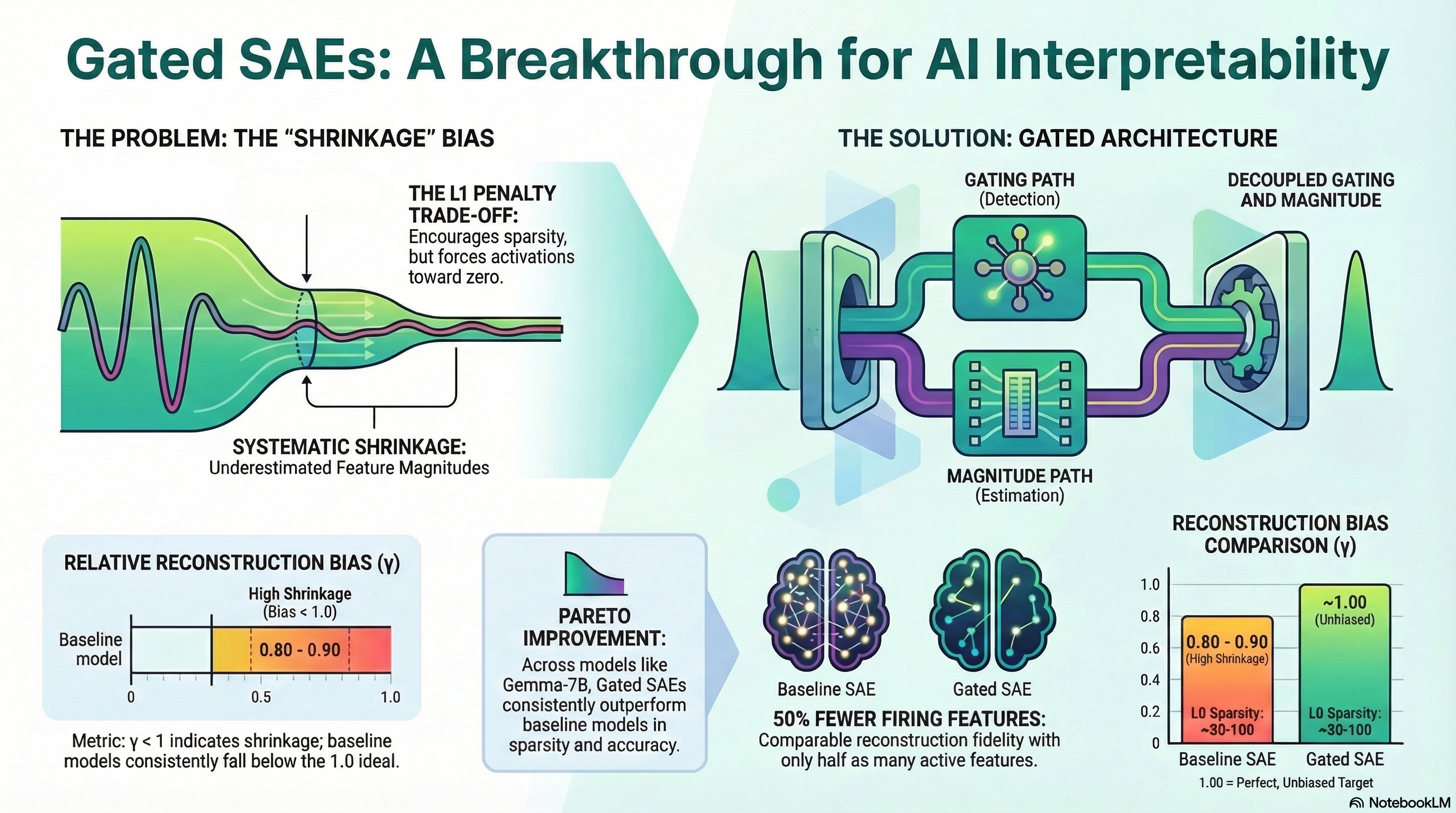
A sparse autoencoder learns an overcomplete dictionary of features that reconstruct an input while keeping only a few of them active at a time. The gated variant splits two decisions that a plain ReLU SAE tangles together:
- a gate path decides which features fire:
f_gate = 1[π_gate > 0] - a magnitude path decides how much they fire:
f_mag = relu(W_mag·x_c + b_mag)
with the magnitudes tied to the gate via a per-feature rescale,
W_mag = exp(r_mag) ⊙ W_gate. The sparse code is f̃ = f_gate ⊙ f_mag and the
reconstruction is x̂ = W_dec·f̃ + b_dec, decoder columns kept unit-norm.
Training minimizes:
L = L_reconstruct + λ · L_sparsity + α · L_aux
L_sparsity = Σ relu(π_gate) drives the sparsity, and L_aux reconstructs the
input from relu(π_gate) through a frozen (stop_gradient) decoder so the gate
path stays well-conditioned. Decoupling the two gives sharper, more
monosemantic features than an L1-penalized ReLU SAE, without the shrinkage
bias. ✨
📦 Install
pip install gated-sae-tf            # core (TensorFlow + Keras 3)
pip install "gated-sae-tf[viz]"     # + matplotlib for the gallery helpers
Needs Python ≥ 3.10 and TensorFlow ≥ 2.16 (where Keras 3 is the default). The
package doesn't pin a TensorFlow build variant, so an existing
tensorflow[and-cuda] install is respected.
🚀 Quickstart
import keras, numpy as np
from gated_sae import GatedSAE, WarmupCosineDecay, sparsity_report

(x_train, _), _ = keras.datasets.fashion_mnist.load_data()
X = x_train.reshape(-1, 784).astype("float32") / 255.0

sae = GatedSAE(input_dim=784, encoding_dim=784 * 8,   # 8x overcomplete
               lambda_sparse=1e-3, aux_weight=0.1, clip_norm=1.0)
sae(X[:2])                          # build the weights
sae.b_dec.assign(X.mean(axis=0))    # init decoder bias to the data mean

steps = (len(X) // 256) * 20
sae.compile(optimizer=keras.optimizers.Adam(
    WarmupCosineDecay(1e-3, warmup_steps=steps // 10, total_steps=steps),
    beta_1=0.0, beta_2=0.999))       # beta_1=0 per the paper

sae.fit(X, epochs=20, batch_size=256)
print(sparsity_report(sae, X))       # L0, alive/dead features, top-k share
That trains an 8× overcomplete gated SAE on Fashion-MNIST and prints the L0
mean/median, alive/dead feature counts, and the top-k activation share. A full
end-to-end walkthrough notebook ships in the repository (examples/).
🧰 The API, at a glance
| Symbol | What it does |
|---|---|
GatedSAE(input_dim, encoding_dim, lambda_sparse=1e-3, aux_weight=1e-2, clip_norm=1.0) |
The model. Custom train_step/test_step, encode/decode, set_lambda for annealing, full get_config serialization. |
WarmupCosineDecay(peak_lr, warmup_steps, total_steps) |
Linear warmup → cosine-decay-to-zero LR schedule. |
sparsity_report(model, X, batch_size=512, k=20) |
Dict of L0 mean/median, alive/dead counts, alive fraction, top-k activation share. |
decoder_sharpness(model) |
(per_feature_kurtosis, mean) — higher kurtosis means sharper, more localized features. |
plot_decoder_gallery(model, codes, top_n=10) |
Grid of the top decoder directions. Needs the [viz] extra. |
plot_feature_gallery(model, codes, X, labels, class_names, ...) |
Decoder-direction + top-activating-images view with MONO/POLY tagging. Needs the [viz] extra. |
🗺️ Roadmap
- More SAE variants (vanilla ReLU, JumpReLU, TopK)
- Activation-store helpers for SAEs on transformer activations
- Pretrained dictionaries / model-hub integration
💛 Contributing
Issues and PRs are genuinely welcome — a new SAE variant, a docs fix, a bug
report, all of it. The full walkthrough notebook, the contributing guide, and
the extended bibliography live alongside this file in the repository
(GUIDE.md and CONTRIBUTING.md).
🤖 How it was made
Built with Claude, shaped and reviewed by me. The implementation follows the gated SAE paper; training, serialization, and every interpretability utility are covered by a 15-test suite that runs in CI.
📚 References & citing
This library implements the gated SAE of Rajamanoharan et al. (2024), Improving Dictionary Learning with Gated Sparse Autoencoders, arXiv:2404.16014 — https://arxiv.org/abs/2404.16014
It sits in the interpretability lineage of Anthropic's Transformer Circuits work on dictionary learning:
- Bricken et al. (2023). Towards Monosemanticity: Decomposing Language Models With Dictionary Learning. Transformer Circuits Thread — https://transformer-circuits.pub/2023/monosemantic-features
- Templeton et al. (2024). Scaling Monosemanticity: Extracting Interpretable Features from Claude 3 Sonnet. Transformer Circuits Thread — https://transformer-circuits.pub/2024/scaling-monosemanticity/index.html
Full bibliography, BibTeX, and related work (Elhage et al., Gao et al.) are in
GUIDE.md in the repository.
⚖️ License
MIT © 2026 Aishwarya Natesh.
1 maintainer

Metadata
1 maintainer
Release files for gated-sae-tf 0.1.1
For a detailed explanation of source distributions (sdists) and built distributions (wheels), please see the package formats documentation.
Source distribution (sdist)
| File | Size | Uploaded | |
|---|---|---|---|
| gated_sae_tf-0.1.1.tar.gz | 17.0 kB | Details |
Built distribution (wheel)
| File | Interpreter | ABI | Platform | Reset |
|---|---|---|---|---|
| gated_sae_tf-0.1.1-py3-none-any.whl | Python 3 | none | any | Details |
Total release size: 30.3 kB
Release files / gated_sae_tf-0.1.1.tar.gz
| Download URL | gated_sae_tf-0.1.1.tar.gz |
|---|---|
| Size | 17.0 kB |
| Tags | Source |
|
SHA-256 checksum How to use checksums |
c9983ce2772b201417efb353f85db542c90aacae4d1701cc7f2864858433547d
|
|
BLAKE2b-256 checksum How to use checksums |
f89f5259a9aca8f172765703df7089a4145bc3c66b9c76b474938e15e223ccbc
|
| Upload date | |
|
Uploaded using Trusted Publishing? What is trusted publishing? |
Yes |
| Uploaded via |
twine/6.1.0 CPython/3.13.12
|
Provenance
Provenance describes where a file came from. On PyPI, provenance is shared via attestations, which provide a verifiable record of the build or publishing details. View details, limitations and caveats.


PyPI Publish Attestation
PyPI verified that this artifact, at this checksum, originated from the publisher listed below.
Signed by GitHub Actions, verified by PyPI on May 30, 2026.
Transparency logRelease files / gated_sae_tf-0.1.1-py3-none-any.whl
| Download URL | gated_sae_tf-0.1.1-py3-none-any.whl |
|---|---|
| Size | 13.4 kB |
| Tags | Python 3 |
|
SHA-256 checksum How to use checksums |
51d36338d9a4e29eee4ce4857c78a17331f4bc437ca55abb7d28e14b5ac7a149
|
|
BLAKE2b-256 checksum How to use checksums |
bd463fec0f05d6e044d2a152c14ce607ae13fa8a7fe10ee756ef0e6d36a58814
|
| Upload date | |
|
Uploaded using Trusted Publishing? What is trusted publishing? |
Yes |
| Uploaded via |
twine/6.1.0 CPython/3.13.12
|
Provenance
Provenance describes where a file came from. On PyPI, provenance is shared via attestations, which provide a verifiable record of the build or publishing details. View details, limitations and caveats.
PyPI Publish Attestation
PyPI verified that this artifact, at this checksum, originated from the publisher listed below.
Signed by GitHub Actions, verified by PyPI on May 30, 2026.
Transparency log












