

Gato: A Generalist Agent
[Deepmind Publication] [arXiv Paper]
aper.
Installation
$ pip install gato-torch
import torch
from gato import Gato

#create model instance
gato = Gato(input_dim=768,
            img_patch_size=16,
            token_sequence_length=1024,
            vocabulary_size=32000,
            actions_size=1024,
            continuous_values_size=1024,
            num_transformer_blocks=8,
            num_attention_heads=24,
            layer_width=768,
            feedforward_hidden_size=3072,
            key_value_size=32,
            dropout_rate=0.1,
            num_group_norm_groups=32,
            discretize_depth=128,
            local_position_encoding_size=512,
            max_seq_len=8192)


#fake inputs for Gato
input_dim = config.input_dim
input_ids = torch.cat([
    torch.rand((1, 1, input_dim)) for _ in range(20)] + # 20 image patches
    [torch.full((1, 1, input_dim), 0.25), #continous value]
     torch.full((1, 1, input_dim), 624.0)] + #discrete (actions, texts)
     [torch.rand((1, 1, input_dim)) for _ in range(20)] + #20 image patches
     [torch.full((1, 1, input_dim), 0.12), #continous value
      torch.full((1, 1, input_dim), 295.0)], #discrete( actions, text)
      dim=1)

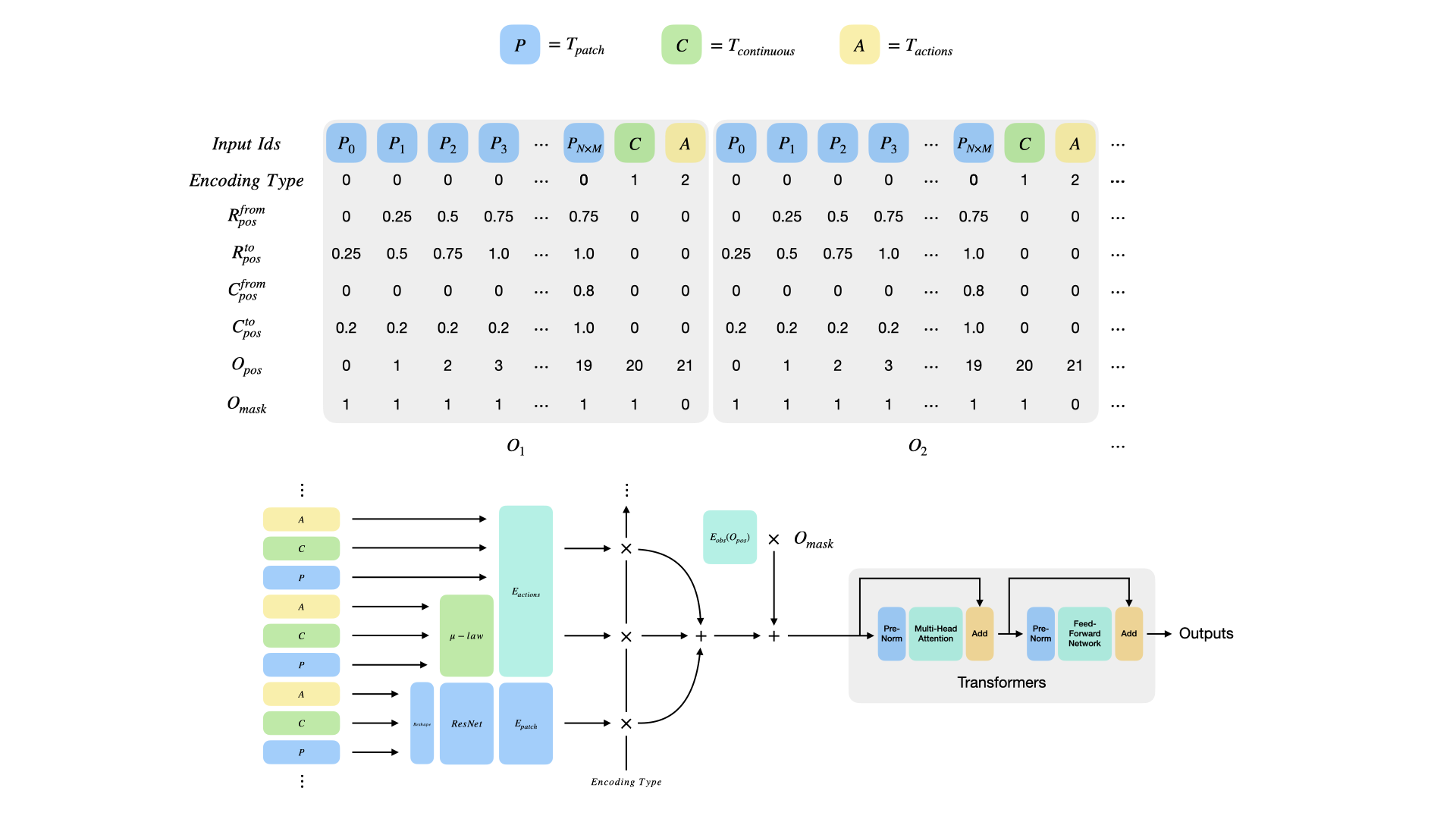
encoding = torch.tensor([
    [0, 0, 0, 0, 1, 2, 0, 0, 0, 0, 1, 2]
])

row_pos = (
    torch.tensor([[0.00, 0.25, 0.50, 0.75, 0, 0, 0.00, 0.25, 0.50, 0.75, 0, 0]]),  # pos_from
    torch.tensor([[0.25, 0.50, 0.75, 1.00, 0, 0, 0.25, 0.50, 0.75, 1.00, 0, 0]])  # pos_to
)

col_pos = (
    torch.tensor([[0.00, 0.00, 0.00, 0.80, 0, 0, 0.00, 0.00, 0.00, 0.80, 0, 0]]),  # pos_from
    torch.tensor([[0.20, 0.20, 0.20, 1.00, 0, 0, 0.20, 0.20, 0.20, 1.00, 0, 0]])  # pos_to
)


obs = (
    torch.tensor([[ 0,  1,  2, 19, 20, 21,  0,  1,  2, 19, 20, 21]]),  # obs token
    torch.tensor([[ 1,  1,  1,  1,  1,  0,  1,  1,  1,  1,  1,  0]])  # obs token masking (for action tokens)
)


hidden_states = gato((input_ids, (encoding, row_pos, col_pos), obs))
Dataset and Model Architecture
Paper Reviews
Full Episode Sequence
Architecture Variants
Appendix C.1. Transformer Hyperparameters
In the paper, Deepmind tested Gato with 3 architecture variants, 1.18B, 364M, and 79M.
I have named them as large(), baseline() and small() respectively in GatoConfig.
| Hyperparameters | Large(1.18B) | Baseline(364M) | Small(79M) |
|---|---|---|---|
| Transformer blocks | 24 | 12 | 8 |
| Attention heads | 16 | 12 | 24 |
| Layer width | 2048 | 1536 | 768 |
| Feedforward hidden size | 8192 | 6144 | 3072 |
| Key/value size | 128 | 128 | 32 |
Residual Embedding
Appendix C.2. Embedding Function
There are no mentions that how many residual networks must be stacked for token embeddings.
Therefore, I remain configurable in GatoConfig.
Whatever how many residual layers are existing, full-preactivation is a key.
The blocks are consisted of:
- Version 2 ResNet architecture (based on ResNet50V2)
- GroupNorm (instead of LayerNorm)
- GeLU (instead of ReLU)
Position Encodings
Appendix C.3. Position Encodings
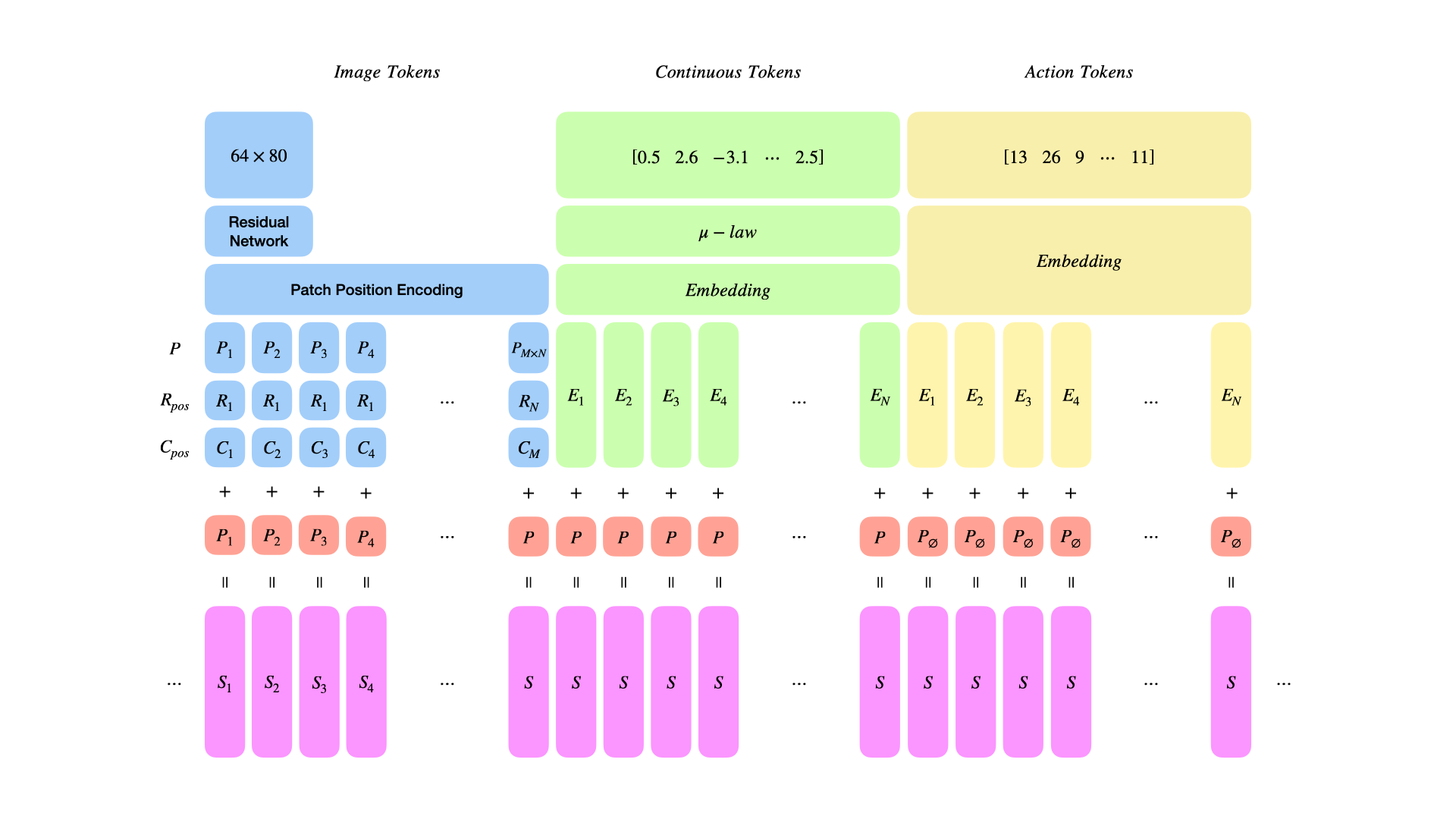
Patch Position Encodings
Like Vision Transformer (ViT) by Google, Gato takes the input images as raster-ordered 16x16 patches.
Unlike the Vision Transformer model, however, Gato divides its patch encoding strategy into 2 phases, training and evaluation.
For high-performance computation in TensorFlow, I have used the following expressions.
$C$ and $R$ mean column and row-wise, and $F$ and $T$ mean from and to respectively.
$$ \begin{align} v^R_F &= \begin{bmatrix} 0 & 32 & 64 & 96 \end{bmatrix} \ v^R_T &= \begin{bmatrix} 32 & 64 & 96 & 128 \end{bmatrix} \ v^C_F &= \begin{bmatrix} 0 & 26 & 51 & 77 & 102 \end{bmatrix} \ v^C_T &= \begin{bmatrix} 26 & 51 & 77 & 102 & 128 \end{bmatrix} \ \ P_R &= \begin{cases} \mathsf{if} \ \mathsf{training} & v^R_F + \mathsf{uniform}(v^R_T - v^R_F) \ \mathsf{otherwise} & \mathsf{round}(\frac{v^R_F + v^R_T}{2}) \end{cases} \ P_C &= \begin{cases} \mathsf{if} \ \mathsf{training} & v^C_F + \mathsf{uniform}(v^C_T - v^C_F) \ \mathsf{otherwise} & \mathsf{round}(\frac{v^C_F + v^C_T}{2}) \end{cases} \ \ E^R_P &= P_R \cdot 1^{\mathsf{T}}_C \ E^C_P &= 1^{\mathsf{T}}_R \cdot P_C \ \ \therefore E &= E_I + E^R_P + E^C_P \end{align} $$
Local Observation Position Encodings
In the definition of Appendix B., text tokens, image patch tokens, and discrete & continuous values are observation tokens
When Gato receives those values, they must be encoded with their own (local) time steps.
Contributing
License
Licensed under the MIT license.
Roadmap:
-
Get functional prototype
-
Integrate ALIBI, multi query, qk norm and other SOTA stuff
-
integrate action tokens
1 maintainer

Metadata
1 maintainer
Release files for gato-torch 0.0.2
For a detailed explanation of source distributions (sdists) and built distributions (wheels), please see the package formats documentation.
Source distribution (sdist)
| File | Size | Uploaded | Provenance | Actions |
|---|---|---|---|---|
| gato_torch-0.0.2.tar.gz | 10.4 kB | Without provenance | Details for gato_torch-0.0.2.tar.gz |
Built distribution (wheel)
| File | Interpreter | ABI | Platform | Actions Reset |
|---|---|---|---|---|
| gato_torch-0.0.2-py3-none-any.whl | Python 3 | none | any | Details for gato_torch-0.0.2-py3-none-any.whl |
Total release size: 18.6 kB
Release files / gato_torch-0.0.2.tar.gz
| Download URL | gato_torch-0.0.2.tar.gz |
|---|---|
| Size | 10.4 kB |
| Tags | Source |
|
SHA-256 checksum How to use checksums |
e29746f33ef7406934bd7e65e0dd916baa9b1ee0fd35169759631a910f64b317
|
|
BLAKE2b-256 checksum How to use checksums |
3a954a1dd1e9725359c61ec1fffcb609e7a4c832bebee3484865a1ffd64dab60
|
| Upload date | |
|
Uploaded using Trusted Publishing? What is trusted publishing? |
No |
| Uploaded via |
poetry/1.3.2 CPython/3.11.0 Darwin/22.4.0
|
Release files / gato_torch-0.0.2-py3-none-any.whl
| Download URL | gato_torch-0.0.2-py3-none-any.whl |
|---|---|
| Size | 8.1 kB |
| Tags | Python 3 |
|
SHA-256 checksum How to use checksums |
f040acf3c689966c0ce1bb64b3e388db43a760e481765407d3fbfa88cd517f68
|
|
BLAKE2b-256 checksum How to use checksums |
9507e60fa544bd1a80f3dc384c5ef558ecb82d3bf6ff321c7f85fa52cec41309
|
| Upload date | |
|
Uploaded using Trusted Publishing? What is trusted publishing? |
No |
| Uploaded via |
poetry/1.3.2 CPython/3.11.0 Darwin/22.4.0
|
Security for gato-torch 0.0.2
Provenance
Provenance describes where a file came from. On PyPI, provenance is shared via attestations, which provide a verifiable record of the build or publishing details. View details, limitations and caveats.
No provenance found
None of the files in this release were uploaded with provenance metadata.
A note on package security
PyPI is a repository for distributing packages, not a service for auditing them. While third-party security researchers and our staff do their best to detect and remove malicious packages, PyPI cannot guarantee the quality, security or suitability of any given package.
To learn more about protecting yourself from malicious actors, visit our package security documentation.














