
Gauntlet




Regression testing and failure analysis for learned robot policies.
Gauntlet answers one question for VLA, diffusion, and scripted policies:
How does this policy fail, and has the new checkpoint regressed against the last one?
It wraps any policy behind a small adapter, runs it across a seeded grid of simulator perturbations (lighting, camera pose, clutter, object pose, actuation latency, sensor corruption, instruction paraphrase), and writes a report that breaks failures down by condition instead of averaging them away.
58-second overview (real rollouts, report and CLI output):
https://github.com/user-attachments/assets/b91519fc-2dba-4d9d-8b56-556e082810a2

Clip from the overview (crop-row scene). If the player above does not load, click the clip to open the full video.
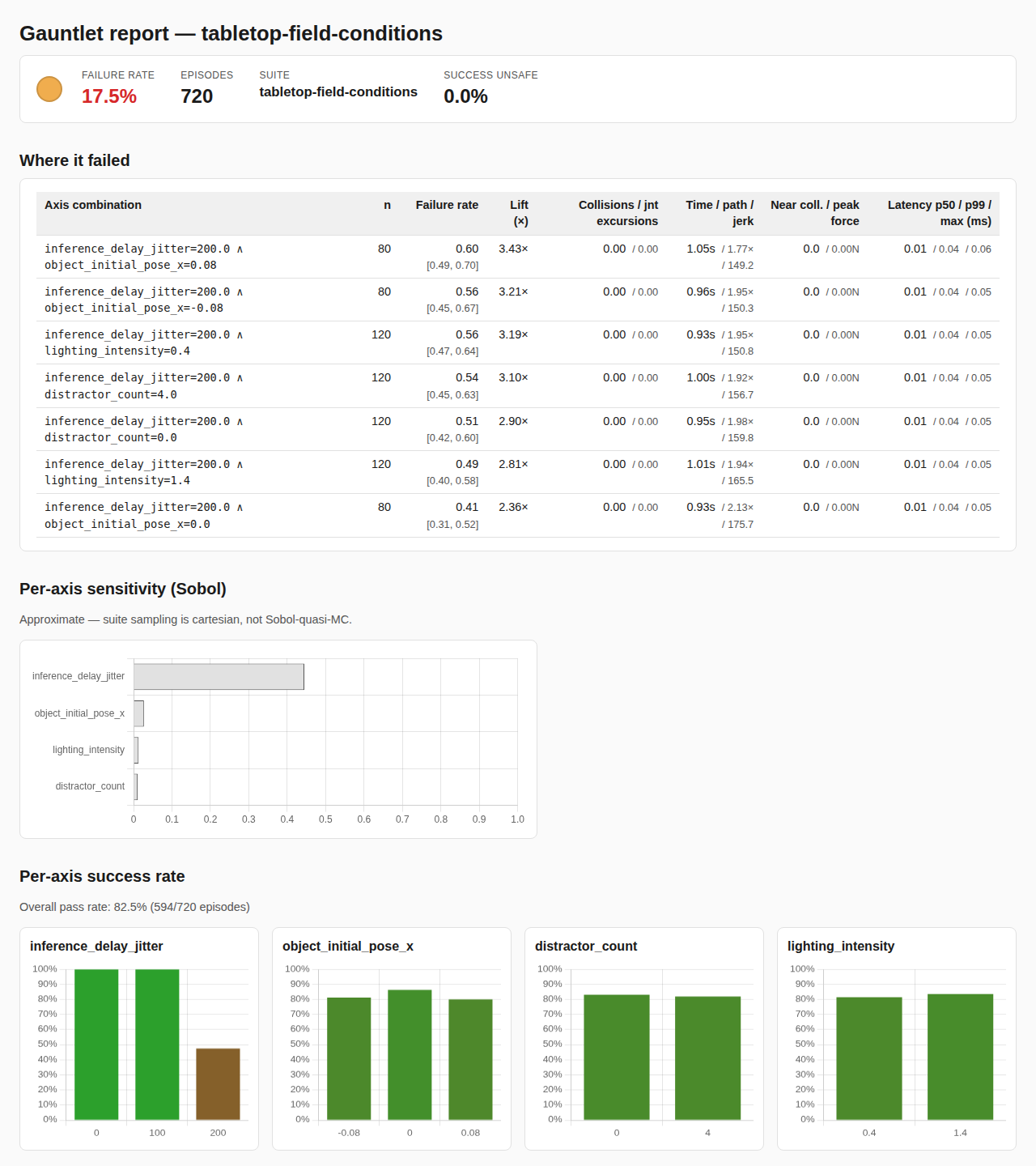
Report from the field-conditions example: the baseline is perfect up to 100 ms of control latency and falls to 47% at 200 ms. Every failure cluster is a latency cluster.
Why
A success rate is a mean, and a mean hides the thing you care about. Two checkpoints at 80% can fail in completely different places, and a fine-tune that gains two points on the clean scene can lose its entire safety margin on one axis. Gauntlet makes the per-condition picture the default output:
- Failure clusters first. Axis combinations whose failure rate is well above baseline, with Wilson CIs, ranked by lift.
- Paired comparisons.
gauntlet compare/gauntlet diffline two runs up cell by cell (common random numbers + McNemar when seeds match) and flag regressions, not just a headline delta. - Sensitivity indices. Per-axis first- and total-order Sobol indices, corrected for rollout seed noise.
- Reproducible. Every episode is determined by
(suite, cell, seed);gauntlet replayre-simulates any one bit-for-bit, optionally with one axis nudged.
See a real report
Every GitHub Release
ships reference-benchmark.zip: two policies (a closed-loop controller
and a degraded copy of it) on the smoke suite and the
field-conditions suite, with the
compare / diff deltas. Unzip and open any report.html.
Example: perception for row guidance
docs/crop-row.md
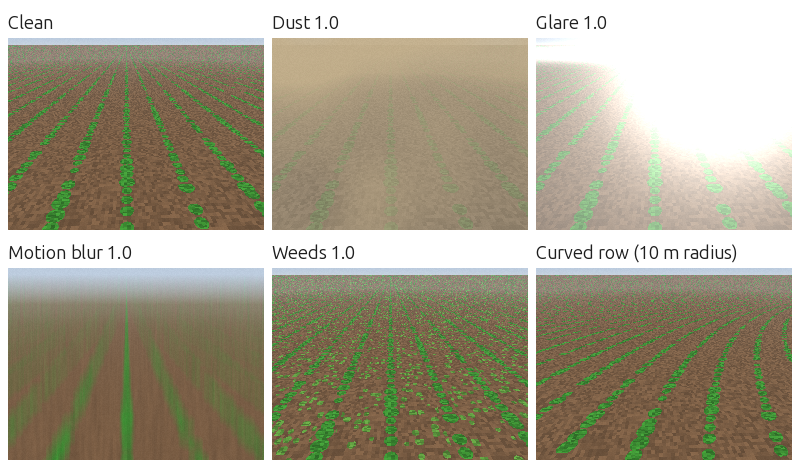
evaluates two row-guidance perception models, a classical
excess-green detector and a small CNN trained on clean images, on 480
rollouts each under dust, glare, motion blur, weeds and curved rows
(procedurally generated scenes). Overall success differs by under
3 points; the per-condition report shows the CNN fails every curved
row while the classical detector collapses in dense dust (3%) and weeds.
Install
pip install gauntlet-robotics            # core: MuJoCo, torch-free
pip install 'gauntlet-robotics[hf]'      # + OpenVLA / HuggingFace adapter
pip install 'gauntlet-robotics[lerobot]' # + SmolVLA / pi0 / diffusion adapters
Other extras: pybullet, genesis, isaac (backends), monitor
(drift detection), video, ros2. Python ≥ 3.11.
Quickstart
git clone https://github.com/mhussainahmad/gauntlet && cd gauntlet
uv sync

# 1. One policy, one suite: 24 rollouts, a few seconds.
uv run gauntlet run examples/suites/tabletop-smoke.yaml --policy random --out out/smoke
xdg-open out/smoke/report.html        # macOS: open

# 2. Baseline vs. regressed checkpoint on field-style conditions: 2 x 720 rollouts, ~15 s.
uv run python scripts/generate_reference_benchmark.py \
  --suite examples/suites/tabletop-field-conditions.yaml --out out/field
cat out/field/diff.txt
Each run writes episodes.json (one record per rollout), report.json
(the analysis) and a self-contained report.html.
Bring your own policy
A policy is anything with act(obs) -> action:
# my_policy.py
import numpy as np

class MyPolicy:
    def __init__(self) -> None:
        self.model = load_my_checkpoint()          # your code

    def act(self, obs: dict[str, np.ndarray]) -> np.ndarray:
        # obs: ee_pos, cube_pos, target_pos, ... (+ "image" with render_in_obs=True)
        return self.model(obs["ee_pos"], obs["cube_pos"])  # 7-D EE twist + gripper

def make_policy() -> MyPolicy:
    return MyPolicy()
uv run gauntlet run examples/suites/tabletop-basic-v1.yaml \
  --policy my_policy:make_policy --out out/mine
uv run gauntlet compare out/last_week/episodes.json out/mine/episodes.json
Third-party packages can also register policies and envs through entry
points; see docs/plugin-development.md.
What's in the box
| Tasks | Tabletop pick-and-place (tabletop), planar pushing (tabletop-push: no grasp, success only once the cube settles in the target), three-cube stacking with per-subtask credit (tabletop-stack), a mobile-base variant (tabletop-mobile), and camera-guided crop-row following (crop-row: perception under dust, glare, blur, weeds and curved rows). |
| Backends | MuJoCo (core; every task), PyBullet (pick-and-place, state and images) and Genesis (pick-and-place; state tested in CI, image rendering not exercised in CI). Isaac Sim adapter written against the Isaac Sim 5.0 API, CI-tested against a mocked runtime but not yet run on hardware. Same action/observation spaces; compare refuses cross-backend diffs unless asked. |
| Perturbation axes | Lighting, camera offset and full extrinsics, object texture / pose / class swap, distractors, OOD initial state, actuation latency, image corruption, colour shift, instruction paraphrase; for crop rows, dust, glare, motion blur, weeds and row curvature. All of them run straight from a suite YAML. |
| Sampling | Cartesian grids, Latin hypercube, Sobol, worst-case search; gauntlet suite plan sizes episodes-per-cell for a target effect. |
| Policy adapters | Random, scripted pick-and-place and push controllers, a classical crop-row detector, OpenVLA (HF), SmolVLA / pi0 / diffusion (LeRobot), GR00T, RDT, Decision Transformer. |
| Analysis | Failure clusters, Wilson CIs, paired compare, per-cell diff, Sobol indices, behavioural metrics (time, path length, jerk), safety counters, gauntlet bisect across checkpoints. Non-finite observations or actions end the episode as a flagged failure instead of silently corrupting it. |
| Operations | Rollout caching, MP4 recording, runtime drift detection, ROS 2 publish/record, fleet aggregation, static dashboard, real-to-sim scene ingestion with a nearest-frame renderer and a smoke-test gaussian-splat fit (gsplat CUDA or pure PyTorch). |
Details for each are in the user guide. Design
decisions are recorded as RFCs and design notes under docs/.
Stability
0.5.x is on PyPI as gauntlet-robotics. The public API, on-disk
schemas and CLI flags follow Semantic Versioning;
the contract is in docs/stability.md. Pin
gauntlet-robotics>=0.5,<0.6.
Development
uv sync
uv run ruff check . && uv run ruff format --check .
uv run mypy                 # --strict
uv run pytest               # ~1,800 torch-free tests; extras run in their own CI jobs
See CONTRIBUTING.md and the
property-test notes.
Project layout
src/gauntlet/
  policy/      # Policy adapter protocol + reference wrappers (Random, Scripted, HF, LeRobot)
  env/         # Parameterized envs — MuJoCo (core) + PyBullet/Genesis/Isaac (extras)
  suite/       # YAML-defined perturbation grid suites (cartesian / LHS / Sobol)
  runner/      # Parallel rollout orchestration + seed management + cache
  report/      # Per-run failure analysis + HTML/JSON generation
  monitor/     # Runtime drift detection + action-entropy ([monitor] extra)
  replay/      # Single-episode replay with axis overrides
  ros2/        # ROS 2 publisher + recorder ([ros2] extra; rclpy via apt/Docker)
  diff/        # Structured per-axis report deltas powering `gauntlet diff`
  aggregate/   # Fleet-wide failure-mode clustering across many runs
  dashboard/   # Self-contained static SPA indexing every report.json
  realsim/     # Real-to-sim scene ingestion + renderers (nearest-frame, gaussian splat)
  plugins.py   # Entry-point discovery for third-party policies / envs
  cli.py       # gauntlet run / report / compare / diff / aggregate /
               # dashboard / realsim / monitor / replay / ros2
License
MIT, see LICENSE.
1 maintainer

Metadata
1 maintainer
Release files for gauntlet-robotics 0.5.1
For a detailed explanation of source distributions (sdists) and built distributions (wheels), please see the package formats documentation.
Source distribution (sdist)
| File | Size | Uploaded | |
|---|---|---|---|
| gauntlet_robotics-0.5.1.tar.gz | 468.9 kB | Details |
Built distribution (wheel)
| File | Interpreter | ABI | Platform | Reset |
|---|---|---|---|---|
| gauntlet_robotics-0.5.1-py3-none-any.whl | Python 3 | none | any | Details |
Total release size: 1.0 MB
Release files / gauntlet_robotics-0.5.1.tar.gz
| Download URL | gauntlet_robotics-0.5.1.tar.gz |
|---|---|
| Size | 468.9 kB |
| Tags | Source |
|
SHA-256 checksum How to use checksums |
4ef762ee2b7faf30325550d87a1e51564ef3d308227aa135060e4296ec23ddf9
|
|
BLAKE2b-256 checksum How to use checksums |
17c39a077697729f0a1fac1fc303470d9d40d19b439c7130de30c7d3c6de2c97
|
| Upload date | |
|
Uploaded using Trusted Publishing? What is trusted publishing? |
Yes |
| Uploaded via |
twine/7.0.0 CPython/3.13.14
|
Provenance
Provenance describes where a file came from. On PyPI, provenance is shared via attestations, which provide a verifiable record of the build or publishing details. View details, limitations and caveats.


PyPI Publish Attestation
PyPI verified that this artifact, at this checksum, originated from the publisher listed below.
Signed by GitHub Actions, verified by PyPI on Oct 4, 2026.
Transparency logRelease files / gauntlet_robotics-0.5.1-py3-none-any.whl
| Download URL | gauntlet_robotics-0.5.1-py3-none-any.whl |
|---|---|
| Size | 548.7 kB |
| Tags | Python 3 |
|
SHA-256 checksum How to use checksums |
b7e7a1f9d4b33c552b2e89252ed33cd5a0bfd3284e73cfe0949a55f28fccdae9
|
|
BLAKE2b-256 checksum How to use checksums |
0747b52b6a1dc7c2874c7af6b146b3a297826377d7f3c9dc52d4804869af684c
|
| Upload date | |
|
Uploaded using Trusted Publishing? What is trusted publishing? |
Yes |
| Uploaded via |
twine/7.0.0 CPython/3.13.14
|
Provenance
Provenance describes where a file came from. On PyPI, provenance is shared via attestations, which provide a verifiable record of the build or publishing details. View details, limitations and caveats.
PyPI Publish Attestation
PyPI verified that this artifact, at this checksum, originated from the publisher listed below.
Signed by GitHub Actions, verified by PyPI on Oct 4, 2026.
Transparency log













